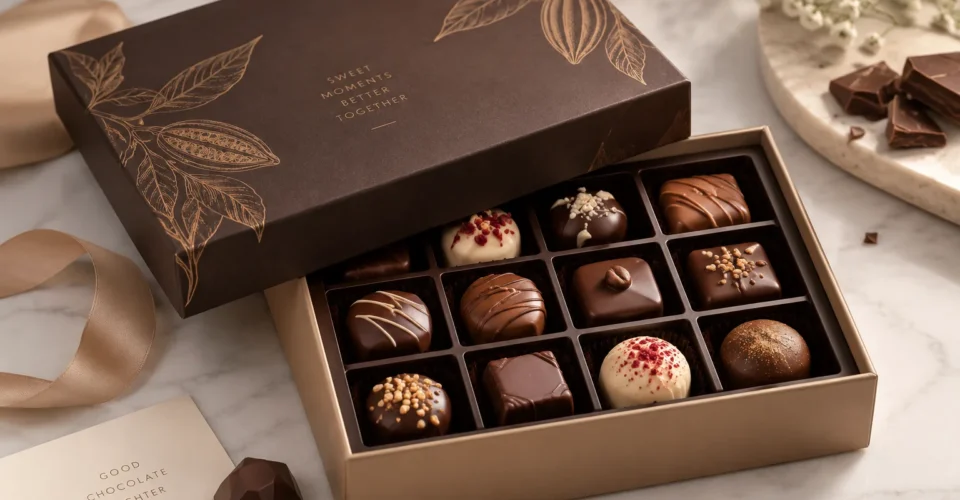
A box with chocolates can be a ready-to-gift assortment, a retail package, or a custom box designed around a chocolate brand’s products. If you are choosing packaging, the right box depends on more than how many chocolates you want to fit inside. You also need to consider the finished chocolate dimensions, arrangement, insert or cavity, opening style, branding, storage, and how the package will be delivered.
For custom chocolate packaging, the most reliable approach is to work from the product outward: measure the finished chocolates, plan the interior, establish the required internal dimensions, choose the box structure, and then finalize materials, printing, finishing, and shipping.
What is a box with chocolates?
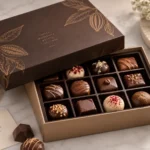
A box with chocolates is a package or gift presentation containing one or more chocolate products. In retail and packaging, it can range from a simple folding carton for a wrapped chocolate bar to a premium rigid box with individual cavities for truffles or bonbons.
- Gift box: focuses on presentation and the gifting experience.
- Retail chocolate box: balances product protection, branding, information, shelf presence, and efficient handling.
- Assortment box: usually needs a tray, divider, or cavity system to keep different pieces organized.
- Premium chocolate box: often uses rigid construction and a more deliberate opening experience.
- E-commerce chocolate package: may use an attractive inner box plus a separate outer shipping solution.
How do you choose the right box for chocolates?
Start with the finished chocolate, not the empty box. The product dimensions determine the cavity or insert; the insert influences the internal dimensions; and the internal dimensions determine the outer box structure.
- Measure the finished chocolate, including its wrapper, cup, liner, topping, or other packed layer.
- Record the maximum length, width, and height across representative pieces.
- Choose the piece count and layout: for example, 3 × 4 for 12 pieces or 4 × 4 for 16 pieces.
- Decide whether the chocolates need individual cavities, dividers, a tray, or no insert.
- Check product clearance, lid clearance, and how customers will remove each piece.
- Choose the box style based on gifting, retail display, premium presentation, or e-commerce.
- Finalize material, printing, and finishing around the approved structure.
- Approve a physical sample loaded with representative chocolates before full production.
Chocolate box sizes: why piece count is not enough
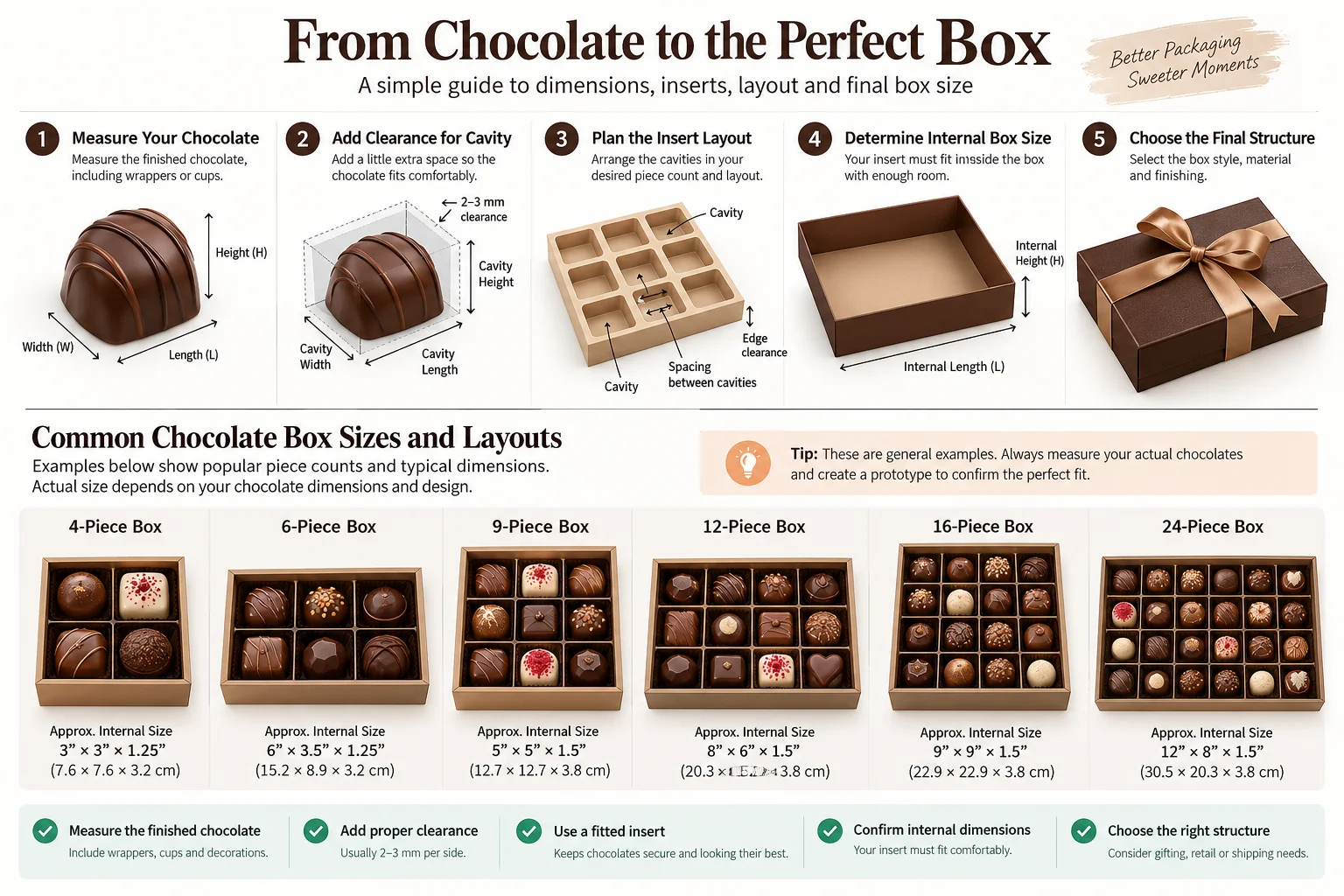
There is no single standard size for a 12-piece or 24-piece chocolate box. Two assortments with the same number of pieces can require very different packaging if one uses small square pralines and the other uses tall truffles with decorative toppings.
| Piece count | Common layout example | What to verify before finalizing |
|---|---|---|
| 4 | 2 × 2 | Cavity size, removal access, and whether an insert is necessary. |
| 6 | 2 × 3 or 3 × 2 | Orientation, overall proportions, and lid clearance. |
| 9 | 3 × 3 | Uniform cavity dimensions and spacing. |
| 12 | 3 × 4 or 4 × 3 | Flavor arrangement, cavity layout, and box footprint. |
| 16 | 4 × 4 | Insert wall thickness and easy product removal. |
| 24 | 4 × 6 or layered | Whether a larger single layer or multiple levels gives the better presentation. |
Treat these layouts as planning references, not universal box standards. Final dimensions must come from the actual product and insert specification.
Length, width and height of a box: internal vs. external dimensions
When a supplier gives you box measurements, confirm whether they are internal or external. Internal dimensions describe the usable space for the product or insert. External dimensions describe the outside footprint and are important for shelf space, shipping, stacking, and outer-case planning.
| Dimension | Use it for | Why it matters |
|---|---|---|
| Internal length | Product and insert fit | Determines how many cavities or pieces fit across. |
| Internal width | Product and insert fit | Controls arrangement and side clearance. |
| Internal height | Product and closure fit | Must clear the tallest finished product and interior components. |
| External length and width | Shelf and shipping planning | Determines footprint and case-packing considerations. |
| External height | Stacking and freight planning | Affects total package volume and storage. |
A practical starting formula for a repeated grid is: internal length ≈ number of columns × cavity width + spacing between cavities + edge allowances. Apply the equivalent calculation to width, then account for the product height, insert/base thickness, and top clearance. The exact allowance is project-specific; do not treat one clearance number as a universal packaging standard.
How to measure chocolates before ordering a custom box
- Measure several representative finished chocolates rather than only one sample.
- Record the maximum length, maximum width, and maximum height.
- Measure with the actual cup, wrapper, liner, or primary package that will be used in production.
- Include toppings or raised decorations that change the finished height.
- Identify the largest and tallest pieces in a mixed assortment.
- Decide how the customer will remove each piece and whether finger access is required.
- Use these measurements to define the cavity or insert.
- Build the outer box around the resulting interior rather than forcing the product into a preselected box size.
For handmade or decorated chocolates, normal production variation should be considered. A cavity that fits one ideal piece may become too tight when real production variation is introduced. A physical sample containing representative products is the practical way to verify the balance between secure fit and easy removal.
Which box style is best for chocolates?
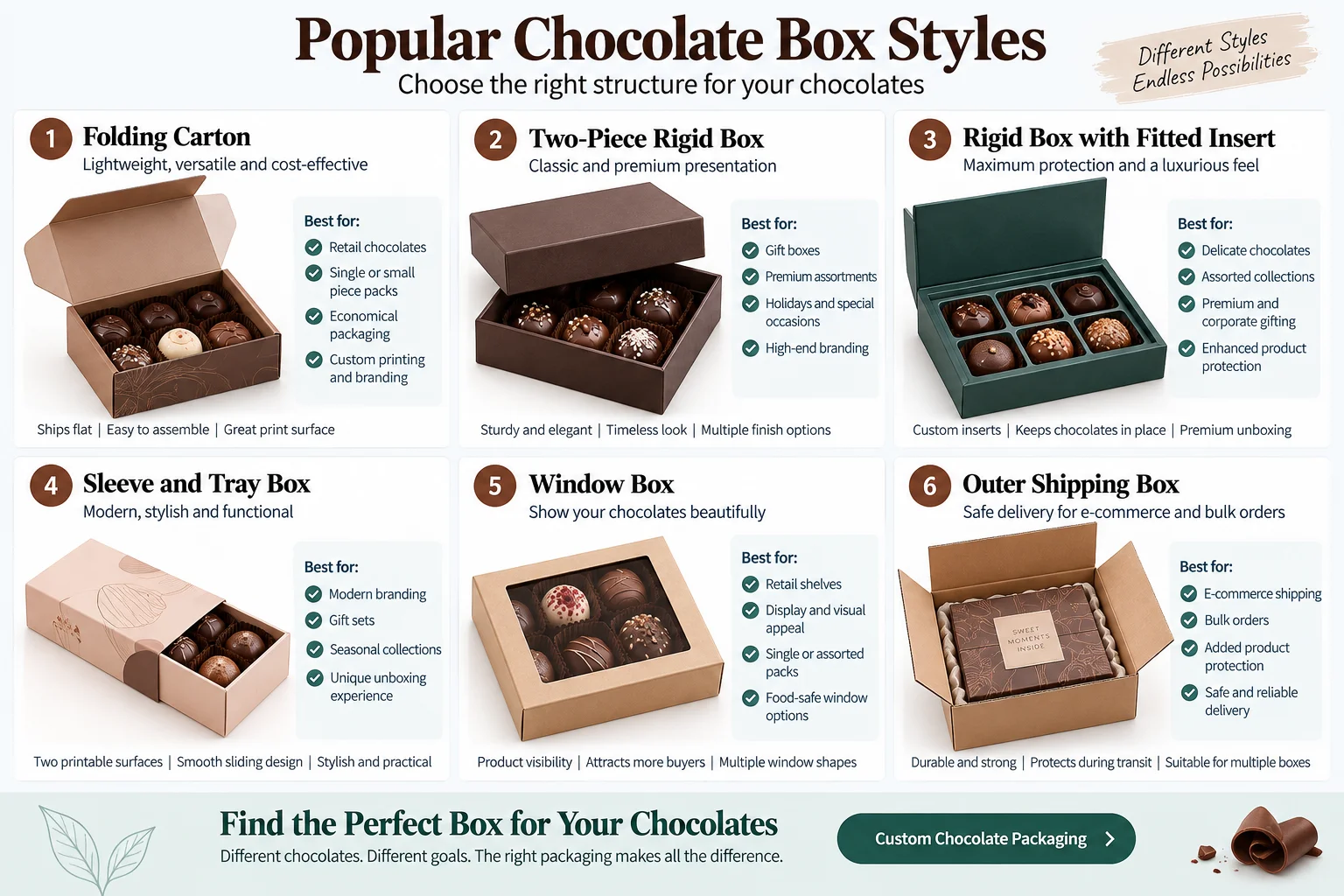
| Box style | Best suited to | Advantages | Important consideration |
|---|---|---|---|
| Folding carton | Bars, wrapped pieces, compact retail products | Efficient printed presentation and generally lighter structure | Assortments may need an internal tray or divider. |
| Two-piece rigid box | Premium gifts and curated assortments | Separate lid and base create a substantial presentation | Higher structure and shipping volume can matter. |
| Rigid box with insert | Truffles, bonbons, organized assortments | Creates dedicated positions for individual pieces | Insert geometry must be tested with the actual chocolates. |
| Rigid sleeve-and-tray | Premium gifting and staged unboxing | Distinctive sliding reveal | Tray movement and friction should be tested. |
| Window box | Display-led retail products | Lets customers see the product before opening | Window placement affects structure and artwork. |
| Gift box | Seasonal and occasion-based collections | Strong presentation and branding potential | Decorative features can increase material and assembly requirements. |
| Outer mailer/shipping box | E-commerce fulfillment | Adds a distribution layer around the presentation package | Should be designed for the actual shipping route and handling conditions. |
Chocolate box inserts: when do you need one?
An insert is useful when the chocolates need defined positions, separation, support, or a more organized presentation. It is especially helpful for individual truffles, bonbons, mixed assortments, and products that can move or collide during handling.
- Individual cavities for molded chocolates or delicate pieces.
- Dividers for wrapped chocolates or simple assortments.
- Paperboard trays where a structured but lightweight interior is appropriate.
- Shaped inserts when the product geometry requires more precise positioning.
- Layered interiors when a single level would make the box unnecessarily large.
- Printed flavor maps or numbering when the assortment contains multiple varieties.
Design the insert around the finished product. Check cavity width, length, depth, wall thickness, spacing, top clearance, and removal access. For a structured presentation, fitted insert options for delicate assortments can be a useful option when individual pieces need defined positions. If an insert or liner will directly contact food, its suitability must be evaluated for the specific material and intended conditions of use.
Food-contact packaging: what the outer box does not solve
The decorative outer box is not automatically the food-contact layer. If chocolate touches a wrapper, liner, tray, insert, coating, adhesive, or the box itself, that component should be evaluated for its intended food-contact use. For brands comparing food packaging boxes, the food-contact component and intended use should be considered separately from the decorative structure.
For the United States, FDA explains that food-contact substances are regulated according to their intended use and applicable authorization pathways. FDA also identifies food type and conditions of use as relevant considerations. Requirements in other markets can differ. For that reason, avoid blanket statements such as “every printed cardboard box is food safe” or “FDA approved” unless the exact material system and intended use have been documented.
Materials for chocolate packaging
| Material direction | Useful application | Main consideration |
|---|---|---|
| Paperboard/cardboard | Printed cartons, retail packs, compact gift formats | Select grade and construction for the required stiffness and print result. |
| Kraft | Natural-looking branded packaging | The substrate’s natural tone affects color appearance and visual style. |
| Rigid board | Premium gift and presentation boxes | Structured construction can increase material, storage, and shipping volume. |
| Corrugated board | Outer shipping protection | Plan around the complete shipping system, not just the inner box. |
Material choice should follow the job the package has to perform. For printed cartons and other compact formats, printed paperboard packaging options can be explored alongside the product and print requirements. A high-volume retail product may benefit from an efficient printed carton, while a premium chocolate collection may justify a rigid packaging solution. The correct choice depends on the product, sales channel, desired presentation, quantity, and distribution conditions.
Custom boxes with logo: how to build the brand into the package
Custom boxes with a logo can carry more than a brand mark. A chocolate package may also need flavor names, product information, barcode or QR code, seasonal artwork, a gift message, or a short brand story. The goal is to create a clear visual hierarchy rather than place every element wherever there is free space.
- Place the primary logo where the package is most likely to be seen first.
- Keep essential product information away from folds, glue areas, windows, and closure features.
- Use a consistent visual system across flavors so variants are easy to distinguish.
- Plan barcode or QR-code placement before final artwork approval.
- Use foil, embossing, debossing, or special finishes as controlled accents rather than applying every effect at once.
- If stickers or labels are used for variable flavors or batch information, keep them off folds, seams, closures, and other areas that can interfere with handling.
Print-ready artwork for a chocolate box
A print-ready packaging file should be built from the supplier’s approved dieline and specifications. The exact file requirements vary by printer, structure, material, and finishing process, so the supplier’s artwork instructions should take priority.
- Use vector artwork for logos, type, line art, barcodes, and other elements that need crisp scaling.
- Keep raster images at an appropriate effective resolution at their final print size; 300 PPI is a common target for high-quality print imagery, unless the production specification calls for something different.
- Use the required color mode and spot-color setup for the selected print process.
- Add bleed and safe areas exactly as specified on the dieline.
- Keep important text and logos clear of cut, fold, glue, window, and finishing areas.
- Confirm fonts, linked assets, transparency, overprint, and other prepress requirements with the printer.
- Approve the proof before production.
How many pixels do you need for box artwork?
Pixels are determined by the physical print size and the required resolution, not by the box name. For raster artwork, a simple planning formula is: pixels = physical inches × target PPI.
| Physical print size | At 300 PPI | At 150 PPI |
|---|---|---|
| 2 × 2 in | 600 × 600 px | 300 × 300 px |
| 3 × 4 in | 900 × 1,200 px | 450 × 600 px |
| 4 × 6 in | 1,200 × 1,800 px | 600 × 900 px |
| 5 × 7 in | 1,500 × 2,100 px | 750 × 1,050 px |
These are image-resolution examples, not packaging dieline specifications. Vector artwork is preferable for logos and text because it is resolution-independent. The final production file should follow the packaging printer’s required dimensions, bleed, color setup, and file format.
Printing terms worth knowing
If you encounter the word “collate” in a print workflow, it usually means arranging multiple printed pages or sets in the correct sequence. It is more relevant to brochures, booklets, and multi-page documents than to a single folding carton.
For packaging, the more important terms are dieline, trim, bleed, safe area, print area, spot color, overprint, finishing, proof, and print-ready artwork.
Chocolate packaging for retail, gifting and e-commerce
| Use case | Packaging priorities | Common starting direction |
|---|---|---|
| Retail shelf | Brand visibility, information, footprint, handling | Printed folding carton or windowed carton where appropriate. |
| Premium gifting | Presentation, insert, structure, opening experience | Rigid or two-piece rigid box with organized interior. |
| Corporate gifting | Branding, assortment organization, polished presentation | Branded rigid gift box or structured presentation box. |
| Wedding/event favors | Compact size, consistent appearance, easy handling | Small custom carton or favor-style box. |
| E-commerce | Presentation plus transit protection | Inner chocolate box plus an outer shipping solution. |
| Seasonal collections | Artwork flexibility, inventory management, timing | Reusable box structure with replaceable sleeve/label where appropriate. |
Can a box with chocolates be mailed?
It can be shipped or mailed when the complete packaging system is appropriate for the product and route, but the decorative chocolate box should not automatically be treated as the shipping container. For e-commerce, consider the inner presentation box, protective materials, outer shipping box, handling, destination climate, and the chocolate’s temperature sensitivity. Carrier rules and food-shipping requirements vary by destination, so confirm the current requirements for the actual service and route before shipping.
Does chocolate packaging prevent melting?
A decorative box by itself is not a temperature-control system. Chocolate performance in transit depends on the product, primary packaging, ambient conditions, storage, route duration, and the complete shipping setup. If heat exposure is a concern, evaluate the distribution conditions rather than assuming that a thicker or more attractive box will solve the problem.
How much do custom chocolate boxes cost?
There is no single useful price for a custom chocolate box without a specification. Cost can change with the finished size, structure, material, quantity, insert, printing process, artwork versions, tooling, finishing, assembly, packing, and freight.
| Cost factor | Why it changes the quote |
|---|---|
| Box structure | Rigid, multi-part, magnetic, or specialty structures can require more material and assembly. |
| Finished size | Larger dimensions generally use more material and may increase shipping volume. |
| Quantity | Setup and tooling costs can be spread across more units at higher quantities. |
| Insert | A fitted cavity or tray adds material and engineering requirements. |
| Printing | Color count, print process, coverage, and proofing requirements affect production. |
| Finishing | Foil, embossing, coatings, windows, and specialty details add process steps. |
| Artwork versions | Multiple flavors or seasonal designs can increase setup and inventory complexity. |
| Shipping | Rigid pre-assembled boxes can occupy more volume than flat-shipping cartons. |
When comparing quotes, make sure the suppliers are quoting the same specification. A cheaper quote may simply use a different material, insert, finish, quantity, assembly method, or shipping assumption.
What should you send when requesting a custom chocolate box quote?
- Chocolate type: bars, truffles, bonbons, pralines, or mixed assortment.
- Finished product dimensions and normal production variation.
- Number of pieces per box.
- Wrapper, cup, liner, or primary packaging dimensions.
- Preferred piece arrangement or flavor map.
- Desired box structure.
- Target internal or external dimensions, if already known.
- Insert or cavity requirements.
- Material preference, if any.
- Logo, artwork, and branding requirements.
- Printing and finishing requirements.
- Quantity and number of product variants.
- Sales channel: retail, gifting, e-commerce, events, or wholesale.
- Destination and required delivery date.
- Whether a physical sample is required.
How to test a chocolate box before production
- Approve the structural design or sample.
- Load the sample with representative finished chocolates.
- Check every cavity for fit and movement.
- Close the package and verify top clearance.
- Open it as a customer would.
- Remove chocolates from every area of the insert.
- Confirm the assortment order and flavor map.
- Inspect folds, closures, windows, artwork, and finishes.
- Test the inner package inside the intended shipping solution.
- Resolve fit, handling, presentation, or packing-speed problems before the production run.
Common chocolate packaging mistakes to avoid
- Choosing a box from piece count alone.
- Confusing internal dimensions with external dimensions.
- Changing the wrapper or paper cup after the insert has been approved.
- Designing cavities too tightly for normal product variation.
- Designing cavities too loosely so pieces move during handling.
- Designing artwork before the final dieline is approved.
- Treating the decorative box as the food-contact layer without verifying the exact materials and intended use.
- Assuming a decorative box will solve temperature or melting problems during shipping.
- Skipping the physical sample.
- Comparing supplier quotes that use different specifications.
A quick chocolate box decision guide
| If your product is… | Start by considering… |
|---|---|
| A wrapped chocolate bar | Printed folding carton or sleeve. |
| A uniform truffle assortment | Fitted cavity insert inside a carton or rigid presentation box. |
| A mixed premium assortment | Rigid or two-piece presentation structure with an organized insert. |
| A retail product where visibility matters | Windowed carton, if the complete packaging system supports it. |
| A premium corporate chocolate gift | Branded rigid gift box with organized interior presentation. |
| An e-commerce chocolate gift | Attractive inner box plus an outer shipping solution designed for the route. |
Packaging inserts, thank-you cards and promotional inserts
The customer experience does not have to end with the box itself. For direct-to-consumer chocolate brands, a small printed insert can explain flavors, provide serving or storage information, tell the brand story, or invite a repeat purchase. A thank-you card can reinforce the brand after delivery, while a promotional insert can introduce a seasonal collection or related product.
Keep these inserts separate from the food-contact layer unless the material system is specifically intended and documented for that use. Size them so they do not interfere with the chocolate cavities, lid closure, or unboxing sequence.
Frequently Asked Questions
What size box do I need for chocolates?
Measure the finished chocolates first, including wrappers or cups. Then design the cavity or insert and size the outer box around the required internal space. Piece count alone does not determine the final dimensions.
What is a standard chocolate box size?
There is no single universal standard. Common piece counts include 4, 6, 9, 12, 16, and 24, but the actual dimensions depend on the chocolate size, arrangement, insert, and clearance.
Should I measure internal or external box dimensions?
Use internal dimensions to determine product fit. Check external dimensions separately for shelf, shipping, stacking, and outer-case planning.
Do chocolate boxes need inserts?
Not always. Inserts are most useful when pieces need individual positions, separation, support, or a more organized presentation.
What is the best material for a chocolate box?
It depends on the product and purpose. Paperboard can suit printed retail cartons, rigid board can suit premium presentation, kraft can support a natural visual style, and corrugated board can serve as an outer shipping layer.
Can I put my logo on a chocolate box?
Yes. A custom box can incorporate logos, colors, artwork, product information, labels, and selected finishes. Plan the artwork around the final dieline and structural features.
Can I order a custom-size chocolate box?
Yes. Custom sizing is useful when the chocolates have unusual dimensions, a specific cavity arrangement, or presentation requirements that a standard box cannot meet.
How many pixels should my chocolate box artwork be?
Pixels depend on the physical print size and required resolution. For raster images, calculate pixels as inches multiplied by the target PPI. A 3 × 4 inch image at 300 PPI, for example, is 900 × 1,200 pixels. Vector logos and text do not depend on a fixed pixel count.
What does print-ready mean for packaging?
It means the artwork has been prepared according to the printer’s approved dieline and production specifications, including the required dimensions, bleed, color setup, fonts, linked assets, and other prepress requirements.
What does collate mean in printing?
Collate means arranging multiple printed pages or sets in the correct sequence. It is usually more relevant to brochures and booklets than to a single chocolate box.
Where should stickers or labels go on a chocolate box?
Place them on a flat, accessible panel that does not interfere with folds, seams, closures, windows, barcodes, or important printed information. The exact location depends on the box structure and label purpose.
Can I mail a box with chocolates?
You can ship a chocolate package when the complete packaging system and shipping route are appropriate. Consider the inner box, outer shipping protection, handling, climate, temperature sensitivity, and current carrier or destination requirements.
Can a chocolate box keep chocolates from melting?
A decorative box alone cannot be treated as temperature control. Melting risk depends on the chocolate, primary packaging, storage conditions, transit time, temperature exposure, and the complete shipping system.
What should I provide for a custom chocolate box quote?
Provide product dimensions, piece count, wrapper or cup dimensions, preferred arrangement, box style, quantity, artwork, insert requirements, finishes, destination, and target delivery date.
Should I approve a sample before ordering?
For custom packaging, a physical sample is a practical way to verify product fit, closure, insert alignment, artwork, and presentation before full production.
Custom chocolate packaging from BoxNovo
BoxNovo currently offers custom packaging options that can support chocolate and gift applications, including chocolate-specific presentation boxes, custom rigid boxes with inserts, two-piece rigid structures, and custom presentation boxes for gifting. The site also provides food-box, cardboard, rigid, kraft, printing, sleeve, and quote pathways.
If you are preparing a custom chocolate packaging project, send the finished chocolate dimensions, piece count, desired arrangement, preferred structure, quantity, artwork, and any insert or presentation requirements. That gives the packaging team the information needed to evaluate the box around the actual product.
Ready to discuss a custom project? Discuss your packaging specifications and include your chocolate dimensions, piece count, box style, quantity, and artwork requirements.
Conclusion
The best box with chocolates is the one that fits the finished product, supports the way it will be presented, and matches the demands of its sales and delivery channel. Start with the chocolate measurements, then build the insert and internal dimensions, select the box structure, and finish the package with the right branding and print treatment.
For a custom chocolate brand, that product-first process creates packaging that is easier to specify, easier to test, and more likely to deliver the intended presentation without unnecessary space or structural problems.