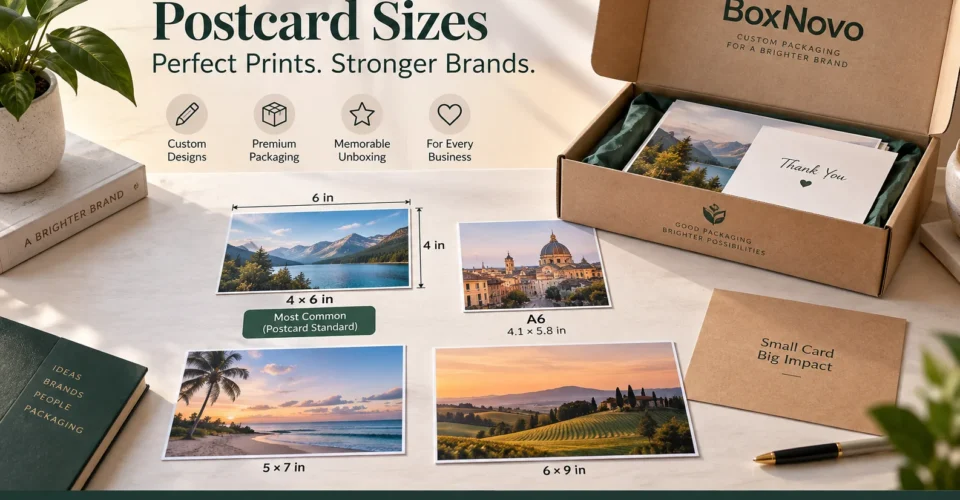
If you need the right postcard size, start with the finished trim size, not the pixel dimensions of your design file. The most common printed postcard formats include 4×6 inches, 5×7 inches, A6 (105×148 mm), and 6×9 inches, but the best choice depends on whether you are printing, mailing, using the card as a packaging insert, or combining several of those goals.
For U.S. mailing, do not assume that a “standard” printing size automatically qualifies for the postcard postage category. USPS has separate size rules for Retail and Commercial First-Class Mail postcards. Always check the postal class you plan to use before approving a production run.
Quick Answer: What Is a Standard Postcard Size?
There is no single universal standard postcard size. In commercial printing, 4×6 inches (102×152 mm) is one of the most common postcard formats in the U.S., while A6 (105×148 mm) is a common ISO-format card size. 5×7 inches (127×178 mm) and 6×9 inches (152×229 mm) are popular when more space is needed.
If your main goal is U.S. Retail First-Class postcard postage, size alone is not enough: USPS currently defines the Retail postcard range as 5–6 inches long, 3.5–4.25 inches high, and 0.007–0.016 inches thick. A 4×6 card fits that dimensional range; a 5×7 card does not.
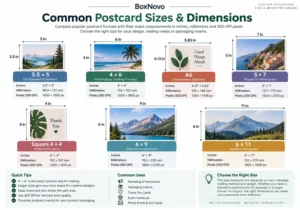
Postcard Size Dimensions at a Glance
| Format | Inches | Millimeters (approx.) | 300-DPI pixels | Typical use |
|---|---|---|---|---|
| 3.5 × 5 | 3.5 × 5 | 89 × 127 | 1050 × 1500 | Small cards, compact inserts |
| 4 × 6 | 4 × 6 | 102 × 152 | 1200 × 1800 | Direct mail, photos, inserts |
| A6 | 4.13 × 5.83 | 105 × 148 | 1240 × 1748 | International/ISO-style cards |
| 5 × 7 | 5 × 7 | 127 × 178 | 1500 × 2100 | More copy, promotions, photos |
| Square | 4 × 4 | 102 × 102 | 1200 × 1200 | Creative cards; mailing rules vary |
| 6 × 9 | 6 × 9 | 152 × 229 | 1800 × 2700 | Large-format mailers and promotions |
| 6 × 11 | 6 × 11 | 152 × 279 | 1800 × 3300 | Large promotional formats; verify mail class |
Pixel values are calculated at 300 DPI for the finished trim size. Add bleed separately; do not confuse trim pixels with the final document or canvas size.
What Does “Standard” Mean? Printing Size vs. Mailing Size
The word standard causes confusion because printers and postal operators use it differently. A printer may call 4×6 or 5×7 a standard size because it is commonly produced. A postal service may define a qualifying postcard class using its own dimensions, thickness, shape, and processing rules.
That distinction matters. A card can be a normal or typical postcard size for design purposes but still receive a different postage treatment. Treat “standard postcard size” as a printing convention unless you are specifically discussing a postal standard.
The Most Common Postcard Sizes
4 × 6 Inches — The Practical All-Purpose Choice
4×6 inches is a strong default when you need a familiar, compact card that works for direct mail, photography, promotions, or packaging inserts. It provides enough space for a headline, short message, image, QR code, and call to action without feeling oversized.
For U.S. Retail First-Class postcards, 4×6 inches falls within the published dimensional range, but thickness and other mailing requirements still matter.
5 × 7 Inches — More Room for Design
5×7 inches gives you substantially more design area than 4×6. It is useful for richer photography, longer promotional copy, thank-you messages, product education, or branded inserts.
Do not describe 5×7 as a USPS postcard-rate size simply because it is a common printed postcard. Under the current USPS Retail postcard dimensions, its 7-inch length is outside the 5–6 inch postcard range.
A6 Postcard Size — 105 × 148 mm
A6 measures 105 × 148 mm, approximately 4.13 × 5.83 inches. It belongs to the ISO A-series of paper sizes. A6 is especially useful when your design workflow already uses metric or ISO paper formats.
For internationally shipped print products, separate the design specification from the postal specification: first define the physical card size, then confirm the destination country’s mailing rules.
6 × 9 Inches — Large Postcard Format
6×9 inches gives you a much larger canvas for product photography, promotional messaging, catalog-style layouts, and oversized direct-mail creative. It is better suited to campaigns where visual impact and information density matter more than compactness.
Because postal classification depends on destination and service, verify the intended mailing category before choosing this size for a mail campaign.
Square Postcards
Square cards are visually distinctive and useful for creative campaigns, invitations, brand cards, and packaging inserts. The trade-off is that square formats can receive different postal treatment than rectangular cards. Never assume a square card qualifies for the same postage category as a similarly sized rectangle.
Postcard Size for Mailing: USPS Rules You Should Know
For U.S. Retail First-Class Mail postcards, USPS currently lists these dimensions: 5–6 inches in length, 3.5–4.25 inches in height, and 0.007–0.016 inches in thickness.
| USPS Retail postcard requirement | Current published range |
|---|---|
| Length | 5–6 in |
| Height | 3.5–4.25 in |
| Thickness | 0.007–0.016 in |
| Key point | A card must meet the applicable postal rules; printed size alone does not guarantee postcard-rate eligibility. |
USPS also publishes a different dimensional range for Commercial First-Class Mail postcards: 5–9 inches in length, 3.5–6 inches in height, and 0.007–0.016 inches in thickness. That is why a larger postcard can still be mailable as a postcard under some commercial mailing programs even though it falls outside the Retail postcard range.
For a live campaign, confirm the current postal requirements and postage before printing thousands of pieces.
Postcard Size and Postage: Why Size Is Only One Variable
Postage is not determined by size alone. Depending on the postal service and mailing class, classification can also depend on thickness, weight, shape, aspect ratio, machinability, destination, and the specific service being purchased.
- Choose the mailing class before finalizing the postcard dimensions.
- Confirm the postal operator’s current size, thickness, weight, and shape requirements.
- Check whether the design includes a clear area for addressing, postage, indicia, or barcodes when required.
- Ask the printer or mail house to confirm that the finished stock and construction meet the intended mailing specification.
- Keep a record of the postal source and date used for approval because postal requirements can change.
Postcard Size in Pixels: 300 DPI Conversion Chart
Pixels depend on resolution. A physical postcard does not have one fixed pixel size. For print work, 300 DPI is a common production target, so the table below shows the corresponding pixel dimensions for the finished trim size.
| Finished size | 300-DPI pixel size |
|---|---|
| 3.5 × 5 in | 1050 × 1500 px |
| 4 × 6 in | 1200 × 1800 px |
| A6 (4.13 × 5.83 in) | 1240 × 1748 px |
| 5 × 7 in | 1500 × 2100 px |
| 4 × 4 in square | 1200 × 1200 px |
| 6 × 9 in | 1800 × 2700 px |
| 6 × 11 in | 1800 × 3300 px |
Formula: pixels = inches × DPI. For example, a 4×6 postcard at 300 DPI is 4×300 by 6×300 = 1200×1800 pixels.
If your printer specifies a different resolution, follow the printer’s production specification rather than treating 300 DPI as a universal law.
Postcard Photo Dimensions and Photo Size
If you are printing a photograph as a postcard, 4×6 inches is a natural starting point because it matches a widely used photo format. At 300 DPI, a 4×6 image is 1200×1800 pixels.
For an A6 postcard, the 300-DPI target is approximately 1240×1748 pixels. For a 5×7 postcard, it is 1500×2100 pixels.
The source photo should have enough resolution for the final crop. Do not stretch a small image to a large postcard and expect the extra pixels to create detail.
Bleed, Trim Size, and Safe Area
Your finished postcard size is the trim size, the dimensions after cutting. The artwork file is normally larger when bleed is required.
| Term | Meaning | Why it matters |
|---|---|---|
| Trim size | Final finished postcard dimensions | This is the size the customer receives |
| Bleed | Extra artwork extending beyond the trim edge | Prevents unwanted white edges after trimming |
| Safe area | Inner zone for important text/logos | Reduces the chance of critical content being cut |
| Working file | The complete production canvas | Includes trim, bleed, and design elements |
Bleed and safe-area requirements vary by printer. A common commercial-print starting point is 0.125 inch bleed on each side, but the printer’s template always wins.
For BoxNovo production, use the exact dieline or artwork specification supplied for the job rather than applying a generic bleed value to every project.
Postcard Size for Packaging Inserts
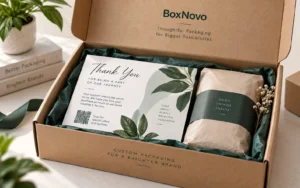
A postcard does not have to be mailed. The same basic formats can work as packaging inserts inside product boxes, subscription boxes, ecommerce shipments, and retail packaging.
A 4×6 card can work especially well inside custom product packaging when you need a compact printed insert.
| Insert goal | Recommended starting size | Why |
|---|---|---|
| Short thank-you message | 3.5 × 5 or 4 × 6 | Compact and easy to place in smaller boxes |
| Thank-you + QR code + offer | 4 × 6 | Balanced space for message and CTA |
| Product care or education | 4 × 6 or 5 × 7 | More room for instructions and visuals |
| Brand story / promotional insert | 5 × 7 | More design area for storytelling |
| Large product presentation card | 6 × 9 | Useful when the box has ample internal space |
The right packaging insert size should be chosen from the product box’s usable internal footprint, not from the postcard’s popularity. Leave enough clearance for the card to enter and exit the box without bending or catching on the product.
For ecommerce shipments, a compact insert can also be paired with custom shipping mailers to keep the message part of the unboxing experience.
Choosing a Box for a Printed Insert
When an insert is part of a premium product presentation, a structured box can make the card feel more intentional. For a built-in insert area, rigid packaging with a built-in insert can be considered when the packaging needs a more structured presentation.
For larger branded cards used alongside a product, presentation-focused packaging can also be relevant when the box has enough interior space.
How to Choose the Right Postcard Size
- Need a compact, familiar format? Start with 4×6.
- Need more room for copy or photography? Consider 5×7.
- Working in an ISO/metric print workflow? Consider A6.
- Need a larger promotional canvas? Consider 6×9.
- Using it as a packaging insert? Measure the box interior first, then choose the largest practical card that fits comfortably.
- Mailing it? Choose the postal class first, then verify the current rules for dimensions, thickness, weight, shape, and processing.
Japanese Postcard Size
“Japanese postcard size” is not a safe phrase to interpret as one universal international standard without specifying the use. Japanese stationery and postal products can use country-specific formats, and postal requirements are distinct from ISO paper sizes. If your project is intended for mailing in Japan, confirm the current Japan Post specifications for the exact service rather than assuming that A6 or 4×6 is automatically the local postcard standard.
For an internationally shipped print product, separate the design specification from the postal specification: first define the physical card size, then confirm the destination country’s mailing rules.
Postcard Size vs. Other Printed Cards
| Format | Typical role | Main advantage |
|---|---|---|
| Postcard | Mailing, promotion, inserts | Flexible front/back communication |
| Business card | Contact information | Compact personal/company identification |
| Flyer | Promotion or information | More space for content |
| Thank-you insert | Packaging experience | Adds a personal brand touch inside the box |
| Product card | Instructions, product story, care | Useful after purchase |
The same 4×6 or 5×7 physical size can serve different purposes. What changes is the content, stock, finish, and whether the item needs to meet mailing requirements.
Common Postcard Size Mistakes
- Treating A6 as a universal postal postcard standard.
- Assuming the most common printed size automatically qualifies for the lowest postage category.
- Designing only to pixel dimensions and forgetting the physical trim size.
- Adding bleed after the artwork is finished instead of building the production file correctly.
- Placing text or logos too close to the trim edge.
- Using a low-resolution photo and enlarging it for print.
- Choosing a packaging insert size before measuring the actual box interior.
- Failing to check thickness and stock when a mailing class has thickness limits.
- Using a square or unusual shape without checking postal treatment.
- Approving a large production run before confirming the current postal rules.
A Simple Postcard Size Decision Table
| Your priority | Best starting point | Check before production |
|---|---|---|
| U.S. Retail postcard postage | 4×6 is a practical starting point | Current USPS size, thickness and mailing requirements |
| Compact packaging insert | 3.5×5 or 4×6 | Box interior and product clearance |
| More design space | 5×7 | Mail class if sending through the post |
| ISO/metric workflow | A6 | Printer template and destination postal rules |
| Large promotional mailer | 6×9 | Mail class, thickness, weight and machinability |
| Creative square format | Square | Postal classification and extra handling/postage |
Final Recommendation
For most general-purpose projects, 4×6 inches is the strongest starting point because it is compact, familiar, easy to design, and useful for both direct-mail concepts and packaging inserts.
For premium product presentation, structured packaging with a built-in insert can be considered when the card is part of a more formal product presentation.
If the postcard will be mailed, treat the postal specification as the final authority. If it will go inside a custom box, treat the box’s usable interior dimensions as the final authority. For print production, treat the printer’s current template as the final authority.
If you are choosing a postcard specifically for an insert or branded unboxing experience, BoxNovo’s custom box collection provides a broader range of packaging formats to consider.
Frequently Asked Questions About Postcard Size
What is a postcard size?
A postcard size is the physical width and height of a postcard. There is no single worldwide size; common commercial formats include 4×6 inches, 5×7 inches, A6, and 6×9 inches.
What is the standard postcard size in the U.S.?
For printing, 4×6 inches is a very common U.S. postcard format. For USPS Retail First-Class postcard pricing, the published dimensional range is 5–6 inches long by 3.5–4.25 inches high, with 0.007–0.016 inch thickness.
What is the typical or average postcard size?
There is no single official average. 4×6 inches is a common commercial format, while 5×7 and A6 are also widely used.
What is A6 postcard size?
A6 is 105×148 mm, approximately 4.13×5.83 inches. It is an ISO A-series paper size, not a universal postal postcard rule.
What is postcard size in pixels?
At 300 DPI, a 4×6 postcard is 1200×1800 pixels. A 5×7 postcard is 1500×2100 pixels. A6 is approximately 1240×1748 pixels at 300 DPI.
What size is a postcard for a postcard stamp?
That depends on the postal operator, service, and destination. In the U.S., USPS publishes a specific Retail postcard dimensional range. Check the current postal rules before assuming a card qualifies for postcard pricing.
What is the maximum postcard size?
There is no single worldwide maximum. In the U.S., USPS currently lists Retail First-Class postcards up to 6 inches long and 4.25 inches high, while Commercial First-Class Mail postcards have a larger published maximum of 9×6 inches.
Is 5×7 a standard postcard size?
5×7 is a common commercial printing size, but it should not be described as a USPS Retail postcard-rate size because its 7-inch length exceeds the current Retail postcard maximum of 6 inches.
Can a postcard be used as a packaging insert?
Yes. 4×6 and 5×7 are useful starting points for thank-you cards, promotional inserts, QR-code cards, product education, and brand messages. Measure the box interior before selecting the final insert size.
Does postcard thickness matter?
Yes, especially for mailing. USPS Retail postcards have a published thickness range of 0.007–0.016 inch. Other postal services and classes can have different rules.
What is a normal postcard size for printing?
A practical shortlist is 4×6, A6, 5×7, and 6×9 inches. The best choice depends on content, printing workflow, packaging space, and mailing requirements.
What are postcard photo dimensions?
For a 4×6 postcard/photo at 300 DPI, use 1200×1800 pixels as the finished-size target. For 5×7, use 1500×2100 pixels. Add bleed according to your printer’s specification.