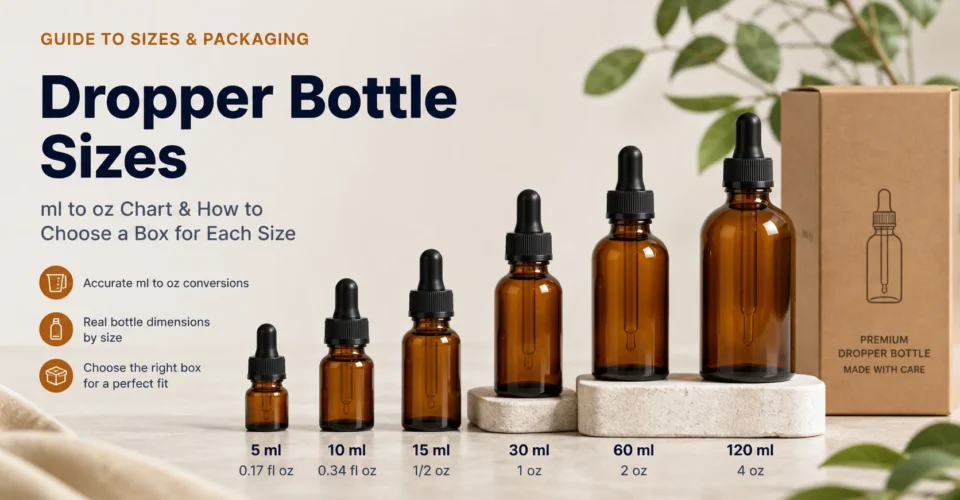
Quick answer: Common dropper bottle sizes are 5, 10, 15, 30, 50, 60 and 100 ml, sold in the US as 1/2 oz, 1 oz, 2 oz and 4 oz. One US fluid ounce is 29.57 ml, so a 1 oz dropper bottle is about 30 ml. To choose a box, measure the bottle with the dropper fitted, then add clearance and any insert.
Key facts at a glance
- Conversion: 1 US fl oz = 29.5735 ml exactly; 1 ml = 0.034 fl oz
- Best-known size: 1 oz (30 ml), often in amber glass with a 20-400 or 18 mm neck
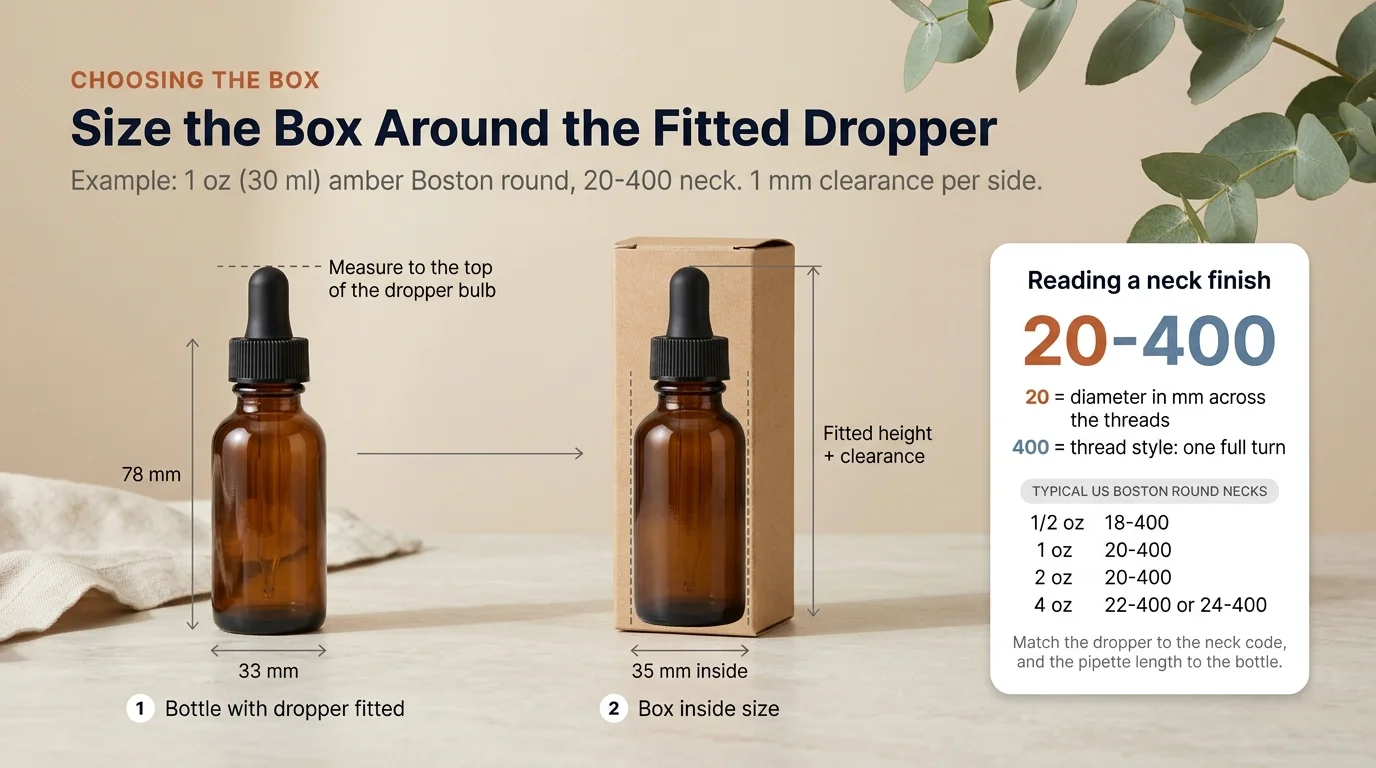
- Real 1 oz bottle: 3.08 in (78 mm) tall and 1.299 in (33 mm) wide, before the dropper is fitted
- Neck finish: in “20-400”, 20 is the neck diameter in mm and 400 is the thread style (one full turn)
- Box sizing: measure with the dropper fitted; the dropper bulb and collar add height above the bottle
- Safety rule: liquids with more than 5% methyl salicylate by weight (for example, many wintergreen oils) need child-resistant packaging in the US
Bottle measurements in this guide come from published supplier specifications listed in the Sources section. Sizes vary by manufacturer, so always measure your own bottle.
In this guide
- Dropper bottle size chart: ml to oz
- Real height and diameter by size
- The most common sizes and their uses
- Neck finishes and droppers
- Glass vs plastic, amber vs clear
- How to choose a box for each size
- Label sizes for dropper bottles
- Child-resistant droppers
- Common mistakes
- Frequently asked questions
- Sources
Dropper Bottle Size Chart: ml to oz
Dropper bottle sizes are sold in milliliters, US fluid ounces or both. Because 1 US fluid ounce is 29.5735 ml, ml to oz bottle sizes rarely convert to round numbers. This dropper bottle size chart shows the exact conversion and the matching BoxNovo box for each size.
| Bottle Size (ml) | US Fluid Ounces | Often Sold As | Matching Box |
|---|---|---|---|
| 5 ml | 0.17 fl oz | 5 ml sample or tester | See the dropper box range below |
| 10 ml | 0.34 fl oz | 10 ml (about 1/3 oz) | 10 ml bottle boxes |
| 15 ml | 0.51 fl oz | 1/2 oz | 15 ml bottle boxes |
| 30 ml | 1.01 fl oz | 1 oz | 30 ml bottle boxes or 1 oz bottle boxes |
| 50 ml | 1.69 fl oz | 50 ml | Sized to order |
| 60 ml | 2.03 fl oz | 2 oz | 60 ml bottle boxes or 2 oz bottle boxes |
| 90 ml | 3.04 fl oz | 3 oz | 90 ml bottle boxes |
| 100 ml | 3.38 fl oz | 100 ml | 100 ml bottle boxes |
| 120 ml | 4.06 fl oz | 4 oz | 120 ml bottle boxes |
| 200 ml | 6.76 fl oz | 200 ml | 200 ml bottle boxes |
For US ml to oz bottle sizes going the other way: 1/2 oz = 14.79 ml, 1 oz = 29.57 ml, 2 oz = 59.15 ml and 4 oz = 118.29 ml. That is why a 1 oz dropper bottle and a 30ml dropper bottle are treated as the same size, and why a 2 oz dropper bottle is sold as 60 ml. The exact factor comes from the US gallon (231 cubic inches, with 1 inch = 2.54 cm) divided into 128 fluid ounces. NIST rounds it to 30 ml per fluid ounce for household use.
Dropper Bottle Sizes: Real Height and Diameter
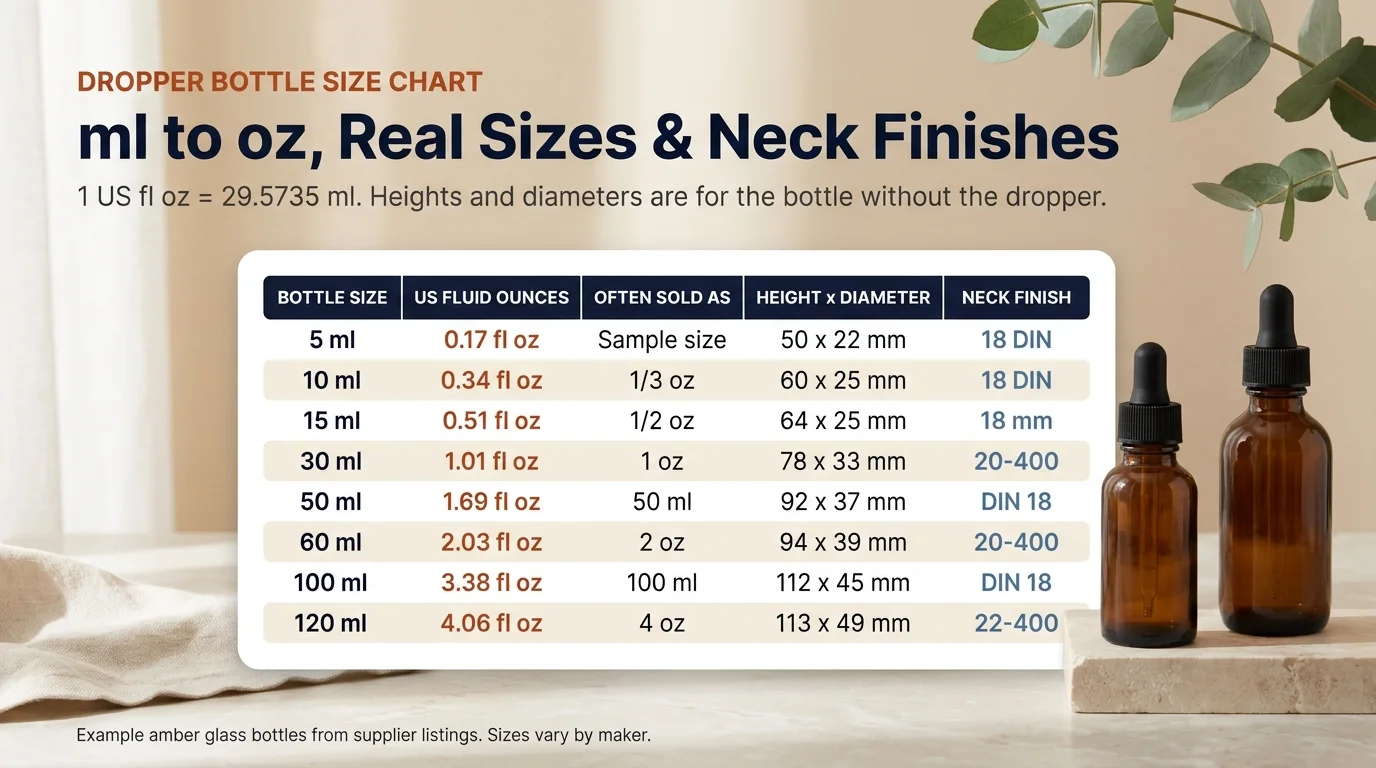
Capacity alone does not tell you the box size, because dropper bottle sizes are named by volume. Height and diameter decide the box, and they vary by maker and neck style. These are published specifications for stock amber glass bottles, measured without the dropper.
| Size | Bottle Style and Neck | Height (no dropper) | Diameter | Source |
|---|---|---|---|---|
| 5 ml | Boston round, 18 DIN | 1.98 in (50 mm) | 0.855 in (22 mm) | Container and Packaging |
| 10 ml | Boston round, 18 DIN | 2.375 in (60 mm) | 0.973 in (25 mm) | Container and Packaging |
| 15 ml (1/2 oz) | Boston round, 18 mm | 2.5 in (64 mm) | 1 in (25 mm) | TricorBraun |
| 15 ml | Round, DIN 18 | 65.1 mm (2.56 in) | 28.5 mm (1.12 in) | Berlin Packaging EU |
| 30 ml (1 oz) | Boston round, 20-400 | 3.08 in (78 mm) | 1.299 in (33 mm) | Container and Packaging |
| 30 ml | Round, DIN 18 | 78.8 mm (3.10 in) | 33 mm (1.30 in) | Berlin Packaging EU |
| 50 ml | Round, DIN 18 | 92.2 mm (3.63 in) | 37.2 mm (1.46 in) | Berlin Packaging EU |
| 60 ml (2 oz) | Boston round, 20-400 | 3.70 in (94 mm) | 1.535 in (39 mm) | Container and Packaging |
| 100 ml | Round, DIN 18 | 112 mm (4.41 in) | 44.5 mm (1.75 in) | Berlin Packaging EU |
| 120 ml (4 oz) | Boston round, 22-400 | 4.447 in (113 mm) | 1.929 in (49 mm) | Container and Packaging |
Two bottles with the same capacity can differ: the two 15 ml bottles above are 25 mm and 28.5 mm wide. Order your box from your own bottle, not from a size label. To check how any bottle fits a box, use the box size calculator.
The Most Common Dropper Bottle Sizes and Their Uses
| Size | Typical Products | Packaging Notes |
|---|---|---|
| 5 ml | Samples, testers, travel kits | Often packed several to a box with an insert |
| 10 ml | Pure essential oils, concentrates | Small boxes; usually amber glass for light protection |
| 15 ml (1/2 oz) | Face serums, blends, beard oils | Slim box; check the dropper height |
| 30 ml (1 oz) | Serums, tinctures, CBD oils, beard oils | The best-known retail size; widest choice of stock droppers and boxes |
| 50 to 60 ml (2 oz) | Hair oils, larger serums, body oils | Taller box; heavier glass benefits from an insert |
| 100 to 120 ml (4 oz) | Carrier oils, refill sizes | Long pipette; consider a sturdier box or shipper |
30 ml is a common serum size; see serum box packaging. Beard oils commonly come in 30 to 50 ml bottles, packed in beard oil boxes, and tincture brands in CBD tincture boxes.
Neck Finishes and Droppers: Why They Change the Box
A neck finish code such as 20-400 has two parts. The first number is the diameter across the outside of the threads in millimeters. The second number is the thread style and neck height set by the Glass Packaging Institute and the Society of the Plastics Industry: a 400 finish has one full thread turn, 410 has one and a half and 415 has two.
| Bottle Size | Typical US Neck Finish (Boston round) | Example Pipette Length |
|---|---|---|
| 1/2 oz (15 ml) | 18-400 | 18 mm droppers come with pipettes from about 48 to 109 mm |
| 1 oz (30 ml) | 20-400 | 76 mm pipette on a 20-400 dropper |
| 2 oz (60 ml) | 20-400 | 89 mm pipette made for 2 oz bottles |
| 4 oz (120 ml) | 22-400 (some makers use 24-400) | 108 mm pipette on a 24-400 dropper |
- Match the dropper to the neck: an 18-400 dropper will not fit a 20-400 bottle.
- European bottles: many 5 to 100 ml dropper bottles use an 18 mm DIN (GL18) neck, which takes 18-400 and 18-410 closures on some models. Check the supplier’s compatibility list.
- Match the pipette to the bottle: the pipette should almost reach the base. One 30 ml GL18 bottle needs a 77 mm pipette.
- Measure the fitted height: the bulb and collar sit above the neck, so the box must be taller than the bare bottle.
Glass vs Plastic, Amber vs Clear
| Material | Strengths | Watch Out For |
|---|---|---|
| Amber glass | Protects contents from UV light below about 450 nm; used for light-sensitive oils and pharmaceuticals | Heavier and breakable; needs a snug box or insert |
| Clear (flint) glass | Shows the color of the product | No light protection; better for light-stable formulas |
| PET plastic | Lighter, lower cost, recyclable; can store some diluted essential oil products well | Pure essential oils can damage plastic and rubber parts; test compatibility first |
Glass maker Beatson Clark states that its amber glass protects contents from ultraviolet light below about 450 nanometres and meets US and European Pharmacopoeia light transmission requirements. Container and Packaging recommends glass for pure, concentrated essential oils and testing any plastic with your actual product.
How to Choose a Box for Each Dropper Bottle Size
Box inside size = bottle with dropper fitted + clearance + insert. Work through these steps:
- Fit the dropper you will sell with, then measure the total height from the base to the top of the bulb.
- Measure the widest point, usually the bottle shoulder or the dropper collar.
- Add clearance: enough for the bottle to slide in without forcing, usually a millimeter or two each side.
- Add the insert, if you use one, to hold glass still and stop it hitting the box walls.
- Set the inside dimensions, and let the printer add board thickness for the outside.
- Test a sample with a filled bottle before printing the full run.
| Bottle | Bottle Diameter | Example Box Width and Depth (1 mm each side) | Box Height |
|---|---|---|---|
| 10 ml, 18 DIN | 25 mm | 27 x 27 mm | Fitted height + clearance |
| 15 ml (1/2 oz) | 25 mm | 27 x 27 mm | Fitted height + clearance |
| 30 ml (1 oz), 20-400 | 33 mm | 35 x 35 mm | Fitted height + clearance |
| 60 ml (2 oz), 20-400 | 39 mm | 41 x 41 mm | Fitted height + clearance |
| 120 ml (4 oz), 22-400 | 49 mm | 51 x 51 mm | Fitted height + clearance |
Height is left to your measurement because droppers differ: bulb size, collar style and child-resistant caps all change it. For more on inside and outside sizes, read this guide to choosing custom box dimensions.
Box Styles for Dropper Bottles
- Tuck end box with insert: the standard retail choice; BoxNovo makes printed dropper bottle boxes in every size.
- Multi-bottle sets: bottle boxes with dividers keep two to six bottles apart.
- Shipping: glass needs protection in transit; use bottle shipping boxes for e-commerce orders.
- Vials and ampoules: smaller glass formats are covered in this vial packaging guide.
Browse the full bottle box range for every size and style.
Label Sizes for Dropper Bottles
A dropper bottle label must fit the flat label panel between the shoulder and the base, and wrap around the bottle without overlapping itself.
| Bottle | Example Label Size | Why It Fits |
|---|---|---|
| 15 ml (1/2 oz) | 1.25 x 2.5 in | One 15 ml bottle has a 1.4375 in label panel and a 1 in diameter |
| 30 ml (1 oz) | 1.75 x 4.0 in | One 30 ml bottle has a 2 in label panel; a 1.299 in bottle is about 4.08 in around |
| 60 ml (2 oz) | 2.0 x 4.0 in | A 1.535 in bottle is about 4.82 in around, leaving a visible gap at the back |
Label sizes are those listed by printer Sttark; label panel heights come from TricorBraun. Your bottle may differ, so check with the label size recommender and order printed bottle labels to match. In the US, cosmetics such as serums state net contents in fluid ounces; FDA allows metric units to be added.
Child-Resistant Droppers: When You Need Them
Under the Poison Prevention Packaging Act, liquid preparations containing more than 5 percent by weight of methyl salicylate must be in child-resistant packaging. CPSC has recalled wintergreen and birch essential oils sold in ordinary dropper bottles for this reason. Child-resistant dropper closures are made for common dropper necks, but they change the closure height, so measure them before setting the box size.
Common Dropper Bottle Packaging Mistakes
| Mistake | Fix |
|---|---|
| Sizing the box from the capacity alone | Measure the actual bottle; same-capacity bottles differ in width and height |
| Measuring the bottle without the dropper | Measure with the dropper you will sell, fitted |
| Mixing neck finishes | Match the dropper to the neck code, for example 20-400 to 20-400 |
| Pipette too short or too long | Use the pipette length the supplier lists for that bottle |
| Rounding 30 ml to exactly 1 oz on every label | Remember 30 ml is 1.01 fl oz and 1 oz is 29.57 ml; state what you actually fill |
| Pure essential oils in plastic | Use glass, or test plastic compatibility first |
| No child-resistant closure on methyl salicylate products | Use a child-resistant dropper above the 5 percent threshold |
Dropper Bottle Box Checklist
- Bottle size confirmed in both ml and fl oz.
- Bottle measured with the dropper fitted, at its widest point.
- Neck finish and dropper matched, with the right pipette length.
- Glass or plastic chosen for your formula; amber if light-sensitive.
- Box inside size set with clearance and any insert.
- Label size checked against the label panel and circumference.
- Child-resistant closure added where required.
- Sample box tested with a filled bottle.
Frequently Asked Questions
What are the standard dropper bottle sizes?
The most common are 5, 10, 15, 30, 50, 60 and 100 ml, and in US sizes 1/2 oz, 1 oz, 2 oz and 4 oz.
How many ml is a 1 oz dropper bottle?
One US fluid ounce is 29.57 ml, so a 1 oz dropper bottle holds about 30 ml.
Is a 30ml dropper bottle the same as 1 oz?
Almost. 30 ml is 1.01 US fluid ounces, so the two are sold as the same size.
How many ml is a 2 oz dropper bottle?
2 US fluid ounces is 59.15 ml, so 2 oz bottles are usually sold as 60 ml.
How tall is a 1 oz dropper bottle?
One stock 1 oz amber Boston round measures 3.08 inches tall and 1.299 inches wide without the dropper. The dropper adds height above the neck.
What does 20-400 mean on a bottle?
20 is the neck diameter in millimeters across the threads, and 400 is the thread style, which has one full turn.
What neck size does a 1 oz Boston round use?
Usually 20-400. Half-ounce bottles commonly use 18-400, and 4 oz bottles 22-400 or 24-400 depending on the maker.
How do I choose a box for a dropper bottle?
Measure the bottle with the dropper fitted, add a little clearance and any insert, and test a sample box with a filled bottle.
Why are dropper bottles amber?
Amber glass blocks ultraviolet light below about 450 nm, which helps protect light-sensitive oils and formulas.
Can essential oils go in plastic dropper bottles?
Pure essential oils can damage plastic and rubber parts, so glass is recommended. Some diluted products work in PET after testing.
What label size fits a 1 oz dropper bottle?
A 1.75 x 4 inch label is a common size for 1 oz bottles, but check your bottle’s label panel height and circumference.
Do essential oil dropper bottles need child-resistant caps?
Liquids with more than 5 percent methyl salicylate by weight, such as many wintergreen oils, must use child-resistant packaging in the US.
What size dropper bottle is best for serums?
30 ml (1 oz) is a common serum size, with 15 ml for smaller or trial sizes.
How many ounces is a 100 ml dropper bottle?
100 ml is 3.38 US fluid ounces.
How many ml is a 4 oz dropper bottle?
4 US fluid ounces is 118.29 ml, so 4 oz bottles are often sold as 120 ml.
How many ml is a dram?
NIST lists 1 fluid dram as about 3.7 ml, which is why “1 dram” vials are smaller than a 5 ml bottle.
Final Takeaway
Dropper bottle sizes run from 5 ml samples to 4 oz refills, but the label size is only the start. Convert carefully (1 fl oz = 29.57 ml), measure your actual bottle with the dropper fitted, match the neck finish and pipette, and size the box with clearance and an insert. That gives you a box that fits, protects the glass and leaves room for a clear label.
Check an instant price estimate, then send us your bottle measurements to request a box quote.
Sources
- NIST Office of Weights and Measures: household measures and metric equivalents
- Container and Packaging: 1 oz amber glass Boston round (20-400)
- Container and Packaging: 2 oz amber glass Boston round (20-400)
- Container and Packaging: 4 oz amber glass Boston round (22-400)
- Container and Packaging: 5 ml amber euro dropper bottle (18 DIN)
- Container and Packaging: 10 ml amber euro dropper bottle (18 DIN)
- TricorBraun: 15 ml amber Boston round dropper bottle
- TricorBraun: 30 ml amber Boston round dropper bottle
- Berlin Packaging EU: 15 ml DIN 18 dropper bottle
- Berlin Packaging EU: 30 ml DIN 18 dropper bottle
- Berlin Packaging EU: 50 ml DIN 18 dropper bottle
- Berlin Packaging EU: 100 ml DIN 18 dropper bottle
- Uline: amber Boston round bottles and cap sizes
- Miron Violettglas: neck finishes explained
- TricorBraun: 20-400 dropper with 76 mm pipette
- Uline: 20-400 dropper caps, 89 mm, for 2 oz bottles
- Coloured Bottles: 30 ml amber dropper bottle (77 mm pipette)
- Beatson Clark: amber glass technical information
- Container and Packaging: essential oils in glass or plastic
- Sttark: label sizes for bottles
- FDA: Summary of Cosmetics Labeling Requirements
- eBottles: child-resistant packaging regulations
- CPSC: essential oil recall for missing child-resistant packaging