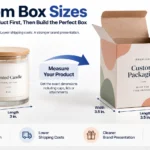
Quick Answer: How Do You Choose the Right Custom Box Size?
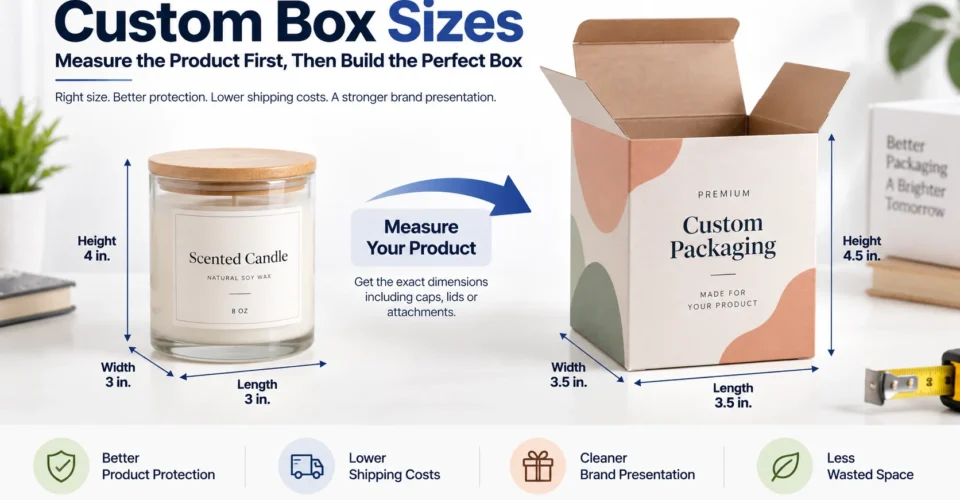
The right custom box size starts with the product, not a stock box. Measure the product at its maximum relevant points, define how it will sit inside the package, account for any insert or protective material, and then determine the internal dimensions the package needs. After that, check the finished outside dimensions if shipping, storage, display space, or an outer carton matters.
For most rectangular packaging, dimensions are communicated as length × width × height (L × W × H). The exact naming convention can vary by supplier or box style, so the safest specification states the dimensions, unit, orientation, and whether they are internal or external.
- Measure the product at its maximum length, width, and height, including attached parts that must remain inside the package.
- Define the packing orientation: what is the base, what is upright, and how the product will actually sit in the box.
- Measure the complete packing arrangement when using a tray, divider, insert, wrap, foam, tissue, or other protective material.
- Determine the clearance required for the specific product and packaging method rather than applying a universal number.
- Calculate the preliminary internal box dimensions.
- Check the external dimensions when shipping, storage, display, or master-carton fit matters.
- Test a physical sample with the real product before approving production when fit or protection is important.
There is no single clearance allowance that is correct for every package. A fitted retail carton, a fragile e-commerce shipment, and a gift box with a custom insert have different requirements. Treat clearance as part of the packaging design, not as a fixed rule.
For a broader look at how sizing connects with materials, structure, printing, and product presentation, see our complete guide to custom packaging.
What Do L × W × H Box Dimensions Mean?
L × W × H means length, width, and height in the stated orientation. For a conventional rectangular package, these three measurements describe the package’s three axes. Some suppliers use “depth” for the third dimension, so always follow the supplier’s stated orientation or dieline when one is provided.
| Term | Meaning | What to State in a Quote |
|---|---|---|
| Length (L) | One horizontal axis of the product or package. | Identify the reference face or opening. |
| Width (W) | The second horizontal axis, perpendicular to length. | State the unit and measurement basis. |
| Height (H) | The third axis, often the upright/depth direction. | State what counts as the top or highest point. |
| Internal dimensions | Usable space inside the assembled package. | Use for product-fit requirements. |
| External dimensions | Finished outside footprint of the assembled package. | Use when outer size matters for shipping, storage, or display. |
Example: A 12 × 4 × 3-Inch Box
If 12 × 4 × 3 inches is specified as an internal size, those numbers describe the usable cavity in the stated orientation. If the same numbers are external, they describe the outside footprint. The numbers alone do not tell the reader which one was intended.
When preparing a packaging specification, stating the measurement basis is just as important as stating the numbers. If you regularly work with packaging measurements, the BoxNovo sizes and dimensions guides can provide a useful starting point for related sizing topics.
How to Measure a Product for a Custom Box
Measure the product in the condition and orientation in which it will actually be packaged. A product specification from a catalog may not capture a cap, pump, handle, decoration, flexible material, or other feature that changes the maximum packaged dimensions.
1. Measure the Maximum Length, Width, and Height
- Measure the widest relevant point rather than a narrow section.
- Measure the tallest point, including caps, pumps, handles, toppers, and attached components.
- Measure the deepest or thickest point that must fit inside the package.
- For flexible products, measure them in their intended packed condition.
2. Define the Product Orientation
Write down which face is the base and which direction is up. A product rotated 90 degrees may require a different box proportion even though the three product measurements are unchanged.
3. Include Anything That Stays With the Product
- Caps, pumps, handles, straps, or closures
- Attached labels or decorative elements that protrude
- Protective sleeves or wraps
- Lids or hinged parts that remain attached
- Accessories that will occupy the same package cavity
4. Measure the Complete Arrangement for Multiple Products
For a multi-pack, arrange the products exactly as they will be packed and measure the full arrangement. Include dividers, trays, compartments, and the height of the complete stack. Do not calculate the box by simply multiplying one product’s dimensions by the number of units.
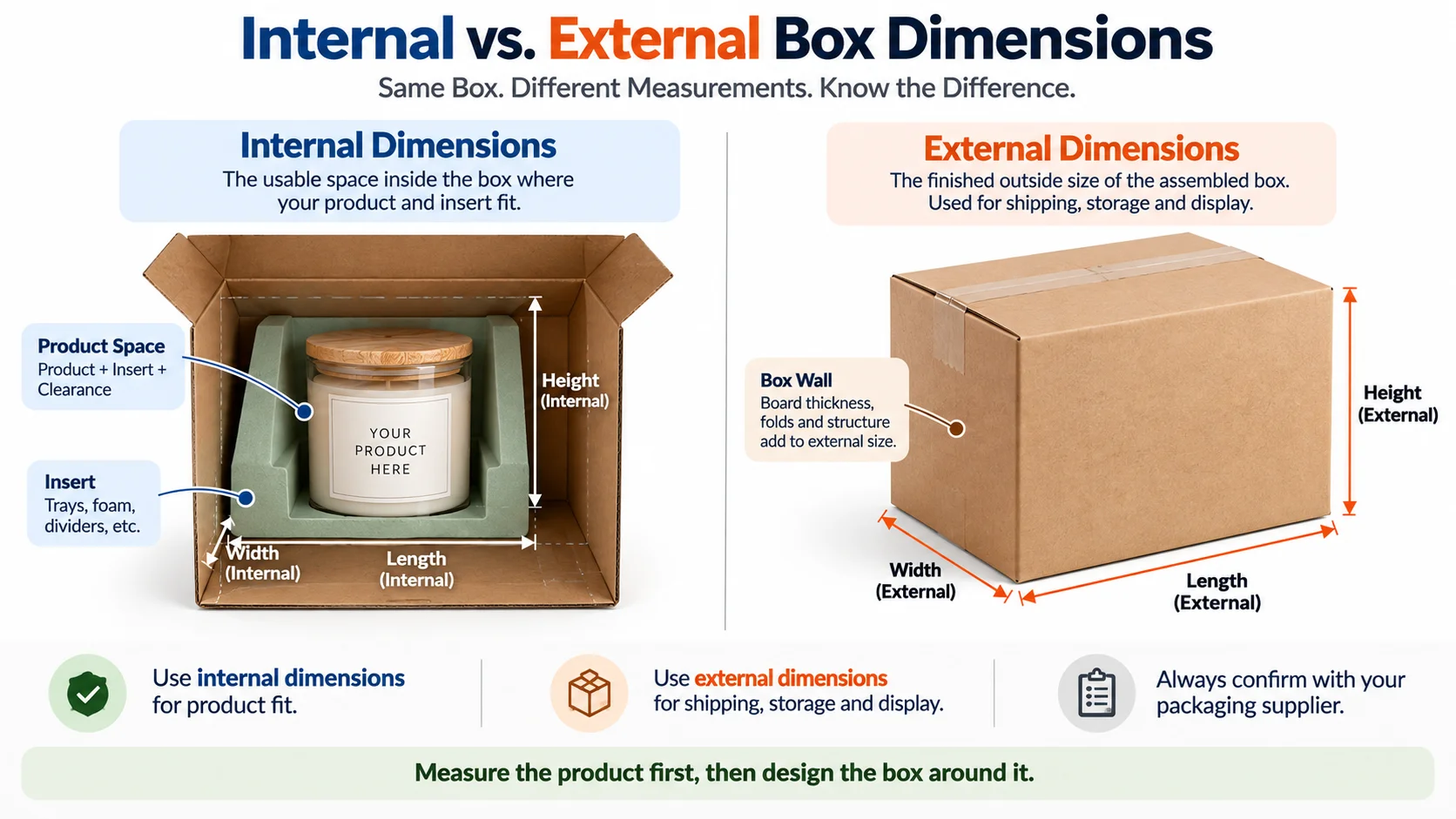
Internal vs. External Box Dimensions: Which One Should You Use?
Use internal dimensions to describe the space the product or insert must fit inside. Use external dimensions to describe the finished outside package when the outer footprint matters. The two are not interchangeable because board thickness, folds, walls, lids, and construction features occupy space.
| Requirement | Primary Dimension to Use | Reason |
|---|---|---|
| Product fit | Internal | The product must fit inside the usable cavity. |
| Insert fit | Internal | The assembled insert must fit within the box structure. |
| Shipping footprint | External | The finished parcel occupies the external footprint. |
| Storage / shelf planning | External | The package consumes outside space. |
| Master-carton planning | External | The finished package must fit inside the outer carton. |
| Retail presentation | Both | Internal fit protects the product; external size affects display. |
A clear quote request might say: “Please quote a box with internal dimensions of 8 × 6 × 2 inches, product upright.” If the external footprint is important, ask the packaging supplier to confirm it after the material and structure are selected.
How Much Clearance Should You Leave Around a Product?
Clearance is the intentional space between the product or packing system and the box interior. The required amount depends on the product, box construction, insert, protective material, packing process, manufacturing tolerance, and whether the package is designed mainly for presentation, fulfillment, or direct shipping.
Competitor guides commonly suggest small allowances for snug retail packaging and larger allowances when cushioning or void fill is required. Those figures should be treated as starting references rather than universal specifications. The correct allowance should be confirmed for the actual packaging system.
| Packaging Situation | Better Sizing Approach |
|---|---|
| Snug retail carton | Use controlled clearance that allows normal packing and removal without forcing the product. |
| Fragile shipped product | Size around the actual cushioning or insert system rather than relying on empty space alone. |
| Fitted insert | Measure the assembled insert and product arrangement, then confirm closure clearance. |
| E-commerce mailer | Include the real protective material and avoid unnecessary void volume. |
| Multi-product package | Measure the full arrangement, including dividers and compartment walls. |
A Practical Formula for Custom Box Dimensions
Preliminary internal dimension = product dimension + insert/protection space + required clearance
If clearance is entered as a per-side amount, it is added twice on that axis. If a protective layer or insert occupies a known total amount on an axis, include that amount in the calculation. The exact geometry changes when an insert creates a separate product cavity, when tabs hold the product in place, or when the structure is tapered or irregular.
Example: if a product is 6.00 inches long, the design uses 0.125 inches of clearance on each end, and the packaging system adds 0.25 inches of total space along that axis, the preliminary internal length is 6.00 + 0.25 + 0.25 = 6.50 inches. This is a planning calculation, not a final dieline specification.
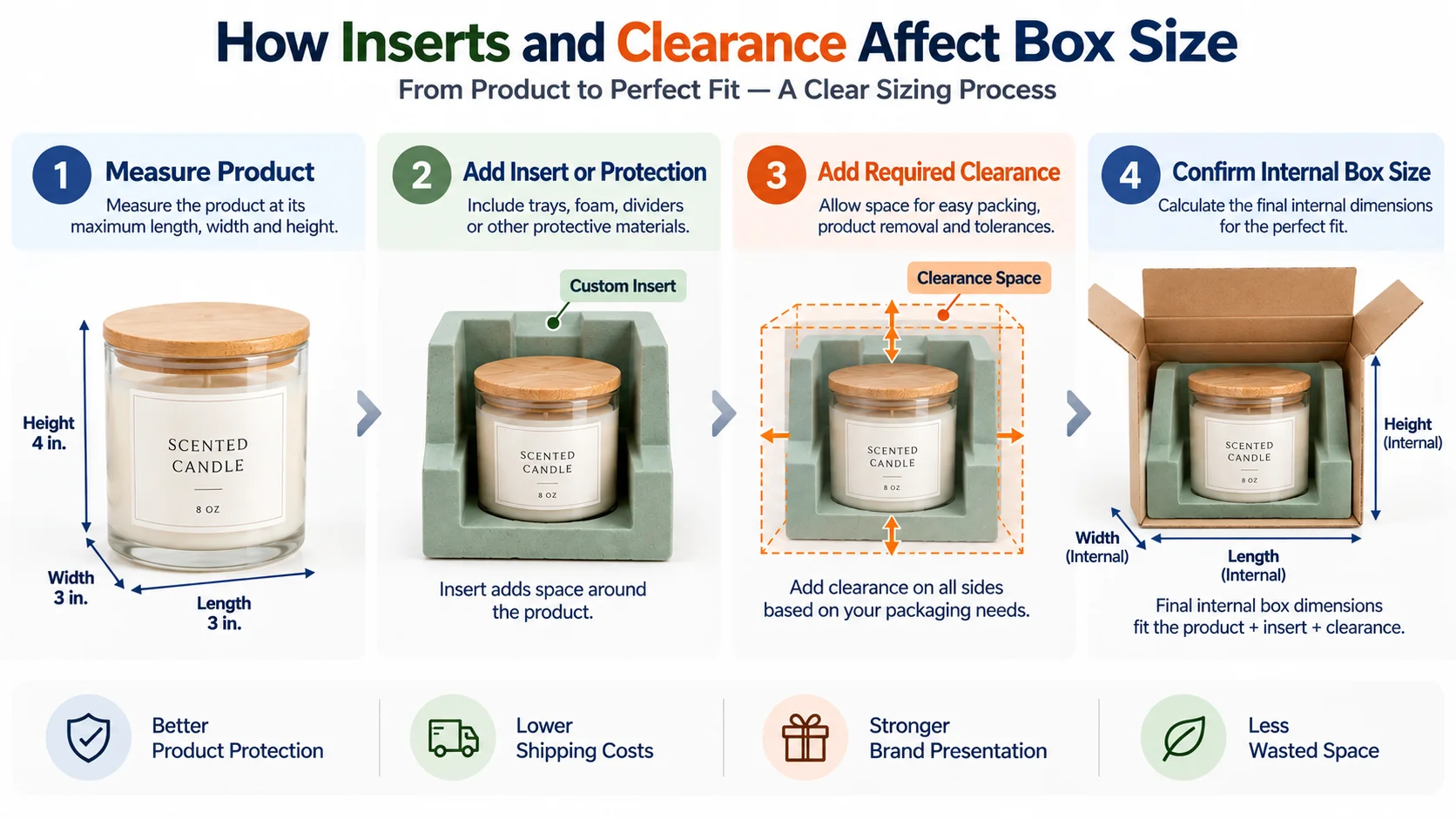
How Packaging Inserts Affect Box Size
An insert can define the product cavity more precisely than the outer box itself. Instead of measuring an empty box and hoping the insert fits, measure the assembled product-and-insert system.
- Paperboard trays can create fixed pockets or compartments.
- Foam may occupy space around several sides of the product.
- Dividers change the available width and length of each compartment.
- Finger notches and removal gaps may require additional usable space.
- A lid or closure must clear the product and insert without pressing on either one.
For a gift set or multi-product package, record the unit count, row/column arrangement, divider thickness, and overall height. That creates a repeatable packaging specification instead of a rough estimate.
When an insert is central to the presentation, BoxNovo’s gift packaging options are a relevant place to explore how the finished package can be structured around the products inside.
How Product Shape Changes the Measurement
Rectangular Products
Measure the maximum length, width, and height in the intended packing orientation.
Cylindrical Products
Record the maximum diameter or width and the full height, including the closure or cap.
Irregular Products
Measure the maximum envelope the package must contain. If three numbers do not describe the shape well, provide a labeled drawing, product photo, CAD file, or physical sample.
Flexible Products
Measure the item in its intended packed condition. Folding, rolling, compression, or an insert can materially change the required package dimensions.
How to Choose Between a Standard and Custom Box Size
There is no universal “standard box size” for all products. A common stock or shared size can work when the product fits safely and the packaging presentation is acceptable. Custom dimensions become more useful when the product is unusual, the fit needs to be controlled, an insert defines the cavity, or a stock size creates unnecessary empty space.
| Factor | A Shared/Common Size May Work When… | Custom Sizing Is More Useful When… |
|---|---|---|
| Product fit | The product fits without forcing or excessive movement. | The product needs a controlled or unusual cavity. |
| Insert | The insert already fits the chosen structure. | A tray, divider, foam, or multi-compartment insert defines the space. |
| Shipping | The package does not create unnecessary volume. | Reducing empty volume is important to fulfillment. |
| Presentation | The proportions suit the product. | The package needs a specific orientation or premium presentation. |
| SKU range | Several products can safely share one size. | A specific SKU requires its own dimensions. |
When the product needs a made-to-fit package rather than a generic stock format, made-to-fit product packaging can be considered as part of the sizing decision.
How Box Dimensions Affect Shipping Cost
Box size can affect shipping cost because some carriers use dimensional weight when a package occupies significant space relative to its actual weight. The exact rules depend on the carrier, service, destination, and current rate structure.
For example, UPS currently describes dimensional weight as package volume divided by a divisor, with the divisor varying by rate type; its current U.S. guidance lists 139 for Daily Rates and 166 for Retail Rates. FedEx’s current U.S. guidance uses a 139 divisor for the dimensional-weight calculation described on its packaging page. Because carrier rules can change, use the current carrier documentation for a shipment-specific calculation.
The practical packaging lesson is simple: do not make a shipping package larger than the product and protection system require. The finished external dimensions matter for shipping, while the internal dimensions determine whether the product fits.
For products that will travel as their own shipping package, shipping-ready mailer packaging can be a useful format to consider after the product, protection, and external footprint have been measured.
Custom Box Size Examples
Example 1: Small Cosmetic Bottle
Suppose a bottle measures 1.5 × 1.5 × 4 inches. Confirm the widest point, the full cap or pump height, and whether an insert will hold the bottle in place. If an insert creates a fixed pocket, size the box around the assembled insert rather than simply adding a generic gap.
Example 2: Product With a Fitted Insert
Measure the insert’s outside footprint and height after the product is positioned. The box interior must accommodate the insert and allow the closure to operate without pressing on the product.
Example 3: E-Commerce Mailer
Measure the product together with the tissue, wrap, accessories, and protective material that will actually be used. Then check the finished external size because the mailer may travel as its own shipping package.
Example 4: Multi-Product Gift Set
Arrange all products exactly as they will appear in the finished set, including dividers or a tray. Measure the full arrangement rather than multiplying the dimensions of one product.
How Box Style Can Affect the Final Dimensions
The three-dimensional sizing concept remains useful across packaging styles, but construction changes how those dimensions are achieved. Folding cartons, mailer boxes, rigid setup boxes, sleeves, and die-cut structures can have different walls, folds, closures, and usable cavities.
- Folding cartons are shaped by panels, folds, closure flaps, and the product cavity.
- Mailer boxes must accommodate the product and protective packing while preserving the closure geometry.
- Rigid boxes have substantial structural walls and may require separate consideration of the base and lid relationship.
- Die-cut structures can include windows, handles, dividers, custom cavities, and other features that cannot be fully described by three numbers.
For retail applications where panel layout and closure geometry matter, straight-tuck retail box structures are one example of a format where the product cavity and folding construction need to be considered together.
If you are comparing different packaging constructions, BoxNovo’s packaging box styles page provides a broader way to explore structural formats.
For rigid construction, the relationship between the base, lid, walls, and usable cavity becomes especially important. BoxNovo also offers rigid packaging formats for readers evaluating that type of structure.
If the package is tapered, hinged, compartmentalized, or otherwise irregular, provide a drawing or sample with the product dimensions. L × W × H is the starting specification, not the complete structural drawing.
Why You Should Test a Sample Before Ordering Custom Boxes
A dimension can look correct on screen and still fail during real packing. A physical sample lets you test the product, insert, closure, removal process, and finished presentation together.
- Does the product enter without forcing it?
- Does it stay in the intended position?
- Does the insert remain secure?
- Does the lid or closure close without pressing on the product?
- Is there unnecessary movement?
- Can the product be removed without damaging it or the package?
- Does the packing process work at the expected fulfillment speed?
- Does the assembled package have the intended external footprint?
- If it ships directly, does the protection system match the intended handling conditions?
Common Custom Box Sizing Mistakes
- Giving external dimensions when the supplier needs internal product-fit dimensions.
- Mixing inches and millimeters in the same specification.
- Measuring a narrow section instead of the maximum relevant point.
- Forgetting a cap, pump, handle, topper, sleeve, or attached component.
- Applying a generic clearance number without considering the actual insert or protection system.
- Ignoring product orientation.
- Sizing a multi-product package from one unit instead of the complete arrangement.
- Forgetting lid and closure clearance.
- Making the box substantially larger than necessary without a packaging reason.
- Approving production without a sample-fit test when fit is critical.
What to Send a Packaging Supplier With Your Dimensions
A useful quote request removes guesswork. Give the supplier enough information to understand both the product and the intended packaging system.
| Specification | What to Provide |
|---|---|
| Product dimensions | Maximum length × width × height. |
| Measurement basis | Internal box requirement or external finished size. |
| Unit | Inches or millimeters; use one unit consistently. |
| Orientation | What is up, what is the base, and how the product sits. |
| Packing arrangement | Single unit, stacked, nested, multi-pack, or compartments. |
| Insert/protection | Tray, foam, divider, tissue, sleeve, wrap, void fill, or other layer. |
| Closure | Tuck flap, mailer closure, lid/base, sleeve, or other structure. |
| Use case | Retail, e-commerce, gifting, shipping, display, or mixed use. |
| Quantity | Expected quantity and whether several SKUs will share the structure. |
| Sample | Whether a physical fit sample is required before production. |
Custom Box Measurement Checklist
- ☐ Product length recorded
- ☐ Product width recorded
- ☐ Product height recorded
- ☐ Maximum points checked
- ☐ Product orientation defined
- ☐ Attached components included
- ☐ Insert/protection measured
- ☐ Clearance requirement considered
- ☐ Internal dimensions identified
- ☐ External dimensions checked if needed
- ☐ Unit stated
- ☐ Closure and lid clearance checked
- ☐ Shipping/storage footprint considered
- ☐ Sample-fit test planned
- ☐ Final dimensions approved before production
Frequently Asked Questions About Custom Box Sizes
How Do I Measure a Product for a Custom Box?
Measure the product at its maximum relevant length, width, and height in the position in which it will be packed. Include attached components and then account for inserts, protection, and the clearance required by the actual packaging system.
What Do L × W × H Mean for a Box?
They mean length, width, and height in the stated orientation. Because naming conventions can vary, confirm the reference face and state whether the dimensions are internal or external.
Are Box Dimensions Measured Inside or Outside?
They can be specified either way. Use internal dimensions when describing the space required for the product or insert, and external dimensions when the finished package footprint matters for shipping, storage, display, or master-carton planning.
What Is a Standard Box Size?
There is no single standard size for all products. Common stock sizes can be useful when they fit the product and packing method, but custom dimensions are appropriate when the product, insert, protection, or presentation requires a different cavity.
How Much Extra Space Should I Leave Around My Product?
There is no universal allowance. The correct clearance depends on the product, box structure, insert, protective material, packing process, and manufacturing tolerance. A supplier should confirm the final fit for the selected construction.
How Do I Size a Box for Multiple Products?
Arrange all products exactly as they will be packed, including dividers or trays, then measure the complete length, width, and height of the arrangement. Do not multiply one product’s dimensions by the unit count.
Can Box Dimensions Affect Shipping Cost?
Yes. Carriers may use dimensional weight when a package takes up substantial space relative to its actual weight. The applicable formula and divisor vary by carrier and service, so use current carrier guidance for the shipment being planned.
Do Box Dimensions Translate Directly to Pixels?
No. Physical box dimensions are measured in inches or millimeters. Artwork pixel dimensions depend on the final print size and the printer’s required resolution. Use the supplier’s dieline and artwork specifications rather than converting the physical box size to pixels by itself.
What Printing Specifications Should I Confirm for Custom Boxes?
Confirm the supplier’s dieline, bleed, safe area, color mode, file format, and required artwork resolution before preparing final artwork. These requirements vary by printer, material, printing process, and structure, so do not treat one competitor’s print specification as a universal standard.
Material selection can also affect the final packaging approach. For a broader overview of packaging substrates and material categories, see BoxNovo’s packaging material types guide.
Should I Order a Sample Before Ordering Custom Boxes?
A physical sample is worth considering when product fit, inserts, closure, protection, or presentation is important. Test the real product in the real packing arrangement before approving a production run.
A Practical Next Step for Custom Packaging
Once you have the product dimensions, orientation, insert or protection requirements, target internal size, and intended use, you have a useful starting specification for a custom packaging quote. BoxNovo can use those details to help determine an appropriate custom box format instead of forcing the product into an unsuitable stock size.
Ready to discuss your box size? Send BoxNovo your product dimensions, quantity, preferred box style, material requirements, artwork status, and any insert or special-structure needs through the custom packaging quote process.
The goal is a package that fits the product, supports the way it will be packed and handled, and presents the brand cleanly without unnecessary empty volume.