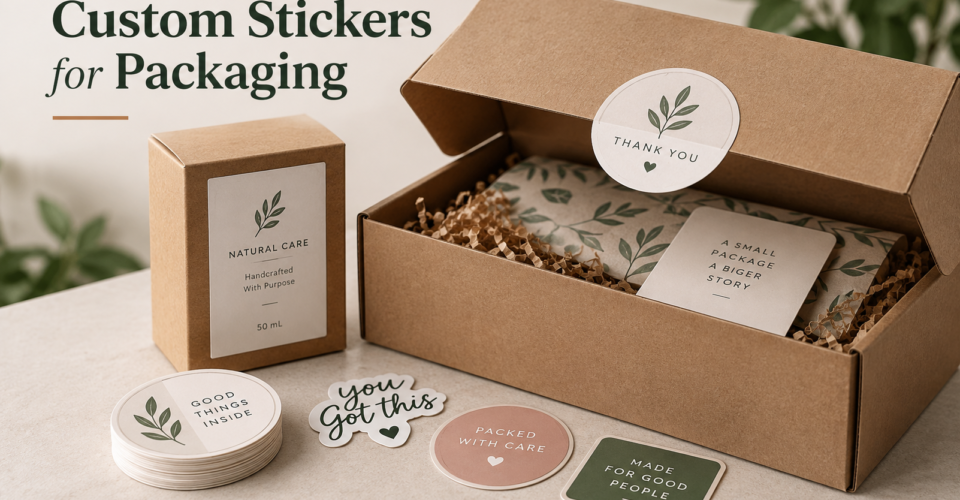
A custom sticker can do much more than put a logo on a package. The right sticker can seal a mailer, identify a product, add branding to a plain box, close tissue paper, carry a QR code, or give a customer a small piece of your brand to keep.
The important part is choosing the specification for the job. A sticker used as a dry cardboard box seal does not have the same requirements as a product label on a bottle that encounters moisture or oil. Shape, size, material, adhesive, finish and application method all affect the result.
This guide explains how to choose a custom sticker for real packaging applications, including circle stickers, die-cut and kiss-cut formats, paper, vinyl, BOPP and clear materials, size decisions, adhesive selection, artwork preparation, e-commerce packaging, sticker formats, cost drivers, removal and the point at which stickers should give way to fully printed boxes.
What Is a Custom Sticker?
A custom sticker is a printed adhesive-backed piece made to a specific design, shape, size, material and application. In packaging, the same basic product can serve very different roles: a logo seal on a mailer, a product label on a jar, a thank-you sticker inside a shipment, or a QR code that connects the physical package to a digital page.
Custom Sticker vs. Label: What Is the Difference?
In everyday use, the terms overlap. “Sticker” often emphasizes branding, decoration or promotion, while “label” usually suggests identification or product information. A product label may need space for ingredients, net weight, directions, SKU information or other required content; a brand sticker may only need a logo or short message.
The practical distinction is the job. If the adhesive piece must carry important product information, design around readability and the actual content required. If its main purpose is branding or sealing, design around visual impact, placement and the surface it must adhere to.
Where Custom Stickers Fit in a Packaging System
Think of the package as a system rather than a single printed surface. A sticker can work with a box, mailer, insert, tissue layer or product container. It can also bridge the gap between stock packaging and fully custom packaging when you want branding without changing the entire box structure.
| Packaging job | Typical placement | Key decision | Common formats |
|---|---|---|---|
| Brand seal | Box flap, mailer closure, tissue | Clean adhesion + intentional break | Circle, rectangle, die-cut |
| Product label | Jar, bottle, pouch, tin | Surface + moisture/oil exposure | Rectangle, oval, custom |
| Plain-packaging upgrade | Outer box or mailer | Brand visibility + box surface | Circle, rectangle, die-cut |
| Insert / thank-you | Card, tissue, inside box | Easy handling + brand message | Circle, square, sheet |
| Promotional giveaway | Inside package | Durability + design appeal | Die-cut, sheet |
| QR / operational | Product, box, insert | Legibility + scanability | Rectangle, circle, roll |
The Custom Sticker Decision System
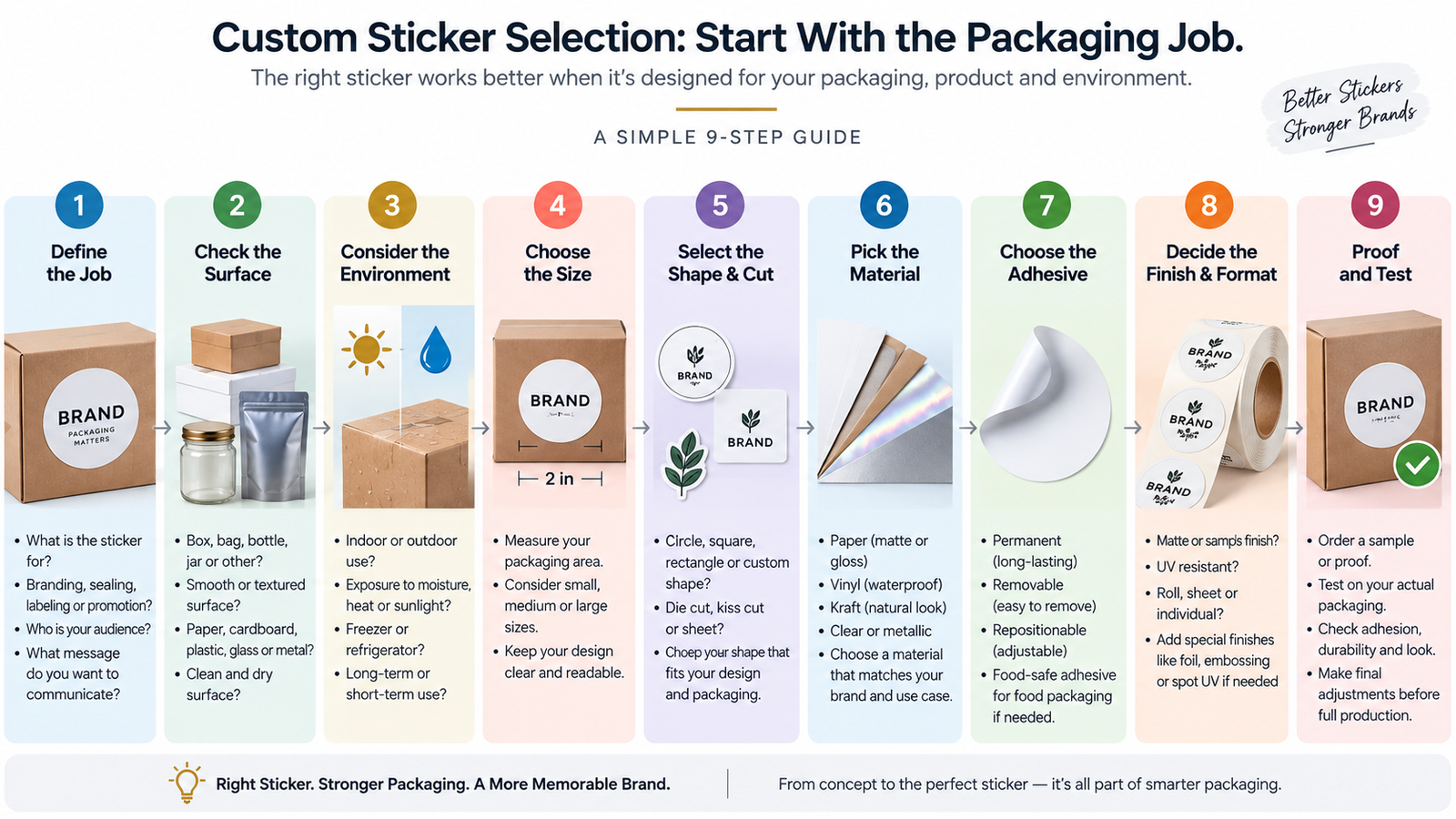
Use this sequence before ordering:
- Define the job: seal, label, brand, insert, promotion, identification or QR.
- Identify the surface: paperboard, corrugated board, coated box, glass, plastic, pouch, metal or tissue.
- Identify the environment: dry, humid, wet, oily, refrigerated, outdoor, or normal room conditions.
- Measure the application area: available width/height or circle diameter, while avoiding folds, seams and edges.
- Choose the shape and cut: standard circle/rectangle, die-cut or kiss-cut.
- Choose material and adhesive based on the surface and required life.
- Choose the finish and format: matte/gloss/specialty; individual, sheet or roll.
- Proof the artwork and, for important applications, test the actual sticker on the actual packaging.
This process is more reliable than starting with “vinyl or paper?” because material choice is downstream of the application. The same logo may need different constructions when it moves from a dry carton to a wet product container.
Circle Sticker Catalog: Sizes, Uses & Design Tips
Circle stickers deserve their own place in a packaging guide because the shape works across many touchpoints without making the design feel overly complicated. A circle can act as a seal, logo badge, tissue closure, lid accent or small product-label element.
Why Circle Stickers Work Well for Packaging
A circle naturally centers a logo and gives the viewer a defined visual boundary. It is especially useful where the sticker crosses a flap or closes a folded material because the eye can immediately read it as a seal. If the application is primarily a round product label, round label formats are another practical reference point when comparing the sticker concept with a dedicated label solution.
Choosing a Circle Diameter
Do not choose a diameter from a generic chart alone. Measure the actual area available. For a box seal, check the flap width and the distance to folds or edges. For a bottle or jar lid, check the flat area and curvature. For a logo-only sticker, make sure the smallest important text or logo detail remains legible at the finished size.
| Circle size concept | Good starting use | Check before ordering |
|---|---|---|
| Small circle | Small logo, tissue seal, thank-you accent | Logo legibility and application area |
| Medium circle | Mailer flap, box seal, jar/lid accent | Flap width, seams and curvature |
| Large circle | Promotional graphic, large seal, feature badge | Visual balance and surface area |
These are use categories rather than universal diameter rules. The correct size depends on the package and artwork.
Circle vs. Die-Cut vs. Kiss-Cut
Choose a standard circle when the shape itself is enough. Choose die-cut when the silhouette is part of the branding. Choose kiss-cut when you want a custom-shaped sticker that remains on an easy-to-handle backing sheet.
For example, a simple round logo seal on a mailer may not benefit from a complex cut. A mascot sticker intended as a customer giveaway may. A sheet containing several brand icons is naturally suited to kiss-cutting.
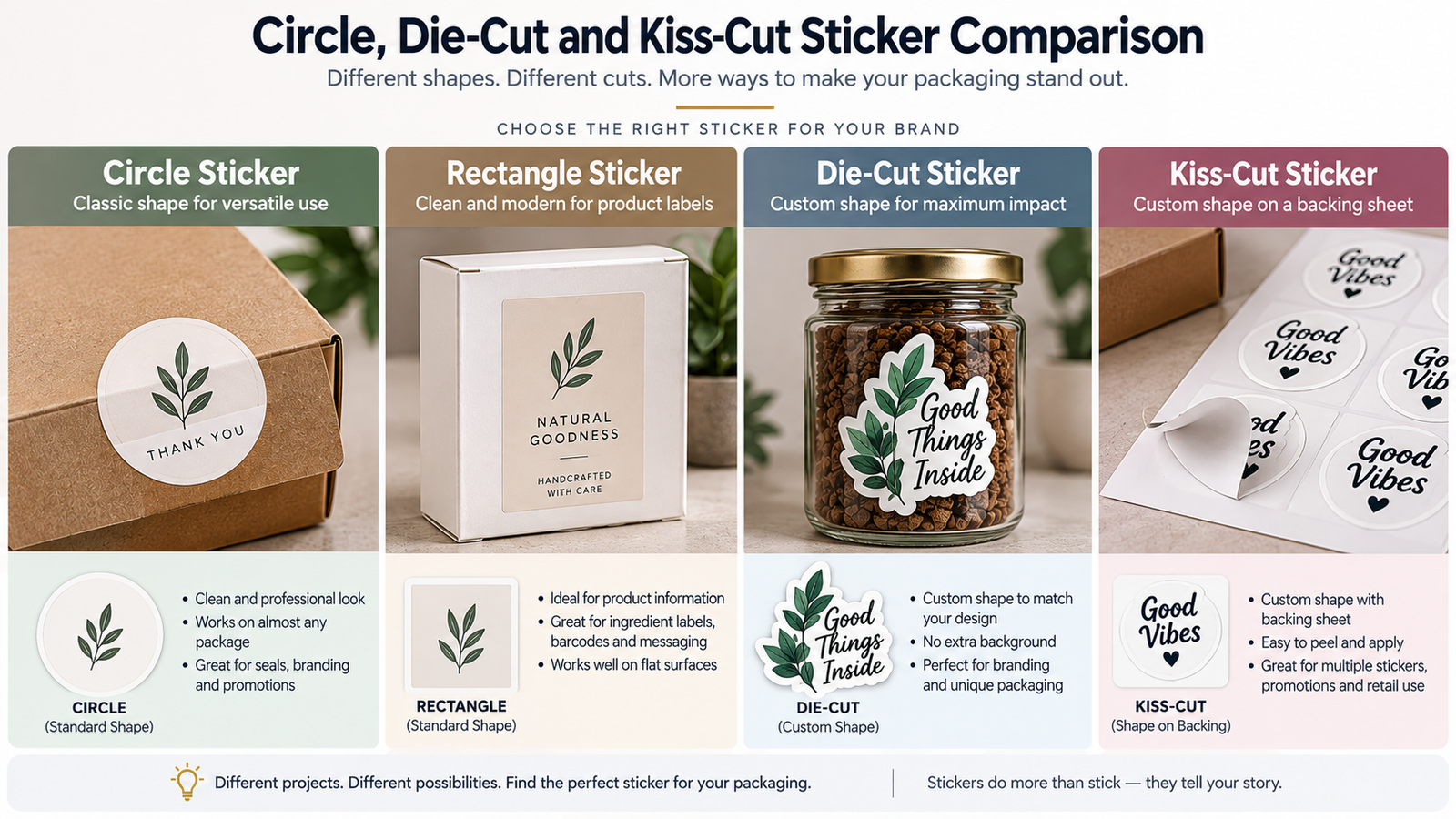
Die-Cut vs. Kiss-Cut vs. Standard Shapes
What Is a Die-Cut Sticker?
A die-cut sticker is cut through the sticker material and backing to the final shape. The finished piece follows the contour of the artwork instead of remaining inside a rectangular liner. It is useful when the sticker itself is meant to look like a designed object.
What Is a Kiss-Cut Sticker?
A kiss-cut sticker is cut through the sticker layer while the backing remains intact. The result is easy to handle and peel from the liner. Kiss-cut is especially useful for sticker sheets, sets and irregular designs that need a stable backing.
When Should You Use Standard Circle or Rectangle Stickers?
Use a standard shape when it gives you the look and application you need. Standard shapes can simplify production and keep the design focused. A circle or rectangle is not automatically less premium; poor sizing and cluttered artwork are usually bigger problems than the shape itself.
A white rectangle sticker can be particularly useful when a package needs a clean field for product information, a barcode or a QR code. A circle can be better when the visual job is a centered logo or seal.
Which Cutting Method Works Best for Packaging?
For a box seal, choose based on how you want the seal to look and how it will be applied. For a product label, choose the shape that fits the container and information hierarchy. For promotional sticker packs, die-cut or kiss-cut formats can make the sticker itself part of the experience.
Sticker Formats: Individual, Sheets & Rolls
Sticker format determines how the finished pieces are stored, handled and applied. It is separate from the material and cut shape, so a circle sticker, rectangle or die-cut design can often be supplied in more than one format.
Individual stickers are useful when each piece is peeled and applied one at a time or included as a standalone promotional item. They are straightforward for packaging seals and customer-facing giveaways.
Sticker sheets keep multiple designs on a shared backing. They are useful for brand kits, inserts, seasonal sticker sets and small operations that want several designs in one organized format. Kiss-cutting is commonly used because each sticker can be peeled from the sheet without separating the entire backing.
Roll labels place repeated stickers on a continuous liner. They can be practical for high-volume hand application and for packaging workflows that use a compatible dispenser or automated labeling equipment. Roll direction, core size and winding can matter for equipment, so those requirements should be confirmed before ordering.
The key question is not which format sounds most professional. It is how the stickers will be stored, picked, peeled and applied. A format that saves labor can be more valuable than a small difference in unit price.
| Format | Best fit | Main consideration |
|---|---|---|
| Individual | Seals, standalone promotional stickers, giveaways | Easy one-at-a-time application |
| Sheet | Brand kits, inserts, multiple designs, hand application | Organized handling; multiple stickers share a backing |
| Roll | Repeated application, higher-volume workflows, dispensers | Confirm roll direction, core and equipment requirements |
Custom Sticker Materials: Paper, Vinyl, BOPP & More
Paper Stickers
Paper is often a sensible choice for dry packaging, box seals, tissue seals and indoor brand applications. It can give kraft and uncoated packaging a natural appearance. Its limitation is exposure to water, oil and other conditions that can weaken the substrate or adhesive.
BOPP Stickers
BOPP is a polypropylene film commonly used for product labels where moisture, oil or handling is a concern. White BOPP provides an opaque printable surface; clear BOPP can create a no-label look on suitable containers. Always match the adhesive and finish to the actual application.
Vinyl Stickers
Vinyl is a durable synthetic option used for applications that need greater resistance to handling, moisture or outdoor exposure. It can also be used for packaging, but its durability should be treated as an application requirement rather than a reason to choose vinyl automatically.
Clear / Transparent Stickers
Clear film lets the underlying surface show through. It can work especially well on glass or transparent packaging where a solid white label would hide the product. Design needs extra attention because the substrate underneath becomes part of the visual result.
Kraft, Metallic & Holographic Options
Kraft and uncoated materials can support natural or handmade brand aesthetics. Metallic and holographic finishes create a stronger visual effect and are better treated as specialty design choices. The artwork should be simple enough for the finish to enhance rather than overwhelm it.
How to Choose the Right Sticker Material for Your Packaging
The material/surface relationship is more useful than declaring one substrate “best.” The exact coating, roughness, surface energy, temperature, contamination and expected handling can change adhesion. For broader packaging material context, see the packaging material guide.
| Surface / environment | Material direction | Why | Test |
|---|---|---|---|
| Dry paperboard / carton | Paper or suitable film | Dry, simple branding and seals | Adhesion to the exact box finish |
| Corrugated shipping box | Paper or film depending on handling | Balance appearance and durability | Roughness, dust and transit handling |
| Glass bottle / jar | BOPP or clear film | Good fit for smooth curved surfaces | Curvature and adhesive |
| Plastic / pouch | BOPP or vinyl depending on substrate | Synthetic surface may need compatible adhesive | Actual plastic and surface treatment |
| Moisture / oil exposure | Synthetic film generally preferred | Paper may soften or lift | Water/oil exposure and dwell time |
| Tissue / delicate paper | Light-duty paper/removable option where appropriate | Reduce fiber pull and tearing risk | Removal and fiber pull |
This table is a decision aid, not a universal material specification. A real-surface test is the safest final check.
How to Choose the Right Sticker Size
Measure the Actual Application Area
Measure the flat, usable area rather than the overall package dimension. A sticker that fits the box face can still fail if it crosses a fold, seam, opening edge or strong curve.
Leave Room Around Folds, Seams, Curves & Edges
Keep critical artwork away from cuts and folds. On curved containers, remember that a label can wrinkle or lift when it is forced around a diameter it was not designed for.
Small Sticker vs. Large Sticker
A smaller sticker is not automatically cheaper or better. It may reduce coverage but make the logo or required information too small. A larger sticker can create stronger visual impact but may overwhelm the package or create more application difficulty.
When the Sticker Contains Text, Barcode or QR Code
Information-heavy stickers need enough physical space for the content to remain readable and scannable. Keep adequate contrast and clear margins around machine-readable elements. The final size should be validated at actual print size, not only on a design monitor.
For artwork that will be rasterized, the useful question is not simply “how many pixels?” but “how many pixels at the final printed size?” A 300-DPI workflow is common for raster artwork, but the printer’s current template and production requirements should control the final file setup.
Sticker Adhesive: Permanent vs. Removable
Permanent Adhesive
Permanent adhesive is commonly used where the sticker is intended to stay attached for the life of the packaging or product. The correct permanent adhesive still depends on the substrate and conditions.
Removable Adhesive
Removable adhesive can be appropriate when the recipient is expected to remove the sticker cleanly or when the packaging surface should remain presentable after removal. It should not be assumed to work on every surface without testing.
Why Adhesion Testing Matters
The same sticker can behave differently on uncoated paperboard, gloss-coated board, soft-touch surfaces, glass and plastic. Test the actual material, not a similar-looking sample, and check the result after the intended dwell time and handling conditions.
How Do I Remove a Sticker Without Damaging the Package?
Removing a sticker is different from applying one because the goal is to separate the adhesive without damaging the package surface. Start gently and test an inconspicuous area first.
On delicate paperboard, tissue or uncoated packaging, aggressive pulling can lift fibers, tear the surface or remove part of the printed coating. A removable adhesive may reduce that risk, but “removable” should still be treated as application-specific rather than a guarantee for every substrate.
On stronger surfaces, work slowly and keep the peel angle controlled instead of jerking the sticker away. Avoid solvents or heat unless the packaging material and its printed finish are known to tolerate them. A method that works on glass can damage coated paperboard.
If the sticker is intended to be removed by the customer, choose the adhesive and package surface with that end use in mind from the beginning. Removal should be considered during specification, not after the package has already been produced.
Sticker Finishes: Matte, Gloss, Kraft, Foil & Specialty Effects
| Finish | Visual character | Useful when |
|---|---|---|
| Matte | Soft, low-glare, restrained | Premium, beauty, wellness, natural or low-glare packaging |
| Gloss | Bright, reflective, saturated | Bold graphics, retail visibility, colorful packaging |
| Kraft / uncoated | Natural, tactile, writable | Artisan, handmade, natural-positioned packaging |
| Foil / metallic | Reflective, premium | Gift, luxury, special editions and seals |
| Holographic | Light-shifting, high visual impact | Promotional or attention-led applications |
How to Design a Custom Sticker for Packaging
Start With the Job, Not the Artwork
A logo sticker, product label and promotional giveaway have different priorities. Decide what the sticker must accomplish before choosing fonts, colors or decorative effects.
Logo and Brand Hierarchy
For a box seal, the logo may be the main element. For a product label, the product name and required information may need to lead. For a QR sticker, the code and its surrounding quiet space must remain functional.
Typography and Readability
Avoid packing a small sticker with information that only works on a desktop screen. Print the design at final size and inspect it under realistic viewing conditions.
Bleed, Safe Area & Cut Line
Use the printer’s template whenever one is supplied. Artwork that reaches the cut edge generally needs bleed; critical text and logos should remain inside a safe area. A separate cut path is needed for many custom die-cut workflows.
QR Codes and Barcodes
Machine-readable graphics need adequate contrast, clear surrounding space and sufficient physical size. Do not place them over busy patterns or reflective effects without testing the finished result.
Test the Artwork at Actual Size
A design that looks excellent at 200% zoom can become unreadable when printed at two inches. The final proof should be judged at the intended physical size.
How to Turn a Logo Into a Sticker
Turning a logo into a sticker starts with the artwork, but the logo file is only one part of the decision. First decide whether the logo will be printed inside a standard circle or rectangle or whether the sticker itself should follow the logo silhouette.
For a simple brand seal, a centered logo inside a circle can be easier to reproduce and apply consistently. For a mascot, icon or distinctive silhouette, a die-cut outline can make the sticker feel like a deliberate brand asset. If the sticker will be distributed on a sheet, a kiss-cut layout can make handling easier.
Before sending the logo to a sticker printer, check the artwork at the finished physical size. Fine strokes, tiny text and narrow gaps that look clear on a large monitor can disappear after reduction. Keep the original vector artwork when possible and use the printer’s current template for bleed and cut-line requirements.
If the package is dark, such as a black mailer, contrast becomes especially important. A light logo, a white printable field, or a carefully designed transparent treatment can produce very different results. Do not assume a clear sticker will look identical on every dark surface; the underlying package becomes part of the visual design.
The goal is not simply to put a logo on adhesive material. The goal is to create a finished sticker that remains recognizable, legible and easy to apply at its actual size.
How Custom Stickers Are Printed and Ordered
A typical custom sticker workflow moves through artwork, specification, proofing, production and application. The exact workflow varies by supplier, but the buyer should expect the specification to be confirmed before production.
- Define the application. State whether the sticker is a box seal, product label, insert, promotional piece, QR label or another use.
- Confirm the substrate. Identify the actual packaging surface and any coating, texture, curvature or environmental exposure.
- Choose size and shape. Measure the usable application area rather than relying only on the package’s overall dimensions.
- Choose material, adhesive, finish and format. These decisions should work together rather than being selected independently.
- Prepare the artwork. Confirm file format, color requirements, bleed, safe area and cut path using the supplier’s current instructions.
- Review the proof. Check physical size, logo placement, text, color appearance, cut shape and any functional code.
- Test important applications. Apply a sample to the actual packaging and evaluate adhesion, appearance and handling before committing to a large run.
- Plan the reorder. Keep the approved artwork, final specification and quantity history so repeat orders remain consistent.
This workflow is also where a sticker printer can add value beyond simply producing the artwork. A useful proof should make the final size and cut easier to judge before the full order is produced.
Custom Sticker Cost: What Actually Changes the Price
There is no single universal price for a custom sticker. The cost is shaped by the specification and production quantity. The main variables are sticker size, total quantity, material, finish, cut complexity, format and production method.
A small run can have a higher unit cost because setup and handling are spread across fewer pieces. Larger runs can reduce the effective cost per sticker, but only if the additional inventory makes sense for the brand. A seasonal campaign or frequently changing SKU may not benefit from buying the largest possible quantity.
Specialty finishes can also change the economics. If a holographic, foil or metallic effect is central to the packaging concept, compare the visual benefit against the additional production cost. For a simple box seal, a standard shape and straightforward material may deliver the intended result without adding complexity.
When requesting a quote, give the supplier the complete specification: finished size, shape or cut, material, finish, adhesive requirement, format, quantity and application surface. Comparing incomplete quotes can make one option appear cheaper simply because the specifications are different.
Custom Stickers for E-Commerce Packaging
Mailer Box Seals
A sticker can turn a plain shipment into a branded opening moment. If you already use branded mailer packaging, the sticker can be treated as one more brand touchpoint rather than the only branded element.
Shipping Box Branding
For shipping-heavy products, a sticker can add a controlled brand surface to transit-ready corrugated packaging while the box itself handles structure and transit protection.
Product Labels
When the sticker is identifying the product itself, the container becomes the primary surface. This is where material, adhesive and information density matter most. Made-to-fit product presentation boxes can then carry the broader product-presentation system when a sticker is only one component.
Thank-You and Insert Stickers
A small sticker on an insert, tissue fold or inside lid can create a second branded moment after the outer package is opened. It is also a natural place for a short thank-you message or customer-facing brand mark.
Subscription Box Packaging
Subscription and recurring-shipment brands can use stickers to create seasonal variations without redesigning the underlying box for every campaign.
On a dark package such as a black mailer, check contrast at the actual application size. A transparent sticker can behave very differently from a white or opaque sticker because the package color becomes part of the finished appearance.
Custom Stickers by Product and Packaging Type
Food & Beverage Packaging
Food packaging can involve moisture, oils, refrigeration and required product information. Choose the material, adhesive and finish around the actual package and handling environment, and verify any applicable labeling requirements for the product category. In food label creation, the information hierarchy is often more important than decorative effects; food-product labeling options can be useful when the label itself needs to carry the product information.
Cosmetic & Beauty Packaging
Cosmetic packaging often combines curved containers, moisture exposure and a premium visual requirement. Clear films, BOPP and suitable vinyl can be considered depending on the surface and design. For bottle-based products, container labels for bottles provide a relevant packaging route to consider alongside the sticker specification.
Candle Packaging
For candles, consider the container material, lid curvature, handling and any heat exposure relevant to the sticker’s placement. Do not treat a general “waterproof” label as proof of suitability for every candle application; dedicated candle labeling may be a better fit when the label itself is part of the product presentation.
Jewelry Packaging
Small jewelry boxes and pouches benefit from restrained branding. A small circle, foil-style or matte logo sticker can create a defined brand signature without filling the package with graphics.
Retail Packaging
Retail labels often need stronger information hierarchy because the customer may compare multiple products side by side. Make the product name, variant and essential information easy to find.
Small-Business & Handmade Packaging
Stickers can be especially useful when product lines change frequently or packaging volumes are still developing. They allow a business to standardize a box format while varying the branding or product information applied to it.
Common Packaging Scenarios
The most useful way to apply the decision system is to walk through real packaging scenarios.
For a kraft mailer used for e-commerce orders, a circle or rectangular seal can provide a simple branded closure. Measure the flap, keep the sticker clear of the fold, and select an adhesive that works with the mailer’s actual coating and paper surface. If the mailer already carries strong printed branding, the sticker can be reserved for a seasonal message or seal.
For a shipping carton, the sticker is usually one component of a larger transit system. A durable label may be appropriate where handling is heavy, while a simple brand seal may be sufficient on an interior flap. For corrugated packaging, test the actual board because roughness and dust can affect adhesion.
For a bottle or jar, curvature becomes a primary design constraint. A label that looks correctly sized on a flat proof may wrinkle or lift when wrapped around a smaller diameter. Smooth glass, coated glass and plastic can also have different adhesive requirements. If the product needs full-container graphics rather than a discrete label, compare the sticker approach with alternatives such as shrink sleeves.
For a water bottle or other frequently handled container, resistance to moisture is only one part of the decision. The material, ink, protective layer and adhesive all contribute to finished performance. Confirm the supplier’s complete construction rather than relying on the word “waterproof” alone. Labels designed for water bottles are another product-specific option to compare when the container itself is the main labeling surface.
For food packaging, separate the branding decision from the product-information requirement. Food label creation may involve required information that must remain readable and may be governed by rules specific to the product and market. The sticker’s available area should be planned around that information rather than adding it as an afterthought.
For a small jewelry or gift package, the sticker may be intentionally restrained. A small circle or matte logo seal can create a recognizable brand moment without competing with the box, ribbon or insert. If the package itself is a premium rigid structure, the sticker can be used as a secondary touchpoint instead of carrying the entire visual identity.
Custom Stickers vs. Fully Printed Packaging
| Question | Sticker-led approach | Fully printed box |
|---|---|---|
| Need to change branding often? | Flexible; update sticker artwork | Existing inventory may become outdated |
| Multiple SKUs share one box? | Differentiate with SKU/product stickers | May require more printed box versions |
| Need branding across the entire surface? | Limited to sticker area | Better for full-surface graphics |
| Small/early-stage runs? | Can work well with stock packaging | May require a more involved production plan |
| Premium unboxing structure? | Sticker adds a touchpoint | Box structure + print can be the primary experience |
When Stickers Make More Sense
Stickers are useful when flexibility, SKU variation, small packaging touchpoints or incremental branding matter. They can also complement stock packaging while a brand is refining its packaging system.
When Fully Custom Printed Boxes Make More Sense
A fully printed box becomes more appropriate when the packaging itself needs to communicate a complete visual system, when the brand wants artwork across multiple faces, or when the box structure and print are part of the product presentation.
Using Stickers With Custom Boxes
The two approaches are not mutually exclusive. A broader custom packaging system can use the box for the core brand system while a sticker adds a seasonal message, SKU variation, seal, QR experience or limited-edition detail.
For premium presentation, stickers can also be paired with custom gift presentation boxes or premium rigid packaging with inserts when the sticker is intended to be a secondary branded touchpoint rather than the main package design.
Common Custom Sticker Mistakes
- Choosing material before defining the application.
- Using one sticker specification for every packaging job.
- Making a sticker so small that important text or branding becomes unreadable.
- Ignoring folds, seams, curves and package openings.
- Assuming a sticker that adheres to cardboard will behave identically on coated board or plastic.
- Skipping an actual-surface adhesion test.
- Sending artwork without bleed, safe area or the required cut-line setup.
- Using reflective or transparent materials without checking how colors will reproduce.
- Choosing a specialty finish that competes with the logo instead of supporting it.
- Comparing sticker price without considering quantity, size, material, finish, cut and format.
Custom Sticker Buying Checklist
Before requesting a quote, write down the following specification so different options can be compared on the same basis.
| Decision | Write down before ordering |
|---|---|
| Purpose | Seal / label / brand / insert / promotional / QR / operational |
| Surface | Exact packaging material and finish |
| Environment | Dry / humid / wet / oily / refrigerated / outdoor |
| Size | Width × height or circle diameter |
| Shape | Circle / rectangle / oval / custom |
| Cut | Standard / die-cut / kiss-cut / sheet |
| Material | Paper / BOPP / vinyl / clear / specialty |
| Adhesive | Permanent / removable / supplier recommendation |
| Finish | Matte / gloss / uncoated / metallic / specialty |
| Format | Individual / sheet / roll |
| Artwork | Vector/raster, color mode, bleed, safe area, cut line |
| Proof | Digital proof and/or physical sample |
| Quantity | Initial run + expected reorder volume |
Frequently Asked Questions About Custom Stickers
What is a custom sticker?
A custom sticker is a printed adhesive-backed piece made to a specific design, size, shape, material and application. In packaging it can serve as a seal, label, branding element, insert or identification tool.
What is the difference between a sticker and a label?
The terms overlap. “Label” usually suggests product identification or functional information, while “sticker” often refers to branding, decoration or promotion. The job determines the specification.
What is a die-cut sticker?
A die-cut sticker is cut through the sticker and backing to the final custom shape, so the finished piece follows the design outline.
What is a kiss-cut sticker?
A kiss-cut sticker is cut through the sticker layer while the backing remains intact, making the sticker easy to peel from a liner or sheet.
Are circle stickers good for packaging?
Yes. Circles work well for box seals, tissue closures, lid accents and logo badges. The right diameter depends on the actual application area and artwork.
What size should a packaging sticker be?
Measure the usable application area and choose a size that avoids folds, seams and curves while keeping the logo or required information legible. There is no single universal packaging-sticker size.
What are common sticker sizes?
Common sizes vary by supplier and application. Instead of treating a size chart as a rule, start with the usable area of the package and the amount of information the sticker must carry.
What material is best for packaging stickers?
There is no universal best material. Paper can suit dry packaging; BOPP or suitable vinyl can be better for moisture or oil exposure; clear film can work when the underlying surface should remain visible.
Are vinyl stickers waterproof?
Many vinyl constructions are designed to resist water, but waterproof performance depends on the complete material, ink, protective layer and adhesive system. Confirm the supplier’s specification for the intended environment.
Can I put custom stickers on cardboard boxes?
Yes, but test the actual box surface. Uncoated, coated and corrugated surfaces can have different adhesion and handling characteristics.
Can custom stickers be used on mailer boxes?
Yes. They are commonly used as flap seals, logo badges, thank-you elements and seasonal branding. A mailer box’s board and finish should guide the material and adhesive choice.
Can stickers be used with custom printed boxes?
Yes. A sticker can add a seal, SKU variation, seasonal message, QR code or special-edition detail to an already printed package.
How do I remove a sticker without damaging the package?
Start gently and avoid pulling aggressively. The safest method depends on the surface and adhesive. On delicate paperboard or tissue, test a small area first because removal can lift fibers or surface coatings.
How much do custom stickers cost?
Cost depends on size, material, finish, cut type, quantity, format and production method. A supplier quote is more reliable than a generic per-sticker number.
Should I choose sheets, rolls or individual stickers?
Choose based on application. Rolls are useful for repeated or machine-assisted application, sheets can be convenient for hand application and multiple designs, and individual stickers work well for promotional or standalone use.
Can a custom sticker include a QR code or barcode?
Yes, provided the finished design gives the code enough physical size, contrast and clear surrounding space. Test the printed result rather than relying only on the screen proof.
Can I use a sticker on a water bottle?
A sticker can be used on a water bottle, but the material, adhesive, ink and protective layer should be selected for repeated handling and moisture exposure. Confirm the supplier’s durability specification for the intended surface; labels designed for water bottles are a relevant product-specific option to compare when the container itself is the main labeling surface.
Are fruit stickers the same as packaging stickers?
They are a useful example of the broader label category: a small adhesive label can identify a product without being a large branding surface. The exact material and adhesive should still match the product and handling environment.
Do I need a sticker or a shrink sleeve?
They serve different purposes. A sticker labels a defined area; a shrink sleeve can cover a much larger portion of a container. Choose based on the coverage, appearance, application process and product requirements.
How many pixels should a sticker design be?
Pixels depend on the final physical size and the required print resolution. Work from the printer’s current template and evaluate raster artwork at its final print size rather than choosing a pixel count in isolation.
Final Guide: Choosing the Right Custom Sticker
Start with the job. Then identify the surface and environment. After that, choose the size, shape, material, adhesive, finish and format. Finally, proof the artwork and test the actual sticker on the actual packaging when performance matters.
The strongest packaging sticker is not necessarily the thickest, most expensive or most specialized option. It is the one that performs its intended job cleanly and fits the larger packaging system.
If the sticker is only one part of a larger packaging project, explore a broader custom packaging system to evaluate how the box, print, inserts and branding can work together.
If you are still deciding between box styles or materials, the broader custom packaging planning guide can help connect the sticker decision to the broader packaging plan.
For a project that needs a custom packaging recommendation, request a custom packaging quote with your product dimensions, box type, sticker purpose and expected quantity.