A wine bottle box is more than an outer carton around a bottle. The right package has to fit the actual bottle, support the way it will be displayed or gifted, create enough internal structure for the chosen insert or divider, and give the brand a clean surface for presentation. For shipping-focused requirements, the outer protective system also has to be considered separately from a premium retail or gift box.
The most useful starting point is the bottle itself—not a generic box size. Wine bottles can have different heights, body widths, shoulder shapes, bases, closures, and proportions even when their stated volume is the same. That means a box that fits one bottle profile may not be appropriate for another.
If you are comparing custom options, BoxNovo’s product measurement and box sizing guide is a useful companion because it explains how internal and external dimensions affect product fit, inserts, storage, and shipping.
Quick answer: Choose a wine bottle box by first measuring the exact bottle and deciding whether the package is primarily for retail presentation, gifting, direct-to-consumer delivery, or a combination. Then choose the insert, structure, material, printing, and finishing around that use case.
Why Wine Bottle Packaging Should Start With the Bottle
A wine box should be developed around the bottle’s real dimensions and orientation. Record the bottle’s maximum relevant width, full height, base, neck and closure profile, and any feature that affects the cavity. If the package includes an insert, divider, tissue, card, or accessory, measure the complete arrangement rather than sizing the outer box first.
This matters because bottle shape changes the available space inside the package. A tall, narrow bottle and a wider-shouldered bottle can require different internal proportions even when their nominal volume is similar.
Avoid treating published “standard” wine box dimensions as universal. Planning references can be useful, but the final internal size should be confirmed against the actual bottle and packaging construction.
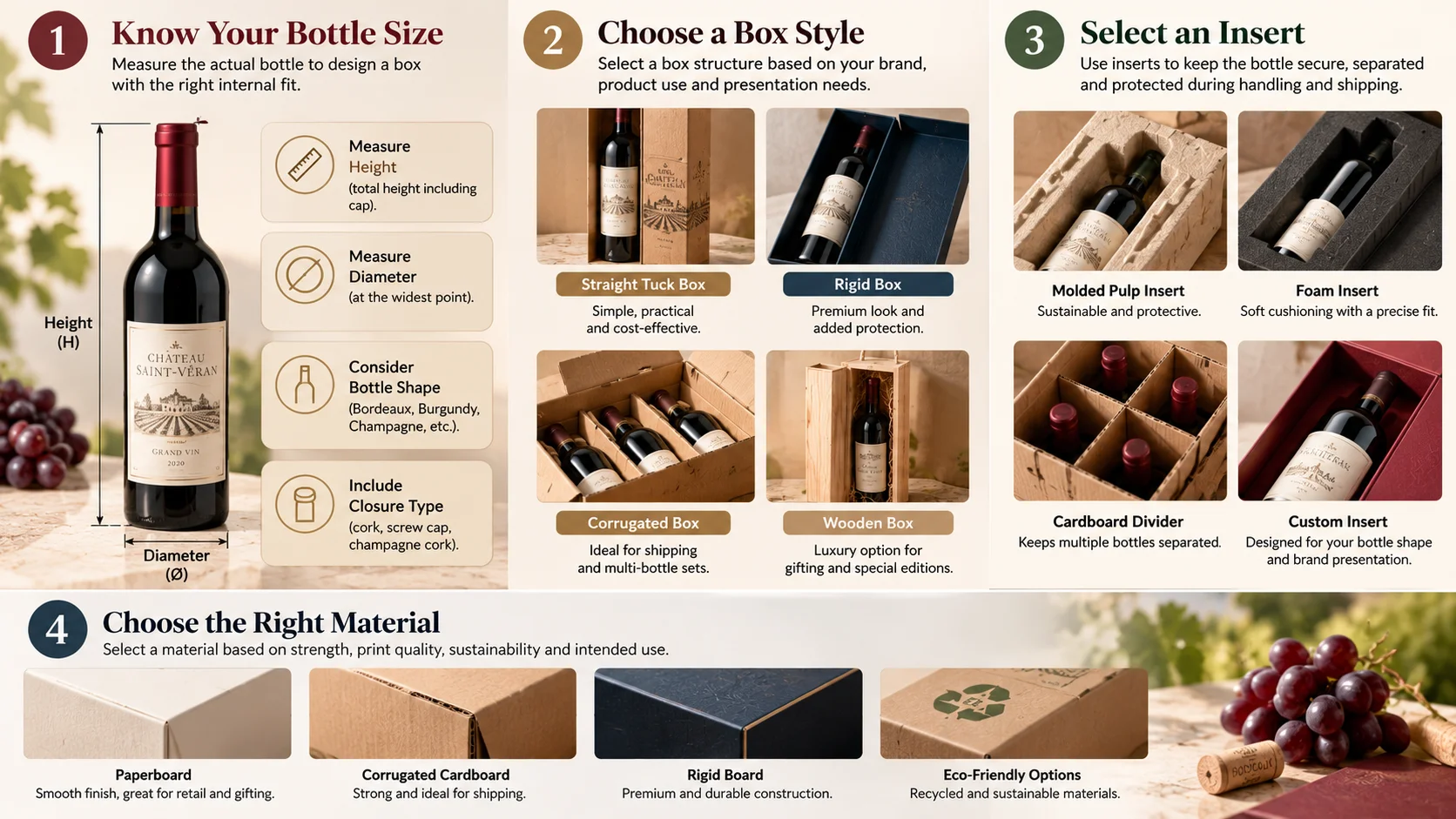
Wine Bottle Box Sizes: How to Choose the Right Dimensions
There is no single wine bottle box size that works for every bottle. The correct dimensions depend on the bottle profile, the number of bottles, the orientation, the insert or divider, and the intended presentation.
For a single-bottle package, start with the internal cavity. For a multi-bottle package, determine the complete bottle arrangement and then account for the walls, dividers, inserts, and closure structure. The finished external dimensions matter separately when shelf space, storage, shipping, or an outer carton is important.
A practical sizing brief should state:
- the bottle height and maximum body width or diameter;
- the bottle orientation inside the box;
- whether dimensions are internal or external;
- the number of bottles or accessories in the package;
- the insert, divider, tray, or other protective structure;
- the unit of measurement; and
- whether a physical sample will be required before production.
For a deeper explanation of product-fit measurements, see BoxNovo’s guide to choosing custom box dimensions. It specifically recommends measuring the product at its maximum relevant points and treating clearance as part of the packaging design rather than applying one universal allowance.
Common Wine Bottle Box Formats
The best wine bottle box style depends on what the customer needs to do with the package and what the package needs to communicate. A presentation box for a premium gift does not have the same priorities as a practical retail carton or a shipping-focused outer package.
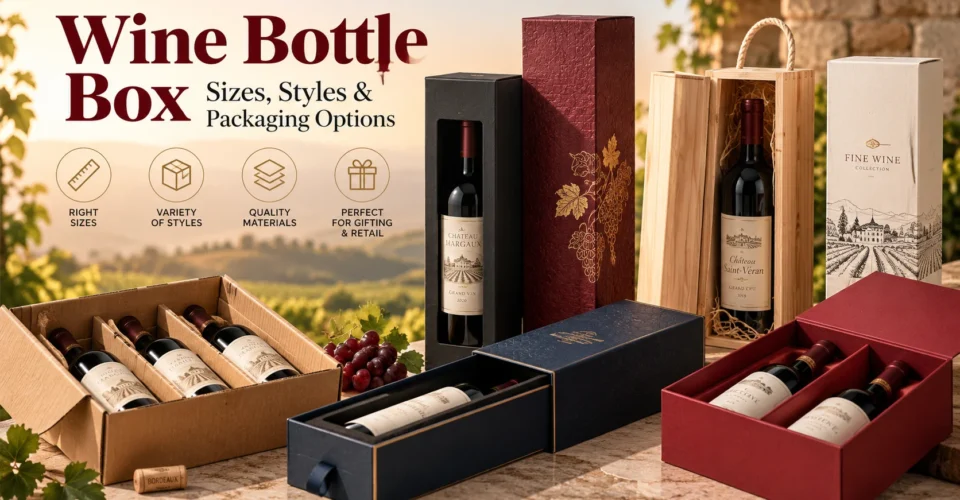
Common formats include single-bottle folding cartons, two- or multi-bottle gift boxes, rigid presentation boxes, sleeve-and-tray structures, drawer-style boxes, windowed cartons, and corrugated bottle packs with dividers. The same bottle can therefore be packaged in very different ways depending on the sales channel and brand position.
| Format | Best suited to | Key consideration |
|---|---|---|
| Single-bottle folding carton | Retail, tasting, gifting, branded product presentation | Efficient structure with a printable exterior |
| Rigid presentation box | Premium gifts, limited releases, luxury positioning | Higher-end presentation and a stronger structural feel |
| Sleeve and tray | Modern retail and gift presentation | Creates layered presentation while keeping the product accessible |
| Drawer-style box | Premium gifting and unboxing | Opening experience becomes part of the presentation |
| Multi-bottle gift box | Gift sets, collections, tasting assortments | Insert/divider layout must match bottle count and arrangement |
| Corrugated bottle box with dividers | Transport, fulfillment and multi-bottle handling | Protection and bottle separation take priority over luxury presentation |
Wine Bottle Box Inserts and Dividers: What Should Go Inside?
The insert is part of the packaging structure, not an afterthought. Its job can be to hold the bottle in position, separate multiple bottles, create a presentation cavity, or provide space for related accessories.
For one bottle, a fitted tray, collar, platform, or shaped cavity may be appropriate depending on the desired presentation and protection. For multiple bottles, dividers can separate the bottles into individual cells. A premium gift set may also use an insert to organize a bottle with glasses, a card, tasting materials, or another compatible accessory.
BoxNovo also offers custom bottle boxes with divider structures, which is particularly relevant when multiple bottles need defined positions inside the package.
The important design principle is simple: finalize the bottle arrangement and insert together with the box dimensions. Changing the insert can change the cavity and therefore the outer structure.
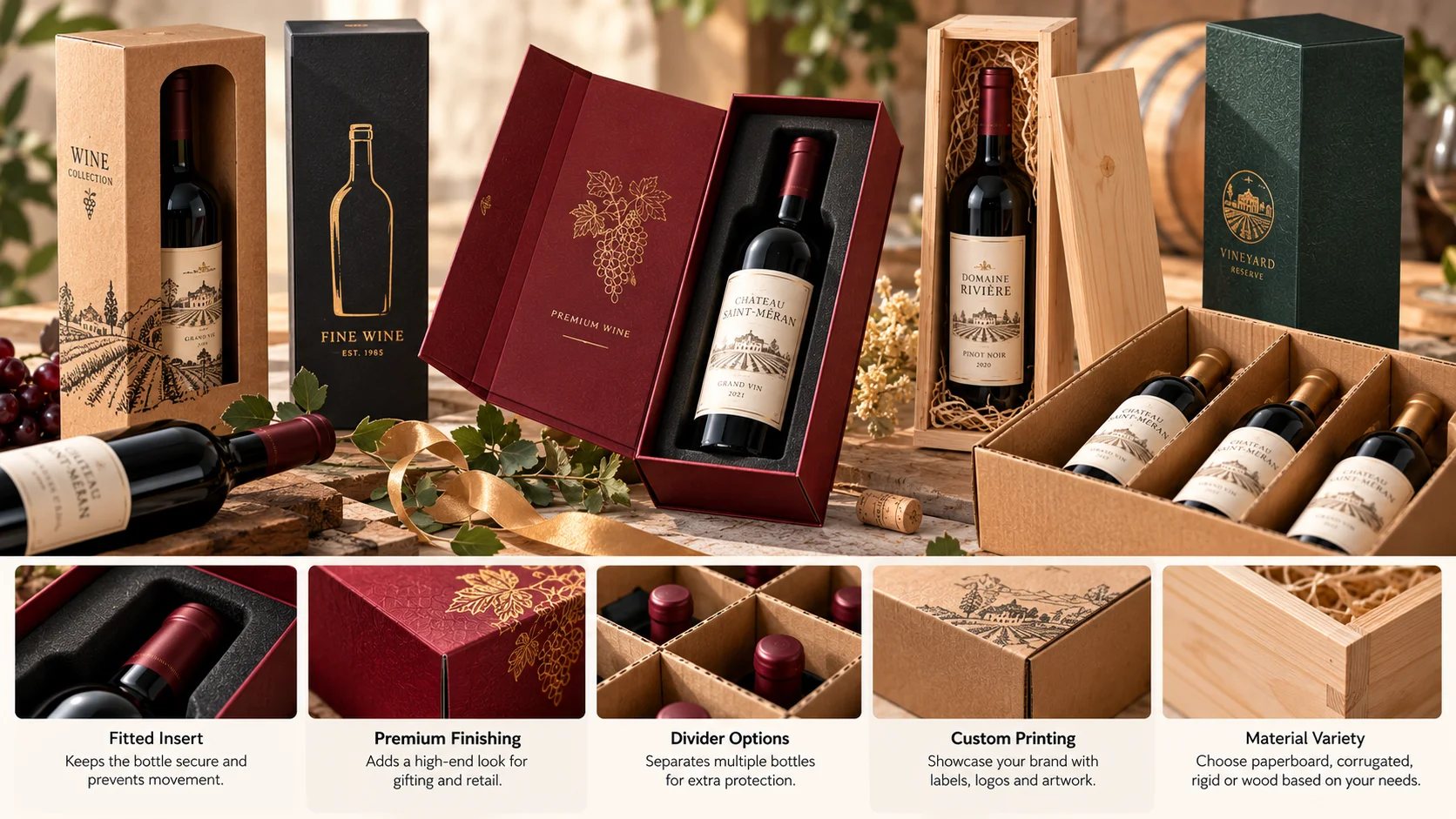
Wine Bottle Box Materials: Paperboard, Corrugated and Rigid
Material selection should follow the package’s job. Paperboard can suit printed retail cartons and presentation-focused structures. Corrugated board is more useful when the package must provide a shipping-oriented protective structure. Rigid board is often selected when the physical feel and premium presentation of the package are important.
There is no universally “best” wine box material. Consider bottle weight, number of bottles, intended handling, presentation requirements, printing, finishing, insert construction, storage, and delivery conditions together.
BoxNovo’s packaging material comparison guide can help compare material directions before the final structure is selected.
| Material direction | Typical packaging role | What to evaluate |
|---|---|---|
| Paperboard / cardboard | Retail cartons, printed single-bottle boxes, presentation packaging | Print surface, folding structure, finish, product fit |
| Corrugated | Shipping-oriented bottle packaging and protective outer cartons | Board construction, flute/strength requirements, dividers, handling |
| Rigid board | Premium gift and luxury presentation boxes | Structure, thickness, interior fit, finish, opening experience |
Wine Bottle Box Styles for Retail, Gifting and E-Commerce
The sales channel changes what the box needs to accomplish.
Retail packaging needs a clear brand presence, practical handling, and proportions that work on the shelf. The exterior graphics, label relationship, and opening structure all contribute to product presentation.
Gift packaging can place more emphasis on the opening experience, tactile finishes, inserts, ribbons, windows, or accessory compartments. The box can become part of the gift itself.
E-commerce packaging has a different priority: the package must be designed around the actual delivery environment. A beautiful retail box may still need an additional shipping structure if it is not intended to perform as the parcel-protection system.
If the bottle will travel as its own shipping package, keep that requirement separate from the presentation-box decision and review BoxNovo’s wine shipping box guide for shipping-specific configurations. This article focuses primarily on the bottle presentation and packaging-choice side of the decision.
Wine Bottle Label Design: Make the Box and Label Work Together
A wine bottle box and wine bottle label should look like parts of the same brand system. The box may carry the larger visual story while the bottle label communicates the product identity and information directly on the bottle.
Think about the front-facing relationship between bottle and box. If a window exposes the label, the window location becomes part of the structural design. If the bottle is fully enclosed, the box may need to communicate more of the product’s visual identity through printing.
The back label also matters to the overall presentation. Information that belongs on the bottle should not be duplicated unnecessarily on every box panel. Instead, define a clear information hierarchy across the bottle, box, insert, and any supporting card.
For practical guidance, BoxNovo’s product label design guidance explains why label and packaging decisions should be planned together and checked against the actual package surface.
Printing and Finishing Options for Wine Boxes
Printing should support the package’s role rather than overwhelm it. A premium wine box may use restrained typography, brand colors, texture, foil accents, embossing, debossing, or a matte finish. A retail carton may prioritize strong color reproduction and clear product hierarchy.
Before selecting a finish, check the substrate, available printable panels, folds, seams, windows, and closures. A beautiful effect on the wrong panel can disappear around a fold or compete with the bottle label.
For brands that want to explore broader structural and visual options, BoxNovo’s custom box styles and structural formats provide a useful starting point.
How to Choose a Wine Bottle Box for Your Brand
Use this decision sequence before requesting a final quote:
- Measure the actual bottle. Record maximum width, height, base, neck and closure profile.
- Define the role of the package. Decide whether it is primarily retail, gifting, direct-to-consumer, or a presentation layer inside another shipping package.
- Set the bottle arrangement. Decide one bottle, multiple bottles, or a bottle-plus-accessories configuration.
- Choose the insert approach. Select a tray, divider, fitted cavity, or another structure appropriate to the arrangement.
- Choose the box style. Match the opening experience and structure to the brand and use case.
- Select the material. Balance presentation, structure, printing, handling and shipping requirements.
- Plan the graphics. Coordinate box artwork with the bottle label and other branded elements.
- Review the complete package. Check internal fit, external dimensions, closure, label visibility, removal experience and storage/shipping needs.
- Approve a physical sample when fit matters. A sample can reveal issues that are difficult to judge from artwork alone.
For broader packaging planning, BoxNovo’s complete custom packaging planning guide connects dimensions, materials, structure, printing, finishes and inserts into one workflow.
Wine Bottle Back Label and Box Information: What Goes Where?
Packaging information should be planned as a system. The bottle label has limited physical space, while the box may provide additional panels for brand storytelling, product information, handling information, or gift messaging.
Do not assume every piece of bottle information belongs on the box. Start by identifying what the bottle must communicate directly, what the box should communicate before opening, and what can be moved to an insert or supporting card.
For regulated wine labeling, required information can vary by market and product. Treat local legal and labeling requirements as a separate compliance check rather than relying on a generic packaging template.
Custom Wine Bottle Box vs. Stock Packaging
Stock packaging can be useful when an available format already fits the bottle and meets the presentation requirements. Custom packaging becomes more valuable when the bottle has an unusual profile, the brand needs a specific structure, the package contains multiple components, or the presentation needs to be distinctive.
Custom does not automatically mean premium or expensive. The useful question is whether changing the dimensions, structure, material, insert or printing solves a real product or brand requirement.
For general branded product packaging, BoxNovo’s custom product box solutions are another relevant reference point.
Common Wine Bottle Box Mistakes
- Choosing a box from bottle volume alone instead of measuring the actual bottle.
- Using external dimensions when the project requires internal product-fit dimensions.
- Designing the outer box before deciding how the bottle will be held.
- Using the same insert layout for bottle shapes that are materially different.
- Ignoring the bottle label’s visibility or orientation.
- Treating a premium presentation box as if it were automatically a shipping carton.
- Adding decorative finishes before checking folds, seams and usable print areas.
- Repeating the same information on the bottle, box and insert without a clear hierarchy.
- Approving production without checking a physical sample when fit or presentation is important.
- Assuming a published “standard” wine box size will fit every bottle profile.
A Practical Wine Bottle Box Checklist
- ☐ Actual bottle measured
- ☐ Maximum width/diameter confirmed
- ☐ Full height including closure confirmed
- ☐ Bottle orientation defined
- ☐ Single- or multi-bottle arrangement confirmed
- ☐ Insert/divider approach selected
- ☐ Internal dimensions separated from external dimensions
- ☐ Retail, gifting and shipping roles defined
- ☐ Box artwork coordinated with the bottle label
- ☐ Printing and finish selected for the chosen material
- ☐ Physical sample planned where fit matters
- ☐ Market-specific labeling requirements reviewed
How Much Does a Custom Wine Bottle Box Cost?
There is no reliable single price for a custom wine bottle box. Cost can change with the number of bottles, dimensions, material, structure, insert, printing, finishing, quantity, sampling and delivery requirements.
The better approach is to create a clear packaging brief first. Once the bottle, arrangement, structure and material direction are known, a supplier can quote the actual project instead of comparing a generic “wine box” price that may not represent the final package.
BoxNovo’s pricing and production requirements can be discussed directly through its packaging team once the project specifications are defined.
Final Takeaway: Choose the Wine Bottle Box Around the Bottle
The strongest wine bottle packaging starts with the product and works outward. Measure the actual bottle, decide how it should be positioned, choose the insert or divider, select the box structure and material, then coordinate the graphics and label relationship.
For retail and gifting, the box can become a major part of the brand experience. For e-commerce and shipping, presentation still matters, but the protective shipping system has to be evaluated separately.
If you need a custom package, BoxNovo can develop the structure around the bottle, brand, intended use and packaging requirements. Discuss your wine packaging requirements with BoxNovo and provide the bottle dimensions, quantity, preferred style, material direction, artwork status, and insert requirements so the project can be evaluated from the inside out.
Frequently Asked Questions About Wine Bottle Boxes
What is a wine bottle box?
A wine bottle box is packaging designed to hold and present one or more wine bottles. Depending on the structure, it can serve retail, gifting, presentation, storage, or shipping-related needs.
What size box do I need for a wine bottle?
The required size depends on the actual bottle profile, not volume alone. Measure the bottle’s maximum width and full height, then account for the insert, required clearance, closure and packaging construction.
Are wine bottle boxes available for one bottle and multiple bottles?
Yes. Packaging can be designed for single-bottle presentation, multi-bottle gift sets, tasting assortments, or larger grouped configurations. The insert or divider layout should be designed with the bottle arrangement.
What is the best material for a wine bottle box?
There is no universal best material. Paperboard can suit printed presentation cartons, corrugated board is useful for shipping-oriented structures, and rigid board can suit premium presentation. The right choice depends on the package’s job.
Do wine bottle boxes need inserts?
Not every presentation box needs the same insert, but an internal tray, divider, collar, or fitted cavity can help position bottles and organize multi-product sets. Shipping applications may require a more protective internal structure.
Can the box be designed around a specific wine bottle shape?
Yes. Custom packaging can be developed around the actual bottle dimensions and profile. This is especially useful when the bottle is unusually wide, tall, heavy, or shaped differently from common formats.
Can I use one wine box for different bottle shapes?
Sometimes. A shared outer format can work when the insert or internal structure can accommodate the range. If the bottle profiles differ substantially, separate packaging formats may provide a better fit and presentation.
Should the wine bottle label match the box design?
Ideally, the bottle label and box should be treated as one visual system. The box can extend the brand story while the label communicates product identity and required information directly on the bottle.
What is the difference between a wine gift box and a wine shipping box?
A wine gift box emphasizes presentation and the opening experience. A shipping box is designed around handling and transport protection. One package can serve both roles only when its structure has been designed and tested for both.
Should I get a sample before ordering wine boxes?
A physical sample is useful when bottle fit, insert alignment, closure, label visibility, or premium presentation matters. It lets the real bottle and package be evaluated together before full production.
Can wine bottle boxes include accessories?
Yes. A custom structure can sometimes organize a bottle with compatible accessories such as a card, tasting material, or other gift components, provided the dimensions and packaging requirements are designed together.
What information should I give a packaging supplier?
Provide the actual bottle dimensions, quantity, bottle arrangement, intended use, desired box style, material direction, insert requirements, artwork status, and any relevant labeling or shipping considerations.