
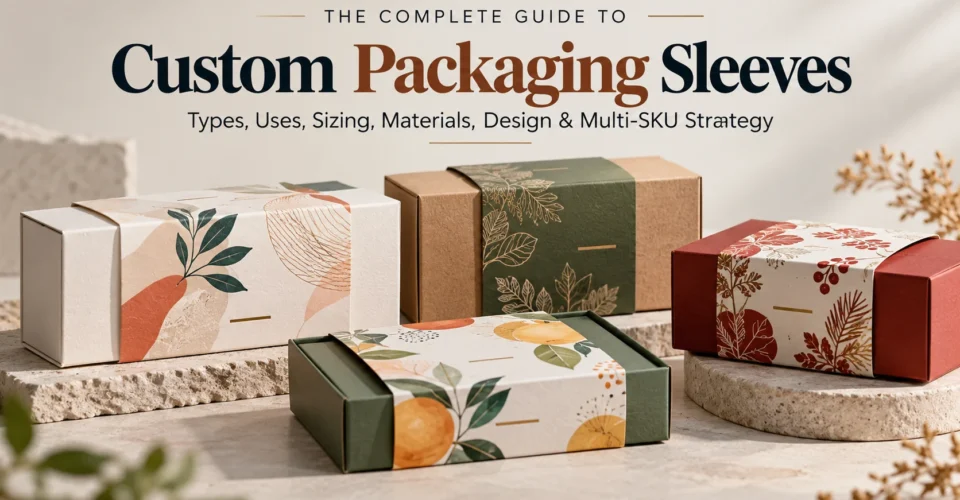
A custom packaging sleeve is an open-ended printed wrap designed to fit around a box, tray, pouch, bottle carrier, or another finished package. It adds a branded surface without requiring every product variant to use a completely different outer package.
The most important thing to understand is this: a packaging sleeve is sized around the finished package it will actually surround—not the bare product. The base package, board thickness, inserts, closures, surface finish, projections, sleeve direction, and application method can all affect the final fit.
This guide explains when custom packaging sleeves make sense, how to measure them, how to choose materials and finishes, how to plan artwork, how to manage multiple SKUs, how to think about total packaging cost, and what to test before production.
What Is a Custom Packaging Sleeve?
A custom packaging sleeve is a printed paper or paperboard component that wraps around another package or product presentation. It is commonly open at both ends and relies on the underlying package for most of the structural support.
That makes a sleeve different from a fully enclosed carton. The carton, tray, pouch, or other base package carries the product and provides the primary closure or protection, while the sleeve adds another surface for branding, product identification, seasonal artwork, product information, or promotional messaging.
A sleeve can be narrow like a belly band, wide enough to cover most of a box, or designed as part of a sleeve-and-tray presentation. Some designs may also incorporate windows, die-cuts, special folds, or contrasting interior printing.
The distinction matters because a sleeve should not automatically be treated as a shipping package, moisture barrier, tamper-evident seal, or protective outer carton. Those functions must come from the complete packaging system.
If you are still defining the overall packaging system, BoxNovo’s complete custom packaging guide is a useful starting point for comparing dimensions, structures, materials, printing, and other packaging requirements.
When Should You Use Packaging Sleeves?
Packaging sleeves are particularly useful when you want a strong printed presentation without manufacturing a completely different structural package for every visual variant.
- Multiple flavors, scents, colors, or product variants share the same physical package.
- Seasonal or limited-edition artwork needs to change without replacing the base package.
- A gift set needs a branded outer presentation around a tray.
- A retail product needs more printable surface area than a label can provide.
- A subscription or promotional package needs changing artwork while the physical structure stays consistent.
- A brand wants a premium presentation without making every SKU a completely different structural package.
A sleeve is less suitable when the outer component must provide significant crush resistance, a secure shipping closure, a controlled moisture barrier, or another structural function the sleeve itself cannot provide.
Packaging Sleeve vs. Belly Band vs. Full Box
| Format | Best Use | Main Strength | Main Limitation |
|---|---|---|---|
| Narrow belly band | Minimal branding or product information | Uses a relatively small printed area | Limited coverage and information space |
| Wide packaging sleeve | Branding around a finished box or package | Large visual surface without replacing the base package | Fit depends on the finished package |
| Sleeve and tray | Premium presentation and organized product display | Strong presentation and unboxing potential | Requires careful coordination between components |
| Fully printed box | Branding plus primary package structure | Combines presentation and structure in one component | Every visual variant may require a separate printed package |
The right choice depends on whether you are changing the brand presentation, the physical package, or both.
How to Size a Custom Packaging Sleeve
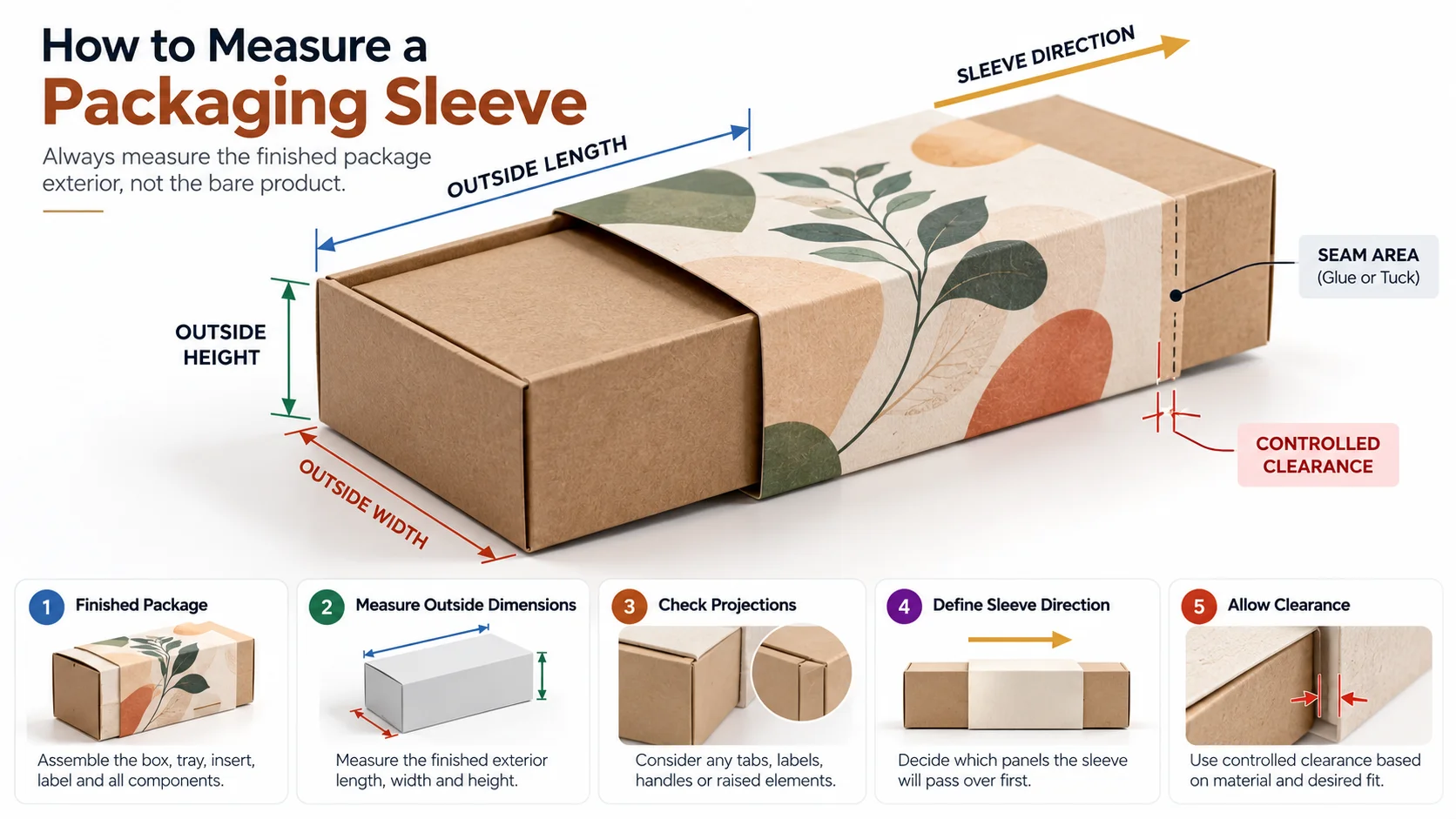
The most important sizing rule is to measure the finished outside package that the sleeve will surround.
Do not start with the product dimensions alone.
If a product sits inside a tray, for example, the sleeve needs to fit around the outside of the completed tray—not around the product cavity. If a box has a paper wrap, coating, label, insert, or closure that changes the finished exterior, those components need to be considered as part of the assembled package.
Step 1: Confirm the Finished Package
Assemble the base package exactly as it will be presented to the customer. Include the tray, insert, lid, label, wrap, closure, or other components that can affect the sleeve’s path.
Step 2: Measure the Outside Dimensions
Record the finished external length, width, and height using one consistent measurement unit. For a rectangular package, these measurements establish the physical footprint around which the sleeve must be developed.
If you are working through different box dimensions, BoxNovo’s guide to custom box sizing can help with the broader dimension-planning process.
Step 3: Identify Projections and Irregular Areas
Check for handles, tabs, raised labels, lid edges, rounded corners, tapered walls, windows, decorative elements, or other features that can affect how the sleeve slides or seats.
Step 4: Define the Sleeve Direction
Decide which panels the sleeve will pass over first and where the seam will sit. The same finished package can require a different sleeve layout depending on the intended orientation.
Step 5: Establish Controlled Clearance
A sleeve needs enough clearance to apply and remove without binding, but not so much that it moves excessively during handling.
There is no single clearance number that should be treated as universal. Required clearance depends on the sleeve material, thickness, coating, finished package, corner geometry, surface friction, application method, and desired retention.
Step 6: Define the Reveal
If the sleeve is intentionally shorter than the package to expose an edge, create a thumb opening, reveal part of the base package, or create a particular visual effect, define that reveal before the dieline is finalized.
Step 7: Approve a Physical Sample
Test the sleeve on representative finished packages before approving production. Check sliding resistance, alignment, seam position, corner behavior, artwork placement, and the appearance of the assembled package.
Why Outside Dimensions Matter
Packaging dimensions can describe different things. Internal dimensions describe usable space inside a box or tray. External dimensions describe the finished footprint of the package. Because a sleeve wraps around the outside, its fit is driven primarily by the finished external geometry.
That is why a specification such as “6 × 4 × 2 inches” is incomplete unless the measurement basis is clear.
For a useful sleeve specification or quote, provide:
- Finished external length × width × height.
- Measurement unit.
- Exact base package or tray.
- Product orientation.
- Insert or accessory configuration.
- Surface finish or coating if known.
- Quantity and number of variants.
- Whether the sleeve will be applied by hand or equipment.
- Whether a physical sample is required before production.
A packaging supplier should also confirm whether quoted dimensions refer to the finished exterior, internal cavity, or another structural measurement.
A Simple Sleeve Sizing Example
Suppose a finished tray measures approximately 6 × 4 × 2 inches on the outside.
That does not mean the sleeve should simply be ordered at 6 × 4 × 2 inches. The sleeve has to travel around the tray’s actual exterior, and its final dimensions depend on board thickness, coating, corner construction, seam placement, application clearance, and any intentional reveal.
The correct development process is:
- Measure the finished tray.
- Confirm the actual outside dimensions.
- Select the sleeve material.
- Define the desired fit and clearance.
- Build the sleeve dieline.
- Produce a physical sample.
- Test the sleeve on the representative finished package.
- Approve the production specification.
This approach is much more reliable than applying one fixed clearance value to every packaging sleeve project.
Sleeve Materials: Paperboard, Kraft and Other Options
Material selection affects more than appearance. It can change stiffness, fold behavior, print quality, surface friction, finish, and how the sleeve interacts with the package underneath.
For a broader comparison before selecting a specific stock, see BoxNovo’s packaging material comparison guide.
| Material | Why Consider It | What to Watch |
|---|---|---|
| Paperboard or cardstock | Versatile printed presentation and clean graphics | Exact caliper, coating, and stiffness affect fit |
| Kraft paperboard | Natural appearance and understated brand presentation | Surface color and texture can affect print appearance |
| Coated paperboard | Smooth surface and controlled print appearance | Surface coating can affect friction and handling |
| Specialty or laminated stock | Premium visual or tactile effects | Added layers can affect thickness and application |
Do not choose a sleeve material from GSM alone. Board thickness, caliper, stiffness, surface treatment, grain direction, coating, and the sleeve construction all matter.
If a sleeve must slide over a finished package, the interaction between the two surfaces deserves particular attention. A glossy coating over a smooth package can behave differently from an uncoated or textured combination.
Cardboard and Paperboard for Printed Sleeves
Cardboard and paperboard are common choices when a sleeve needs a clean printed surface and a balance between presentation and practical handling.
For more detail on board characteristics and available specifications, see BoxNovo’s cardboard packaging material options.
Kraft Sleeves
Kraft can be useful when the natural paper appearance supports the brand identity. It can create a more understated or organic visual direction while still allowing branded printing.
Environmental claims should still be evaluated based on the complete packaging specification, including coatings, inks, adhesives, manufacturing, and local recycling conditions rather than assuming that every kraft package is automatically more sustainable.
Rigid Sleeve Structures
For premium applications, a rigid sleeve can be developed as part of a more substantial presentation package. Rigid packaging is especially relevant when the structure and tactile experience are central to the product presentation.
For this type of application, explore premium rigid sleeve packaging structures.
Printing and Finishing for Packaging Sleeves
A sleeve can expose several panels at once, giving you a useful branding surface—but only when the artwork is planned around the physical structure.
Before artwork is finalized, identify:
- Front and back panels.
- Side panels.
- Top and bottom edges.
- Fold and score locations.
- Seam or glue area.
- Areas hidden by the underlying package.
- Barcode or required-information placement.
- Safe areas and bleed.
- Direction of text and graphics.
- Any inside printing or reverse-side messaging.
Do not place important information across a fold, seam, or area that may be covered by the base package.
Finishing can be used selectively. Depending on the chosen stock and production process, options may include matte or gloss surfaces, soft-touch effects, foil accents, embossing, debossing, or spot coatings.
The most elaborate finish is not automatically the best finish. Use finishing where it improves visual hierarchy, tactility, shelf presence, or brand recognition.
Packaging Sleeve Design: Build the Artwork Around the Structure
A strong sleeve design usually has three information layers:
- Identification: brand, product name, variant, or collection.
- Decision support: flavor, scent, color, size, quantity, benefit statement, or other information a buyer needs.
- Supporting information: ingredients, instructions, barcode, QR code, website, promotional message, or other required content where appropriate.
Keep the most important information on the panels that remain visible after the sleeve is applied.
For multi-SKU programs, make the variable element easy to identify. If ten variants share one base box, the sleeve should help customers distinguish them quickly instead of forcing them to search through dense artwork.
If your packaging also uses labels, BoxNovo’s label design resource can help with information hierarchy, artwork setup, materials, and finishing decisions.
Sleeve and Tray Packaging
Sleeve-and-tray packaging is a two-piece presentation system: the tray holds the product while the sleeve creates the outer branded presentation.
This format can work particularly well for:
- Gift sets.
- Cosmetics and personal-care products.
- Jewelry and accessories.
- Premium retail products.
- Subscription or curated collections.
- Products where a controlled reveal is part of the unboxing experience.
The tradeoff is coordination. The tray, sleeve, product, insert, and any closure or accessory need to work as one complete system.
For a premium sleeve-and-tray project, test the complete filled package rather than approving the sleeve by itself.
Multi-SKU Packaging Sleeves: The Biggest Commercial Advantage
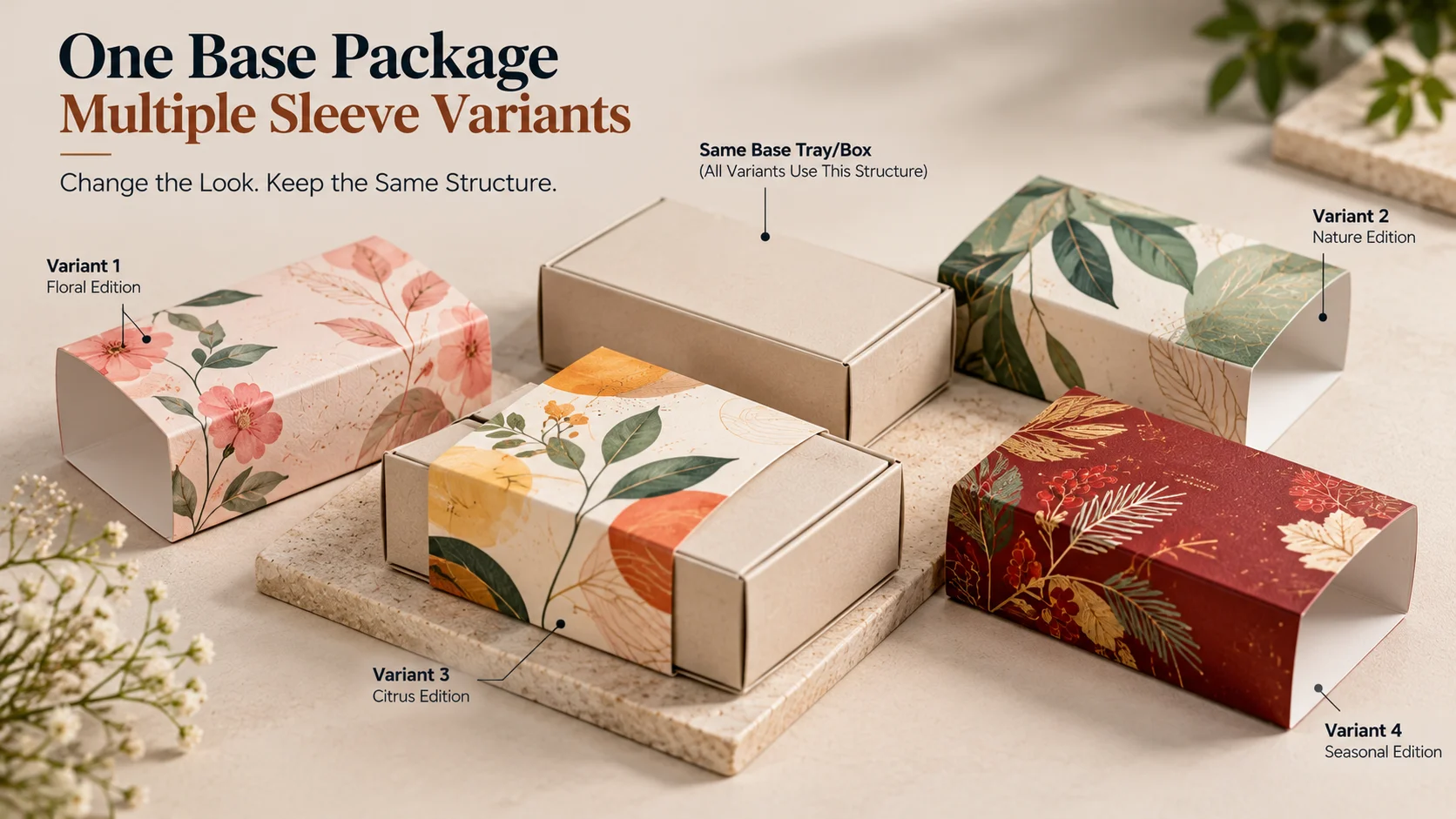
One of the strongest reasons to use custom packaging sleeves is the ability to separate the physical base package from the visual product variant.
A common strategy is:
One base package + multiple sleeves = multiple product presentations.
For example, one tray or box construction might support:
- Vanilla, chocolate, and strawberry flavors.
- Three skincare scents.
- Seasonal holiday and everyday versions.
- Different languages or market-specific information.
- Limited-edition campaigns.
- Retail and promotional variants.
This can reduce the need to redesign the structural package every time the artwork changes.
However, shared packaging should only be used when the physical package is genuinely shared. If one SKU is taller, uses a different insert, adds a bottle cap, changes tray depth, or requires a different closure, the same sleeve specification may no longer fit correctly.
| SKU | Base Package | Sleeve Variant | Physical Fit | Artwork | Production |
|---|---|---|---|---|---|
| SKU A | Same | Variant A | Confirmed | Approved | Ready |
| SKU B | Same | Variant B | Confirmed | Approved | Ready |
| SKU C | Different insert | Variant C | Recheck | Pending | Hold |
| SKU D | Same | Seasonal | Confirmed | Proofing | Hold |
The key is to validate the physical package first and then manage artwork variants around that common structure.
How Custom Sleeves Affect Total Packaging Cost
The lowest sleeve unit price does not automatically produce the lowest total packaging cost.
Evaluate the complete system:
- Sleeve material and finished size.
- Printing coverage and production requirements.
- Finishing and special effects.
- Tooling or setup where applicable.
- Sampling and proofing.
- Quantity per SKU.
- Artwork changes.
- Packing and application labor.
- Storage for multiple variants.
- Potential leftover inventory.
- Shipping and handling.
- Rejects or rework caused by poor fit.
For a multi-SKU program, compare at least two packaging models:
- One fully printed box for each SKU.
- One shared base package plus different sleeves.
The sleeve strategy can be attractive when the structural package is truly common and artwork changes frequently. It can be less attractive when every SKU still needs a different base package, the sleeve is difficult to apply, or low-volume variants create excessive inventory.
The right comparison is total packaging cost and operational effort—not sleeve unit price alone.
Choosing the Right Packaging Structure
A sleeve should be considered as one structural option within the larger packaging system. Before committing to a sleeve, compare it with the other available structures based on product protection, presentation, assembly, shipping, and branding requirements.
Explore BoxNovo’s packaging styles and structures when you need to compare different formats before finalizing the sleeve concept.
For broader product-packaging decisions, BoxNovo’s product packaging resource can also help connect the packaging structure to the product, presentation, and use case.
Quality Control Before Production
A production-ready sleeve should pass more than a visual artwork proof.
| Check | What to Verify |
|---|---|
| Fit | The sleeve slides on and off as intended without binding or becoming excessively loose. |
| Alignment | Graphics land correctly on the visible panels. |
| Seam | The seam is positioned as planned and does not interfere with important artwork. |
| Reveal | Any exposed edge or opening is consistent across samples. |
| Surface interaction | The finish provides the intended balance of friction and retention. |
| Construction | Folds, scores, corners, and glued areas are clean and consistent. |
| Variable information | Product names, variant details, barcodes, and other information are correct. |
| Packing operation | The intended person or equipment can apply the sleeve efficiently. |
| Representative units | The approved sample works with actual production components. |
For complex or tight-fit packaging, a physical sample is particularly valuable because digital artwork cannot demonstrate real sliding resistance, surface friction, or the interaction between the sleeve and the finished package.
When a Sleeve Is the Wrong Packaging Choice
A sleeve is not automatically the best solution simply because it looks attractive.
- The package must provide significant shipping protection.
- The outer component needs a secure shipping closure.
- The sleeve would move excessively during normal handling.
- The base package changes dimensions between SKUs.
- The sleeve is being used to solve a structural problem it cannot actually solve.
- Application time becomes too high for the packing operation.
- The design depends on surface area that becomes hidden after assembly.
- A label, printed carton, or another package component can provide the required information more effectively.
For shipping-heavy applications, evaluate the complete protective package rather than treating a decorative sleeve as the shipping container.
Common Packaging Sleeve Mistakes
- Measuring the product instead of the finished package.
- Confusing internal dimensions with external dimensions.
- Applying one clearance number to every material and structure.
- Ignoring board thickness, coating, or surface friction.
- Forgetting inserts, lids, labels, or projections.
- Placing important artwork over a seam or fold.
- Using the same sleeve for SKUs that do not actually share the same exterior.
- Comparing sleeve unit price without considering application and inventory costs.
- Approving artwork without testing the assembled package.
- Treating a sleeve as a substitute for shipping protection or a secure closure.
Custom Packaging Sleeve Specification Checklist
- Product name and description
- Finished base-package dimensions
- Measurement basis: internal or external
- Product orientation
- Tray, insert, lid, label, or accessory details
- Sleeve style and intended direction
- Desired material or appearance
- Print coverage and artwork status
- Finish requirements
- Number of SKUs or variants
- Quantity per SKU
- Application method: hand or equipment
- Shipping and handling environment
- Sample or proof requirement
- Required delivery timing
How to Prepare a Custom Sleeve Project for a Quote
The more complete the initial packaging specification, the easier it is to evaluate the right structure and avoid fit problems later.
For a sleeve quotation, prepare:
- The finished external dimensions of the base package.
- A description or photo of the base package.
- The number of SKUs.
- Quantity required for each SKU.
- Preferred sleeve material, if known.
- Printing requirements.
- Finishing requirements.
- Whether the sleeve will be applied manually or mechanically.
- Any inserts, labels, closures, or accessories.
- Whether you need a physical sample before production.
If you are developing a broader branded package rather than only a sleeve, BoxNovo’s custom packaging design resource can help you approach structure, branding, artwork, and production as one coordinated project.
Frequently Asked Questions
What is a custom packaging sleeve?
A custom packaging sleeve is a printed paper or paperboard wrap designed to fit around a finished package or product presentation. It adds branding and information while the underlying package provides most of the structure and protection.
What is the difference between a sleeve and a belly band?
A belly band is usually a narrower wrap used for a smaller branding or information area. A packaging sleeve is typically wider and covers more of the underlying package. Terminology can vary between suppliers, so the physical dimensions and intended function should always be specified.
How do you measure a packaging sleeve?
Measure the finished external dimensions of the package the sleeve will surround. Include the actual tray, box, insert, lid, label, coating, and other features that affect the outside profile. Fit and clearance should then be established through structural development and physical sampling.
Is there a standard clearance for packaging sleeves?
No single clearance value applies to every sleeve. Required clearance depends on material, thickness, coating, finished package geometry, surface friction, application method, and desired retention. A physical sample is the safest way to confirm the final fit.
Can a packaging sleeve have printing on the inside?
Yes, depending on the selected material and production method. Inside printing can be useful for instructions, brand messages, patterns, or unboxing details, but the available print area and production requirements should be confirmed during structural development.
Can one sleeve size work for multiple SKUs?
Yes, when the SKUs share the same finished external package geometry. If an insert, height, lid, accessory, or other component changes the exterior dimensions, the sleeve should be rechecked rather than assumed to fit.
Are packaging sleeves suitable for shipping?
A sleeve by itself should not be assumed to provide the protection or closure required for parcel shipping. Evaluate the complete package, including the base box, protective components, closure, and outer shipping system.
How much do custom packaging sleeves cost?
Cost depends on dimensions, material, printing, finish, quantity, number of variants, setup or tooling where applicable, packing requirements, and other production factors. For multiple SKUs, compare the total system cost against alternatives such as fully printed boxes.
What information should I send for a sleeve quote?
Provide the finished package dimensions, measurement basis, material preference if known, artwork or print requirements, quantity, number of SKUs, application method, inserts or accessories, intended use, and whether you need a physical sample.
Final Takeaway
Custom packaging sleeves work best when they are treated as part of a packaging system rather than as a decorative afterthought.
Start with the finished package. Measure its exterior. Define how the sleeve will travel around it. Select material and finish based on both appearance and physical behavior. Build artwork around the seam, folds, visible panels, and required information. If multiple SKUs share a base package, verify the physical geometry before assuming one sleeve specification will work for all of them.
Most importantly, approve the complete assembled package before production when fit or presentation matters. A sleeve can create a strong branded experience, but its success depends on the relationship between the sleeve, the base package, the product, and the way the package is handled.
When you are ready to develop the actual sleeve structure, explore BoxNovo’s custom sleeve box solutions and provide the finished package dimensions, quantity, artwork requirements, and preferred material.
For projects where the sleeve is only one part of a larger product package, explore custom product packaging options to coordinate the package structure, dimensions, branding, printing, materials, and presentation.