A box partition is an internal packaging structure that divides an outer box into separate compartments, or cells, so multiple products can be kept apart during handling and transport. A well-designed partition can reduce product-to-product contact, limit unwanted movement, organize a multi-product pack, and make packing more consistent. The partition works as part of the complete package, it should be designed around the actual box, products, material, handling conditions, and required presentation rather than treated as a generic insert.
The key distinction is simple: a partition usually creates multiple cells within one outer package, while a fitted insert is more often shaped around one product or a specific set of cavities. Some packaging systems use both. The right choice depends on what the package needs to accomplish.
What Is a Box Partition?
A box partition is a set of cut or slotted internal pieces, commonly paperboard, chipboard, or corrugated fiberboard, that divide the usable space inside a box. Interlocking strips can form a grid of cells, while simpler divider structures can separate rows, layers, or groups of products.
For a multi-unit package, the partition creates a physical boundary between products. That boundary can help keep bottles from knocking together, stop packaged components from shifting into one another, and make it easier to load a predictable number of units into each box.
A partition does not automatically make a package safe for every product or shipping environment. Cell dimensions, board specification, partition height, outer-box construction, product weight, and the amount of movement allowed inside each cell all affect the final result.
Box Partition vs. Divider vs. Insert vs. Layer Pad
These terms overlap in everyday packaging conversations, but they are useful to distinguish when you are specifying a custom package.
| Packaging component | Primary job | Typical structure | Best suited to |
|---|---|---|---|
| Box partition | Creates multiple compartments inside one box | Interlocking or slotted grid | Multiple products that need separation |
| Divider | Separates products, rows, or sections | Flat, slotted, or custom-cut board | Small groups, rows, or general separation |
| Fitted insert | Positions a product in a shaped cavity | Die-cut, folded, molded, foam, or other fitted structure | Products needing precise positioning |
| Layer pad | Separates stacked product layers | Flat sheet of board | Products packed in tiers |
| Void fill | Reduces unused space and movement | Loose or formed filling material | Packages with irregular empty space |
When Should You Use Box Partitions?
A partition is worth considering when several products share one outer box and contact, movement, organization, or pack-out consistency is a concern.
- Multiple rigid products need their own compartments.
- Fragile products could strike one another during handling.
- Different SKUs or components need to stay organized within one kit.
- A product bundle needs a repeatable arrangement during fulfillment.
- The package needs internal separation without a fully molded cavity.
- The interior should look organized when a customer opens a retail or e-commerce package.
For a single product that needs a close-fitting cavity, a fitted insert may be more appropriate than a grid partition. For stacked products, a layer pad may solve the separation problem more directly. The goal is not to add an insert simply because one is available; it is to select the simplest internal structure that solves the actual packaging problem.
Types of Box Partitions and Divider Structures
Interlocking Cross Partitions
Cross partitions use slotted strips that interlock to form a grid. They are particularly useful when several similar products need individual cells. The grid can be configured around the product count and the interior footprint of the outer box.
Flat Dividers
Flat dividers create a smaller number of sections rather than a full cell grid. They can be useful when products are grouped in rows or when the package needs simple separation instead of one compartment per item.
Layer Pads
A layer pad is a flat board placed between stacked tiers. It is not the same thing as a cell-forming partition. Its job is to separate layers and distribute contact between products above and below.
Custom Die-Cut or Folded Structures
A custom internal structure can combine slots, folds, tabs, partitions, and product-specific features when a standard grid does not fit the product mix. This is especially useful for kits with different shapes or accessories that need defined locations.
| Structure | Main advantage | Consider when |
|---|---|---|
| Full grid partition | Individual compartments | Several similar products share one box |
| Partial divider | Simple separation with less material | Products are grouped in rows or sections |
| Layer pad | Separates stacked tiers | Products are arranged vertically in layers |
| Custom multi-level structure | Handles different product heights/shapes | A kit has mixed components |
| Fitted insert | Precise product positioning | One or a few products need shaped cavities |
Box Partition Materials: What Should You Choose?
The material should be selected according to product weight, fragility, cell dimensions, shipping conditions, required rigidity, appearance, printing needs, and production requirements. There is no universal “best” partition material.
For broader material selection guidance, see BoxNovo’s packaging material comparison guide.
Common choices include paperboard or chipboard for lighter-duty organization and presentation, and corrugated fiberboard when greater structural support or shipping protection is required. The exact board specification should be confirmed for the finished design rather than selected from material name alone.
| Material category | Typical strengths | Good starting applications | Watch for |
|---|---|---|---|
| Paperboard / chipboard | Smooth, printable, relatively light | Retail sets, light products, presentation-focused interiors | Board stiffness and cell size must match the load |
| Corrugated fiberboard | Fluted structure adds rigidity and cushioning | Shipping, jars, bottles, heavier or fragile multi-packs | Flute and wall construction affect space and performance |
| Specialty/fitted materials | Can provide shaped support | Premium presentation or highly specific product geometry | Material and construction should match the package and recovery/disposal requirements |
How to Size a Box Partition Correctly
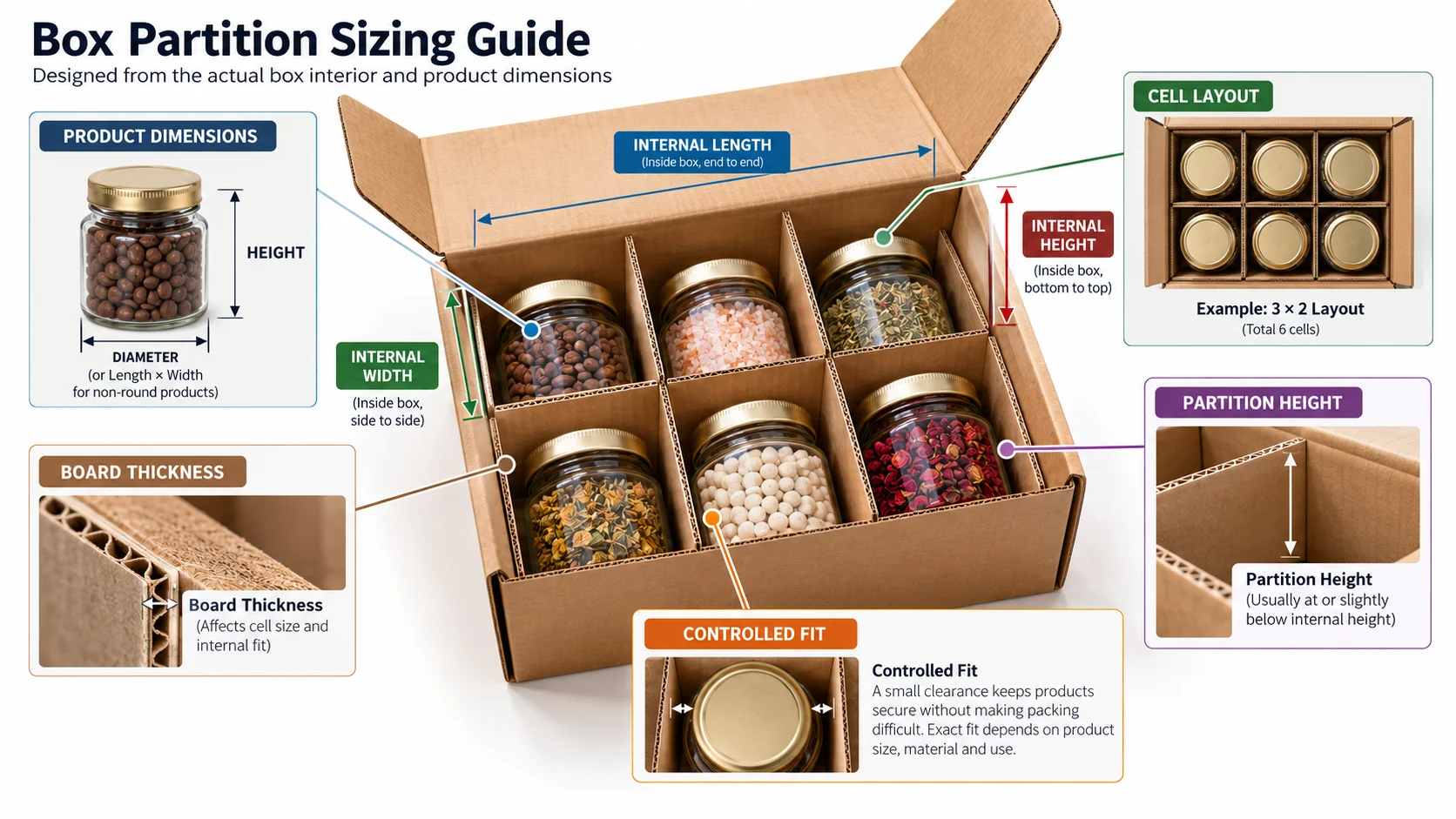
The most important sizing rule is to design the partition around the finished packaging system, not just the product name or a product photograph. Start with the actual inside dimensions of the assembled outer box and the actual production products that will be packed.
For related dimensional guidance, see BoxNovo’s custom box sizing guide.
1. Measure the Outer Box Interior
Record the usable internal length, width, and height of the assembled box. State the measurement basis clearly. Internal dimensions describe usable space; external dimensions describe the finished outside footprint. Do not substitute one for the other.
2. Measure the Products
Measure the actual production product, including caps, closures, protrusions, accessories, or other components that will occupy the cell. For round products, record the relevant diameter and height. For rectangular products, record length, width, and height in a stated orientation.
3. Decide the Cell Layout
Determine how many products belong in the box and how they should be arranged. A 2 × 3 layout, for example, creates six nominal positions, but the final cell dimensions still have to account for the partition material and the real product geometry.
4. Account for Board Thickness and Construction
The material occupies space. Slotting, interlocking pieces, folds, or other construction details can also affect the usable cell. Do not calculate cell size from the outer box footprint alone.
5. Establish a Controlled Fit
A cell that is too loose can allow unwanted movement; a cell that is too tight can make packing and removal difficult and may put stress on the product or partition. There is no single clearance value that is correct for every product. Fit should be determined from the product geometry, material, handling method, and intended use.
6. Set Partition Height
The partition should provide enough vertical separation to perform its job without interfering with box closure or the way the product is loaded. The ideal height depends on the box construction, product height, closure, and handling requirements; it should not be treated as a universal percentage or fixed measurement.
7. Build and Test a Physical Sample
A physical sample lets you check actual insertion force, product movement, cell alignment, box closure, assembly time, and overall presentation. Measurements are essential, but they do not replace testing the finished package.
A Simple Box Partition Fit Check
| Check | What to verify | What a problem may indicate |
|---|---|---|
| Cell fit | Product stays positioned without excessive force | Cell geometry or clearance needs adjustment |
| Board stability | Walls remain upright under normal loading | Material, height, slotting, or layout may need revision |
| Box closure | Flaps/closure operate without interference | Partition height or position is too large |
| Pack-out | Products can be loaded and removed efficiently | Cells are too tight or assembly is inefficient |
| Shipping movement | Products remain separated during expected handling | Fit, outer-box structure, or internal protection needs review |
How Partition Design Changes by Product Type
Glass Bottles and Jars
Glass products are a common reason to use individual cells. The partition should prevent adjacent units from contacting each other while remaining practical to load and remove. Product shape, diameter, weight, neck or closure geometry, and the outer-box construction all matter. For bottle-focused packaging with built-in separation, custom bottle packaging with dedicated dividers can be a relevant direction to explore.
Candles and Jars
Candle jars can benefit from cell-based separation, particularly when several units share a shipping or gift package. The partition should be developed around the finished jar dimensions rather than a nominal product category. When a candle package needs a more fitted interior instead of a simple grid, a candle box with a fitted insert can provide another structure to consider.
Cosmetics and Beauty Products
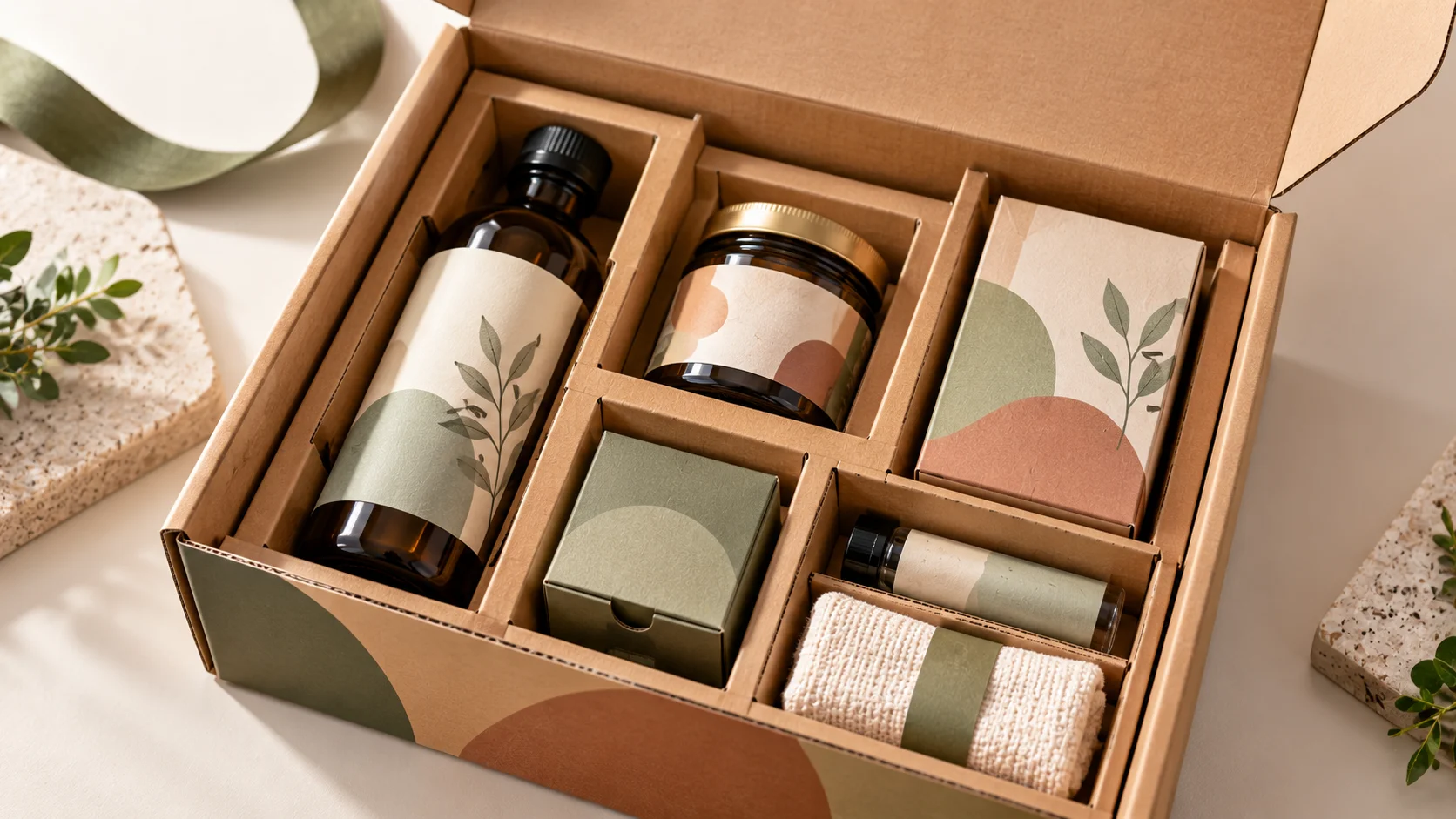
Cosmetic kits often contain mixed shapes and heights. A single uniform grid may not be the best solution when bottles, tubes, palettes, or accessories are combined. A mixed compartment layout can provide more practical organization.
Electronics and Small Components
Small components may need individual cells to prevent scratching, tangling, or uncontrolled movement. Fragility, surface finish, sharp edges, and accessory count should influence the internal design.
Food and Gift Sets
Gift sets can use partitions to separate different products while keeping the arrangement visible and organized. Where food-contact or regulatory requirements apply, the material and finished construction should be selected according to the actual application and applicable requirements.
Multi-SKU Kits and Product Bundles
A partition can be particularly useful when one outer box contains several different products or accessories. The layout should reflect the actual bill of materials so that every component has a defined place and the pack-out process is repeatable.
Box Partitions for Shipping vs. Retail and E-Commerce Packaging
A shipping-focused partition and a presentation-focused partition can solve different problems even when they sit inside similar boxes.
| Priority | Shipping-focused package | Retail / e-commerce package |
|---|---|---|
| Primary goal | Prevent movement and product-to-product contact | Protect, organize, and present the contents |
| Material focus | Structural performance and handling | Structure plus appearance and print compatibility |
| Layout | Efficient, repeatable pack-out | Efficient pack-out plus intentional presentation |
| Branding | Usually secondary | Can be an important part of the unboxing experience |
| Validation | Fit, loading, closure, handling | Fit, loading, closure, presentation, customer interaction |
For e-commerce, remember that the internal component is only one part of the protection system. The outer box, closure, dimensions, product fragility, handling path, and any additional cushioning should be evaluated together. For a broader view of how packaging supports the finished product experience, BoxNovo’s product packaging resources are a useful next step.
Can Box Partitions Support Branding and Product Presentation?
Yes, when the selected material and printing process are suitable. A partition can be more than a purely hidden protective component: its visible surfaces can support color, product organization, instructions, messaging, or a branded interior experience.
The design should still prioritize function. Printing or decorative features should not interfere with slots, folds, assembly, product fit, or the intended recovery/disposal path of the finished package.
If you are developing the outer package at the same time, BoxNovo’s complete packaging planning guide covers structure, materials, sizing, printing, finishing, and inserts as part of the larger packaging system. For the visual and structural side of the package, custom packaging design guidance can also help connect the partition with the rest of the branded package.
Common Box Partition Design Mistakes
- Designing from a product photo instead of measuring the actual production product.
- Using external box dimensions when the partition needs to fit the box interior.
- Ignoring board thickness and slot construction when estimating cell size.
- Assuming one clearance value works for every product and material.
- Making cells so tight that pack-out becomes slow or difficult.
- Making cells so loose that products can move significantly during handling.
- Choosing board strength without considering product weight and cell geometry.
- Making the partition tall enough to interfere with the box closure.
- Forgetting accessories or secondary components in the bill of materials.
- Skipping a physical sample before committing to production.
- Optimizing only for maximum product density while ignoring packing labor and protection.
- Treating the partition as a separate component instead of designing it with the outer box.
How to Order Custom Box Partitions
A supplier can develop a much better partition when the specification describes the complete packaging system. Before requesting a quote, prepare:
- Assembled outer-box internal length, width, and height.
- Product dimensions and weight for every item that will occupy a cell.
- Product count per box and the desired cell arrangement.
- Product photos or, ideally, a physical sample when geometry is difficult to describe.
- Required partition height and any box-closure constraints.
- Preferred material or the performance requirement if the material is not yet known.
- Shipping, storage, or handling conditions that may affect the design.
- Printing, branding, or interior presentation requirements.
- Quantity, assembly method, and fulfillment workflow.
- Any need for multiple SKUs or changing product assortments.
Box Partition Specification Checklist
| Area | Confirm before production |
|---|---|
| Product | Dimensions, weight, shape, fragile points, accessories |
| Outer box | Internal dimensions, construction, closure, usable height |
| Partition | Cell count, layout, material, thickness, height, fit |
| Operations | Assembly method, loading sequence, pack-out time, storage |
| Branding | Print coverage, artwork, color, visible surfaces |
| Validation | Physical sample, fit test, closure test, pack-out review |
How BoxNovo Can Fit Into the Packaging Planning Process
A partition should be considered as part of the package rather than an isolated accessory. BoxNovo’s packaging resources emphasize choosing dimensions, materials, structure, printing, and internal components around the actual product and intended use.
For a broader look at packaging structures and applications, explore BoxNovo’s custom packaging styles and structures.
For a general product-box starting point, custom product box solutions are a relevant option when the outer package needs to be developed around a specific product.
For a paperboard-focused package, custom cardboard packaging can be considered alongside the partition specification.
For shipping-oriented structures, BoxNovo’s corrugated packaging options provide a relevant material category.
For premium presentation where a fitted interior is more appropriate than a simple grid, custom rigid boxes with fitted inserts offer a directly relevant alternative.
Frequently Asked Questions About Box Partitions
What is a box partition?
A box partition is an internal packaging structure that divides an outer box into separate compartments or cells. It is commonly used to separate multiple products, reduce unwanted contact and movement, and organize the package interior.
What is the difference between a box partition and a box insert?
A partition generally creates multiple cells or sections within a box, while an insert is a broader term that can include fitted cavities, trays, pads, foam structures, and other internal components. A partition is one type of internal packaging solution, but not every insert is a partition.
What materials are used for box partitions?
Common materials include paperboard or chipboard and corrugated fiberboard. The appropriate choice depends on product weight, fragility, cell size, handling, shipping conditions, printing requirements, and the outer-box construction.
How do I measure a box partition?
Start with the assembled box’s usable internal dimensions, then measure the actual products, determine the number and arrangement of cells, account for the partition material and construction, set a controlled fit, and validate the design with a physical sample.
How tight should a partition cell fit?
There is no universal clearance value. The cell should control unwanted movement without making loading and removal unnecessarily difficult or placing harmful stress on the product or partition. The correct fit depends on product geometry, material, handling, and use.
What is a layer pad?
A layer pad is a flat sheet placed between stacked layers of products. It separates tiers rather than creating individual cells within a single layer.
Are corrugated partitions good for fragile products?
They can be a practical option for fragile multi-unit packages because corrugated board provides a structured separation between products. The complete package still needs to be designed around the product, box, handling conditions, and required protection.
Can box partitions be customized for different product sizes?
Yes. Custom partitions can use different cell layouts and dimensions to accommodate a specific product mix. When products vary significantly in shape or height, a mixed or more specialized internal structure may be more suitable than a uniform grid.
Can box partitions be printed or branded?
Depending on the material and construction, visible partition surfaces can be printed or used for interior branding, instructions, color coding, or product organization. Printing should not interfere with assembly or functional surfaces.
Should I test a box partition before production?
Yes. A physical sample is useful for checking product fit, movement, loading, removal, closure, assembly time, and overall presentation before a larger production run.
Final Takeaway: Design the Partition Around the Complete Package
The right box partition is not simply a divider that fits inside an empty carton. It is an internal packaging structure developed around the products, box dimensions, material, fit, handling requirements, and intended customer experience.
Start with real product and box measurements. Choose the partition structure based on how the products need to be separated. Select the material according to the load and environment. Then test the assembled package before production. That process produces a partition that is easier to pack, more predictable in transit, and better aligned with the purpose of the package.
If you are ready to develop a custom box and internal packaging system around your product, discuss your packaging requirements with BoxNovo.