Great beer labels do two jobs at once. They sell the beer in a crowded cooler, and they carry the information the law requires, at the right size and in the right place. Getting both right means making four decisions together: the design, the label size for your bottle or can, the material that survives […]
Great beer labels do two jobs at once. They sell the beer in a crowded cooler, and they carry the information the law requires, at the right size and in the right place. Getting both right means making four decisions together: the design, the label size for your bottle or can, the material that survives ice and condensation, and the printing method that fits your volume.
This guide covers each of those decisions for craft brewers, beverage brands and homebrewers. It covers the US federal rules that most often send labels back for corrections, typical label sizes for common bottles and cans, and how to choose materials and printing. There’s also a step-by-step method for making your own labels and a calculator that works out the right label size for your container.
What Goes on a Beer Label?
In the US, beer and other malt beverages are labeled under rules from the Alcohol and Tobacco Tax and Trade Bureau (TTB). Most of the information can appear on any label on the container, front or back. The table below shows what a typical US beer label must include. It’s a planning summary, not legal advice, so check the current rules and your state’s requirements before you print.
Label element
Required?
Key rule
Brand name
Yes
The name the beer is sold under
Class and type
Yes
For example ale, lager, stout or “malt beverage”
Net contents
Yes
US measures, such as “12 FL. OZ.”; may be embossed on the container
Name and address
Yes
Of the bottler or importer; may be embossed on the container
Health warning statement
Yes
Exact wording set by federal law
Alcohol content
Only in some cases
Required when alcohol comes from added flavors or other non-beverage ingredients (other than hops extract); otherwise optional unless state law says otherwise
Certain ingredients
When present
FD&C Yellow No. 5, cochineal extract or carmine, sulfites (10 ppm or more) and aspartame must be declared
Country of origin
Imports only
Follows US Customs rules
Source: TTB malt beverage mandatory label information.
Not every surface counts as a label. Mandatory information can’t rely on the bottom of the container, the cap or a foil or heat-shrink capsule.
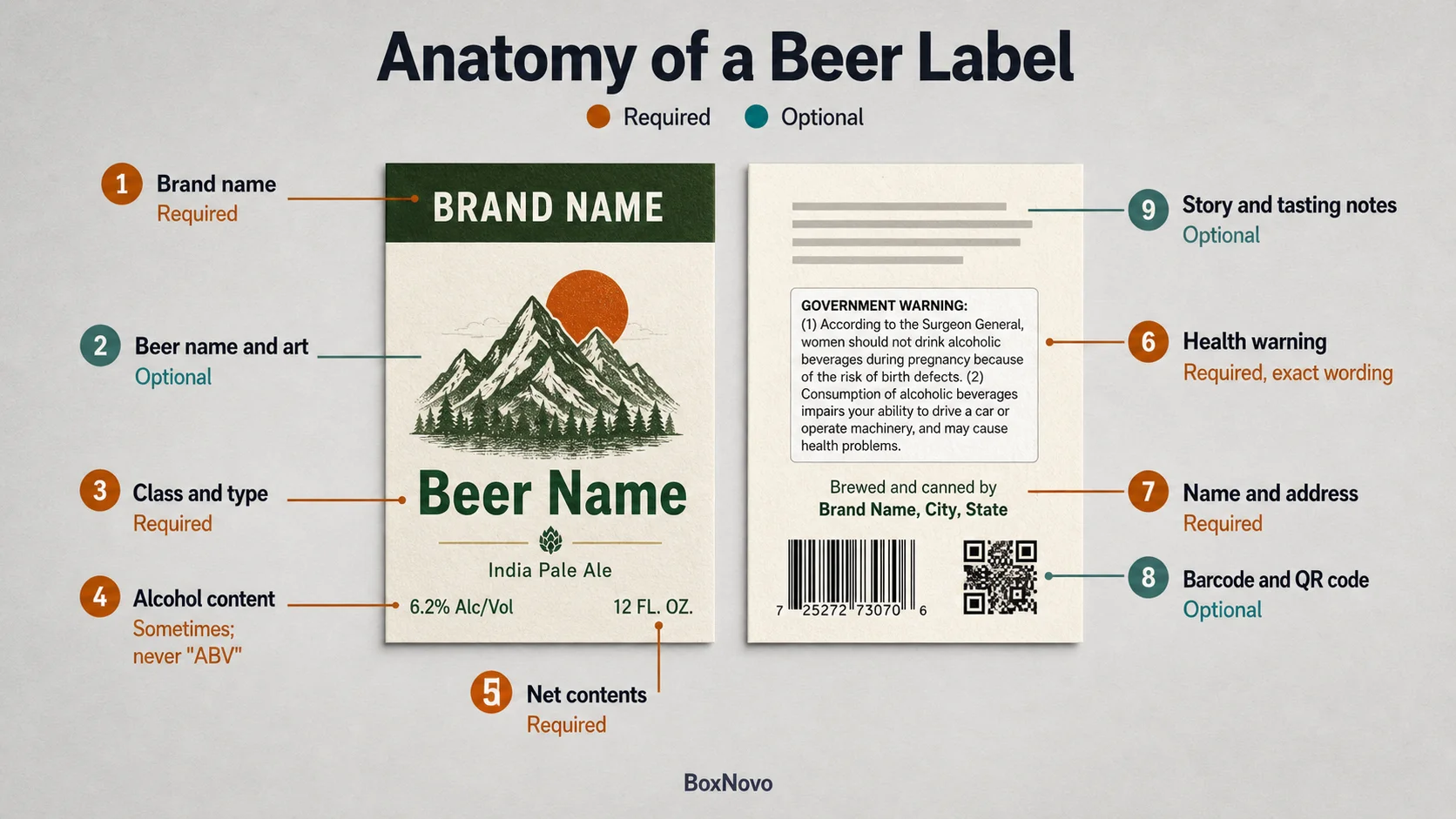
What goes on a US beer label: required elements in amber, optional ones in teal.
Federal Rules That Catch New Brewers Out
These details come straight from TTB guidance and are some of the most common reasons labels need correcting:
Don’t write “ABV.” TTB doesn’t accept “ABV” as an abbreviation. Use “Alc/Vol,” “Alc. by Vol.” or “Alcohol 5.2% by volume.” Ranges such as “5–6%” aren’t allowed either. The TTB alcohol content rules allow the actual alcohol to vary by 0.3 percentage points either side of the stated figure.
“IPA” alone isn’t a class or type. TTB doesn’t treat “IPA” as a recognized designation, so the label also needs a term such as “ale” or the full “India Pale Ale.” A US-made beer in a foreign style needs “style,” as in “Belgian Style Ale” (TTB class and type guidance).
“Brewed with” has a specific meaning. Use it only for ingredients added during the boil or fermentation. Otherwise, write “with” or “flavored with.”
A 16 oz can is “1 Pint.” Exact pints, quarts and gallons must be stated in those units, so a 16 fl oz container says “1 Pint.” Metric, such as 473 mL, is optional and can’t replace the US measure (TTB net contents rules).
The health warning wording is fixed. It must read exactly: “GOVERNMENT WARNING: (1) According to the Surgeon General, women should not drink alcoholic beverages during pregnancy because of the risk of birth defects. (2) Consumption of alcoholic beverages impairs your ability to drive a car or operate machinery, and may cause health problems.” “GOVERNMENT WARNING” must be in bold capitals, and the rest may not be bold. Keep it as one paragraph, separate from other text and on a contrasting background (27 CFR Part 16).
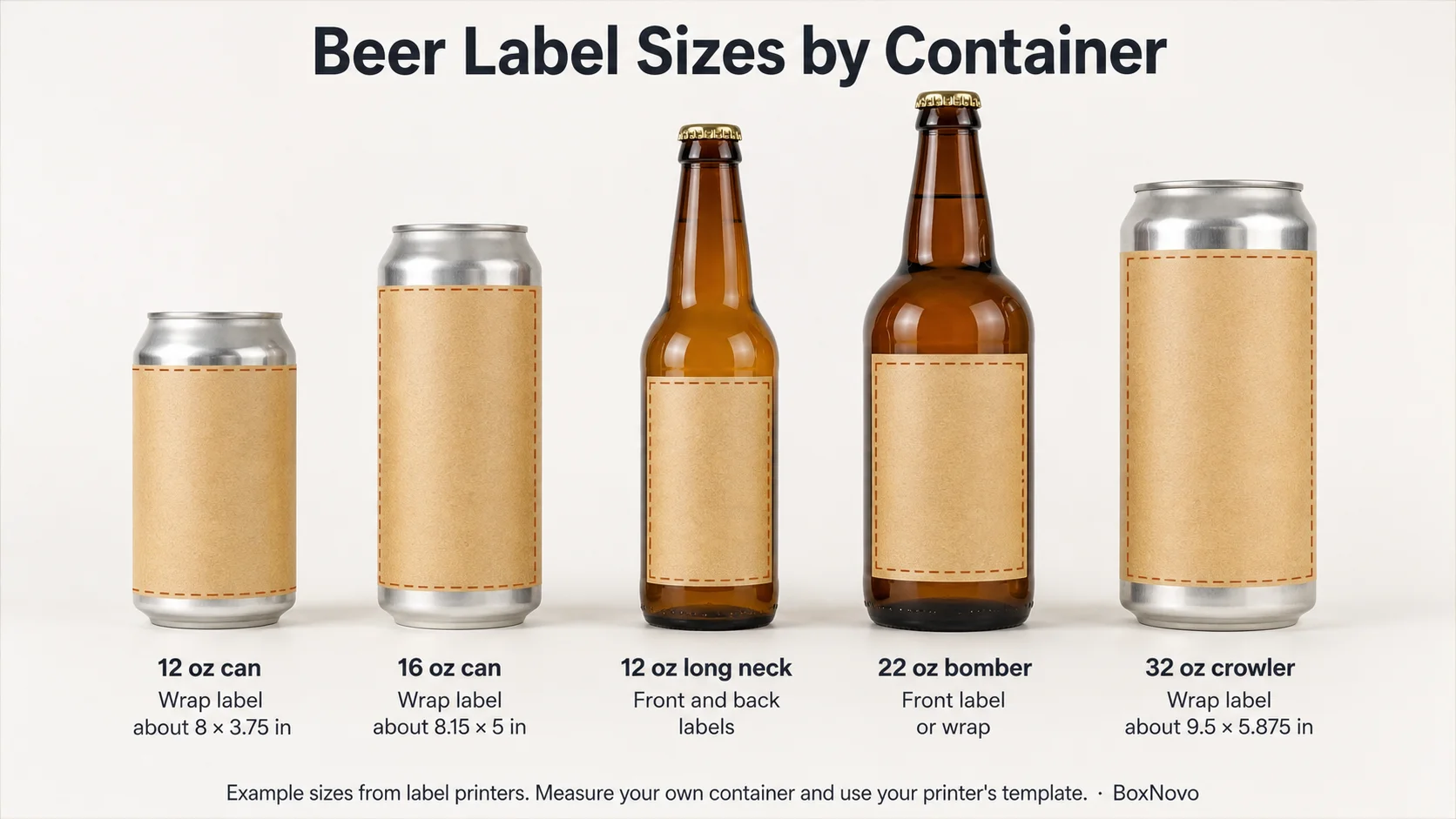
Typical beer label formats by container. Always measure your own bottle or can before ordering.
Minimum Text Sizes on Beer Labels
Federal rules set minimum heights for mandatory text and the health warning, and a maximum height for the alcohol statement. The health warning also has a limit on how tightly the letters can be packed.
Container size
Mandatory information, minimum
Health warning, minimum
Warning, max characters per inch
Alcohol statement, maximum
8 fl oz or less
1 mm
1 mm
40
3 mm
Over 8 up to 40 fl oz
2 mm
2 mm
25
3 mm
Over 40 up to 101 fl oz
2 mm
2 mm
25
4 mm
Over 101 fl oz (3 liters)
2 mm
3 mm
12
4 mm
Measure the height of the letters on a printed proof rather than relying on the font’s point size, because the same point size prints at different heights in different typefaces. When in doubt, size up.
Label Approval: COLAs and State Registration
Before a packaged beer enters interstate commerce, the brewer needs a Certificate of Label Approval (COLA) from TTB. Many states also require their own brand or label registration, often even for beer sold only in-state. Plan for both before you lock your print date, because a label returned for correction can delay a release.
Once a label is approved, some changes don’t need a new COLA. TTB’s list of allowable revisions includes changing colors and label shape, updating the net contents or alcohol content statement, and adding a QR code. Check the current list before you redesign.
Changes to Watch: Allergen and Alcohol Facts Labeling
Allergen declarations are currently voluntary for malt beverages. If you choose to declare one major food allergen, you must declare all of them. In January 2025, TTB proposed making major food allergen labeling mandatory and proposed a separate “Alcohol Facts” statement. These were proposals, not final rules, when we last checked. If you’re designing a long-running label system, leave space on the back label in case they become required.
Beer Label Design: How to Stand Out on the Shelf
Your label usually gets a few seconds of attention in a cooler or on a shelf. Good beer label design makes those seconds count, then rewards a closer look. For general principles that apply to any product, see our product label guide. The points below are specific to beer.
Build a Clear Hierarchy
Decide what a shopper should read first, second and third. For most craft beers that order is:
Beer name and artwork: the hook that gets the can picked up.
Brewery name or logo: who made it, so fans can find you again.
Style and strength: “Hazy India Pale Ale, 6.8% Alc/Vol” tells a buyer what to expect.
Details: tasting notes, hops, food pairings and the mandatory information.
Design for Three Distances
A beer label is seen from across the store, at arm’s length and in the hand. From a distance, color and one bold shape do the work. At arm’s length, the beer name and style must be readable. In the hand, the story, hops and pairing notes reward a closer look. If a design only works up close, it’s invisible in a cooler.
Keep the Front Facing Forward
On a round container, a shopper sees only about a third of the circumference head-on. Text that wraps further around the curve gets squeezed and is hard to read. Keep the beer name, style and key artwork in that center zone. The calculator below shows how wide it is for your container.
Beer Labels and Your Logo
Your brewery logo doesn’t have to be the biggest thing on the label. Many breweries keep the logo in the same spot and size on every label, and let each beer’s name and art change. That consistency makes a range easy to spot as one brand. Use a simplified, one-color version of the logo for small cans and neck labels so it stays crisp.
Create a Label System for Your Range
If you brew more than a few beers, design a template rather than one-off labels. Fix the logo position, the type styles and a dedicated zone for compliance text, then vary color and artwork by beer. A system speeds up new releases, keeps mandatory text in a consistent place for approvals and makes the range look planned. Strong, consistent packaging is one of the main ways packaging builds sales.
Color, Finishes and Effects
Color-code styles so regulars can find their favorite quickly, for example one color family per style or series.
Metallic labels or foil add a premium look, especially for barrel-aged or special releases.
Clear labels create a “no-label” look on glass. They need a white ink layer under the colors, or the artwork looks faded against the beer.
Matte, soft-touch or tactile varnish adds texture that people notice in the hand.
Get exact brand colors right before printing; you can match your brand colors across CMYK, RGB and HEX.
Artwork Setup Checklist
Work at final size on the printer’s template, with images at 300 dpi.
Extend backgrounds into the bleed (often 1/8 in) and keep text inside the safe area. Our guide shows how to set bleed margins correctly.
Keep text away from the seam on wrap labels and away from curved edges.
Reserve a compliance zone with a plain, contrasting background for the health warning and mandatory information.
Convert fonts to outlines or embed them before sending files.
Beer Label Sizes for Bottles and Cans
The right label size depends on the container’s circumference, the height of its straight, flat area and the label style you choose. Containers vary by manufacturer, so treat the sizes below as starting points and measure your own.
Container
Typical diameter
Common label style
Example label sizes from printers
12 oz standard can
About 2.6 in
Full wrap
8 × 3.75 in
16 oz can
About 2.6 in
Full wrap
About 8.15 × 5 in
12 oz long neck bottle
About 2.4 in
Front and back, or partial wrap
3 × 4 in or 3.5 × 4 in rectangles
22 oz bomber bottle
About 2.9 in
Front label or wrap
4 × 6 in or 4.875 × 8 in
32 oz crowler can
About 3 in
Full wrap
9.5 × 5.875 in
Container diameters from Dimensions.com and supplier listings; example label sizes from LabelValue, Sttark and Stomp. Sizes vary between printers, so confirm against your printer’s template.
Wrap, Front and Back, or Neck Labels?
Full wrap labels cover most of the container and suit cans, where the straight wall is tall and even. Leave a small gap where the ends meet unless the material is designed to overlap.
Front and back labels suit glass bottles. The front sells; the back carries the health warning, mandatory details and the story.
Neck labels add a premium touch, a batch number or a seasonal flag. Small round sticker labels also work on crowler lids and cap tops for extra branding. Mandatory information can’t go on the cap.
How to Measure a Bottle or Can
Find the circumference. Wrap a strip of paper around the container, mark where it overlaps and measure the strip. Or measure the diameter and multiply by 3.14.
Measure the straight wall. Measure from where the container starts to curve at the bottom to where it narrows at the shoulder or top. The label must fit inside this height.
Measure filled and chilled. Test on the real container your beer ships in, not a sample from a different supplier.
Allow a margin above and below the label so it doesn’t lift on a curve.
For boxes, pouches and other non-cylindrical packaging, use our tool to find a label size.
Can Labels vs. Shrink Sleeves vs. Printed Cans
Canning breweries have three main ways to brand a can:
Option
Best for
Trade-off
Pressure-sensitive can labels
Small and medium batches, many beers, frequent releases
Covers most, not all, of the can
Shrink sleeves
Full 360-degree coverage with bold, edge-to-edge art
Usually a higher cost per can and larger minimum orders than labels
Pre-printed cans
Very high volumes of one core beer
Large minimum orders, often 150,000 cans or more per design
Beer labels face cold, wet conditions that most product labels never see: condensation in coolers, hours in ice buckets and handling with wet hands. Choosing the right material matters more than almost any design detail.
Material
Water and ice resistance
Look
Best for
Coated paper
Low; can wrinkle or tear when wet
Smooth, economical
Gift bottles, dry shelf storage, short-term use
Wet-strength paper
Handles condensation; some grades resist ice buckets
Textured, premium, craft feel
Bottles in fridges and taprooms
White BOPP film
Waterproof and oil-resistant
Gloss or matte
Cans, coolers and ice buckets
Clear BOPP film
Waterproof
“No-label” look on glass
Glass bottles; needs a white ink layer
Metallic BOPP film
Waterproof
Silver or metallic shine
Premium and special releases
Shrink sleeve film
Waterproof; full coverage
Edge-to-edge printing
Cans with 360-degree designs
BOPP (biaxially oriented polypropylene) is the usual choice for cans and anything that will sit in ice. Some wet-strength papers can turn gray or lose opacity after time in an ice bucket, so test paper labels in ice water before ordering a large run.
If you’re choosing materials for your whole product line, you can compare packaging materials for boxes, bags and labels in one place.
Adhesives and Application
Use a permanent adhesive for bottles and cans. Federal rules require a label carrying the health warning to stay on unless it’s removed with water or solvents.
Apply to clean, dry, room-temperature containers. Labels applied to cold, wet containers often lift or wrinkle. If you must label cold or damp containers, ask for an adhesive made for those conditions.
Check the application temperature range on the material’s spec sheet, and the service temperature range for cold storage.
Ask for the right roll format if you use a labeling machine: core size, outside roll diameter and unwind direction must match your applicator.
Beer Label Printing Considerations
Choosing a Print Method
Print method
Best for
Trade-off
Digital label printing
Short runs, many beers, frequent releases and limited editions
Higher cost per label on very large runs
Flexographic printing
Long runs of core beers with stable designs
Plates and setup make short runs expensive
Embellishments (foil, embossing, tactile varnish)
Premium and special releases
Extra cost and setup
Home printing on sheet labels
Homebrew and one-off gifts
Limited durability; needs the right label stock for your printer
Most craft breweries use digital printing for seasonal and small-batch beers and move high-volume core beers to flexo as quantities grow. If you need printed bottle labels on rolls for hand or machine application, send your container size, label size, material and quantity for an exact quote.
Proof Before You Print
Print a full-size proof and wrap it around a filled container.
Check every line of mandatory text for spelling, size and placement.
Chill a sample label in ice water for a few hours, then check for lifting, wrinkling and smudging.
Look at it from 6 to 10 feet away to check that the beer name and style still read.
How to Make Beer Labels: Step by Step
Collect the information. Brand name, beer name, style, net contents, name and address, health warning, and alcohol content if required or wanted.
Measure your container and decide on the label style: wrap, front and back, or front only.
Work out the label size with the calculator above, then get the printer’s template for that size.
Design the artwork with a clear hierarchy, a compliance zone, bleed and a safe area.
Choose the material and finish based on how the beer will be stored and served.
Print a proof and test it on a filled, chilled container.
Get approvals if you’re selling: a COLA for interstate sales and any state registrations.
Print and apply to clean, dry containers, then store labeled stock before chilling.
Printable Beer Labels for Homebrewers
Homebrewers don’t need TTB label approval, because homebrew can’t be sold. Federal law lets an adult brew up to 100 gallons a year for personal or family use, or 200 gallons in a household with two or more adults, and that beer may not be sold or offered for sale (American Homebrewers Association). State and local laws can add limits. Labels for personal bottles can be whatever you like, but these tips make them work better:
Choose label stock made for your printer. Inkjet ink on plain paper labels can run when wet. Waterproof inkjet or laser labels hold up better in the fridge.
Use removable labels if you reuse bottles. They peel off cleanly for the next batch. For stubborn old labels, our guide to removing old labels covers safe methods.
Add batch details: brew date, bottling date, style and an estimated strength so you can track how each batch ages.
Use a free template. Many homebrewers design printable beer labels in Canva; these Canva printing tips help you get the size and quality right.
Make it a gift. For weddings, holidays and events, personalized gift labels printed professionally look sharper and last longer than home prints.
Root Beer Labels: Different Rules
Root beer usually isn’t beer at all. Most root beer is a non-alcoholic soft drink, so it follows US Food and Drug Administration (FDA) food labeling rules rather than TTB rules. The FDA Food Labeling Guide requires a statement of identity, net quantity of contents, an ingredient list, the name and place of business of the manufacturer, packer or distributor, nutrition labeling unless an exemption applies, and allergen declarations where they apply.
Alcoholic “hard” root beer is different. If it’s made as a flavored malt beverage, it falls back under TTB rules, usually with a statement of composition, and alcohol content is required when alcohol comes from added flavors. For soda brands, cafés and craft soda makers, food and drink labels need room for nutrition facts and ingredients, which changes the layout compared with a beer label.
Some beers made without malted barley or without hops, such as certain gluten-free beers, are also labeled under FDA rules rather than TTB rules. Check which agency covers your product before you design.
Beer Packaging Beyond the Label
The label is only part of how a beer is presented. Carriers, gift packs and shipping boxes are seen before the label in many sales.
Gift sets and variety packs:divided bottle boxes keep bottles apart and give you a large printed surface for the brand.
Online and club shipments:shipping boxes for bottles protect glass in transit. Check carrier and state rules for shipping alcohol before you sell online.
Taproom promotion:taproom table tents carry the label art onto tables to promote new releases.
Retail shelves: keep labels, carriers and displays visually consistent; our notes on shelf-ready retail design explain how.
Beer Label Mistakes to Avoid
Writing “ABV” or using “IPA” as the only style description on a US label.
Paraphrasing the health warning or setting it in type that’s too small or tightly packed.
Using plain paper labels on beer that will sit in ice or a wet cooler.
Designing on a flat screen without testing the label on a real, chilled container.
Running text across the seam of a wrap label.
Placing key artwork so far around the curve that shoppers can’t see it from the front.
Forgetting state label registration when planning a release date.
Ordering a huge flexo run for a beer that may change next season.
Beer Label Checklist
Mandatory information is complete: brand name, class and type, net contents, name and address, health warning, and alcohol content if required.
Text sizes meet the minimums for your container size, checked on a printed proof.
The label fits the straight wall with a margin, and wrap labels leave a seam gap.
The beer name and style are readable in the front-facing zone from a few feet away.
The material matches the conditions: BOPP or wet-strength paper for cold, wet use.
The adhesive suits your application temperature and the container surface.
Artwork has bleed, a safe area and correct colors.
Approvals are planned: COLA and any state registrations before release.
Frequently Asked Questions About Beer Labels
What information is required on a beer label?
In the US, a beer label must show the brand name, class and type, net contents, the bottler’s or importer’s name and address, and the government health warning. Alcohol content is required only when alcohol comes from added flavors or other non-beverage ingredients, though some states require it. Certain ingredients, such as sulfites at 10 ppm or more and FD&C Yellow No. 5, must be declared when present.
What size is a beer label for a 12 oz bottle?
There’s no single standard. Many 12 oz bottles use front labels around 3 × 4 in or 3.5 × 4 in, often with a matching back label. Measure the bottle’s straight area, because glass shapes vary, or use the calculator above.
What size label fits a 12 oz can?
A full wrap label for a standard 12 oz can is commonly about 8 × 3.75 in, which leaves a small gap at the seam. A 16 oz can uses a similar width with a taller label, around 5 in.
What is the best material for beer labels?
White, clear or metallic BOPP film is the most reliable choice for cans and for bottles that go into coolers or ice buckets, because it’s waterproof. Wet-strength paper gives a textured, craft look and handles condensation, but test it in ice water first.
Can I write “ABV” on a beer label?
Not on a US label regulated by TTB. Write the alcohol content as “Alc/Vol,” “Alc. by Vol.” or “alcohol by volume,” for example “6.2% Alc/Vol.”
Do beer labels need to show alcohol content?
Federally, it’s required only when the beer contains alcohol from added flavors or other non-beverage ingredients other than hops extract. Otherwise it’s optional, but some states require it and most drinkers expect it.
Do homebrew beer labels need TTB approval?
No. Homebrew is for personal or family use and can’t be sold, so it doesn’t go through TTB label approval. If you start selling beer, you’ll need the proper brewery permits and label approvals.
How do I make beer labels stay on cold, wet bottles?
Use a waterproof material such as BOPP with a permanent adhesive, and apply labels to clean, dry, room-temperature containers before chilling. If you must label cold or damp containers, ask for an adhesive designed for those conditions.
Are root beer labels the same as beer labels?
No. Non-alcoholic root beer is a soft drink, so it follows FDA food labeling rules, including an ingredient list and usually Nutrition Facts. Alcoholic hard root beer made as a flavored malt beverage follows TTB rules.
Create Beer Labels That Sell and Comply
The best beer labels start with the container and the rules, then add the design. Measure your bottles and cans, set your label size, reserve space for the mandatory text and pick a material that survives the cooler. Then build a label system that makes every new release instantly recognizable as yours.
If you’re ready to print, BoxNovo can help with label sizes, materials, finishes and proofs for every beer in your range. Request a label quote or browse our bottle packaging range for carriers and gift boxes.
BoxNovo Packaging Experts share practical insights on custom packaging, box styles, printing, labels, dimensions, materials, and product presentation. Our content helps businesses understand packaging options, choose the right solutions for their products, and create packaging that looks professional while supporting a stronger brand experience.