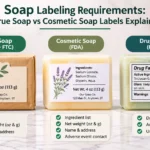
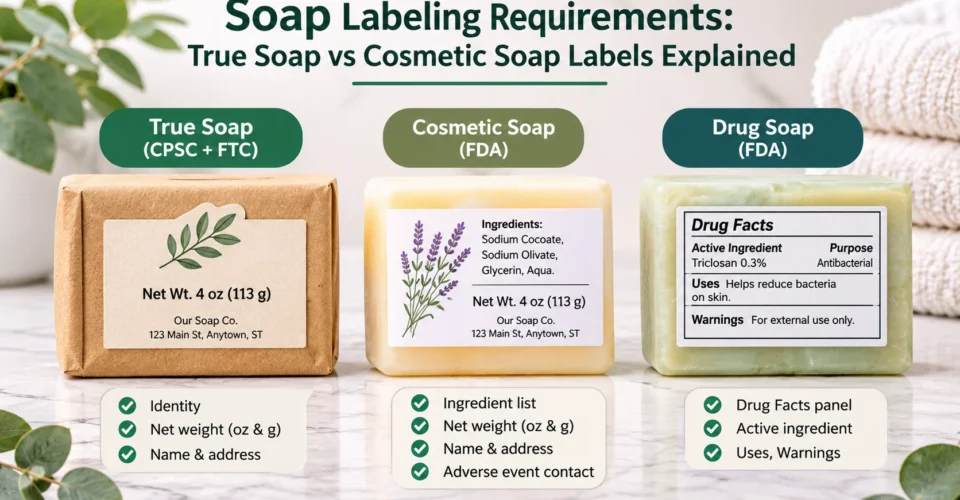
Quick answer: Soap labeling requirements depend on what your soap is. True soap (fats plus lye, sold only to clean) is regulated by the CPSC, and its package label needs the product identity, net weight in ounces and grams, and your business name and address. Soap with cosmetic claims follows FDA cosmetic labeling, including an ingredient list, and soap with drug claims needs an FDA Drug Facts label.
Key facts at a glance
- True soap: mainly alkali salts of fatty acids, cleaning only through them, and sold only as soap (21 CFR 701.20)
- Regulators: CPSC for true soap; FDA for cosmetic and drug soaps
- Claims decide: “moisturizing” or “deodorizing” makes it a cosmetic; “antibacterial” or “treats acne” makes it a drug
- Net weight: in both units, such as “Net Wt 15 oz (425 g)”, in the bottom 30% of the front panel (unless that panel is 5 sq in or less)
- Cosmetic soap: ingredient list in descending order, at least 1/16 in tall (1/32 in on packages with less than 12 sq in for labeling), plus a US contact for adverse event reports
- Children’s soap: soap mainly for kids 12 and under needs a permanent tracking label, third-party lead testing and a Children’s Product Certificate
Rules in this guide come from FDA, CPSC, FTC and federal regulations listed in the Sources section. This is general guidance, not legal advice; check with the agency or a regulatory specialist for your product.
In this guide
- Three types of soap, three sets of rules
- What counts as true soap
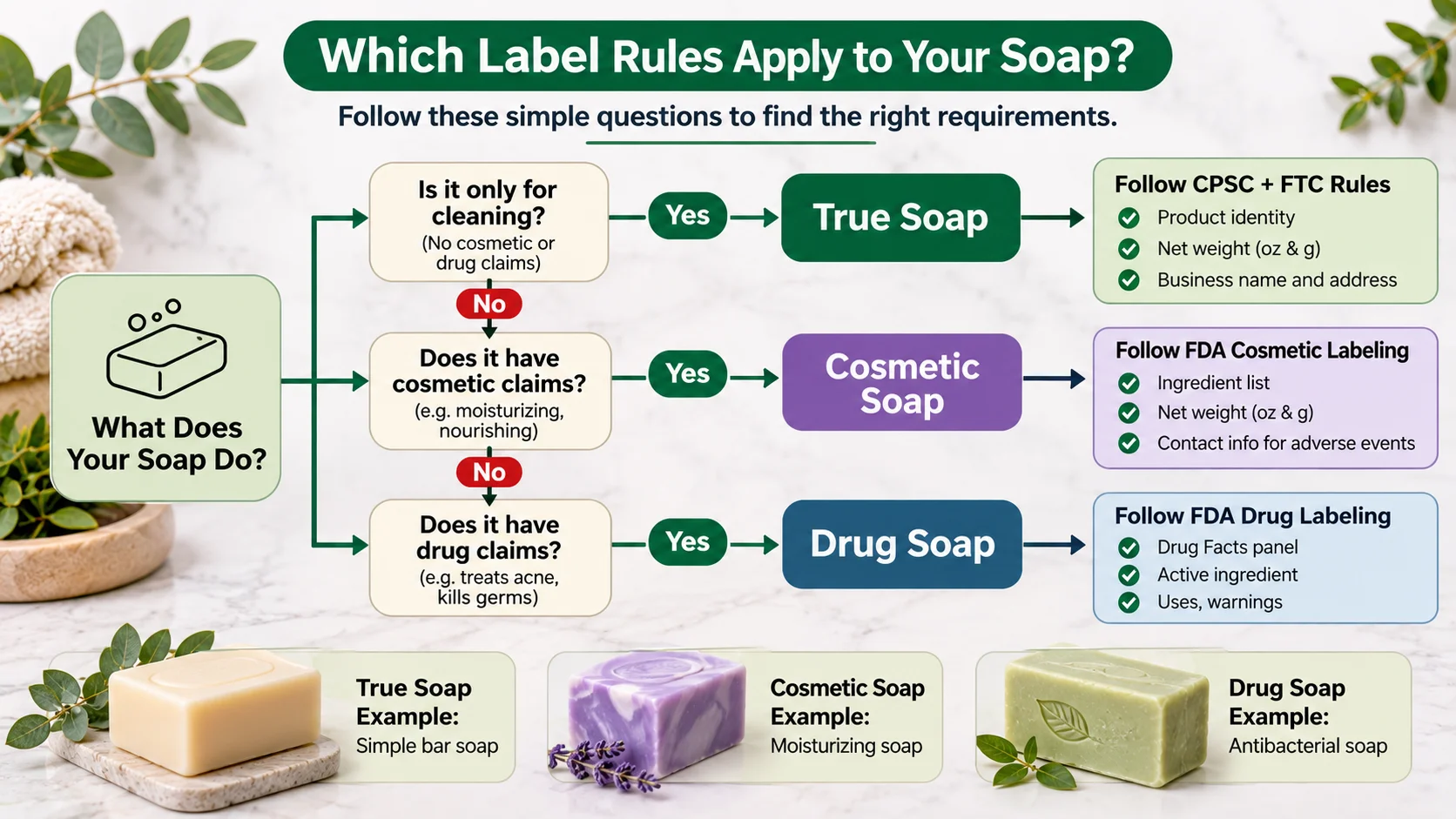
- Claims that change the rules
- Soap label requirements for true soap
- FDA soap labeling for cosmetic soap
- Soap ingredient label
- Drug soap labels
- Children’s soap
- How to label handmade soap
- Labels on sleeves, envelopes and boxes
- Common mistakes
- Soap label checklist
- Frequently asked questions
- Sources
Soap Labeling Requirements Depend on What Your Soap Is
In the US, “soap” can be one of three different products in the eyes of the law. The category decides which agency regulates it and what the label must say.
| Category | What It Is | Regulated By | Main Label Rules |
|---|---|---|---|
| True soap | Fats or oils plus an alkali, cleaning only, no cosmetic or drug claims | CPSC (safety); FTC (package labeling under the Fair Packaging and Labeling Act) | Identity, net quantity, name and place of business; warnings only if hazardous |
| Cosmetic soap | Soap or detergent cleanser with cosmetic claims, or a synthetic detergent bar | FDA | Cosmetic labeling: identity, net quantity, ingredients, name and place of business, adverse event contact, any warnings |
| Drug soap | Soap that claims to treat or prevent disease, such as killing germs or treating acne | FDA | OTC drug labeling with a Drug Facts panel; must meet OTC monograph or approval rules |
A product can also be both a cosmetic and a drug, such as a moisturizing antibacterial bar, and then it must meet the requirements for both.
What Counts as True Soap?
The Food, Drug, and Cosmetic Act does not define soap, so FDA applies the term only to products that meet all three conditions in 21 CFR 701.20:
- Composition: most of the non-volatile matter is alkali salts of fatty acids, the result of combining fats or oils with lye.
- Cleaning action: those alkali salts do the cleaning. If the product contains synthetic detergents, FDA treats it as a cosmetic, not soap.
- Intended use: the product is labeled, sold and represented only as soap.
Most traditional cold process and hot process bars meet the first two conditions. FDA notes that most body cleansers sold in stores, liquid and solid, are actually synthetic detergent products. Those are cosmetics even when the label says “soap.”
Claims That Change Soap Labeling Requirements
The third condition is where most handmade soap labels go wrong. The words on your label, website and social posts show the intended use, and that can move a true soap into FDA territory.
| Claim on the Label or in Marketing | Category |
|---|---|
| “Cleans,” “soap,” “bar soap” | True soap (if it also meets the composition rules) |
| “Moisturizing,” “nourishes skin” | Cosmetic |
| “Deodorizing,” “makes you smell nice” | Cosmetic |
| “Antibacterial,” “kills germs” | Drug |
| “Treats acne,” “relieves eczema” | Drug |
Examples follow FDA’s soap guidance. CPSC also notes that ingredients commonly recognized as cosmetic can point to cosmetic use even without a written claim, so ask FDA if you are unsure about a recipe.
Soap Labeling Requirements for True Soap
CPSC says it has no soap-specific labeling requirements. True soap falls under the Federal Hazardous Substances Act and the Consumer Product Safety Act, and it needs precautionary labeling only if it meets the definition of a hazardous substance, which CPSC says is uncommon and usually limited to strong degreasing soaps that could irritate the eyes.
Package labeling still applies. Soap is a consumer commodity under the Fair Packaging and Labeling Act, which the FTC administers for soaps and detergents. Its rules (16 CFR Part 500) require:
| Label Element | Rule |
|---|---|
| Statement of identity | On the principal display panel (the front), as a main feature, for example “Soap” or “Lavender Soap” |
| Net quantity | By weight for a bar, in both ounces and grams, for example “Net Wt 15 oz (425 g)” |
| Net quantity placement | Within the bottom 30% of the front panel, parallel to the base; this placement rule does not apply when the front panel is 5 sq in or less |
| Net quantity type size | At least 1/16 in for a front panel of 5 sq in or less; 1/8 in for over 5 to 25 sq in; 3/16 in for over 25 to 100 sq in |
| Name and place of business | Manufacturer, packer or distributor, with “Manufactured for” or “Distributed by” if you did not make it; the street address may be left off if your business is listed in a current city or telephone directory |
An ingredient list is not required for true soap, because the ingredient rule (21 CFR 701.3) is a cosmetic rule. Many makers list ingredients anyway because customers ask for them; if you do, keep the list accurate. States can also apply their own weights and measures rules.
FDA Soap Labeling for Cosmetic Soap
Once a soap is a cosmetic, FDA soap labeling follows the general cosmetic rules:
| Element | Where It Goes | Rule |
|---|---|---|
| Product identity | Front panel | The name of the product and what it is |
| Net quantity | Front panel, bottom 30% (unless the panel is 5 sq in or less) | By weight for a bar; FDA’s soap rule says bar products are labeled in avoirdupois pounds and ounces, and metric may be added |
| Ingredient list | Any information panel | Descending order of predominance; ingredients at 1% or less and color additives may follow in any order; letters at least 1/16 in, or 1/32 in if the package has less than 12 sq in for labeling |
| Name and place of business | Information panel | With “Manufactured for” or “Distributed by” if not the maker |
| Adverse event contact | Label | Under MoCRA, a domestic address, domestic phone number or electronic contact (such as a website), required since December 29, 2024 |
| Warnings | Label | Where a product needs one under 21 CFR 740 |
Registration: MoCRA also requires cosmetic facility registration and product listing. Businesses averaging under $1 million a year in cosmetic sales over the previous three years are generally exempt from registration and listing, but not from labeling or adverse event recordkeeping. For the full cosmetic label rules on boxes, see this guide to product label design.
Soap Ingredient Label: How to List Ingredients
- Order: list ingredients above 1% from most to least; those at 1% or less and color additives can follow in any order.
- Fragrance: may be listed as “fragrance.”
- Saponified oils: some makers list what went into the pot (oils, water, sodium hydroxide); others list the finished soap (such as “sodium olivate”). Choose the names FDA’s ingredient rule calls for and use them consistently.
- Size: at least 1/16 in letters, or 1/32 in on a small package.
- Placement: any information panel, or a firmly attached tag, tape or card if space is lacking.
Drug Soap Labels: Antibacterial and Acne Claims
A soap that claims to kill germs or treat a skin condition is an over-the-counter (OTC) drug. It must meet OTC monograph or new drug approval requirements, the firm must register and list with FDA, and the label needs a Drug Facts panel.
| Drug Facts Heading (in order) |
|---|
| Drug Facts (title) |
| Active ingredient(s) |
| Purpose(s) |
| Use(s) |
| Warning(s) |
| Directions |
| Other information |
| Inactive ingredients |
| Questions or comments? |
Most Drug Facts text must be at least 6-point type, and headings at least 8-point. Antibacterial claims carry extra risk: FDA’s final rule of September 6, 2016 ended the marketing of consumer antiseptic washes containing any of 19 active ingredients, including triclosan and triclocarban, from September 6, 2017. Benzalkonium chloride, benzethonium chloride and chloroxylenol were deferred for further review. For most handmade soap makers, the simplest path is to avoid drug claims entirely.
Children’s Soap: Extra CPSC Requirements
A true soap designed primarily for children 12 and under is a children’s product. CPSC requires:
- A permanent tracking label on the product and its packaging, to the extent practicable, showing the manufacturer or private labeler name, the location and date of production, and batch or run information.
- Third-party testing for total lead content by a CPSC-accepted laboratory.
- A Children’s Product Certificate confirming the soap meets the applicable rules.
Shapes, characters and “for kids” wording can all signal a children’s product, so decide on the target age before designing the label.
How to Label Handmade Soap: Step by Step
These steps turn the soap label requirements above into a finished label for a handmade bar.
- Classify the bar: check the recipe against the three true soap conditions and review every claim on the label, website and social media.
- Write the identity for the front panel, such as “Oatmeal Goat Milk Soap.”
- Weigh finished, cured bars and print a net weight you can meet, in ounces and grams.
- Add your business name and address, with “Distributed by” if someone else makes the soap.
- For cosmetic soap, add the ingredient list and the adverse event contact.
- Check type sizes against the front panel and total label area.
- Remove risky claims such as “antibacterial,” “heals” or “treats” unless you intend to sell a drug.
- Proof the label on the actual sleeve, envelope or box before printing.
Cold process soap label example (true soap): front panel with “Lavender Soap” and “Net Wt 4 oz (113 g)” at the bottom; back or side panel with “Made by” plus your business name, city, state and ZIP. Add an optional ingredient list and a lot number to help trace batches.
Size the label area with the label size recommender, and print on soap bar label stock that stands up to handling.

Soap Labels on Sleeves, Envelopes and Boxes
The required information goes on the label of the package the customer sees, and the principal display panel is the part most likely to be displayed. Each soap package format handles this differently:
| Format | Front Panel | Information Panel | Watch Out For |
|---|---|---|---|
| Paper sleeve or belly band | Center of the band | Back of the band | Small total area: plan type sizes early |
| Paper soap envelope | Front flap side | Back panel | Seal and flap must not cover required text |
| Folding box | Main front panel | Side or back panels | Most room for ingredients and claims |
| Window box | Panel around the window | Side or back panels | Do not lose required text to the window cut-out |
| Shrink wrap with a sticker | Sticker on the top face | Second sticker on the back | Labels must stay readable through handling |
Small package example: a 1.5 in wide sleeve around a bar that is 2 in wide and 1 in thick wraps a 6 in perimeter, so the sleeve offers about 9 sq in of label space. For a cosmetic soap, that is under 12 sq in, so the ingredient list may be as small as 1/32 in.
Label materials: soap labels meet wet hands and oils, so choose water-resistant stock; this sticker material guide compares paper, vinyl and clear options. Keep required text away from folds and trim with the bleed and safe zones guide.
Unwrapped bars: labeling rules are built around a package label. If you sell bars loose, ask the regulator or your state weights and measures office how to present the required information.
Compare printed soap sleeves, paper soap envelopes and window soap boxes, see handmade soap box styles, or browse all custom soap packaging options.
Common Soap Labeling Mistakes
| Mistake | Fix |
|---|---|
| “Moisturizing” on a true soap label | Remove the claim or label the bar as a cosmetic |
| “Antibacterial” or “heals eczema” on handmade soap | Remove drug claims unless you meet OTC drug requirements |
| Net weight in ounces only | Show both units, such as “Net Wt 4 oz (113 g)” |
| Net weight from uncured bars | Weigh cured bars; soap loses water as it cures |
| Net weight placed at the top of the front | Place it in the bottom 30% of the front panel |
| Cosmetic soap with no ingredient list | Add ingredients in descending order of predominance |
| No US contact on a cosmetic soap | Add a domestic address, phone or website for adverse events |
| Kids’ soap with no tracking label | Add a permanent tracking label and complete testing and certification |
Soap Label Checklist
- Category decided: true soap, cosmetic, drug or both.
- Every claim on the label and online checked.
- Statement of identity on the front panel.
- Net weight in ounces and grams, from cured bars, in the bottom 30% of the front panel.
- Type size checked against the front panel area.
- Business name and address, with “Distributed by” if needed.
- Cosmetic soap: ingredients in descending order and an adverse event contact.
- Drug soap: Drug Facts panel and FDA registration and listing.
- Children’s soap: tracking label, lead testing and Children’s Product Certificate.
- Label proofed on the actual sleeve, envelope or box.
Frequently Asked Questions
What are the soap labeling requirements in the US?
True soap needs the product identity, net weight in ounces and grams, and the business name and address. Cosmetic soap also needs an ingredient list and an adverse event contact; drug soap needs a Drug Facts panel.
Does the FDA regulate soap?
Not true soap. CPSC regulates true soap, while FDA regulates soap that makes cosmetic or drug claims and synthetic detergent bars.
What is true soap?
A product mainly made of alkali salts of fatty acids, which do the cleaning, and labeled and sold only as soap.
Do I have to list ingredients on handmade soap?
Not for true soap. Cosmetic soap must list ingredients in descending order of predominance.
Does “moisturizing” make soap a cosmetic?
Yes. Claims such as moisturizing, deodorizing or making the user smell nice make the product a cosmetic.
Can I call my soap antibacterial?
Only if you meet FDA’s OTC drug requirements, because “antibacterial” and “kills germs” are drug claims.
How should net weight appear on a soap label?
In both units, such as “Net Wt 4 oz (113 g)”, in the bottom 30% of the front panel unless the panel is 5 sq in or less.
How big must the net weight text be?
At least 1/16 in on a front panel of 5 sq in or less, 1/8 in for over 5 to 25 sq in, and 3/16 in for over 25 to 100 sq in.
What is the minimum size for a soap ingredient list?
At least 1/16 in tall, or 1/32 in if the package has less than 12 sq in available for labeling.
What must a cold process soap label include?
If it is true soap: identity, net weight in ounces and grams, and your business name and address. Add more if the label makes cosmetic or drug claims.
Do I need to register my soap with the FDA?
Not true soap. Cosmetic soap falls under MoCRA registration and listing, though many small businesses with under $1 million in average annual sales are exempt. Drug soap must be registered and listed.
What is MoCRA’s label requirement for cosmetic soap?
Since December 29, 2024, cosmetic labels must include a domestic address, domestic phone number or electronic contact for adverse event reports.
What extra rules apply to children’s soap?
Soap mainly for children 12 and under needs a permanent tracking label, third-party lead testing and a Children’s Product Certificate.
Can the label go on a soap sleeve?
Yes. A sleeve can carry the full label if the front shows the identity and net weight and the back holds the rest.
Do I need my street address on a soap label?
Under the FTC rules, the street address may be omitted if your business is listed in a current city or telephone directory.
What happens if my soap is both a cosmetic and a drug?
It must meet both sets of requirements, including cosmetic and drug labeling.
Final Takeaway
Soap labeling requirements start with one question: is it true soap, a cosmetic or a drug? Keep claims to cleaning and a true soap label needs only identity, a dual-unit net weight and your business details. Add cosmetic claims and you need FDA cosmetic labeling with an ingredient list and adverse event contact; add drug claims and you need a Drug Facts panel. Then design the sleeve, envelope or box so every required line fits where the rules put it.
Need labels and packaging that fit your soap and its required text? Browse the soap box collection, then request a soap quote.
Sources
- FDA: Frequently Asked Questions on Soap
- 21 CFR 701.20: Detergent substances other than soap (Cornell LII)
- CPSC: Soap business guidance
- CPSC: Tracking labels for children’s products
- California Division of Measurement Standards: FTC jurisdiction over soaps and detergents (QC 15-12)
- 16 CFR Part 500: Fair Packaging and Labeling Act regulations
- 16 CFR 500.6: Net quantity location (Cornell LII)
- 16 CFR 500.21: Type size (Cornell LII)
- FDA: Summary of Cosmetics Labeling Requirements
- 21 CFR 701.3: Designation of ingredients (GovInfo)
- 21 CFR 701.13: Net quantity of cosmetics (Cornell LII)
- ArentFox Schiff: MoCRA labeling requirements
- Registrar Corp: MoCRA small business exemptions
- 21 CFR 201.66: OTC Drug Facts labeling (Cornell LII)
- ArentFox Schiff: FDA final rule on consumer antimicrobial washes