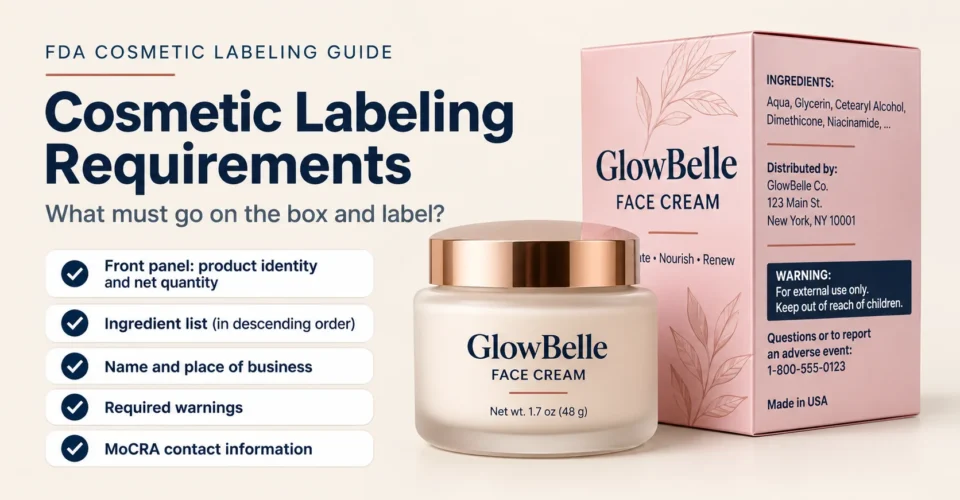
Quick answer: Under U.S. cosmetic labeling requirements, the front panel must show the product’s identity and net quantity. Another panel must show the ingredient list in descending order, the name and place of business, any required warnings and, under MoCRA, contact details for adverse event reports. These rules come from the FDA, the FD&C Act and the Fair Packaging and Labeling Act.
Key facts at a glance
- Front panel (PDP): product identity in bold type, plus the net quantity in the bottom 30% of the panel
- Net quantity units: fluid ounces for liquids; net weight in ounces for creams, solids and powders. Metric may be added
- Ingredients: descending order of predominance, letters at least 1/16 inch tall (1/32 inch if the package has less than 12 square inches for labeling)
- Name and place of business: street address, city, state and ZIP, with “Distributed by” or “Manufactured for” if you did not make the product
- Warnings: bold, on a contrasting background, at least 1/16 inch tall; set wording for aerosols, bubble bath, tanning products and more
- MoCRA: since December 29, 2024, labels must include a domestic address, domestic phone number or electronic contact (such as a website) for adverse event reports
- No pre-approval: FDA does not approve cosmetic labels before sale; the brand is responsible for getting them right
Every rule in this guide is checked against FDA guidance and the Code of Federal Regulations, listed in the Sources section. This is general guidance, not legal advice; confirm your final label with a regulatory specialist.
In this guide
- Who sets cosmetic labeling rules
- Cosmetic, drug or both?
- Requirements at a glance
- Front panel: identity and net quantity
- Information panel: name and address
- Cosmetic ingredient list order
- Required warning statements
- MoCRA labeling
- Box vs container
- Optional claims and extras
- Designing a compliant box and label
- Common mistakes
- Labeling checklist
- FAQs
- Sources
Who Sets Cosmetic Labeling Requirements in the U.S.?
The FDA enforces cosmetic labeling requirements under two laws: the Federal Food, Drug, and Cosmetic Act (FD&C Act) and the Fair Packaging and Labeling Act (FPLA). The detailed rules are in Title 21 of the Code of Federal Regulations, mainly Part 701 (labeling) and Part 740 (warning statements). The Modernization of Cosmetics Regulation Act of 2022 (MoCRA) added new label requirements on top of these.
FDA does not pre-approve cosmetic products or their labels, except that some color additives need approval for their intended use (FDA). That puts the responsibility on the brand. A box or label that misses a required statement can make the product misbranded, and the fix usually means reprinting.
In regulatory terms, the label is the printed matter on the container itself, and labeling includes anything that accompanies the product, such as the outer box, inserts and hang tags. That is why FDA cosmetic labeling requirements apply to your printed packaging as much as to the sticker on the bottle.
Is Your Product a Cosmetic, a Drug or Both?
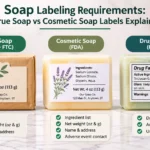
Check this before you design anything. The FD&C Act defines cosmetics by intended use: products applied to the body for cleansing, beautifying or promoting attractiveness. A product intended to treat or prevent disease, or to affect the structure or function of the body, is a drug. Some products are both, and they must meet the rules for both (FDA).
| Product | Classification | What It Means for the Label |
|---|---|---|
| Moisturizer, lipstick, mascara, nail polish, perfume | Cosmetic | Cosmetic labeling rules in this guide |
| Moisturizer or foundation with SPF claims | Cosmetic and drug | Drug Facts panel; active ingredients listed first |
| Antiperspirant deodorant | Cosmetic and drug | Drug Facts panel for the antiperspirant claim |
| Antidandruff shampoo | Cosmetic and drug | Drug Facts panel for the dandruff claim |
| Fluoride toothpaste | Cosmetic and drug | Drug Facts panel because of the fluoride |
Claims decide the category as much as ingredients do. Words like “treats acne,” “repairs damaged skin cells” or “stimulates hair growth” on a box or website can turn a cosmetic into a drug. Drug and drug-cosmetic products also need an expiration date, which pure cosmetics do not (FDA). The rest of this guide covers products that are cosmetics only.
Cosmetic Labeling Requirements at a Glance
Most cosmetic label requirements fall on two areas of the package: the principal display panel (the front the shopper sees) and the information panels (sides and back).
| Element | Where | Key Rule | Regulation |
|---|---|---|---|
| Identity statement | Principal display panel | What the product is, in bold type | 21 CFR 701.11 |
| Net quantity of contents | Principal display panel | Bottom 30% of the panel, parallel to the base, minimum type size by panel area | 21 CFR 701.13 |
| Name and place of business | Information panel | Manufacturer, packer or distributor, with street address, city, state and ZIP | 21 CFR 701.12 |
| Ingredient declaration | Information panel, outer box, or a firmly attached tag or card | Descending order of predominance; minimum 1/16 inch letters | 21 CFR 701.3 |
| Warning statements | Usually information panel; the “safety not determined” warning goes on the front | Bold, contrasting background, minimum 1/16 inch | 21 CFR 740 |
| Adverse event contact | Label | Domestic address, domestic phone number or electronic contact | MoCRA (FD&C Act) |
| Country of origin (imports) | Label | English name of the country of origin | Tariff Act |
All required information must be in English. If the label includes any statement in another language, the required information must also appear in that language (21 CFR 701.2).
Principal Display Panel: Identity and Net Quantity
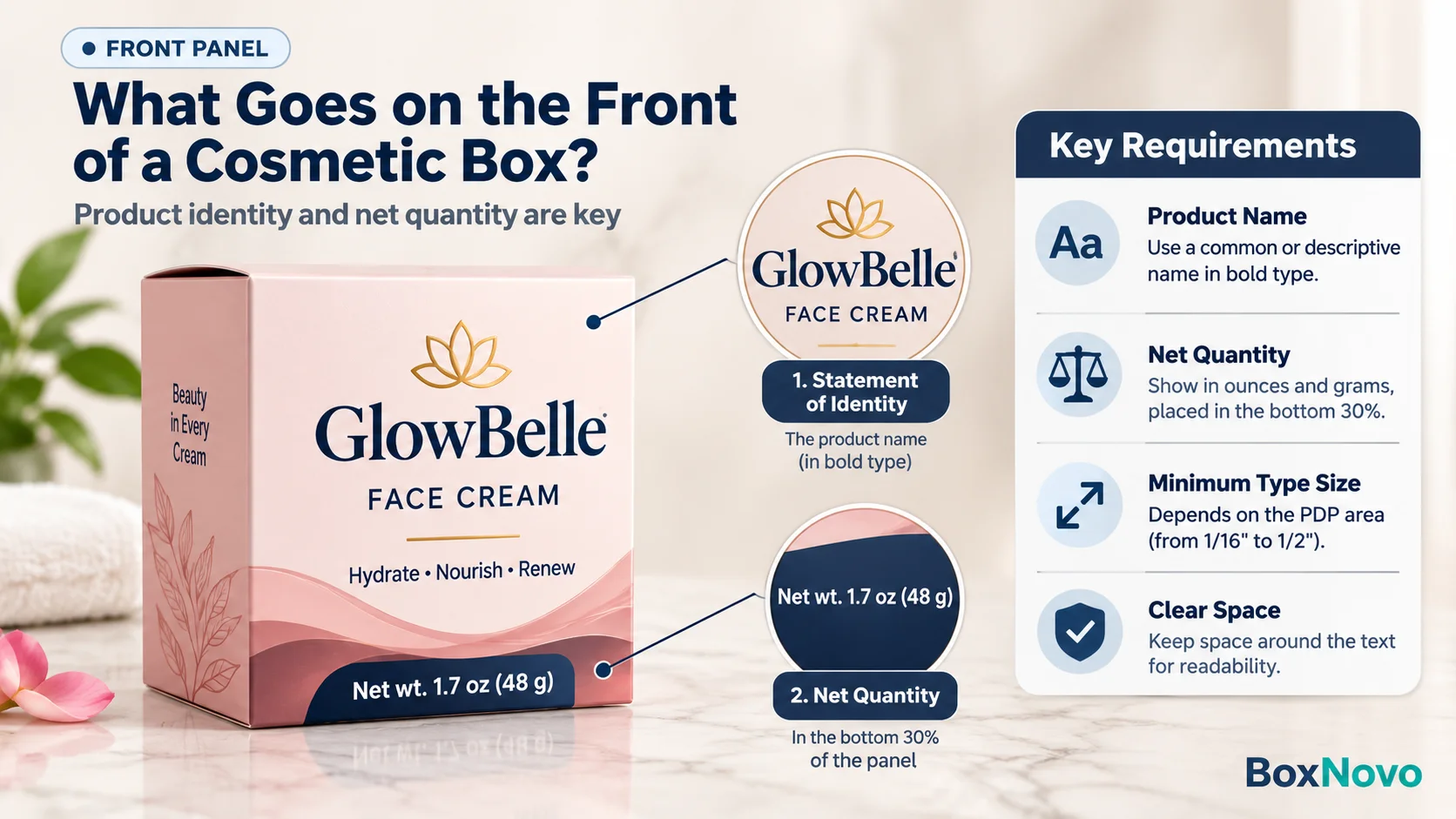
The principal display panel (PDP) is the part of the package most likely to be seen at the time of purchase, usually the front of the box. Its size sets the minimum type size for the net quantity statement, so measure it before you design.
How to Measure the Principal Display Panel
| Package Shape | PDP Area | Example |
|---|---|---|
| Rectangular box | One entire side | Front panel 2 in wide x 5 in tall = 10 sq in |
| Cylinder (bottle, jar, tube) | 40% of height x circumference | 4 in tall x 6 in around: 0.4 x 4 x 6 = 9.6 sq in |
| Other shapes | 40% of the total container surface | Excluding top, bottom, neck, shoulders and flanges |
If a package has more than one principal display panel, for example a box designed to be displayed from either side, the required PDP information must appear on each one (FDA Cosmetic Labeling Guide).
Identity Statement
The identity statement tells the shopper what the product is: “face cream,” “nail polish,” “eau de parfum,” “hair spray.” It must appear on the PDP in bold type. You can use a common name, a descriptive name or, when the nature of the product is obvious, a fanciful name or an illustration. A brand name alone, such as “Glow No. 5,” is not an identity statement unless it is obvious what the product is.
Net Quantity of Contents
The net quantity statement follows strict rules in 21 CFR 701.13 (21 CFR 701.13):
- Units: liquids in U.S. fluid ounces; solids, semisolids, viscous products and mixtures by weight in avoirdupois ounces and pounds.
- Wording: weight must say “net weight” or “net wt.” (“Net wt. 1.7 oz”). For fluid measure, “net” or “net contents” is optional (“1 fl oz”).
- One pound or one pint or more: state ounces first, then larger units in parentheses: “Net wt. 24 oz (1 lb 8 oz).”
- Metric: you may add grams or milliliters, as long as the metric figure is accurate.
- Aerosols: declare the net quantity that will be expelled when the product is used as directed, including the propellant.
- Placement: within the bottom 30% of the PDP, in lines generally parallel to the base. PDPs of 5 square inches or less are exempt from the bottom 30% rule.
- Clear space: keep space above and below equal to the height of the lettering, and space to the left and right equal to twice the width of the letter “N” in that type.
Minimum Type Size for the Net Quantity
| PDP Area | Minimum Letter Height | Typical Package |
|---|---|---|
| 5 sq in or less | 1/16 in (about 1.6 mm) | Lip balm, sample vials, small nail polish |
| More than 5 to 25 sq in | 1/8 in (about 3.2 mm) | Serum boxes, lipstick cartons, small cream jars |
| More than 25 to 100 sq in | 3/16 in (about 4.8 mm) | Larger skincare boxes, gift sets |
| More than 100 sq in | 1/4 in (about 6.4 mm) | Large kits and bundles |
| More than 400 sq in | 1/2 in (about 12.7 mm) | Very large display packs |
Letter height is measured on the lowercase “o” or an equivalent letter when lowercase is used, and letters may not be more than three times as high as they are wide. For text blown, embossed or molded into glass or plastic, add 1/16 inch to the minimum. Because height is measured on the letter itself, a point size alone does not prove compliance: the same point size can be taller or shorter depending on the font.
Example: a cream jar box with a 2 x 5 inch front panel has a 10 sq in PDP, so “Net wt. 1.7 oz (48 g)” needs letters at least 1/8 inch tall, placed in the bottom 30% of the front panel.
Information Panel: Name, Address and Contact Details
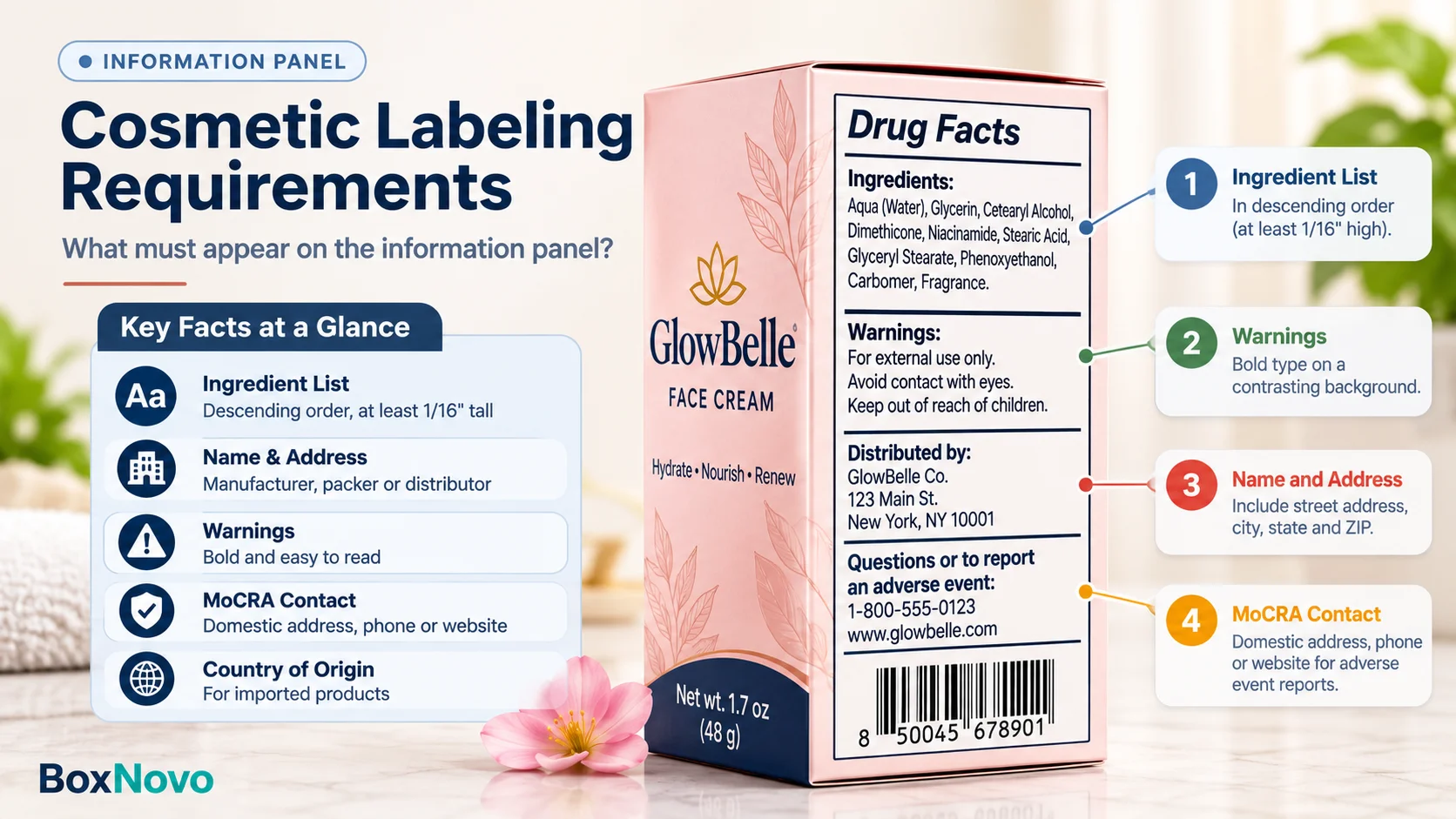
Information panels are the sides and back of the package. They carry the name and place of business, ingredients, warnings, directions for safe use and the MoCRA contact information.
The name and place of business must show the manufacturer, packer or distributor, including the street address, city, state and ZIP code. A corporation must use its actual corporate name. The street address may be left off only if the business is listed in a current city or telephone directory (21 CFR 701.12).
If your business did not make the product, the name must be qualified to show your role, with wording such as “Manufactured for ___” or “Distributed by ___.” This is common for brands using a contract manufacturer or private label supplier.
Cosmetic Ingredient List Order and Rules
Retail cosmetics must declare their ingredients (21 CFR 701.3). The cosmetic ingredient list order and format follow these rules:
- Descending order of predominance: the ingredient present in the largest amount comes first.
- 1% rule: ingredients at 1% or less may follow in any order, after the ingredients above 1%.
- Color additives: may be listed in any order after the other ingredients.
- “May contain”: shade ranges (such as a line of lipsticks or eyeshadows) may list color additives used across the range under “may contain,” under the conditions in the regulation.
- Fragrance and flavor: may be listed simply as “fragrance” or “flavor.” MoCRA will require listing fragrance allergens once FDA issues its rule (see MoCRA labeling).
- Trade secrets: only after FDA accepts a trade secret request may an ingredient be replaced by “and other ingredients” at the end of the list.
- Drug-cosmetics: active drug ingredients come first as “Active Ingredients,” followed by cosmetic ingredients as “Inactive Ingredients.”
Use standard ingredient names. FDA’s rule points to names set by FDA or listed in the industry’s cosmetic ingredient dictionary, which most brands know as INCI names.
Where the Ingredient List Can Go
- Information panel of the box or container, in letters at least 1/16 inch tall.
- Small packages: letters may drop to 1/32 inch if the package has less than 12 square inches available for labeling.
- Tag, tape or card: a firmly attached tag, tape or card can carry the list when the package has too little space or is decorative.
- Display units: for some small products sold from tightly compartmented trays or racks, the list can be shown on the display. The display must say “Federal law requires ingredient lists to be displayed here” in letters at least 3/16 inch tall, with copies available to shoppers.
- Direct mail: products sold only by mail can put the list in accompanying labeling, with a notice of at least 3/16 inch on the package.
The ingredient list is an FPLA requirement, so it must be on the outer package that the shopper sees. If the product sits in a box, the list goes on the box; the bottle inside does not need its own ingredient list (FDA).
Required Warning Statements
A cosmetic must carry a warning whenever one is needed to prevent a health hazard (21 CFR 740.1). Warnings must be prominent and conspicuous, in bold type on a contrasting background, and at least 1/16 inch tall unless another size is approved (21 CFR 740.2). FDA has set exact wording for these product types:
| Product Type | Required Wording (Summary) | Regulation |
|---|---|---|
| Any cosmetic whose safety has not been adequately substantiated | “Warning—The safety of this product has not been determined.” (on the principal display panel) | 21 CFR 740.10 |
| Aerosols (hair spray, dry shampoo, body spray) | “Warning—Avoid spraying in eyes. Contents under pressure. Do not puncture or incinerate. Do not store at temperature above 120 °F. Keep out of reach of children.” | 21 CFR 740.11(a) |
| Aerosols with halocarbon or hydrocarbon propellants | Also: “Warning—Use only as directed. Intentional misuse by deliberately concentrating and inhaling the contents can be harmful or fatal.” (some exemptions apply) | 21 CFR 740.11(b) |
| Feminine deodorant sprays | Begins “Caution—For external use only. Spray at least 8 inches from skin. Do not apply to broken, irritated, or itching skin.” | 21 CFR 740.12 |
| Foaming detergent bath products (bubble bath) | Begins “Caution—Use only as directed. Excessive use or prolonged exposure may cause irritation to skin and urinary tract.” (adult-only products exempt) | 21 CFR 740.17 |
| Tanning products without sunscreen | Begins “Warning—This product does not contain a sunscreen and does not protect against sunburn.” | 21 CFR 740.19 |
For aerosols, “break” may replace “puncture” on glass containers, “Avoid spraying in eyes” may be left off products that are not sprays, and children’s products may add “except under adult supervision” to the last sentence (21 CFR 740.11). Where this table gives only the opening words, the full required text is in the regulation; copy it exactly from the CFR, not from another brand’s label.
Tamper-resistant packaging: cosmetic liquid oral hygiene products (such as mouthwash) and vaginal products sold at retail must use tamper-resistant packaging. The retail package must carry a prominent statement describing the tamper-resistant feature, worded so it is still readable if the feature is broken or missing, for example “For your protection, this bottle has an imprinted seal around the neck.” (21 CFR 700.25).
MoCRA Labeling: What Changed for Cosmetic Labels
MoCRA, signed in December 2022, is the largest update to U.S. cosmetics law since 1938. For packaging, MoCRA labeling comes down to three items:
| MoCRA Label Item | Requirement | Status |
|---|---|---|
| Adverse event contact information | A domestic address, domestic phone number or electronic contact information (which may include a website) through which the responsible person can receive adverse event reports | Required on labels since December 29, 2024 |
| Professional-use products | Products intended only for licensed professionals must state clearly and prominently that they are to be administered or used only by licensed professionals | In force |
| Fragrance allergens | Labels must list fragrance allergens instead of only “fragrance,” once FDA defines the allergens by rule | Pending: as of mid-2026, FDA had not issued the proposed or final rule |
The contact information can be the same as your name and place of business if that is where adverse event reports are received. Many brands add a short line such as “Questions or to report a reaction:” followed by a U.S. phone number or web address. Licensed professionals here means people licensed by a state in cosmetology, nail care, barbering or esthetics (Arnall Golden Gregory).
Fragrance allergen labeling is the one to watch. MoCRA required FDA to propose the rule by June 2024, but industry updates from March and May 2026 reported that no proposed or final rule had been issued (Foley & Lardner). When planning a large print run, leave room in the ingredient panel for a longer list, and check FDA’s MoCRA page before you approve artwork.
MoCRA also requires facility registration, product listing, adverse event reporting and safety substantiation records. These do not change the box design, but the responsible person named on the label is the one accountable for them.
Cosmetic Packaging Requirements: Box vs Container
Cosmetic packaging requirements depend on whether the product is sold in an outer box. FPLA items, such as the ingredient declaration and the PDP net quantity, apply to the outer package. Statements required by the FD&C Act, such as warnings and the name and place of business, must appear on the inner container as well as the outer box (FDA).
| Item | Outer Box | Inner Container (bottle, jar, tube) |
|---|---|---|
| Product name and identity | Yes, on the PDP | Product name on the front |
| Net quantity | Yes, bottom 30% of the PDP | Yes, on an information panel (placement rule does not apply) |
| Ingredient list | Yes | Not required when sold in the box |
| Name and place of business | Yes | Yes |
| Warnings and directions for safe use | Yes | Yes |
If the product is ever sold without its box, for example as a refill or in a gift set where the bottle is loose, the container label becomes the outer label and must carry everything, including the ingredient list. Very small containers, such as sample vials and lip balms, are where this gets difficult. That is why many brands put the full details on the box and keep the container to the minimum, or use a fold-out or peel-back label. See this guide to vial box sizing for small-bottle packaging.
Optional Claims and Extras on Cosmetic Labels
| Item | Required? | What the Rules Say |
|---|---|---|
| Expiration date | No (cosmetics only) | No U.S. law requires shelf lives or expiration dates on cosmetics; drug-cosmetics must have one. FDA notes eye-area products such as mascara have shorter shelf lives |
| “Organic” | Optional, regulated | FDA does not define “organic”; USDA’s National Organic Program does. Only “100% organic” and “organic” (at least 95%) products may use the USDA Organic seal |
| “Cruelty free” or “not tested on animals” | Optional | FDA says there are no legal definitions for these terms; claims must still be truthful |
| “Made in USA” | Optional, regulated | The FTC’s Made in USA Labeling Rule requires an unqualified claim to be true for “all or virtually all” of the product |
| Country of origin | Required for imports | Imported products must show the English name of the country of origin |
| Batch or lot code | Not set by FDA labeling rules | Widely used for traceability and recalls; plan a blank area for coding |
Sources for this table: FDA on organic cosmetics and cruelty-free claims, the USDA organic cosmetics fact sheet and the FTC Made in USA rule.
Designing a Compliant Cosmetic Box and Label
Most labeling problems start at the artwork stage, not the regulation stage. Plan the required text before you plan the design:
- Classify the product as a cosmetic, a drug or both, and decide which claims you will make.
- Measure the PDP on the dieline and set the minimum net quantity type size from the table above.
- Write all required text first: identity, net quantity, ingredients, warnings, directions, name and address, MoCRA contact and country of origin if imported.
- Assign panels: PDP for identity and net quantity; side and back panels for the rest. Keep required text off glue flaps, tuck flaps and areas covered by seals.
- Check contrast and size: warnings bold on a contrasting background; ingredients at least 1/16 inch (or 1/32 inch on small packages). Avoid light text on metallic foil or busy patterns.
- Keep text in the safe zone, clear of trim and folds. This guide to bleed and safe zones shows how.
- Match the label to the container: use the label size recommender for bottles and jars, and this product label design guide for layout.
- Proof a printed sample and measure the actual letter heights before the full run.
Box Types for Common Cosmetic Products
| Product | Labeling Watch-Outs | Packaging |
|---|---|---|
| Serums and face oils | Liquid: net contents in fl oz; dropper bottles have little label space | Serum box packaging |
| Creams and moisturizers | Semisolid: net weight in oz; SPF claims make it a drug | Printed cream boxes |
| Foundation | SPF claims need a Drug Facts panel; shade ranges may use “may contain” | Foundation box designs |
| Lipstick and lip products | Small PDP: often under 5 sq in, so the 1/16 inch minimum and placement exemption may apply | Lipstick box options |
| Perfume | Liquid: fl oz; decorative bottles often rely on the outer box for required text | Custom perfume boxes |
| Nail polish | Tiny bottles: the box or an attached card usually carries the ingredients | Nail polish boxes |
| Hair spray | Aerosol: the 21 CFR 740.11 warning, and a net quantity based on the contents expelled | Hair spray boxes |
For the container itself, custom bottle labels and personalised product labels can carry the inner-container information. You can browse every style of custom cosmetic boxes in one place.
Common Cosmetic Labeling Mistakes
| Mistake | Fix |
|---|---|
| Net quantity at the top of the front panel | Move it to the bottom 30% of the PDP, parallel to the base |
| “1.7 oz” on a cream with no “net wt.” | Weight declarations must say “Net wt.” Liquids use “fl oz” |
| Net quantity in fl oz for a cream or balm | Use net weight for solids, semisolids and viscous products |
| Choosing type by point size only | Measure the printed height of the lowercase “o” |
| Ingredients in alphabetical or marketing order | List in descending order of predominance (1% and color rules aside) |
| Address without a street when the business is not in a directory | Include street, city, state and ZIP |
| Private label product with no “Distributed by” | Add “Distributed by” or “Manufactured for” before the brand’s name |
| No MoCRA contact details | Add a domestic address, domestic phone number or website for adverse event reports |
| Drug claims (acne, SPF, hair growth) on a cosmetic box | Remove the claims, or label and register the product as a drug |
| Required text on a tuck flap or under a seal | Keep required information on panels the shopper can read without opening the box |
Cosmetic Labeling Requirements Checklist
- Product classified as a cosmetic, drug or both, with claims checked.
- Identity statement on the PDP in bold type.
- Net quantity in the right unit, with “Net wt.” for weight, in the bottom 30% of the PDP.
- Net quantity letters meet the minimum height for the PDP area.
- Ingredients in descending order of predominance, at least 1/16 inch (or 1/32 inch under 12 sq in).
- Name and place of business, with “Distributed by” or “Manufactured for” if needed.
- MoCRA adverse event contact: domestic address, domestic phone number or website.
- All required warnings, word for word, bold and at least 1/16 inch.
- Professional-use statement if the product is for licensed professionals only.
- Country of origin for imported products.
- Inner container carries the name, net quantity, warnings and business name.
- Printed proof checked for letter height, contrast and text in the safe zone.
Frequently Asked Questions
What are the FDA cosmetic labeling requirements?
The front panel needs the identity and net quantity. Other panels need the ingredients, name and place of business, required warnings and MoCRA adverse event contact details.
Does the FDA approve cosmetic labels?
No. FDA does not pre-approve cosmetic products or labels, except some color additives. The brand is responsible for compliance.
What is the correct cosmetic ingredient list order?
Descending order of predominance. Ingredients at 1% or less, and color additives, may be listed in any order after the rest.
Can I list fragrance as one ingredient?
Yes, “fragrance” is allowed today. MoCRA will require fragrance allergens to be listed once FDA issues its rule, which was still pending as of mid-2026.
Where does the net quantity go on a cosmetic box?
In the bottom 30% of the principal display panel, parallel to the base. Panels of 5 square inches or less are exempt from this placement rule.
Should a cream show net weight or fluid ounces?
Net weight. Creams, balms, powders and other solids or semisolids use weight; liquids such as serums and perfumes use fluid ounces.
How big must the text be on a cosmetic label?
Ingredients and warnings need letters at least 1/16 inch tall. Ingredients may drop to 1/32 inch on packages with under 12 square inches for labeling. Net quantity size depends on the PDP area.
What does MoCRA labeling require?
A domestic address, domestic phone number or electronic contact such as a website for adverse event reports, required since December 29, 2024. Professional-use products need a professional-use statement.
Do cosmetics need an expiration date?
No U.S. law requires one for cosmetics. Products that are also drugs, such as sunscreens, must carry an expiration date.
Does the bottle inside a box need the full label?
No. The ingredient list can be on the box only. The container still needs the name, net quantity, warnings and name and place of business.
Can I use only my brand name and website as the address?
No. The name and place of business needs a street address, city, state and ZIP, unless the business is listed in a current city or telephone directory.
What warning does a hair spray need?
Aerosols need the 21 CFR 740.11 warning, starting “Warning—Avoid spraying in eyes. Contents under pressure.” Some propellants require an extra misuse warning.
Can I call my product cruelty free or organic?
“Cruelty free” has no legal definition but must be truthful. “Organic” claims follow USDA National Organic Program rules.
Does the label have to be in English?
Yes. If any statement appears in another language, the required information must also appear in that language.
What happens if a cosmetic label is wrong?
A product missing required information can be considered misbranded. The usual fix is relabeling or reprinting the packaging.
Do I need different labels for a product that is also a drug?
Yes. Drug-cosmetics need a Drug Facts panel, with active ingredients listed first and an expiration date.
Final Takeaway
Cosmetic labeling requirements come down to a few fixed rules: identity and net quantity on the front, ingredients in descending order, a full name and place of business, exact warning wording where it applies, and MoCRA contact details. Most errors are layout errors: the net quantity in the wrong place, text too small, or required details on a flap the shopper cannot see. Write the required text first, assign it to the right panels, and check a printed proof before the full run.
Designing a new cosmetic box or label? BoxNovo can lay out your panels and print the box and labels together. Get a packaging quote to start.
Sources
- FDA: Summary of Cosmetics Labeling Requirements
- FDA: Cosmetic Labeling Guide
- 21 CFR 701.13: Net quantity of contents
- 21 CFR 701.12: Name and place of business
- 21 CFR 701.2 and 701.3: Language and ingredient labeling (text mirror)
- 21 CFR Part 740: Cosmetic warning statements (text mirror)
- 21 CFR 740.11: Aerosol cosmetics warning
- 21 CFR 700.25: Tamper-resistant packaging
- FDA: Is It a Cosmetic, a Drug, or Both?
- FDA: Cosmetics and U.S. Law
- FDA: Shelf Life and Expiration Dating of Cosmetics
- Arnall Golden Gregory: MoCRA labeling requirements
- Foley & Lardner: How MoCRA Is Reshaping FDA Oversight of Cosmetics in 2026
- FDA: “Organic” Cosmetics
- USDA: Organic Cosmetics Fact Sheet
- FDA: “Cruelty Free” and “Not Tested on Animals”
- FTC: Made in USA Labeling Rule