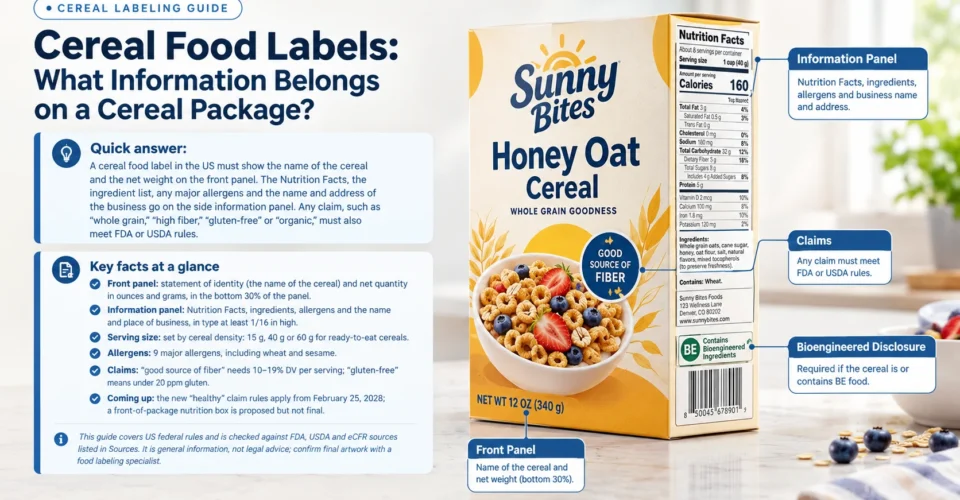
Quick answer: A cereal food label in the US must show the name of the cereal and the net weight on the front panel. The Nutrition Facts, the ingredient list, any major allergens and the name and address of the business go on the side information panel. Any claim, such as “whole grain,” “high fiber,” “gluten-free” or “organic,” must also meet FDA or USDA rules.
Key facts at a glance
- Front panel: statement of identity (the name of the cereal) and net quantity in ounces and grams, in the bottom 30% of the panel
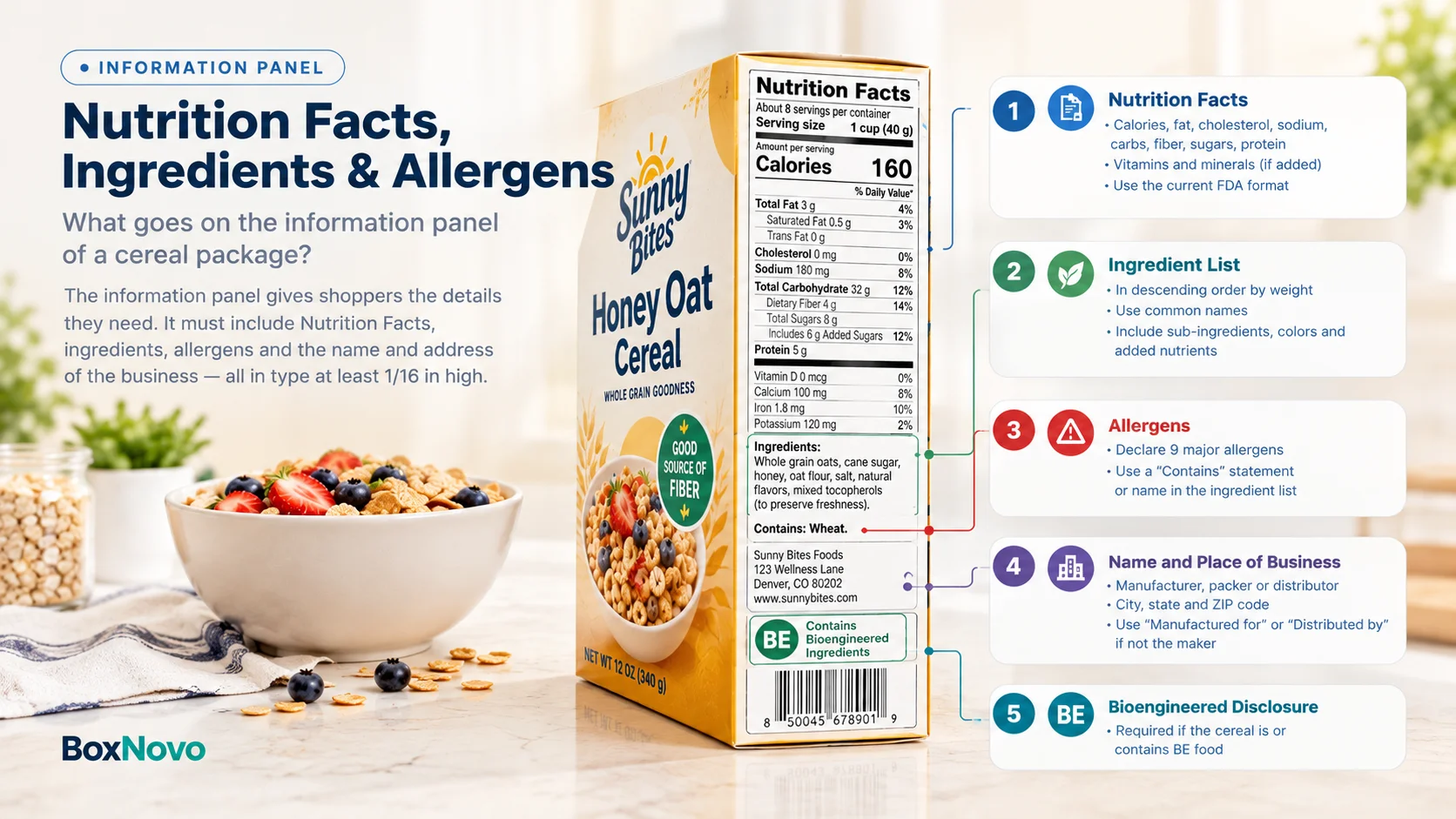
- Information panel: Nutrition Facts, ingredients, allergens and the name and place of business, in type at least 1/16 in high
- Serving size: set by cereal density: 15 g, 40 g or 60 g for ready-to-eat cereals
- Allergens: 9 major allergens, including wheat and sesame
- Claims: “good source of fiber” needs 10–19% DV per serving; “gluten-free” means under 20 ppm gluten
- Coming up: the new “healthy” claim rules apply from February 25, 2028; a front-of-package nutrition box is proposed but not final
This guide covers US federal rules and is checked against FDA, USDA and eCFR sources listed in Sources. It is general information, not legal advice; confirm final artwork with a food labeling specialist.
In this guide
- What a cereal food label is
- Information required on a cereal package
- Front panel: name and net weight
- Information panel: nutrition, ingredients, allergens
- Claims on cereal labels
- Bioengineered disclosure, dates and barcodes
- Label changes coming up
- Muffin food label vs cereal food label
- How to get a food label for your cereal
- Print the label or print the box?
- Common mistakes
- Cereal label checklist
- Frequently asked questions
- Sources
What Is a Cereal Food Label?
A cereal food label is all the required and voluntary information printed on a cereal package: on the carton itself, on a pouch, or on a label applied to a bag or jar. In the US, the Food and Drug Administration (FDA) sets the rules in 21 CFR Part 101, and the USDA adds rules for organic and bioengineered food disclosures. Good food label packaging puts each item where shoppers, retailers and inspectors expect to find it.
FDA divides the package into two main areas:
- Principal display panel (PDP): the part of the package most likely to be seen at the time of purchase. On a cereal box, this is the front.
- Information panel: the panel immediately to the right of the PDP as the customer faces it. On most cereal boxes, this is the right-hand side panel.
FDA does not pre-approve food labels. The brand that sells the cereal is responsible for making sure the label is accurate and complete before it reaches stores (FDA Food Labeling Guide).
What Information Belongs on a Cereal Package?
This table lists every element of a cereal food label, where it goes and whether it is required.
| Label Element | Where It Goes | Required? | Key Rule |
|---|---|---|---|
| Statement of identity (name of the cereal) | Front panel | Yes | Common or usual name, in bold type, parallel to the base of the box |
| Net quantity of contents | Front panel, bottom 30% | Yes | Both US (oz, lb) and metric (g) units |
| Nutrition Facts | Information panel (or front) | Yes, unless exempt | Current FDA format, serving size based on the cereal’s reference amount |
| Ingredient list | Information panel | Yes | Descending order by weight; colors named |
| Major food allergens | Information panel | Yes, if present | In the ingredient list or a “Contains” statement |
| Name and place of business | Information panel | Yes | Manufacturer, packer or distributor, with “Distributed by” or “Manufactured for” if not the maker |
| Bioengineered (BE) disclosure | Any panel the consumer can see | Yes, if the cereal is or contains BE food | Text, symbol, electronic link or text message |
| Nutrient content and health claims | Usually front panel | Optional | Must meet FDA definitions |
| Organic seal and certifier | Front (seal), information panel (certifier) | Optional, but rules apply if used | At least 95% organic for the USDA seal |
| Best-by date and lot code | Top or side flap | Not required by federal law | FDA recommends “Best if Used By” for quality dates |
| UPC barcode | Back or side | Not required by law | Usually required by large retailers |
For how these elements fit together on a full carton, from the back panel to the top flaps, see this guide to the cereal box back panel.
Front Panel: Cereal Name and Net Weight
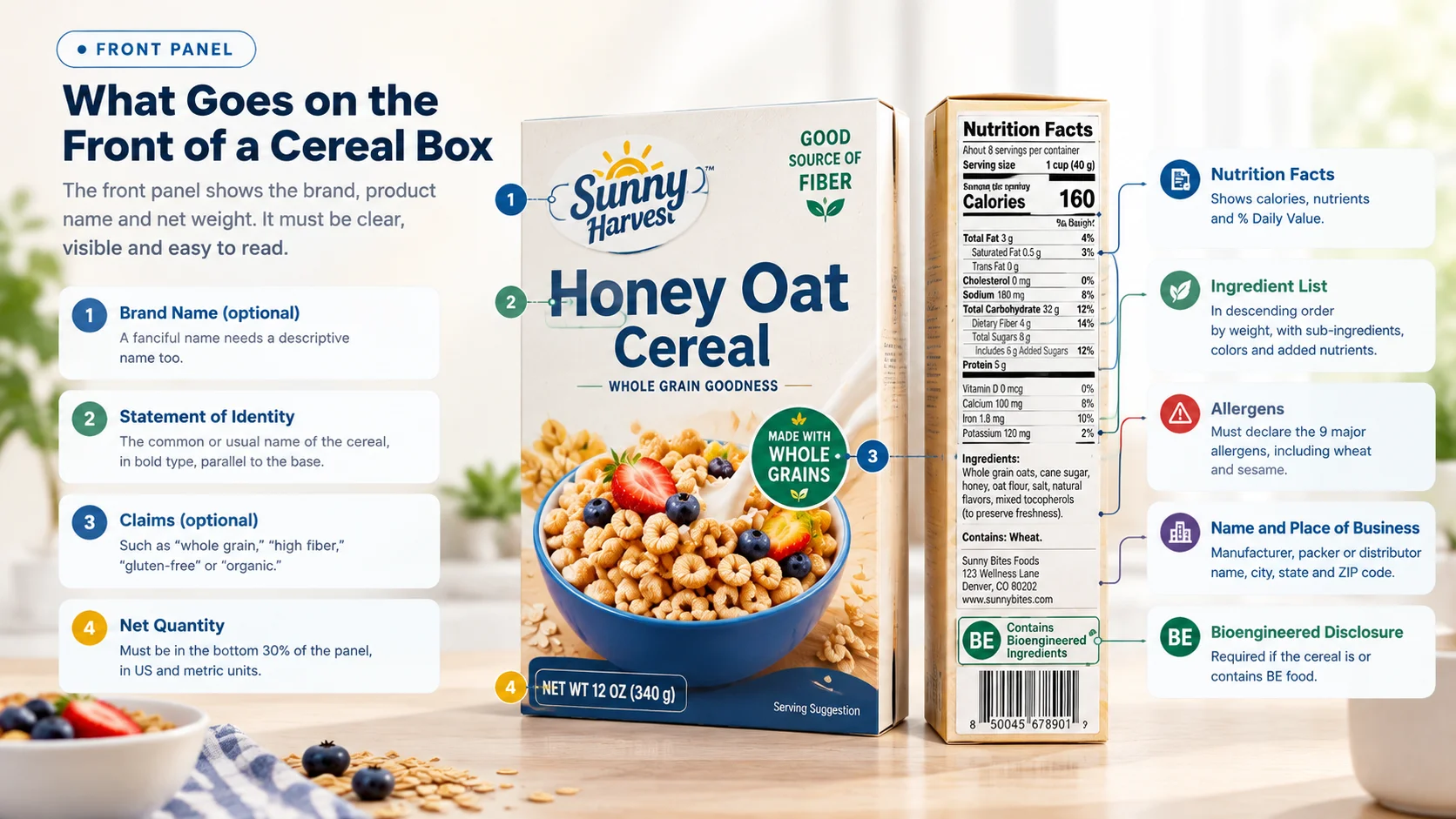
Statement of Identity
The statement of identity is the name of the food. It must appear on the front panel and on any alternate front panel, in bold type, in lines generally parallel to the base of the package. FDA’s guide says the type should generally be at least half the size of the largest print on the label.
Use the common or usual name if the cereal has one, such as “toasted oat cereal,” “corn flakes” or “granola.” If your brand name is fanciful, add a descriptive name so shoppers know what the product is: for example, “Sunrise Crunch” followed by “honey almond whole grain cereal.”
Net Quantity of Contents
The net quantity is the weight of the cereal only, not the box or liner. It must sit in the bottom 30% of the front panel, as a distinct item, in both US and metric units, for example “NET WT 12 OZ (340 g).” The minimum height of the numbers depends on the area of the front panel:
| Front Panel Area | Minimum Type Height |
|---|---|
| 5 sq in or less | 1/16 in |
| More than 5 up to 25 sq in | 1/8 in |
| More than 25 up to 100 sq in | 3/16 in |
| More than 100 up to 400 sq in | 1/4 in |
| Over 400 sq in | 1/2 in |
Example: a cereal box with a front panel of 7.5 × 11 in has an area of 82.5 sq in, so the net weight must be at least 3/16 in tall. These sizes come from 21 CFR 101.105, as summarized by the FDA.
Information Panel: Nutrition Facts, Ingredients and Allergens
The information panel holds the details shoppers check before they buy. Print everything here in type at least 1/16 in high, measured on the lowercase letter “o,” with no unrelated graphics placed between the required items.
Nutrition Facts on a Cereal Box
The Nutrition Facts must use FDA’s current format, which became mandatory on January 1, 2020 for manufacturers with $10 million or more in annual food sales and January 1, 2021 for smaller ones (FDA). It must declare:
- Calories
- Total fat, saturated fat and trans fat
- Cholesterol and sodium
- Total carbohydrate, dietary fiber, total sugars and added sugars
- Protein
- Vitamin D, calcium, iron and potassium
Many cereals are fortified. Any vitamin or mineral that is added to the cereal, or that you make a claim about, must also be listed (21 CFR 101.9(c)(8)(ii)). Vitamins A and C are voluntary unless they are added or claimed.
How Cereal Serving Sizes Are Set
The serving size is not chosen freely. It is based on FDA’s reference amount customarily consumed (RACC), which depends on how much a cup of the cereal weighs:
| Cereal Type | Reference Amount | Label Statement |
|---|---|---|
| Ready-to-eat, under 20 g per cup (such as plain puffed grains) | 15 g | __ cup(s) (__ g) |
| Ready-to-eat, 20 g to under 43 g per cup | 40 g | __ cup(s) (__ g) |
| Ready-to-eat, 43 g or more per cup; biscuit types | 60 g | __ piece(s) (__ g) for biscuits; __ cup(s) (__ g) for others |
| Hot cereal (oatmeal, grits) | 1 cup prepared; 40 g plain dry; 55 g flavored and sweetened | __ cup(s) (__ g) |
Worked example: if one cup of your flakes weighs 30 g, the cereal falls in the 20–43 g group, so the reference amount is 40 g. The serving is the household measure closest to 40 g, which is 1 1/3 cups, declared as “1 1/3 cups (40 g).” Reference amounts come from 21 CFR 101.12, Table 2 (21 CFR 101.12 table).
Cereal With Milk: The Second Column
FDA allows nutrition information for two forms of the same food, such as “as purchased” and “as prepared,” or for common combinations of foods (21 CFR 101.9(e)). That is why many cereal boxes add a second column showing the cereal with milk. It is optional; the column for the cereal as packaged is the one you must provide.
Label Accuracy
Nutrition values must be accurate when FDA tests a product. Added vitamins and minerals must be at least the amount declared, naturally occurring nutrients at least 80% of it, and calories, sugars, added sugars, fat, saturated fat, trans fat, cholesterol and sodium no more than 20% above the label value (21 CFR 101.9(g)). Fortified cereals are usually formulated with a small overage so the vitamins still meet the label at the end of shelf life.
Ingredient List
- Order: list every ingredient in descending order by weight, using common names.
- Sub-ingredients: show what is in compound ingredients, for example “chocolate chips (sugar, chocolate, cocoa butter).”
- Vitamins and minerals: list added nutrients by name, such as “reduced iron,” “niacinamide” and “folic acid.”
- Colors: certified colors must be named, such as “FD&C Red No. 40” or “Red 40.”
FDA revoked the authorization for FD&C Red No. 3 in food, and food makers must stop using it by January 15, 2027 (National Agricultural Law Center). If your cereal or its coatings use it, reformulate and update the ingredient list before then.
Allergen Declaration
Wheat is in many cereals, and milk, soy, tree nuts, peanuts and sesame are common in coatings, clusters and inclusions. FDA recognizes nine major food allergens: milk, eggs, fish, crustacean shellfish, tree nuts, peanuts, wheat, soybeans and sesame. Sesame became the ninth on January 1, 2023 (FDA).
Declare each allergen in one of these ways:
- In the ingredient list by its common name, such as “wheat flour.”
- In parentheses after the ingredient, such as “whey (milk).”
- In a “Contains” statement right after the ingredient list, such as “Contains: Wheat, Milk, Almonds.” Name the specific tree nut.
Name and Place of Business
List the name and address of the manufacturer, packer or distributor: city, state and ZIP code, plus the street address unless the business is listed in a current city or telephone directory. If you are not the manufacturer, add a phrase such as “Manufactured for” or “Distributed by.” Many brands also add a phone number or website for questions, although it is not required.
Claims on Cereal Labels: What Each One Means
Cereal fronts are full of claims. Each one has a legal definition, and using a claim the cereal does not meet makes the product misbranded.
| Claim | What It Requires | Rule |
|---|---|---|
| “Good source of fiber” | 10–19% of the Daily Value of fiber per reference amount | 21 CFR 101.54 |
| “High fiber” or “excellent source of fiber” | 20% or more of the Daily Value per reference amount | 21 CFR 101.54 |
| Fiber claim on a cereal that is not low fat | Total fat per serving must be disclosed next to the claim | 21 CFR 101.54 |
| Whole grain health claim | 51% or more whole grain ingredients by weight per reference amount, with the authorized wording | FDA health claim notification |
| “Healthy” | For grain foods: at least 3/4 oz whole-grain equivalent, with added sugars no more than 10% DV (5 g), sodium no more than 10% DV (230 mg) and saturated fat no more than 5% DV (1 g) per reference amount | Updated rule; compliance date February 25, 2028 |
| “Gluten-free” | Less than 20 ppm gluten; also covers “no gluten,” “free of gluten” and “without gluten” | 21 CFR 101.91 |
| “Organic” with USDA seal | At least 95% certified organic; certifier named on the information panel | USDA National Organic Program |
| “Made with organic oats” | At least 70% certified organic; USDA seal not allowed | USDA National Organic Program |
Sources: 21 CFR 101.54, FDA whole grain health claim, Cooley on the “healthy” rule, FDA Law Blog on gluten-free and USDA organic labeling.
Oats and gluten-free: oats are not a gluten-containing grain under FDA’s rule, but they are often grown and milled alongside wheat. Test finished cereal to confirm it stays under 20 ppm before printing a gluten-free claim.
Bioengineered Disclosure, Dates, Lot Codes and Barcodes
- Bioengineered (BE) disclosure: required since January 1, 2022 for foods that are or contain bioengineered food, which can include corn and soy ingredients. Brands can use text, the BE symbol, an electronic or digital link, or a text message option. Very small food manufacturers with annual receipts below $2,500,000 are exempt (USDA AMS).
- Best-by date: federal law does not require date labels on cereal; infant formula is the only federal exception. If you add a date, FDA supports the phrase “Best if Used By” to show the date is about quality, not safety (FDA).
- Lot code: not a federal label requirement, but essential for tracing a batch and running a recall. Most cereal makers ink-jet the lot code and date on the top flap.
- UPC barcode: not required by law, but large grocery chains usually require one (Penn State Extension). Barcode numbers come from GS1 US.
Cereal Label Changes Coming Up
| Change | Status | What It Means for Cereal |
|---|---|---|
| Updated “healthy” claim | Final rule; compliance date February 25, 2028 | Many sweetened cereals will no longer qualify; check added sugars and whole grain content |
| Front-of-package “Nutrition Info” box | Proposed January 2025; not final as of August 2026 | Would show saturated fat, sodium and added sugars as Low, Med or High on the front |
| FD&C Red No. 3 | Food deadline January 15, 2027 | Reformulate colored cereals and update ingredient lists |
| Texas SB 25 ingredient warning | Enforcement blocked for members of four trade groups by a preliminary injunction (February 11, 2026) | Watch the case if you sell in Texas and use listed additives such as certain colors |
Status details are from Envapack (August 2026) and Covington. Leave space on the front panel in your next carton redesign in case the front-of-package box becomes final.
Muffin Food Label vs Cereal Food Label
Many cereal makers also sell baked goods, granola bars or muffin mixes. A muffin food label follows the same FDA framework: statement of identity, net weight, Nutrition Facts, ingredients, allergens and business name. The main differences are the serving size and the exemptions:
| Item | Cereal | Muffins |
|---|---|---|
| Reference amount | 15 g, 40 g or 60 g by density | 110 g (muffins, excluding English muffins) |
| Serving shown as | Cups and grams | Pieces and grams |
| Common allergens | Wheat, milk, tree nuts, soy | Wheat, eggs, milk, often tree nuts |
| Typical package | Printed carton with a liner, or a pouch | Bakery box, clamshell or bag with an applied label |
Small bakeries may qualify for FDA’s small business nutrition labeling exemption, but packaged muffins still need the ingredient list, allergens, net weight and business name. Grain-based bars such as granola bars use a 40 g reference amount. If you also sell baked goods, see these custom muffin boxes and other bakery packaging boxes.
How to Get a Food Label for Your Cereal
If you are launching a cereal or granola, here is how to get a food label that is accurate and ready to print:
- Finalize the recipe. Lock the formula, including coatings and inclusions, and weigh every ingredient. Any later change can change the label.
- Get the nutrition values. Use a food testing laboratory or FDA-format nutrition labeling software built on ingredient databases. Lab testing is slower and costs more but measures the finished product; software is faster and suits stable recipes made from standard ingredients.
- Work out the serving size by weighing a level cup of cereal and matching it to the reference amount table above.
- Write the ingredient list and allergen statement from your supplier specifications, including sub-ingredients.
- Check every claim against FDA and USDA definitions before it goes on the front.
- Check exemptions. Small businesses with fewer than 100 full-time equivalent employees selling fewer than 100,000 units of the product a year may qualify for a nutrition labeling exemption, but must file an annual notice with FDA and cannot make nutrition claims (FDA).
- Design the artwork on the box or label dieline, with every required item on the correct panel and in the minimum type size.
- Have the label reviewed by a food labeling consultant or regulatory specialist, especially for claims.
- Print a proof, check colors, barcode scanning and legibility, then approve production.
For layout help, these food label design tips cover hierarchy, fonts and color, and the same FDA framework is applied to sauces in this guide to hot sauce label rules and to jars in these honey label requirements.
Print the Food Label or Print the Box?
Food label packaging for cereal usually takes one of three forms. The right choice depends on volume, budget and where you sell.
| Option | Best For | Trade-offs |
|---|---|---|
| Printed folding carton (all label information printed on the box) | Retail cereal brands and grocery distribution | Best shelf impact; any label change needs new cartons |
| Plain box, bag or jar with an applied label | Small batches, farmers markets, test launches | Easy to update; label size limits how much fits |
| Printed stand-up pouch | Granola, muesli and premium cereals | Resealable and light; needs a good barrier film |
BoxNovo produces printed cereal boxes, custom food labels and resealable zipper pouches, along with other food packaging boxes. If you print food label stock for bags or jars, the label size recommender helps you choose a size that fits every required item. For full carton planning, read this custom cereal box guide.
Choosing a Food Label Company
Before you print food label artwork or cartons, compare suppliers. A good food label company or packaging printer should be able to:
- Provide dielines for your exact carton, pouch or label size.
- Print fine text sharply, since much of the information panel is close to 1/16 in tall.
- Offer food-safe materials and coatings suited to dry, oily or frozen products.
- Check barcode scannability and color on a physical proof.
- Print both the cartons and the labels, so colors match across your range.
Set up artwork files with bleed using this bleed and safe zone guide, and preview the finished box in the 3D packaging mockup generator before you order.
Common Cereal Label Mistakes
| Mistake | Fix |
|---|---|
| Net weight placed high on the front panel | Move it into the bottom 30% of the panel |
| Net weight in ounces only | Show both ounces and grams |
| Serving size chosen for a lower calorie count | Base it on the reference amount for the cereal’s weight per cup |
| Old Nutrition Facts format | Use the current format with added sugars, vitamin D and potassium |
| Added vitamins missing from the Nutrition Facts | Declare every added vitamin and mineral |
| Sesame or a tree nut left out of the allergen statement | Check every coating and inclusion; name the specific tree nut |
| “Gluten-free” printed without testing | Test the finished cereal to confirm under 20 ppm |
| “Healthy” or fiber claims that the recipe does not meet | Check claims against FDA definitions per reference amount |
| No space planned for a possible front-of-package nutrition box | Keep a clear area on the front in your next redesign |
Cereal Food Label Checklist
- Statement of identity on the front, bold, at least half the size of the largest print.
- Net weight in ounces and grams in the bottom 30% of the front panel, at the minimum type height.
- Nutrition Facts in the current format, with serving size from the cereal reference amount.
- All added vitamins and minerals declared.
- Ingredient list in descending order by weight, with colors and sub-ingredients named.
- All nine major allergens checked and declared.
- Name and place of business with the right qualifying phrase.
- Bioengineered disclosure if required.
- Every claim checked against FDA and USDA definitions.
- Best-by date, lot code and UPC placed on the flap or back.
- Label reviewed by a specialist and a printed proof approved.
Frequently Asked Questions
What information is required on a cereal food label?
The name of the cereal, net weight, Nutrition Facts, ingredient list, major allergens and the name and address of the manufacturer, packer or distributor.
Where does the Nutrition Facts go on a cereal box?
Usually on the information panel, the side panel to the right of the front. It can also go on the front panel or, if there is not enough room, on another panel the consumer can see.
How is the serving size on a cereal box decided?
By FDA’s reference amount for the cereal’s weight per cup: 15 g for cereals under 20 g per cup, 40 g for 20–43 g per cup and 60 g for 43 g or more per cup.
Does cereal need a best-by date?
No. Federal law does not require date labels on cereal. If you add one, FDA supports “Best if Used By” for quality dates.
Why do some cereal boxes show nutrition with milk?
FDA allows nutrition information for common combinations of foods, so many cereals add an optional column for the cereal with milk next to the required column for the cereal alone.
What allergens must be declared on cereal?
Any of the nine major allergens in the cereal: milk, eggs, fish, crustacean shellfish, tree nuts, peanuts, wheat, soybeans and sesame.
What does “good source of fiber” mean on cereal?
The cereal provides 10–19% of the Daily Value for fiber per reference amount. “High fiber” means 20% or more.
Can oat cereal be labeled gluten-free?
Yes, if the finished cereal contains less than 20 ppm gluten. Oats are often contaminated with wheat, so testing is important.
Does FDA approve cereal labels?
No. FDA does not pre-approve food labels. The brand is responsible for making sure the label meets the rules.
How do I get a food label for my cereal?
Finalize the recipe, get nutrition values from a lab or labeling software, set the serving size, write the ingredient and allergen statements, check claims, design the artwork and have it reviewed before printing.
Is a small cereal brand exempt from nutrition labeling?
Possibly. Businesses with fewer than 100 full-time equivalent employees selling fewer than 100,000 units of a product a year can file for an exemption, but not if they make nutrition claims.
What is different about a muffin food label?
The required elements are the same, but the reference amount for muffins is 110 g and the serving is shown in pieces rather than cups.
Is the front-of-package nutrition box required on cereal?
Not yet. FDA proposed it in January 2025, and it was not final as of August 2026. If finalized, larger companies would have three years to comply and smaller ones four.
Will cereal still be labeled “healthy”?
Only if it meets the updated rule by February 25, 2028: for grain foods, at least 3/4 oz whole-grain equivalent and limits on added sugars, sodium and saturated fat.
What should I look for in a food label company?
Dielines for your exact package, sharp printing of small text, food-safe materials, barcode and color checks on a physical proof, and the ability to print both cartons and labels.
Should I print the label on the box or use a sticker label?
Printed cartons suit retail brands with stable recipes. Applied labels suit small batches and test launches because they are easy to update.
Do cereals need a bioengineered disclosure?
If the cereal is or contains bioengineered food, such as some corn or soy ingredients, a disclosure is required unless the maker has annual receipts below $2,500,000.
Final Takeaway
A compliant cereal food label comes down to the right information on the right panel: the name and net weight on the front; the Nutrition Facts, ingredients, allergens and business name on the information panel; and claims that meet their legal definitions. Set the serving size from the reference amount, declare every added vitamin, test any gluten-free claim and plan ahead for the 2028 “healthy” rules and a possible front-of-package nutrition box.
Ready to print your cereal boxes, pouches or food labels? BoxNovo prints all three, so your food label packaging matches across every format. Request a packaging quote to get started.
Sources
- FDA: Food Labeling Guide
- FDA Food Labeling Guide (PDF copy, University of Kentucky)
- FDA: net quantity of contents and type sizes (21 CFR 101.105)
- FDA: changes to the Nutrition Facts label
- 21 CFR 101.9: nutrition labeling of food
- 21 CFR 101.12, Table 2: reference amounts
- FDA: sesame, the ninth major food allergen
- 21 CFR 101.54: “good source” and “high” claims
- FDA: whole grain foods health claim
- Cooley: FDA’s updated “healthy” claim rule
- FDA Law Blog: gluten-free labeling rule
- USDA AMS: organic labeling
- USDA AMS: bioengineered food disclosure
- FDA: date labels and “Best if Used By”
- FDA: small business nutrition labeling exemption
- National Agricultural Law Center: FDA revokes Red No. 3
- Envapack: US food labeling requirements 2026–2027
- Covington: court enjoins Texas SB 25 warning requirement
- Penn State Extension: food labels