
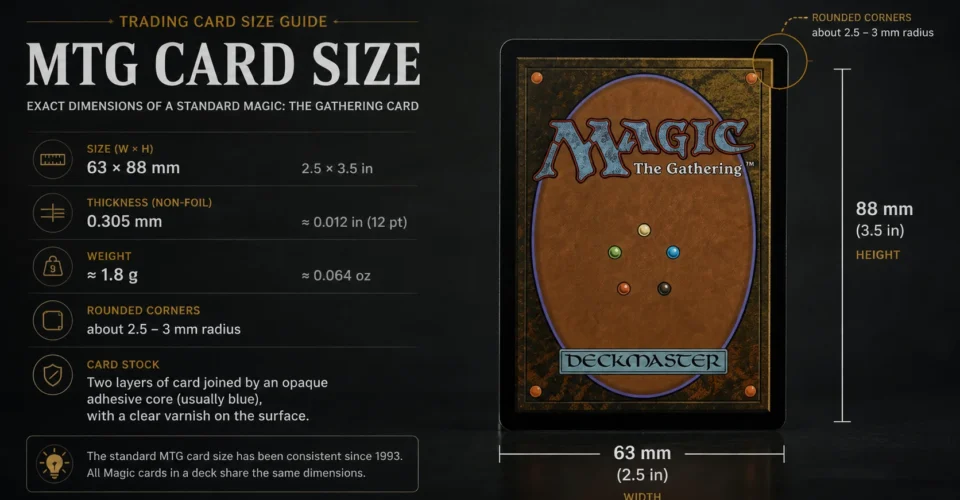
Quick answer: The standard MTG card size is 63 × 88 mm, which is about 2.5 × 3.5 inches. A Magic card is roughly 0.305 mm (0.012 in) thick, weighs about 1.8 grams and has rounded corners. It is the same size as a Pokémon card or a poker-size playing card.
Key facts at a glance
- Size: 63 × 88 mm (2.5 × 3.5 in)
- Thickness: about 0.305 mm (12 pt) for a non-foil card
- Weight: about 1.7 to 1.8 grams
- Corners: rounded, with a radius of roughly 2.5 to 3 mm
- Standard sleeves: about 66 × 91 mm
- Oversized cards (planes, schemes, oversized commanders): about 3.5 × 5 in
- Custom card print file: 2.75 × 3.75 in with bleed, or 825 × 1125 px at 300 dpi
Sizes in this guide are checked against the Magic: The Gathering Comprehensive Rules and other references listed in the Sources section.
In this guide
- What size are MTG cards
- What size are standard MTG cards
- MTG card dimensions in pixels
- Oversized MTG cards
- MTG card size compared with other cards
- MTG sleeve sizes
- Deck sizes, stack height and weight
- Using size and feel to spot fakes
- Custom MTG cards: the rules
- How to make custom MTG cards
- Boxes and packaging for MTG decks
- Common myths
- Frequently asked questions
- Sources
What Size Are MTG Cards?
So, what size are MTG cards? A standard Magic: The Gathering card measures 63 × 88 mm, or about 2.5 × 3.5 inches. The official Comprehensive Rules describe traditional Magic cards as measuring “approximately 2.5 inches (6.3 cm) by 3.5 inches (8.8 cm)” (rule 108.2a).
The size of MTG cards has stayed the same since the game launched in 1993, so old cards and new cards mix in the same deck without any difference in fit.
MTG Card Dimensions: Full Spec Sheet
| Measurement | Metric | Imperial |
|---|---|---|
| Width | 63 mm (63.5 mm exact for 2.5 in) | 2.5 in |
| Height | 88 mm (88.9 mm exact for 3.5 in) | 3.5 in |
| Thickness (non-foil) | About 0.305 mm | About 0.012 in (12 pt) |
| Weight | About 1.7 to 1.8 g | About 0.064 oz |
| Corner radius | About 2.5 to 3 mm | About 1/10 to 1/8 in |
| Card stock | Two layers of card joined by an opaque adhesive core, usually blue, with a clear varnish on the surface | |
Why You See Both 63 × 88 mm and 2.5 × 3.5 Inches
Both figures describe the same card. 2.5 × 3.5 inches converts to 63.5 × 88.9 mm, and the rules round it to 6.3 × 8.8 cm. The difference is less than 1 mm, which is within normal cutting tolerance, so you will see the dimensions of an MTG card written either way. Foil cards have an extra printed layer and are slightly thicker than non-foil cards, which is one reason foils can curl.
What Size Are Standard MTG Cards?
What size are standard MTG cards compared with other Magic cards? Every card you put in a playable deck is a traditional Magic card at 63 × 88 mm. That includes creatures, lands, spells, double-faced cards, foils and special treatments such as borderless and extended-art cards. Only the art changes, never the outside size.
The rules also allow nontraditional cards, such as planes and schemes, which may be oversized or have different backs. These are used with certain formats and are never shuffled into your main deck. Tokens, emblems and art cards that come in packs are usually standard-size MTG cards in shape, but they are printed on different stock and do not count as cards in your deck.
MTG Card Dimensions in Pixels
If you are scanning, designing or printing, the MTG card dimensions in pixels depend on the resolution. Print shops usually ask for 300 dpi, and 600 dpi gives extra detail:
| File Type | Size in Inches | Pixels at 300 dpi | Pixels at 600 dpi |
|---|---|---|---|
| Card at trim size (no bleed) | 2.5 × 3.5 | 750 × 1050 | 1500 × 2100 |
| Card with 1/8 in bleed on every side | 2.75 × 3.75 | 825 × 1125 | 1650 × 2250 |
| Safe area (1/8 in inside the trim) | 2.25 × 3.25 | 675 × 975 | 1350 × 1950 |
Pixel size is simply inches × dpi. A 2.5 × 3.5 inch card at 300 dpi is 2.5 × 300 = 750 pixels wide and 3.5 × 300 = 1050 pixels tall.
Oversized MTG Cards
Some Magic products use larger cards that are not part of a normal deck:
| Card Type | Typical Size | Used For |
|---|---|---|
| Planechase planes and phenomena | About 3.5 × 5 in (88 × 126 mm) | The Planechase variant, played landscape |
| Archenemy schemes | About 3.5 × 5 in | The Archenemy variant |
| Oversized commander cards | About 3.5 × 5 in | Display copies included with some Commander products |
| Vanguard cards | About 3.5 × 5 in | A 1990s variant that changed starting life and hand size |
Oversized cards need oversized sleeves, often listed at about 91 × 130 mm. They also need a box or storage space of their own, because they will not fit a standard deck box.
MTG Card Size Compared With Other Cards
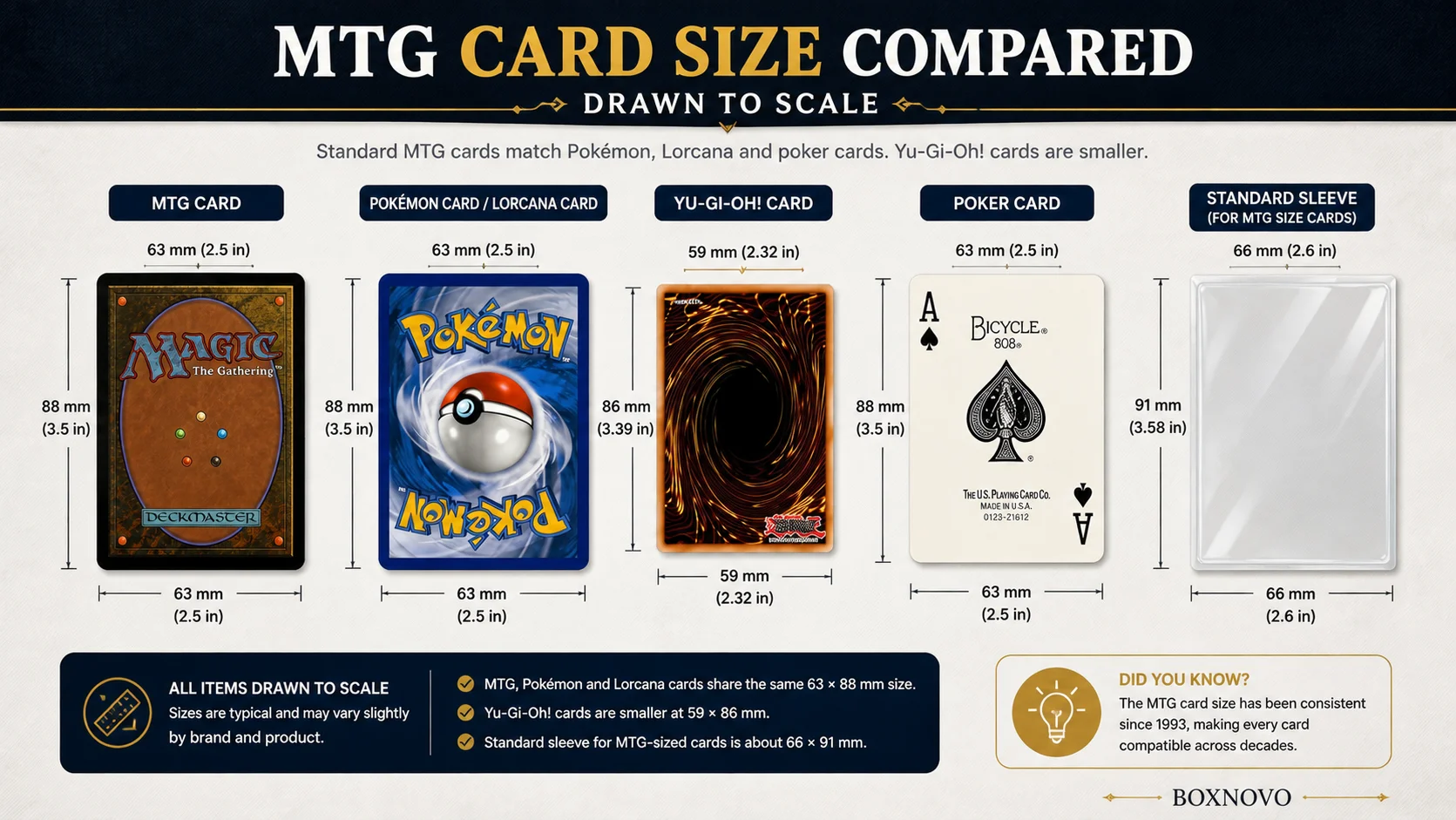
Magic uses the most common trading card size, so many sleeves and boxes are shared across games:
| Card | Size | Same as an MTG Card? |
|---|---|---|
| Magic: The Gathering | 63 × 88 mm (2.5 × 3.5 in) | Yes |
| Pokémon TCG | 63 × 88 mm | Yes |
| Disney Lorcana | 63 × 88 mm | Yes |
| Digimon and Weiss Schwarz | 63 × 88 mm | Yes |
| Poker-size playing cards | 2.5 × 3.5 in | Yes |
| Bridge-size playing cards | 2.25 × 3.5 in | No, about 6 mm narrower |
| Yu-Gi-Oh! | 59 × 86 mm | No, smaller (“Japanese size”) |
Because MTG cards match poker-size playing cards, the same box sizes and printing templates work for both. You can see how a standard playing card deck breaks down for comparison.
MTG Sleeve Sizes
Sleeves protect cards and make them easier to shuffle. They come in a few standard sizes:
| Sleeve Type | Approximate Size | Use |
|---|---|---|
| Standard sleeves | 66 × 91 mm | Everyday play for MTG, Pokémon and Lorcana |
| Perfect-fit inner sleeves | About 64 × 89 mm | A snug first layer under a standard sleeve (double sleeving) |
| Oversized sleeves | About 91 × 130 mm | Planes, schemes and oversized commanders |
Exact sleeve sizes vary slightly by brand, so check the listed size before you buy. A sleeve that is too loose lets dust in, while one that is too tight can bend cards.
MTG Deck Sizes, Stack Height and Weight
How many cards you carry decides what size deck box you need. The Comprehensive Rules set a minimum of 60 cards for Constructed decks, up to 15 cards in a sideboard, and a minimum of 40 cards for Limited decks. Commander decks must contain exactly 100 cards, including the commander.
Using a thickness of about 0.305 mm and a weight of about 1.814 g per card, unsleeved decks measure roughly:
| Cards | Typical Format | Stack Height (Unsleeved) | Weight (Unsleeved) |
|---|---|---|---|
| 40 | Limited (draft, sealed) | About 12 mm (0.48 in) | About 73 g (2.6 oz) |
| 60 | Constructed main deck | About 18 mm (0.72 in) | About 109 g (3.8 oz) |
| 75 | Constructed deck + 15-card sideboard | About 23 mm (0.9 in) | About 136 g (4.8 oz) |
| 100 | Commander | About 30.5 mm (1.2 in) | About 181 g (6.4 oz) |
Sleeves add noticeable thickness, and double sleeving adds more, so deck boxes are sold by sleeved capacity. An “80+” box suits a sleeved 60-card deck with sideboard, and a “100+” box suits a sleeved Commander deck.
Using Size and Feel to Spot Fake MTG Cards
Genuine cards are made to a consistent size, thickness and weight, so a card that feels noticeably lighter, heavier, thicker or a different size from your other cards deserves a closer look. Collectors also use these checks:
- Compare side by side: line the card up with a known real card from the same set and check size, font, spacing and color.
- Use a jeweler’s loupe: printed colors on real cards form a flower-like rosette dot pattern. A different pattern or a ribbed texture suggests a fake.
- Check the flex: a real non-foil card bends slightly under thumb pressure and springs back.
No single test is conclusive, so use several and buy valuable cards from trusted sellers.
Custom MTG Cards: What You Can and Cannot Do
Custom MTG cards are fan-made cards with your own name, art, rules text or design. Many players make a custom MTG card for a playgroup, a cube, a gift or a game night. Before you design one, know these limits:
- Keep it free and personal: Wizards of the Coast’s Fan Content Policy requires fan content to be free. You cannot sell it or license it to others for any type of compensation without permission.
- Do not copy or fake real cards: do not remove legal notices from Wizards material, and never make cards meant to pass as genuine. That is counterfeiting.
- Not tournament legal: under the Magic Tournament Rules, players may not create their own proxies. Only the head judge can issue a proxy, and only for a card damaged or worn during that event.
- Credit artists: use your own art, licensed art or art you have permission to use.
Tools that use official Magic logos and card frames can be shut down. Card Conjurer, a popular custom card site, closed in November 2022 after receiving a cease-and-desist notice from Wizards of the Coast.
How to Make Custom MTG Cards
To make custom MTG cards that look and feel close to the real thing, follow these steps:
- Design the card. Use a custom card maker such as MTG Cardsmith or Magic Set Editor, or design your own layout from scratch in a design tool. If you prefer an easy editor, these steps for designing cards in Canva work too.
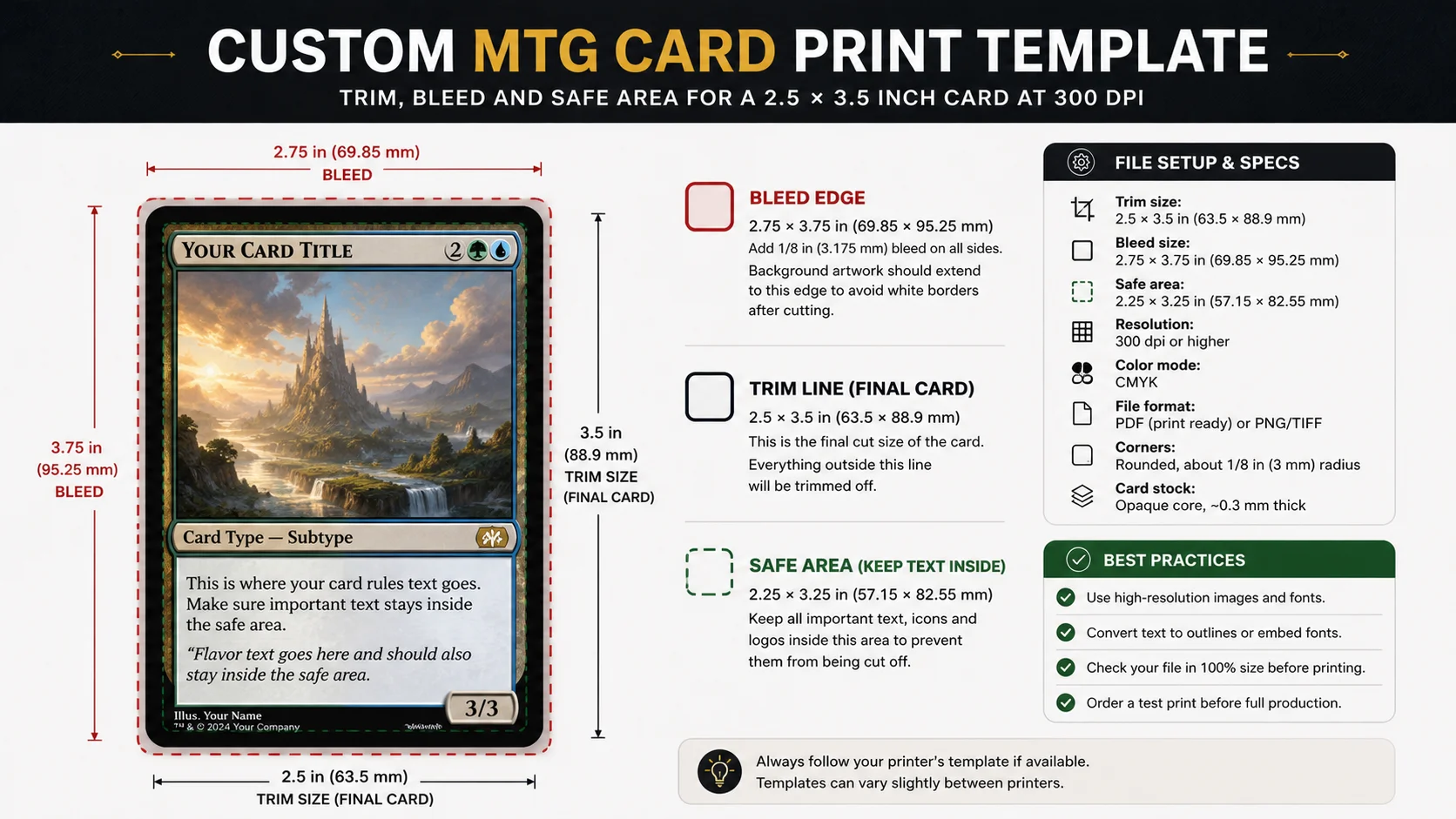
- Set the file size. Use 2.5 × 3.5 inches at trim, plus 1/8 inch of bleed on every side (2.75 × 3.75 inches). At 300 dpi, that is 825 × 1125 pixels.
- Keep text in the safe area. Keep names, rules text and numbers at least 1/8 inch inside the trim line so nothing is cut off. This guide to bleed and safe zones explains the setup.
- Prepare color for print. Convert artwork to CMYK and check it on a proof, because bright screen colors can print duller. Here is why screen and print color differ.
- Choose card stock. Pick a smooth or linen playing card stock with an opaque core so the cards are not see-through. A thickness close to 0.3 mm feels most like a real card.
- Print and cut. Use a card printer that cuts to 2.5 × 3.5 inches with rounded corners, or a home printer with a corner rounder for small runs.
- Test the fit. Slide a printed card into a standard 66 × 91 mm sleeve next to a real card to check the size before you print a full set.
Custom MTG Card Print Checklist
| Specification | Setting |
|---|---|
| Trim size | 2.5 × 3.5 in (63.5 × 88.9 mm) |
| Bleed | 1/8 in (3.175 mm) on every side |
| File size with bleed | 2.75 × 3.75 in (69.85 × 95.25 mm) |
| Resolution | 300 dpi minimum (825 × 1125 px with bleed) |
| Safe area | 2.25 × 3.25 in (57.15 × 82.55 mm) |
| Color mode | CMYK |
| Corners | Rounded, about 1/8 in radius |
| Stock | Playing card stock with an opaque core, close to 0.3 mm thick |
Print shops can use slightly different bleed or template sizes, so always download your printer’s own template before you finalize the files.
Boxes and Packaging for MTG Decks and Custom Cards
Whether you are storing a Commander deck or packaging a custom card set as a gift or product, the box should be sized to the cards, not the other way around. For sleeved MTG cards in 66 × 91 mm sleeves, plan an inside size of about 67 to 68 mm wide and 92 to 94 mm tall. For the depth, measure the actual sleeved stack and add 2 to 3 mm of clearance. These steps for measuring a custom box walk through the process.
Common box styles for card decks and custom card sets:
- Tuck boxes: the classic card box. reverse tuck card boxes and straight tuck end packaging suit single decks and booster-style sets.
- Sealed boxes: seal end card boxes show a custom set has not been opened.
- Premium sets: rigid gift box packaging with a fitted insert protects collector and gift decks.
- Slide-out boxes: sleeve and tray boxes give an easy opening for card sets and accessories.
- Retail: counter display packaging holds several decks or packs at the checkout.
Common Myths About MTG Card Size
| Myth | Fact |
|---|---|
| “Older Magic cards are a different size.” | Card size has stayed at about 63 × 88 mm since 1993. |
| “Yu-Gi-Oh! sleeves fit MTG cards.” | Yu-Gi-Oh! cards are smaller (59 × 86 mm), so small sleeves are too narrow for MTG. |
| “Borderless and extended-art cards are bigger.” | Only the art area changes. The card itself is the same size. |
| “Oversized commanders can be played in your deck.” | Oversized cards are for display. Your deck uses the standard-size copy. |
| “Custom cards are fine for tournaments if they look real.” | Player-made proxies are not allowed in sanctioned tournaments. |
Quick Reference
| Question | Answer |
|---|---|
| MTG card size in mm | 63 × 88 mm |
| MTG card size in inches | 2.5 × 3.5 in |
| Thickness | About 0.305 mm (0.012 in) |
| Weight | About 1.7 to 1.8 g |
| Standard sleeve size | About 66 × 91 mm |
| Oversized card size | About 3.5 × 5 in |
| Print file for custom MTG cards | 2.75 × 3.75 in with bleed (825 × 1125 px at 300 dpi) |
Frequently Asked Questions
What is the MTG card size in inches?
About 2.5 × 3.5 inches, the same as a poker-size playing card.
What is the size of MTG cards in mm?
About 63 × 88 mm. The exact conversion of 2.5 × 3.5 inches is 63.5 × 88.9 mm.
What are the dimensions of a MTG card, including thickness?
A non-foil card is about 63 × 88 × 0.305 mm (2.5 × 3.5 × 0.012 in).
How much does an MTG card weigh?
About 1.7 to 1.8 grams, or roughly 0.064 ounces.
Are MTG cards the same size as Pokémon cards?
Yes. Both are 63 × 88 mm and use the same standard sleeves.
Are MTG cards the same size as Yu-Gi-Oh! cards?
No. Yu-Gi-Oh! cards are smaller, at about 59 × 86 mm.
Are MTG cards the same size as playing cards?
Yes, they match poker-size playing cards at 2.5 × 3.5 inches. Bridge-size playing cards are narrower.
What size sleeves do MTG cards use?
Standard sleeves of about 66 × 91 mm. For double sleeving, use perfect-fit inner sleeves of about 64 × 89 mm inside them.
Are foil MTG cards a different size?
Foils have the same width and height but are slightly thicker because of an extra printed layer.
How big are oversized MTG cards?
Planes, schemes and oversized commanders are about 3.5 × 5 inches and need oversized sleeves.
How thick is a 100-card Commander deck?
About 30.5 mm (1.2 in) unsleeved. Sleeved, it is noticeably thicker, so use a deck box rated for 100 or more sleeved cards.
What size should a custom MTG card file be?
2.75 × 3.75 inches including 1/8 inch bleed, which is 825 × 1125 pixels at 300 dpi. The final trimmed card is 2.5 × 3.5 inches.
Can I make custom MTG cards?
Yes, for personal and casual use. Under Wizards’ Fan Content Policy, fan content must be free, so you cannot sell custom cards without permission, and you should never make cards meant to pass as real.
Are custom MTG cards tournament legal?
No. Players may not create their own proxies for sanctioned events. Only the head judge can issue a proxy for a card damaged during that tournament.
What is the best card stock for custom MTG cards?
A smooth or linen playing card stock with an opaque core, close to 0.3 mm thick, feels closest to a real Magic card.
What are the dimensions of an MTG card’s corners?
The corners are rounded with a radius of roughly 2.5 to 3 mm, about 1/10 to 1/8 inch.
Do MTG cards change size between sets?
No. New and old cards share the same size, so any set can be played together.
Final Takeaway
The standard MTG card size is 63 × 88 mm (2.5 × 3.5 inches), about 0.305 mm thick and about 1.8 grams. It matches Pokémon cards and poker-size playing cards, fits 66 × 91 mm sleeves, and has stayed the same since 1993. For custom MTG cards, set up files at 2.75 × 3.75 inches with bleed, keep text in the safe area, print on an opaque-core stock, and keep your cards free and personal.
Creating a custom card game or deck set that needs its own box? BoxNovo designs and prints card packaging sized to your cards. Request a box quote to start.
Sources
- Magic: The Gathering Comprehensive Rules (hyperlinked): rules 100.2a, 100.2b, 100.4a and 108.2a
- MTG Wiki: Card (thickness, weight, corner radius and card stock)
- MTG Wiki: Commander format (100-card deck size)
- Magic Librarities: Planechase plane card size
- Akihabara BC: trading card game card sizes
- Wargamer: Yu-Gi-Oh! card size
- Wizards of the Coast: Fan Content Policy
- Magic Judges: Magic Tournament Rules 3.4, proxy cards
- TechRaptor: Card Conjurer closure
- TCGplayer: how to identify counterfeit Magic cards