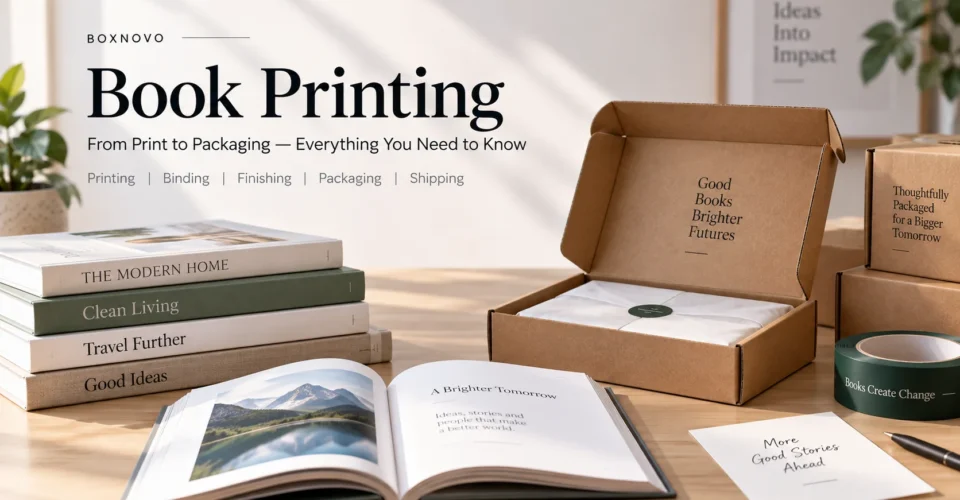
Book printing is the process of turning a prepared manuscript, layout, or artwork into finished physical books. The right choice depends on quantity, page count, trim size, paper, color, binding, finishing, budget, and how the books will be sold or shipped. This guide covers the full path from printing method and file preparation to proofing, cost planning, packaging, and fulfillment.
Quick answer: If you are deciding how to print a book, start with quantity and demand, then choose the printing method. Lock the trim size, paper, binding, cover, and file specifications before production. If the finished books will be shipped or sold as a physical product, measure the bound book before designing the final packaging.
Book Printing at a Glance
| Decision | What to decide first |
|---|---|
| Printing method | Digital, print-on-demand, or offset based on quantity, demand, and production needs. |
| Format | Trim size, page count, cover type, and orientation. |
| Paper | Stock, weight/caliper, finish, opacity, and color requirements. |
| Binding | Perfect bound, saddle stitch, hardcover/case, coil/spiral, or sewn. |
| Proof | Check layout, color, paper, trim, binding, and finishing before a larger run. |
| Packaging | Choose the package from the finished book’s actual length, width, thickness, protection, and sales channel. |
What Is Book Printing?
Book printing converts prepared digital files into physical copies through a production workflow that can include prepress, printing, binding, trimming, finishing, proofing, packing, and delivery. The exact workflow changes by printer, format, quantity, and production method.
| Stage | What happens | Why it matters |
|---|---|---|
| File preparation | Interior and cover files are prepared to the printer’s specifications. | Prevents avoidable trim, bleed, font, image, and layout problems. |
| Prepress | Files are checked for production requirements. | Catches technical issues before production. |
| Printing | Pages and covers are produced by a digital or offset process. | Affects color, consistency, setup, and unit economics. |
| Binding | Printed sheets/pages are assembled into the finished format. | Affects durability, appearance, opening behavior, and thickness. |
| Finishing | Optional coatings, foil, embossing, debossing, trimming, or related work are applied. | Changes appearance, feel, and production requirements. |
| Proofing | A digital or physical proof is reviewed. | Provides a final quality check before a larger run. |
| Packing & shipping | Finished books are packed, stored, fulfilled, or delivered. | Protects the product and affects total landed cost. |
Who Uses Custom Book Printing?
Custom book printing is used for more than traditional novels. The specifications should match the intended reader, use, quantity, and sales channel. Custom book printing can also be used when a standard stock format does not match the desired size, finish, quantity, or presentation.
- Self-published authors producing novels, memoirs, poetry, nonfiction, or children’s books.
- Publishers producing trade titles, educational books, manuals, or specialty editions.
- Businesses producing catalogs, company books, reports, sales materials, or branded publications.
- Schools and organizations producing workbooks, guides, training manuals, and instructional materials.
- Photographers, artists, and designers producing image-heavy books, portfolios, or lookbooks.
- Brands producing catalog printing, lookbook printing, or premium publications.
What Are the Main Book Printing Methods?
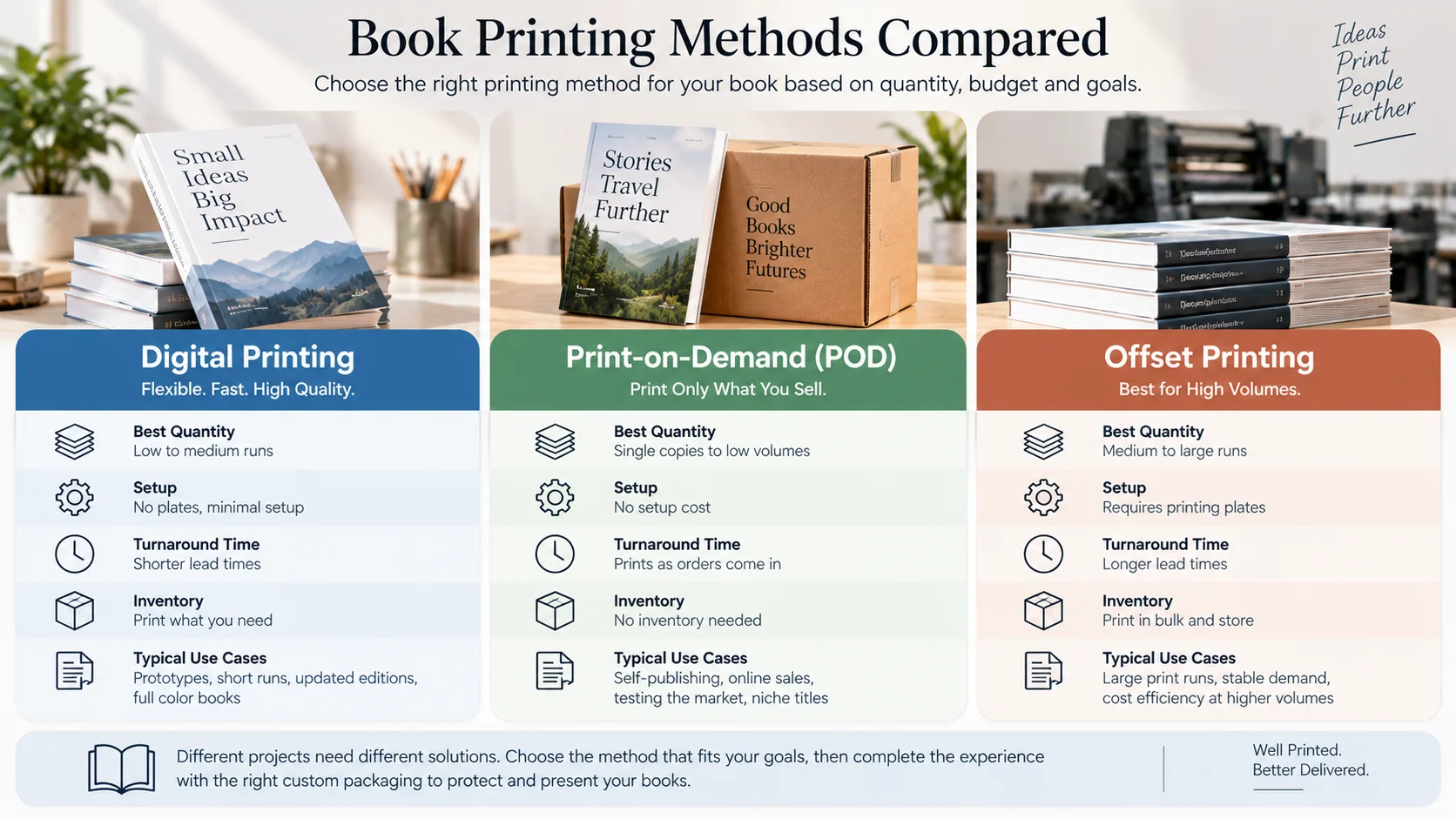
The three production models most readers compare are digital printing, offset printing, and print-on-demand (POD). POD is a fulfillment/production model that often uses digital production, so it is useful to distinguish the printing technology from the inventory model.
Digital Book Printing
Digital book printing sends the prepared artwork directly to a digital press without the conventional plate setup used in offset printing. It is commonly suited to short runs, proofs, frequent reprints, and projects where inventory flexibility matters. Exact capabilities, color options, paper choices, and quantity limits vary by printer.
Offset Book Printing
Offset printing uses plates and an ink-transfer process. Setup is more involved, but larger quantities can make the economics attractive because setup costs are spread across more copies. Offset may also be worth evaluating when a project needs particular paper, ink, color, or finishing options. The printer should confirm the production fit for the specific project.
Book Printing On Demand / Print-on-Demand
Book printing on demand means copies are produced when orders are placed instead of manufacturing a large inventory in advance. POD can make single-copy and low-inventory selling practical, but per-copy costs can be higher than a planned bulk run. It is particularly useful when demand is uncertain or titles are sold continuously in small quantities.
Digital vs. POD vs. Offset: Which Should You Quote?
There is no universal winner; the right choice follows from quantity, demand, update frequency, inventory tolerance, and required production specifications.
| Option | Typical fit | Main advantage | Main trade-off |
|---|---|---|---|
| Digital printing | Short runs, proofs, frequent updates | Flexible quantities and relatively low setup | Unit economics may remain higher at larger volumes |
| Print on demand | Single copies, variable demand, ongoing orders | Reduces the need to hold finished-book inventory | Per-copy cost can be higher |
| Offset printing | Larger runs and stable demand | Can provide attractive unit economics at sufficient volume | Higher setup, planning, and inventory commitment |
How Much Does It Cost to Print a Book?
There is no single reliable price for book printing. A real quote depends on the finished specification and the printer’s production method. The most important variables are page count, trim size, paper, interior color, cover, binding, finishing, quantity, proofing, shipping, and any setup or special-production charges.
- Page count: more pages usually mean more paper and production work.
- Trim size: larger pages can use more material and affect finished weight and shipping volume.
- Color: color interiors can cost more than black-and-white interiors, depending on the production method.
- Paper: stock, weight, finish, opacity, and caliper affect both the reading experience and the finished dimensions.
- Binding: perfect binding, hardcover/case binding, saddle stitch, coil, and sewn construction have different production requirements.
- Quantity: a bulk run may reduce unit cost, while POD reduces the amount of inventory you commit to.
- Finishing: foil, embossing, deboss printing, coatings, lamination, and other specialty processes can add cost.
- Proofing and setup: a proof or special prepress work may add charges.
- Shipping and fulfillment: freight, parcel shipping, storage, handling, and fulfillment can materially change the final cost.
Compare Total Landed Cost, Not Just the Print Quote
For a commercial project, use the full cost of getting a finished book into the customer’s hands. A useful planning model is:
- Total product cost = printing + binding/finishing + packaging + inserts + shipping/freight + storage/fulfillment (when applicable).
What Book Sizes Can You Print?
Book trim size is the finished height and width after trimming. Common trade formats include 5 × 8 inches, 5.5 × 8.5 inches, and 6 × 9 inches, while larger formats are common for workbooks, manuals, catalogs, and image-heavy publications. These are examples, not universal printer standards; always confirm available sizes before finalizing artwork.
| Example trim size | Common use | Packaging implication |
|---|---|---|
| 5 × 8 in | Novels, memoirs, compact trade books | A compact mailer or fitted package may be practical; thickness still matters. |
| 5.5 × 8.5 in | Trade books and nonfiction | Check finished thickness before choosing the package. |
| 6 × 9 in | Novels, business books, nonfiction | A common footprint, but page count and paper can change thickness significantly. |
| 8.5 × 11 in | Workbooks, manuals, catalogs | Larger footprint may call for a wider mailer or stronger box. |
| Custom size | Art, photography, specialty editions | Packaging should be designed from the actual finished dimensions. |
How Paper Choice Affects Book Printing
Paper affects readability, opacity, color reproduction, thickness, weight, and the physical feel of a finished book. The best stock depends on the content and production method rather than one universal ‘best’ paper.
- Uncoated text stock is commonly used for text-heavy books because it has a less reflective reading surface.
- Coated stock can suit image-heavy books when a smoother surface and strong image reproduction are priorities.
- Premium or opaque uncoated stocks can be useful when reduced show-through and a more substantial feel matter.
- Heavier paper can increase opacity and thickness, but it also increases finished weight and can change spine width and shipping requirements.
- Ask for physical paper samples when possible. Two stocks with similar nominal weight can behave differently because of their composition, finish, and manufacturer.
What Book Binding Should You Choose?
Binding affects durability, appearance, opening behavior, page-count limits, thickness, and cost. Choose the binding around how the book will be used rather than treating binding as a purely visual decision. The phrase bound book printing is often used broadly for books that are assembled and finished as a bound publication. Perfect binding book printing is one specific bound format, while hardcover, sewn, saddle-stitched, and coil formats use different construction methods.
| Binding | Good fit | Key consideration |
|---|---|---|
| Perfect bound | Novels, trade books, catalogs, manuals, journals | Clean spine and familiar paperback appearance; does not naturally lie completely flat. |
| Saddle stitch | Short booklets, zines, programs, thin publications | Works with folded sheets and staples; not intended for thick books. |
| Hardcover / case binding | Premium, gift, long-life, and specialty books | Substantial and durable, but generally heavier and more expensive. |
| Coil / spiral | Workbooks, manuals, planners, cookbooks | Opens flat; appearance differs from conventional bound books. |
| Sewn binding | High-use or premium books | Can provide strong section attachment and good opening performance; production can cost more. |
Perfect Bound Book Printing: When Does It Make Sense?
Perfect bound book printing uses adhesive along the spine with a flexible cover to create a square-spined paperback format. It is widely used for novels, journals, catalogs, manuals, and other bound publications. Exact minimum page counts, adhesive choices, paper compatibility, and spine requirements vary by printer, so use the selected printer’s specifications and spine calculator rather than a generic rule.
Practical note: For packaging, the important measurement is the finished spine thickness after printing and binding. A change in page count or paper can change that thickness, so the box or mailer should be designed from the final physical book rather than from the cover dimensions alone.
Hardcover and Softcover Book Printing
Hardcover book printing uses a rigid cover construction, while softcover book printing uses a flexible cover. Hardcover formats can suit premium editions, gifts, art books, and books expected to receive heavier handling. Softcovers are generally lighter and are common for trade paperbacks, manuals, catalogs, and other portable formats.
| Format | Typical use | Packaging consideration |
|---|---|---|
| Softcover / paperback | Trade books, novels, manuals, catalogs | Often lighter and easier to ship, but corners and covers still need protection. |
| Hardcover | Premium editions, gift books, art books | Greater finished thickness/weight may require stronger protection and a larger package. |
How to Prepare a Book for Printing
Before sending files to a book printing company, lock the physical specifications first. The printer’s template or file guide should take precedence over generic design rules.
- Confirm the final trim size.
- Set margins and gutter space for the selected binding.
- Use the printer’s required bleed and safe-area specifications.
- Prepare images to the printer’s required resolution and color specifications.
- Embed fonts or package them according to the printer’s file requirements.
- Prepare the cover as a complete front/spine/back file when required.
- Use the printer’s spine-width calculation or template rather than guessing.
- Confirm page count, pagination, and blank pages before exporting.
- Export the file in the exact format requested by the printer.
What to Check on a Book Proof
A proof is the final opportunity to inspect the physical result before approving a larger production run. A screen proof can confirm layout, but a physical proof is more informative for paper, color, binding, trimming, and finishing.
- Trim and bleed alignment.
- Margins, gutter, and text placement.
- Page numbering and pagination.
- Image sharpness and color appearance.
- Cover alignment and spine position.
- Paper color, opacity, texture, and show-through.
- Binding quality and opening behavior.
- Barcode placement and legibility when applicable.
- Special finishes such as foil, embossing, or deboss printing.
- Actual finished dimensions and thickness.
How to Choose a Book Printing Company
A good book printing company should be able to explain exactly what its quote includes and how your files will move through production. Compare providers using the same specification whenever possible.
- Ask for samples with specifications similar to your project.
- Confirm available printing methods, paper, binding, cover, and finishing options.
- Ask how proofs are produced, what they represent, and how approval works.
- Request a written quote that lists quantity and production specifications.
- Compare turnaround and shipping, not only press time.
- Ask how defects, reprints, or damaged deliveries are handled.
- Confirm whether storage, fulfillment, or distribution services are available if you need them.
- Confirm which specifications are fixed by the printer before you finalize your artwork.
Online Book Printing and Book Printing Services
Book printing online and online book printing services can simplify quoting, file submission, proofing, and ordering. They are especially useful when you need to manage a project remotely. The key is to compare the actual production specification—not just the convenience of the online interface.
- Check the available trim sizes and page-count ranges.
- Confirm paper and cover choices.
- Check binding and finishing availability.
- Review the file-upload and proofing process.
- Compare shipping costs and delivery estimates.
- Confirm whether the service is digital, POD, offset, or a combination.
Self-Publishing Book Printing: What Changes?
Self-publishing book printing usually puts more specification and production decisions in the author’s hands. You may need to coordinate the printer, ISBN/barcode, cover, interior files, proofing, storage, and fulfillment yourself or through separate providers.
- Choose the trim size and binding before final cover design.
- Keep the printer’s cover and spine template available while designing.
- Plan whether copies will be sold individually, in bulk, through a retailer, or through a fulfillment service.
- Decide whether you need POD, a short digital run, or a larger inventory.
- Plan packaging if you will ship books directly to customers.
Book Printing for Children’s Books, Catalogs, Lookbooks, and Other Formats
The content format can change the production priorities. Children’s book printing may place more emphasis on durable covers, color reproduction, paper feel, and safe handling. Catalog printing and lookbook printing may prioritize image quality, page count, color consistency, and presentation. Workbooks and manuals may prioritize easy opening and frequent handling. For premium children’s titles, hardcover children’s book printing may be considered when durability and presentation are priorities; the final choice should follow the printer’s available construction and the intended age group.
| Project type | Common priorities |
|---|---|
| Children’s books | Color, paper feel, durability, safe handling, and age-appropriate format. |
| Catalogs | Efficient page production, color consistency, binding, and shipping volume. |
| Lookbooks | Image reproduction, paper finish, color consistency, and premium presentation. |
| Workbooks / manuals | Opening behavior, durability, writing surface, and repeated handling. |
| Premium / art books | Paper, color, binding, finishing, presentation, and protective packaging. |
Book Printing Short Run vs. Full Book Printing
Short-run book printing is useful when you need a limited number of finished copies, want to test demand, or expect frequent revisions. A larger full production run can make sense when demand is stable and the specification is unlikely to change. Quote both options when the quantity decision is uncertain; the unit price alone does not capture inventory risk, storage, or reprint flexibility.
Can You Print a Single Custom Book?
Custom book printing single copy orders are possible through some digital and POD providers. Availability, binding, paper, size, finishing, and pricing vary by provider. If the project is a single proof or gift copy, ask whether the printer offers the same production specification that will be used for the eventual larger run. If you need custom book printing for a single copy, confirm that the one-off production will match the paper, binding, color, and finishing specification you expect for future copies.
How to Package Printed Books for Shipping and Retail
Printing is only one part of the physical product lifecycle. Once the book is finished, packaging needs to protect the book, fit the actual dimensions, support the sales channel, and avoid unnecessary empty volume. A made-to-fit packaging for books can be specified around the finished book rather than a generic stock size.
| Packaging format | Useful when | Primary consideration |
|---|---|---|
| Book mailer | Single-book e-commerce shipments | Compact protection and efficient packing. |
| Custom corrugated box | Multiple books, heavier books, or higher protection needs | Strength, stacking, internal fit, and shipping durability. |
| Folding carton | Retail presentation or lighter protective needs | Printed presentation, storage efficiency, and structure. |
| Rigid box | Premium editions, gifting, or presentation-led products | High-end structure and controlled presentation. |
| Protective insert | Books that need controlled movement or corner protection | Fit the insert and book together, not as separate dimensions. |
| Branded packaging | Direct sales, launches, premium editions | Adds a consistent presentation layer around the book. |
How to Calculate the Right Box Size for a Book
Start with the finished physical book—not the planned trim size alone. Measure the actual bound book for length, width, and thickness. Then account for the insert, protective material, and the clearance required by the selected packaging structure. For a broader explanation of how to plan packaging dimensions, see packaging dimension guide.
- Preliminary internal dimension = finished book dimension + insert/protection space + required clearance.
- If the clearance value is specified per side, add it twice along that axis.
- State whether the dimensions are internal or external.
- Use one unit consistently, such as inches or millimeters.
- Confirm the final fit with a packaging sample when fit or protection is important.
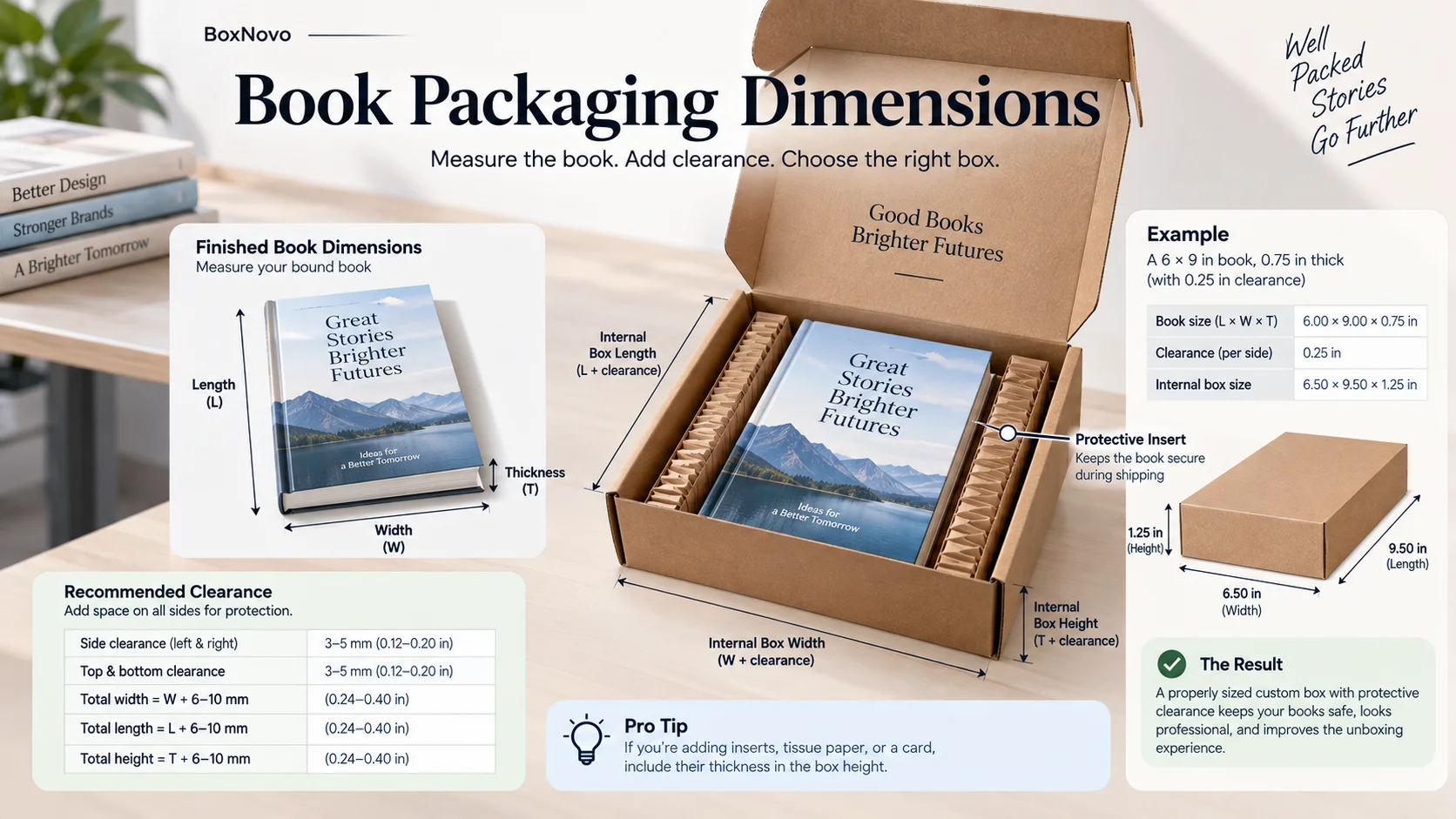
Practical note: Worked example: suppose a finished book measures 6 × 9 × 1 inches. If a packaging design requires 0.125 inches of clearance on each side of the 6-inch and 9-inch axes, plus a known 0.25 inches of protective material along the thickness axis, the preliminary internal dimensions would be 6.25 × 9.25 × 1.25 inches before accounting for any additional structural geometry. This is a planning calculation, not a final dieline specification. The packaging manufacturer should confirm the finished structure.
Internal vs. External Box Dimensions
Internal dimensions describe the usable cavity the book and insert must fit inside. External dimensions describe the finished outside footprint and matter for shipping, storage, display, and master-carton planning. They are not interchangeable because board thickness, walls, folds, lids, and construction features occupy space.
Book Packaging for E-Commerce Orders
For direct-to-customer orders, package the finished book as a parcel rather than simply placing it in the largest available box. For single-book shipments, a compact branded mailer can provide a compact branded format.
- Measure the actual finished book and any wrap, sleeve, insert, or accessory shipped with it.
- Control movement with the packaging system rather than relying on a large empty cavity.
- Protect corners and covers when the book has a premium finish or rigid construction.
- Check the finished external dimensions because the package may travel as its own shipping container.
- For multiple books, measure the combined stack or arrangement and total weight.
- For U.S. shipments, review the current USPS Domestic Mail Manual when the package falls under its book-specific packaging provisions; carrier rules can change.
Book Packaging for Retail and Premium Editions
Retail packaging can serve a different purpose from shipping packaging. A bookstore or gift-oriented product may use a printed carton, sleeve, or rigid presentation box to protect the book and create a defined presentation. For the broader packaging decision framework, see BoxNovo’s broader custom packaging framework.
- Choose a structure that fits the finished book without crushing corners or pressing on the cover.
- Consider how the package will be stored, stacked, displayed, and opened.
- Use premium finishes where they support the product’s positioning rather than adding decoration without a purpose.
- For limited editions or gifts, packaging can become part of the product presentation rather than only a protective layer.
How to Use Packaging Inserts With Books
Packaging inserts can add information, protection, or a branded touch without changing the book itself.
- Thank-you cards for direct-to-customer orders.
- Bookmarks or reading guides.
- Author notes or signed-edition cards.
- Discount or reorder cards.
- Promotional inserts for related products.
- Paperboard or corrugated protective inserts that keep the book centered and reduce movement.
Practical note: Every insert should have a clear job. Measure the assembled insert and book together because the insert can define the required box cavity.
Book Printing and Packaging: Plan the Total Product
A printing decision can look inexpensive until packaging, shipping, storage, and fulfillment are added. Planning these components together helps avoid a mismatch between the finished book and the way it must reach the customer.
- Printing and binding determine the finished book’s dimensions and weight. Packaging material choices can then be evaluated using these packaging material options.
- Paper choice can change thickness, spine width, and shipping weight.
- Packaging must accommodate the actual finished book and any insert.
- External package dimensions can affect shipping and storage.
- Premium packaging should be evaluated against the product price, sales channel, and protection requirements.
Common Book Printing Mistakes
| Mistake | Why it causes problems | Better approach |
|---|---|---|
| Guessing spine width | Page count and paper characteristics affect finished thickness. | Use the selected printer’s spine calculator or template. |
| Skipping the proof | A screen cannot fully show physical color, paper, binding, or trimming. | Inspect a physical proof when the project or quantity justifies it. |
| Choosing paper only by price | Paper affects opacity, thickness, feel, weight, and image reproduction. | Compare samples against the intended use. |
| Ignoring shipping and storage | Books are physical inventory with real weight and volume. | Plan total landed cost and fulfillment. |
| Using generic packaging dimensions | The finished book can differ from the planned trim size in thickness and construction. | Measure the bound book before final packaging design. |
| Adding excessive empty space | Movement can increase and package volume can grow. | Use controlled clearance and an appropriate insert or protective system. |
| Mixing internal and external dimensions | The package may fit incorrectly or be quoted on the wrong basis. | State the measurement basis in every packaging specification. |
Book Printing Checklist
- Final trim size confirmed.
- Page count and pagination confirmed.
- Printing method selected.
- Paper stock and weight selected.
- Interior color method selected.
- Binding selected.
- Cover stock and finish selected.
- Bleed and safe areas confirmed against the printer’s current requirements.
- Spine width confirmed from the printer’s specification.
- Proof reviewed and approved.
- Quantity confirmed.
- Shipping, storage, and fulfillment plan confirmed.
- Finished book length, width, and thickness measured.
- Packaging format selected.
- Insert/protection requirements confirmed.
- Packaging artwork and structural proof approved.
How BoxNovo Fits Into the Packaging Stage
If the finished books will be shipped, gifted, sold online, or presented as a branded product, the package can be designed around the actual book instead of forcing the book into a generic stock size. BoxNovo provides custom packaging in different sizes and styles, with printing, materials, finishing, and structural options selected around the product and intended use.
- For a single-book e-commerce order, a custom mailer can provide a compact branded shipping format.
- For multiple books or higher protection needs, stronger corrugated shipping solution can provide a stronger shipping solution.
- For premium editions or gifting, rigid presentation box with a fitted insert can create a more presentation-led format.
- For branded fulfillment, inserts such as thank-you cards, bookmarks, or promotional cards can be planned alongside the package.
- For any format, provide the finished book dimensions, quantity, intended sales channel, insert requirements, and branding requirements before the final box specification is approved.
Frequently Asked Questions About Book Printing
What is book printing?
Book printing is the process of producing physical books from prepared files. Depending on the project, it can include prepress, printing, binding, trimming, finishing, proofing, packing, and delivery.
Can I print a single book?
Yes. Some digital and POD providers support single-copy production. Available sizes, paper, binding, finishing, and pricing vary by provider.
What is print-on-demand book printing?
Print-on-demand produces copies when orders are placed instead of requiring a large finished inventory in advance. It can reduce inventory exposure but may have a higher per-copy cost than bulk production.
What is the difference between digital and offset book printing?
Digital printing works directly from digital files and is generally flexible for smaller quantities. Offset uses plates and can become more economical for sufficiently large, stable runs. The best choice depends on the full specification and quantity.
What is perfect bound book printing?
Perfect binding uses adhesive along the spine and a flexible cover to create a square-spined paperback format. It is common for novels, catalogs, manuals, journals, and other bound publications.
What is the best paper for book printing?
There is no single best paper. Text-heavy books often use uncoated stocks, while image-heavy projects may use coated stocks. Paper samples are the most reliable way to judge feel, opacity, and appearance for a specific project.
What are common book trim sizes?
Examples include 5 × 8, 5.5 × 8.5, and 6 × 9 inches for many trade-style books, with larger sizes used for workbooks, manuals, catalogs, and image-heavy publications. Availability varies by printer.
How much does it cost to print a book?
Cost depends on page count, trim size, paper, color, binding, quantity, finishing, proofing, and shipping. A printer quote based on the complete specification is required for an exact price.
Can I print a book online?
Yes. Online book printing platforms and book printing services can support remote file submission, specification selection, proofing, and ordering. Compare the actual production specification and shipping terms.
How do I prepare a book for printing?
Confirm trim size, margins, gutter, bleed, safe area, image requirements, fonts, page count, cover/spine dimensions, and the printer’s current file specifications before exporting the final files.
Do I need a proof copy?
A proof is strongly recommended before a large production run when the project is sensitive to color, paper, binding, trimming, or finishing. It can reveal physical issues that are not obvious on screen.
How do I calculate the right box size for a book?
Measure the finished book’s actual length, width, and thickness, then add the space required for the insert, protection, and controlled clearance. State whether the target dimensions are internal or external.
What packaging is best for shipping books?
The appropriate format depends on the book’s size, quantity, weight, value, protection needs, and shipping environment. Book mailers, custom corrugated boxes, and fitted protective systems are common options.
Can I add custom inserts to book packaging?
Yes. Inserts can include thank-you cards, bookmarks, promotional cards, author notes, or protective structures. Measure the complete book-and-insert arrangement when sizing the package.
Can I use branded packaging for books?
Yes. Custom printing can be used on suitable mailers, cartons, corrugated boxes, rigid boxes, sleeves, or other packaging formats, depending on the structure and printing process.
What is full book printing?
If you mean producing the complete finished book rather than only a cover or interior component, the project normally includes the interior, cover, binding, trimming, and any required finishing. Exact production steps vary by printer.
What is color book printing?
Color book printing uses color production for some or all interior pages. The appropriate process depends on the artwork, color requirements, quantity, paper, and printer.
Can children’s books be printed in color?
Yes. Children’s book printing commonly uses color, but the required paper, cover, binding, and finish should be chosen around the intended age group, handling, and production method.
Conclusion
The right book printing specification starts with the book’s purpose, quantity, audience, budget, and sales channel. Choose the production method first, then lock trim size, paper, binding, cover, file requirements, and proofing. After the book is physically finished, measure the actual bound copy before choosing packaging. A package designed around the real book, insert, protection, and shipping requirements is more reliable than a generic box chosen from the planned trim size alone.
Practical note: For BoxNovo readers, the next step is to turn those finished-book measurements into a packaging specification: book dimensions, quantity, packaging style, material, insert needs, branding, and intended use. Those details provide a practical starting point for a custom packaging quote.