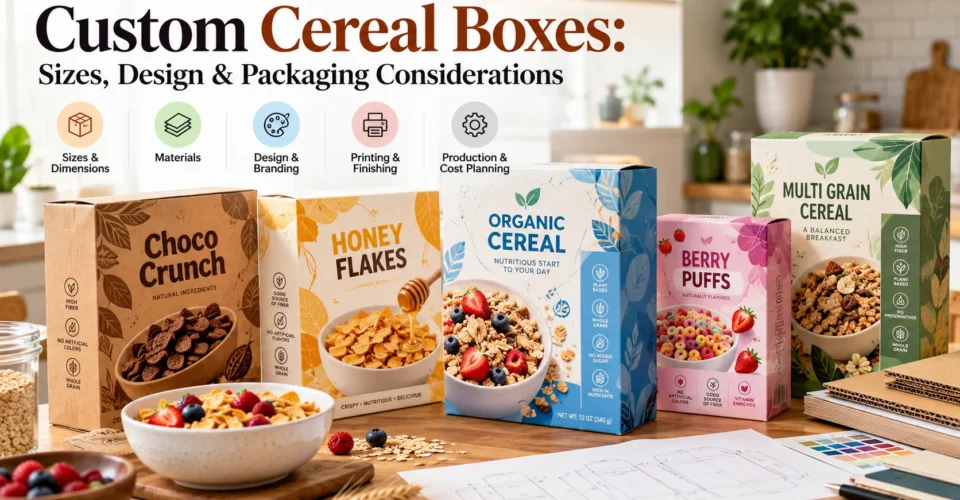
Cereal packaging has to do several jobs at once. It needs to hold the product system, present the brand on shelf, leave enough room for product information, fit the intended retail format, and work with the way the cereal is filled, packed, stored, and handled.
That is why choosing custom cereal boxes should not begin with a generic box size or a front-panel design. A better process starts with the cereal and its inner packaging, then works through dimensions, structure, material, artwork, labeling space, printing, testing, and production.
This guide explains how to plan a custom cereal carton, how to think about common cereal box dimensions, what to measure before creating a dieline, and which packaging decisions can affect shelf presentation, packing efficiency, and the finished customer experience.
What Are Custom Cereal Boxes?
Custom cereal boxes are printed paperboard cartons developed around a cereal product, brand, pack format, and production requirements. The carton can be customized by size, structure, artwork, printing, finishing, and other packaging features.
For many cereal products, the carton and the inner package have different jobs. The inner liner or bag may provide the primary product-contact and barrier function, while the outer carton provides structure, printed communication, shelf presentation, and handling support. The exact packaging system depends on the product and how it is manufactured and sold.
The important point is that a cereal carton is not simply a rectangular advertising surface. Its dimensions, board specification, closure, panel layout, and artwork all need to work together.
Start With the Cereal, Not the Box
The first mistake in cereal packaging is choosing a box from a size chart before understanding the product. Two cereals with the same net weight can occupy different volumes because their bulk density, particle shape, inclusions, and settling behavior can differ.
Before specifying the carton, document the real packaging system:
- Cereal type, particle size, inclusions, and nominal net quantity
- Filled inner bag or liner dimensions
- Seal areas, folds, gussets, and expected headspace
- Expected fill variation and settling after filling
- Single-serve, standard retail, family-size, multipack, hospitality, or promotional format
- Retail shelf orientation and required front-facing area
- Manual or automated filling, carton erection, closing, inspection, and case packing requirements
- Number of flavors, sizes, languages, seasonal versions, or other SKUs
Measure production-representative filled bags rather than relying only on an empty liner or a marketing mockup. A cereal package should have enough room for the actual filled product system without creating unnecessary empty space or forcing the bag into a shape that makes loading, closure, or presentation difficult.
Cereal Box Dimensions: Why There Is No Single Standard
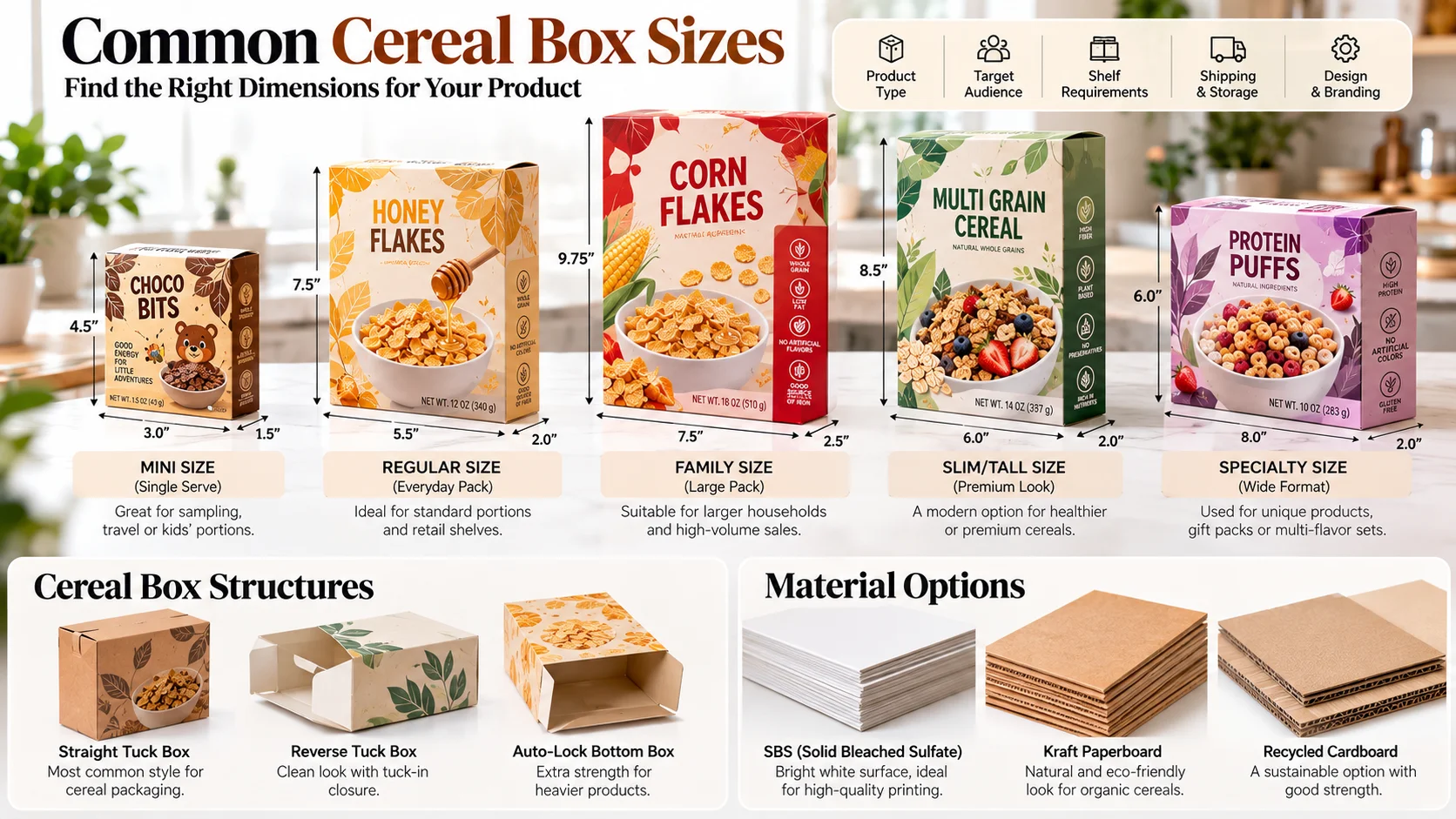
You will often see cereal boxes described as standard, family-size, mini, or single-serve. Those labels are useful for discussing package formats, but they should not be treated as universal manufacturing dimensions.
Published references commonly place regular retail cereal cartons around the roughly 12-inch-high and 8-inch-wide range, with depth varying by product and package format. Other references list different ranges for standard, family, mini, and specialty cartons. The variation exists because cereal density, fill quantity, liner dimensions, retail requirements, structure, and brand presentation all affect the final package.
Use these ranges as planning references, not as a final dieline.
| Format | General Planning Direction | What to Verify |
|---|---|---|
| Mini / single-serve | Compact carton for individual portions, sampling, hospitality, or multipacks | Filled liner, serving quantity, opening method, case packing |
| Standard retail | Upright carton designed for everyday shelf presentation | Front width, shelf height, depth, fill volume, liner fit |
| Family size | Larger carton with greater product volume and expanded panel area | Filled-bag dimensions, shelf clearance, board stiffness, case efficiency |
| Large / value format | Higher-volume package requiring careful structural and logistics planning | Product movement, panel stability, shipping case, pallet pattern |
| Specialty cereal | Custom proportions based on the product and brand concept | Structure, display orientation, insert or window needs, production method |
How to Measure a Cereal Box
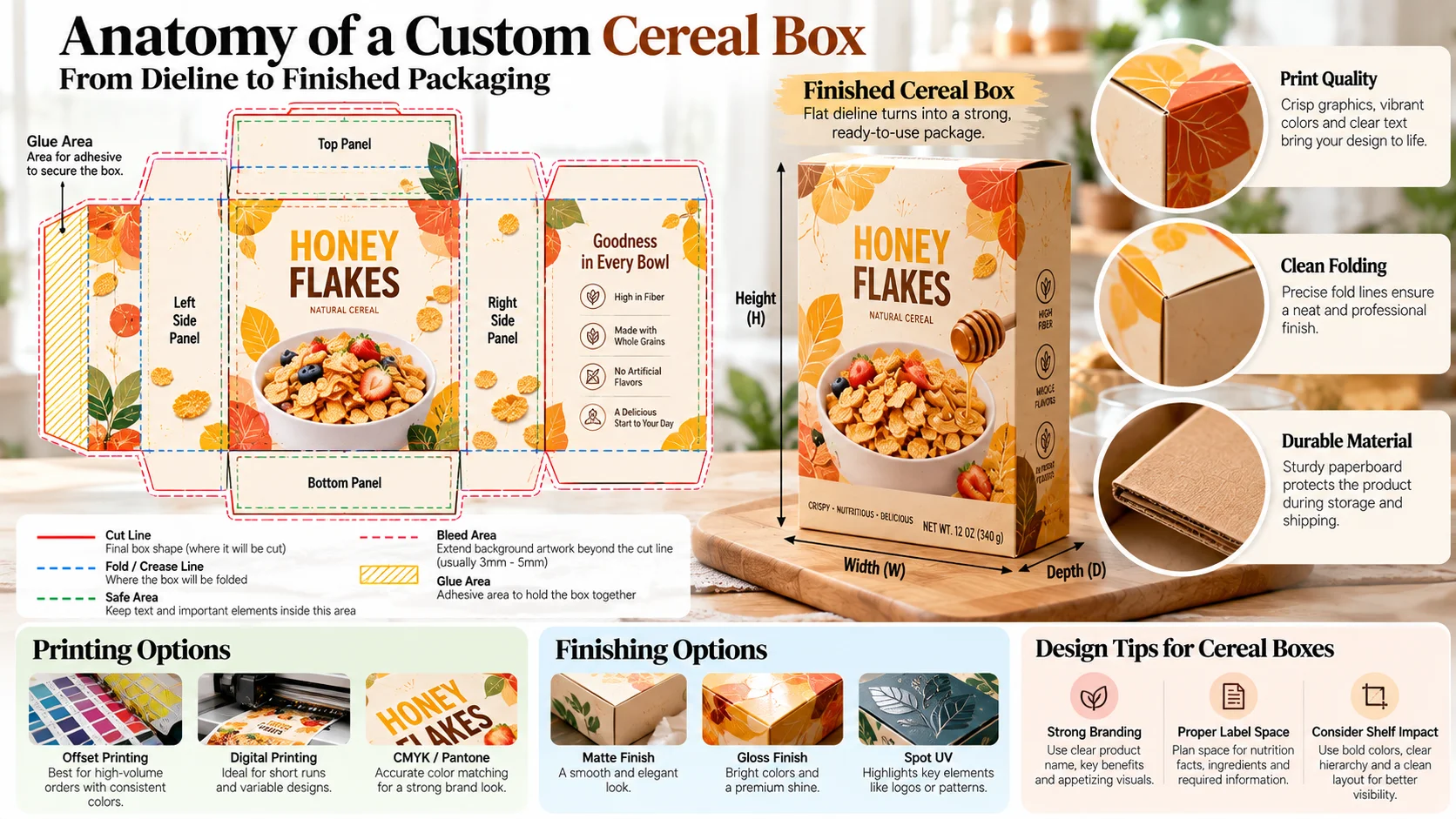
When someone asks for cereal box dimensions, always clarify what the three measurements represent. For an erected carton, a practical consumer-facing convention is height × front width × depth. A packaging manufacturer may use a different technical convention, so label every measurement rather than writing only three numbers.
| Measurement | What It Means | Why It Matters |
|---|---|---|
| Height | Bottom-to-top dimension of the finished carton | Affects shelf clearance, front-panel proportion, and overall presentation |
| Front width | Horizontal width of the main display panel | Controls branding area and shelf-facing footprint |
| Depth | Front-to-back dimension of the finished carton | Affects filled-bag fit, shelf depth, case packing, and material usage |
Measure the finished or approved carton in its natural erected shape. If you are developing a new package, separately document the finished external dimensions, required internal space, product clearance, and production dieline dimensions.
Do not confuse the flat dieline or blank size with the finished box size. A dieline includes panels, flaps, glue areas, folds, and other production geometry, so its total dimensions are naturally larger than the assembled carton.
Choose the Cereal Box Structure
A cereal carton is commonly developed as a folding carton, but the exact construction should follow the product, filling method, closure requirements, shelf presentation, and production process.
Common structural directions include:
| Structure Direction | Potential Use | Planning Considerations |
|---|---|---|
| Tuck-end folding carton | General retail presentation | Closure, flap geometry, opening experience, board specification |
| Reverse tuck format | Retail cartons needing a practical folding closure | Panel orientation, tuck direction, opening and closing behavior |
| Seal-end construction | Packages requiring a more production-oriented closure | Filling process, sealing equipment, assembly sequence |
| Custom specialty carton | Distinctive proportions, windows, or promotional formats | Die-cut complexity, production method, cost, stacking, and testing |
BoxNovo’s packaging style library can be useful when comparing available structural directions before you finalize a cereal carton concept. The important step is to evaluate the structure against the real product and filling workflow rather than choosing a style only because it looks attractive in a mockup.
Choose the Right Material for a Cereal Carton
Paperboard is a natural starting point for many printed folding-carton applications because it provides a printable surface and a defined structure. The final board specification should still be selected around the carton dimensions, product weight, structure, required rigidity, printing, finishing, and handling conditions.
BoxNovo’s packaging material options include paperboard/cardboard, kraft, corrugated, and rigid packaging directions. For a cereal carton, a paperboard-based structure is generally the most relevant direction to evaluate first, while the final specification should be confirmed for the actual package.
BoxNovo’s cardboard specifications include SBS/FBB folding box board in multiple GSM and thickness options, with CMYK and PMS printing and finishes such as matte, gloss, soft touch, spot UV, foil stamping, embossing, and debossing. Availability and suitability still depend on the selected structure and production requirements.
See the cardboard packaging options when you are comparing board thickness, printing, and finish directions.
Should You Use Kraft or White Paperboard?
The visual direction of the carton can influence the material choice. White paperboard provides a clean surface for detailed graphics, photography, illustrations, and strong color reproduction. Kraft can create a more natural visual language, but the substrate color changes the appearance of printed colors and should be considered during artwork development.
| Material Direction | Useful When | Key Question |
|---|---|---|
| White paperboard | Detailed branded graphics and strong color presentation are priorities | Does the board specification provide the required rigidity and print result? |
| Kraft paperboard | A natural or understated visual direction supports the brand | How will the substrate color affect artwork and required product information? |
| Corrugated | Higher protection or shipping strength is important | Is a shipping/protective carton needed instead of a retail cereal folding carton? |
Do not select a material solely because it looks sustainable or premium. Consider the complete package, including coatings, laminations, adhesives, inner packaging, shipping route, and local recycling conditions where environmental claims are being made.
Plan the Front Panel Before Designing the Artwork
The front panel is usually the primary visual communication surface, so its hierarchy should be decided before the designer fills every available space with graphics.
A practical front-panel hierarchy can include:
- Brand identity
- Product name or cereal type
- Variant or flavor
- Product image or serving cue
- Important substantiated selling points
- Net quantity or other applicable front-facing information
Keep the front panel easy to understand at shelf distance. Strong packaging does not require every message to be equally large. Use contrast, spacing, typography, and image placement to guide the eye.
Plan the Back and Side Panels for Information
A cereal carton has more communication surfaces than the front panel. Use the side and back panels deliberately instead of treating them as leftover space.
| Panel | Potential Role |
|---|---|
| Front | Brand, product identity, variant, key visual communication |
| Back | Brand story, product information, preparation or usage content, recipes, or other appropriate communication |
| Side panel | Nutrition information, ingredients, barcode, claims, contact information, or supporting information as applicable |
| Top / bottom | Closure, production coding, secondary identification, or other functional information as applicable |
The exact content depends on the product and market. Do not copy a competitor’s information layout and assume it is legally complete for your product.
Nutrition Facts, Ingredients and Allergen Information
For cereal sold in the United States, packaging artwork needs to accommodate applicable food-labeling requirements. FDA requirements cover Nutrition Facts information and ingredient/allergen disclosures, but the exact obligations depend on the product and circumstances. FDA’s current materials note that packaged foods have specific Nutrition Facts requirements and that major food allergens must be identified under U.S. food-labeling law.
That makes label planning a packaging-design issue as well as a regulatory issue. Collect the approved information before final artwork rather than trying to squeeze required content into a finished design at the end.
For U.S. products, the nine major food allergens currently recognized under federal labeling rules include milk, egg, fish, Crustacean shellfish, tree nuts, peanuts, wheat, soybeans, and sesame. Confirm the exact labeling requirements for the product and market with the applicable authority or a qualified regulatory professional before production.
BoxNovo’s product label design guidance is also useful when planning information hierarchy, barcode placement, production areas, safe areas, and physical proofing as part of a broader packaging system.
Design for Multiple Cereal SKUs
If a cereal brand has several flavors or product variants, do not design every carton as an unrelated package. Build a visual system that makes the family recognizable while allowing each SKU to remain distinct.
| Element | Keep Consistent | Allow to Change |
|---|---|---|
| Brand mark | Placement and general treatment | Seasonal or campaign adaptations when appropriate |
| Typography | Core type system | Limited accent treatments |
| Product name | Hierarchy and placement | Variant-specific name |
| Color system | Overall brand logic | Flavor or product differentiation |
| Product photography | General composition style | Cereal type, ingredients, serving suggestion |
| Information panels | Grid and hierarchy | Variant-specific content and values |
A consistent system makes a cereal range easier to recognize while reducing the amount of structural and design work that has to be reinvented for every SKU.
Prepare the Cereal Box Dieline
The dieline connects the finished carton structure to the artwork. It defines where panels, folds, cuts, flaps, and glue areas occur so the printed design can be positioned correctly on the physical package.
Before artwork is finalized, confirm:
- Finished external and required internal dimensions
- Panel sequence and orientation
- Cut and crease geometry
- Glue areas
- Closure and flap positions
- Window or die-cut areas if applicable
- Bleed and safe-area requirements from the printer
- Barcode and critical-information placement
Never assume a generic bleed value is correct for every packaging project. Use the current production template and specifications supplied for the selected manufacturing process.
Choose Printing and Finishing Carefully
Printing should support the brand without making the information hierarchy harder to read. Process-color printing, spot colors, coatings, and specialty finishes each affect the visual result and production setup.
For cereal cartons, finishing should be chosen with the actual shelf environment and handling conditions in mind. Matte, gloss, soft-touch, spot UV, foil, embossing, or debossing can be useful in the right application, but they should have a clear design purpose.
BoxNovo’s print-preparation guidance can help if your artwork starts in Canva, but the printer’s current production specification should remain the final reference for file setup.
Blank Cereal Boxes vs. Custom Printed Boxes
A blank cereal box can be useful for prototyping, internal testing, temporary packaging, or brands that plan to add labels separately. A custom printed carton integrates the brand and product communication directly into the package.
| Approach | Useful When | Trade-Off |
|---|---|---|
| Blank carton + label | Flexible information, early testing, or changing small-batch SKUs | Requires a separate label application process |
| Fully printed carton | Stable branding and shelf presentation are priorities | Artwork changes affect the printed package |
| Printed carton + variable label | Core brand stays consistent while selected information changes | Requires coordinated carton and label production |
The right approach depends on how often the artwork changes, how the product is sold, how much information must vary, and what the production workflow can support.
Prototype the Cereal Packaging Before Production
A digital mockup can show how the package should look, but it cannot prove that the filled package works physically. A prototype or production-representative sample lets you check the carton against the real inner package and actual product conditions.
Use the sample to review:
- Filled-bag fit
- Top and bottom closure
- Panel squareness and appearance
- Product movement inside the carton
- Front-panel proportion and shelf appearance
- Readability of required information
- Barcode placement and scanning where applicable
- Artwork alignment across folds and panels
- Case-packing and handling considerations
BoxNovo’s custom cardboard packaging can be reviewed when evaluating paperboard-based branded carton options.
Test the Cereal Box in Its Real Use
Testing should reflect the actual way the package will be filled, closed, stored, displayed, transported, and opened. A carton that looks perfect on a desk may behave differently when loaded with a flexible inner bag and placed into a shipping case.
| Test Area | What to Check |
|---|---|
| Fit | Does the filled inner package fit without excessive compression or unnecessary empty space? |
| Closure | Does the top and bottom close as intended? |
| Structure | Does the carton remain square and stable during normal handling? |
| Shelf | Does the package fit the intended shelf orientation and remain visually consistent? |
| Handling | Can the package be picked up, carried, opened, and stored comfortably? |
| Shipping | Does the package work with the intended case, fulfillment, and distribution process? |
| Artwork | Are colors, folds, trims, barcodes, and critical information positioned correctly? |
What Affects Custom Cereal Box Cost?
There is no useful universal per-box price because cereal packaging cost depends on the complete specification. Important variables can include:
- Finished dimensions
- Board material and thickness
- Box structure and die complexity
- Printing coverage and color requirements
- Special finishes
- Windows, inserts, or other components
- Order quantity
- Number of SKUs and artwork versions
- Sampling and proofing requirements
- Packaging and shipping requirements
BoxNovo likewise notes that final pricing varies with quantity, dimensions, materials, printing, finishes, and customization requirements. A complete packaging specification therefore produces a more meaningful quote than simply asking for a “standard cereal box.”
Custom Cereal Box Design Ideas That Have a Practical Purpose
Creative cereal packaging works best when the visual idea also supports a real packaging objective. Consider:
- A strong color system that separates flavors while preserving brand recognition
- A clear product image or serving presentation
- Illustration or character systems that can extend across multiple SKUs
- Distinctive typography that remains readable at shelf distance
- Selective finishing on a logo or key graphic instead of covering every panel
- Window or specialty die-cut concepts where showing the product genuinely adds value
- Recipe or serving content on a secondary panel when appropriate
- QR codes that lead to a tested, mobile-friendly destination
Creativity should not compromise required information, readability, carton strength, filling efficiency, or production reliability.
Common Custom Cereal Box Mistakes
- Choosing a box size from a generic chart without measuring the filled inner package
- Confusing net weight with physical volume
- Using the flat dieline dimensions as the finished carton dimensions
- Leaving nutrition, ingredient, allergen, barcode, or other required information until the end
- Designing the front panel before understanding the complete information hierarchy
- Ignoring the effect of kraft or colored substrates on artwork
- Adding finishes that have no clear purpose
- Skipping a physical prototype
- Testing an empty carton instead of the actual filled packaging system
- Creating every SKU as a completely separate design instead of building a coherent system
- Assuming a competitor’s box dimensions are appropriate for your product
- Making unsupported environmental or performance claims
Custom Cereal Box Checklist
Before approving a cereal carton for production, confirm the following:
- Product and cereal characteristics documented
- Filled inner bag or liner measured
- Expected settling and fill variation considered
- Finished carton dimensions defined
- Internal and external dimensions clearly identified
- Structure and closure selected
- Board material and thickness confirmed
- Front-panel hierarchy established
- Side and back information planned
- Nutrition, ingredient, allergen, barcode, and other applicable information reviewed
- SKU design system established
- Production dieline confirmed
- Bleed and safe areas set according to production specifications
- Printing and finishing requirements confirmed
- Physical sample reviewed
- Filled-product testing completed
- Shipping and case-packing considerations reviewed
- Final artwork proofread and approved
How to Brief a Custom Cereal Box Manufacturer
A clear packaging brief reduces unnecessary back-and-forth and gives the manufacturer enough information to evaluate the project properly.
| Specification | What to Provide |
|---|---|
| Product | Cereal type, variant, net quantity, product characteristics |
| Inner package | Filled liner dimensions, seal format, headspace, material information where relevant |
| Finished size | Height × front width × depth, with internal/external convention identified |
| Structure | Preferred carton style or request for recommendations |
| Material | Preferred paperboard direction, thickness if known, and appearance |
| Artwork | Final design files or design status, plus SKU count |
| Printing | Color process, coverage, and special color requirements if applicable |
| Finishing | Matte, gloss, soft touch, foil, embossing, or other requested treatments |
| Regulatory information | Approved product information and applicable market requirements |
| Quantity | Initial quantity, SKU breakdown, and expected reorder pattern |
| Sample | Whether a physical prototype or pre-production sample is required |
| Delivery | Destination and intended distribution method |
For a broader packaging decision process, BoxNovo’s complete packaging planning guide can help connect product requirements, materials, structure, branding, and production planning.
When Custom Cereal Boxes Make Sense
Custom packaging becomes particularly useful when a cereal brand needs a specific shelf footprint, a consistent multi-SKU identity, a distinctive printed presentation, a structure that differs from stock cartons, or dimensions built around its actual inner package.
It is also useful when the package needs to function as part of a broader brand system. A well-planned carton can coordinate the front panel, information hierarchy, side panels, barcode area, inner package, case configuration, and customer-facing presentation instead of treating each component separately.
BoxNovo’s custom product box solutions provide another reference point for brands evaluating product-specific packaging, dimensions, artwork, and branded presentation.
Frequently Asked Questions About Custom Cereal Boxes
What are custom cereal boxes?
Custom cereal boxes are paperboard cartons developed around a specific cereal product, packaging system, brand, size, structure, artwork, and production requirement.
What are common cereal box dimensions?
Many regular retail cereal cartons fall around the roughly 12-inch-high and 8-inch-wide range, but there is no universal cereal box size. Depth and overall dimensions vary by product density, fill quantity, inner package, retail format, and brand requirements.
What is the standard cereal box size?
There is no single standard that should be treated as a final manufacturing specification. Common retail references are useful for planning, but the finished size should be based on the actual filled package and intended retail and distribution requirements.
How do I measure a cereal box?
For an erected carton, identify height, front width, and depth. If you are developing a new package, also document the required internal space, filled-bag dimensions, product clearance, and production dieline separately.
What material is used for cereal boxes?
Printed cereal cartons are commonly developed from paperboard or folding-box-board materials. The appropriate board specification depends on the carton size, structure, product system, required rigidity, printing, finishing, and handling conditions.
Should cereal boxes have an inner bag?
Many cereal packaging systems use an inner liner or bag as part of the overall package, but the correct configuration depends on the product, barrier requirements, manufacturing process, and intended shelf life. The carton and inner package should be developed as one system.
Can I create blank cereal boxes?
Yes. A blank carton can be useful for prototyping, temporary packaging, testing, or situations where branding is applied separately. Whether a blank carton or fully printed carton is appropriate depends on the production and branding requirements.
How do I design a cereal box for multiple flavors?
Keep the core brand system consistent while varying controlled elements such as flavor color, product name, photography, illustration, or accent graphics. This creates recognizable packaging across the range without making every SKU look identical.
What information goes on a cereal box?
Depending on the product and market, a cereal carton may need product identity, net quantity, ingredients, nutrition information, allergen information, barcode, business details, storage or usage information, and other applicable disclosures. Requirements should be verified for the specific product and market before artwork approval.
How do I choose the right cereal box size?
Start with the actual filled inner package and product characteristics. Measure the filled package, define the required internal space and clearance, consider shelf and shipping constraints, then develop the finished carton dimensions and confirm them with a physical sample.
Final Takeaway
The right custom cereal box is not simply the closest available size with attractive artwork. It is a packaging system developed around the cereal, filled inner package, dimensions, structure, material, information hierarchy, brand system, production process, and real-world handling.
Use common cereal box dimensions as reference points, not rules. Measure the actual product system, separate finished dimensions from dieline dimensions, plan required information before artwork is locked, and validate the package with a physical sample before full production.
When those decisions are made in the right order, custom cereal packaging can support shelf presentation, brand consistency, practical handling, and a more controlled production process.