Good pizza box design balances five things: a sturdy one-piece corrugated structure, a size that fits the baked pie with a little room to spare, food-safe board matched to the pizza’s weight, printing that turns the lid into advertising, and practical details like vents, liners and easy stacking. Get those right and the box keeps […]
Good pizza box design balances five things: a sturdy one-piece corrugated structure, a size that fits the baked pie with a little room to spare, food-safe board matched to the pizza’s weight, printing that turns the lid into advertising, and practical details like vents, liners and easy stacking. Get those right and the box keeps the pizza hot and intact, builds your brand on every delivery and stays affordable to buy in volume.
This guide walks through each decision in the order a pizzeria or food brand usually makes them: structure, size, material, liners, printing and the practical details that decide whether a box works on a busy Friday night. Use the size finder below to work out the exact inside dimensions for your own pies.
What Makes a Good Pizza Box Design?
A good pizza box protects the pizza, keeps it presentable and promotes the business, at a cost that works for a high-volume product. The table below shows the main design elements and the decision behind each one.
Design element
What it does
The decision to make
Structure
Holds the pizza flat and closes securely
One-piece folding box, lid lock tabs, front tuck
Size
Stops the pizza sliding or touching the walls
Inside dimensions based on the baked pie plus clearance
Board and flute
Supports the weight and resists lid sag
E-flute for smaller pies, B-flute for larger pies
Vents
Let steam escape so the crust stays crisper
Number and position of vent holes
Liner or insert
Absorbs grease and keeps the crust off the box
Paper liner, corrugated circle or none
Printing
Turns the lid into advertising
Print method, colors and what goes on the lid and sides
Practical details
Makes boxes easy to store, fold, stack and deliver
Ships flat, folds without glue, stacks without crushing
Pizza Box Structure
The structure is the foundation of pizza box design. It decides how fast staff can fold a box, how well it holds heat and how the pizza looks when the lid opens.
The Classic One-Piece Corrugated Box
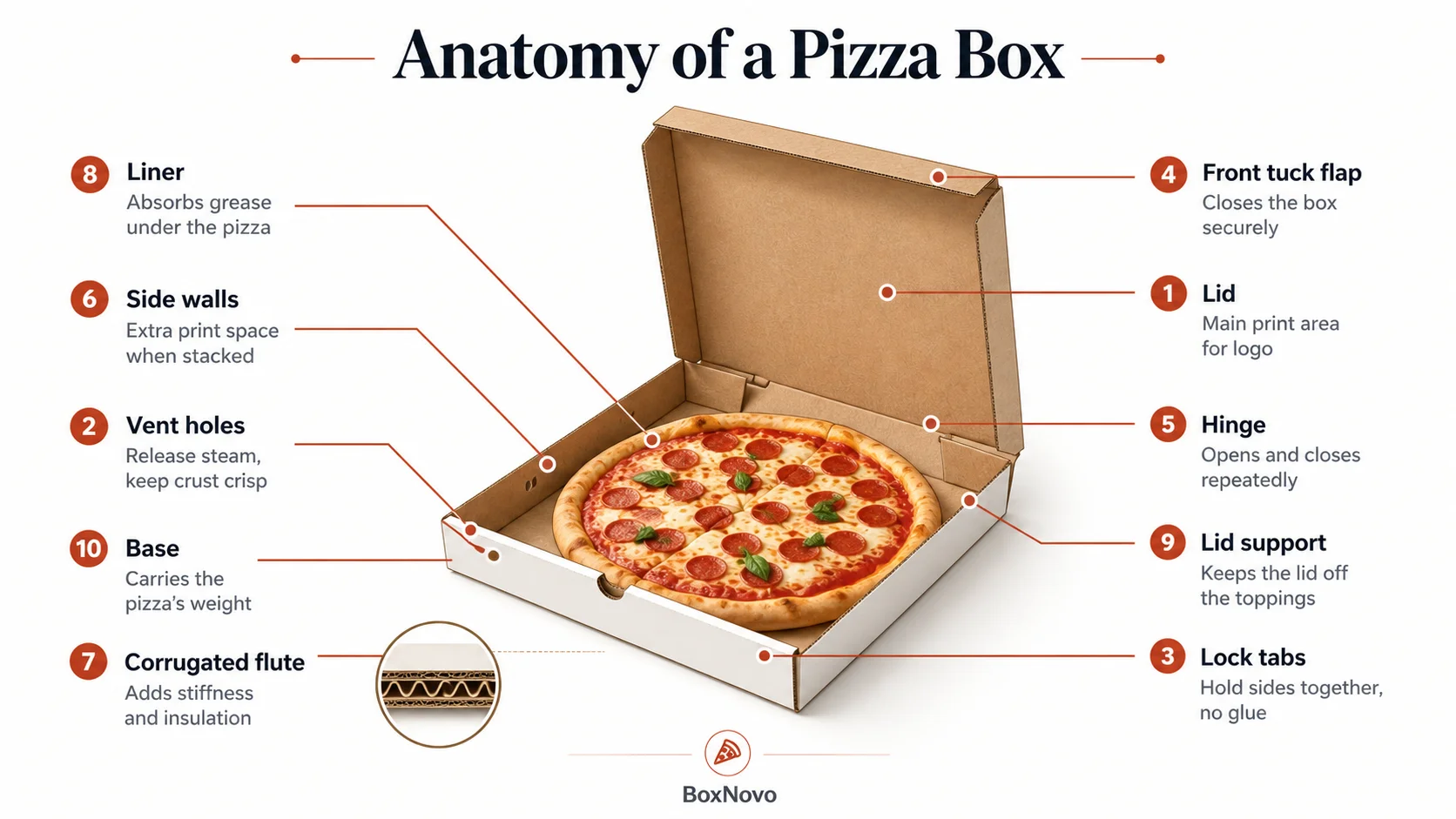
Most pizza boxes are a single die-cut sheet of corrugated board that folds into a tray with an attached lid. The sides fold up and lock with tabs, the lid hinges at the back, and a front tuck flap slides inside the front wall to close it. Because there’s no glue or tape, boxes shfip and store flat and fold in seconds.
When reviewing a box design, check that:
The lid locks securely so the box can be carried one-handed and stacked.
The front tuck is easy to open without tearing the lid.
The corners fold cleanly without gaps where heat escapes.
The hinge is strong enough to survive repeated opening at the table.
Vents and Steam Control
A hot pizza releases steam. If the steam has nowhere to go, it condenses inside the box and softens the crust. Small vent holes or slots in the lid or side walls let some of that moisture escape. The trade-off is heat: more ventilation means a crisper crust but faster cooling, so match the vents to your typical delivery time.
Pizza Box Shapes
Square boxes are the standard because they cut cleanly from flat sheets, stack evenly and fit delivery bags. Other shapes serve specific products:
Square: the default for round pizzas of any size.
Octagonal or round-cornered: a more premium look that also reduces wasted board around the corners.
Rectangular: for flatbreads, Detroit-style or Sicilian pizzas and party trays.
Triangle or wedge: for single slices sold to go.
Mini square boxes: for personal pizzas, sides and desserts.
Pizza Box Size: Matching the Box to the Pie
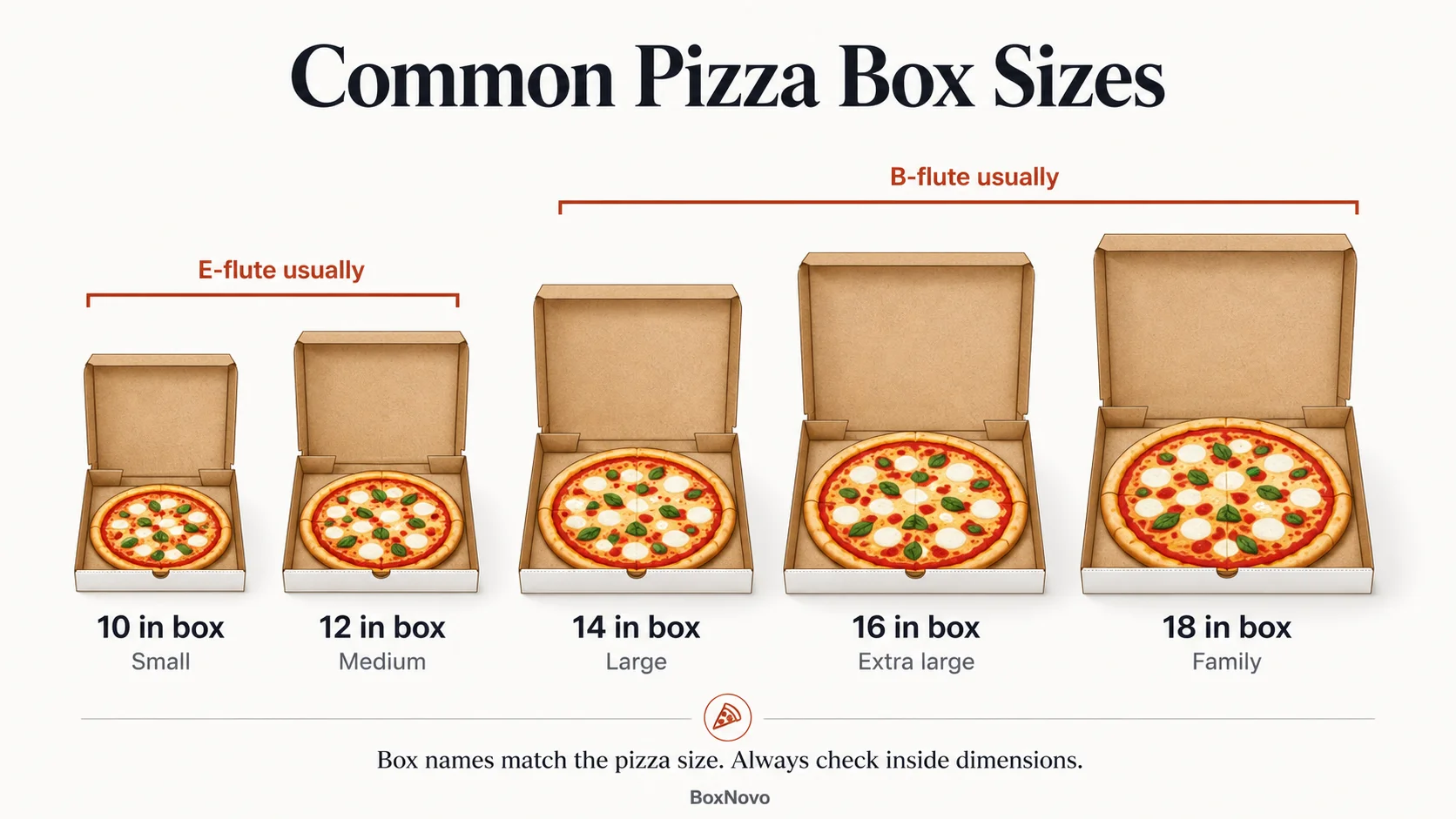
The right pizza box size is the baked pizza’s diameter plus a small clearance on every side, with enough depth to keep toppings off the lid. Box sizes are usually named after the pizza they hold, so a “12-inch box” is sold for a 12-inch pizza, but inside dimensions vary between suppliers. Always compare inside dimensions rather than the size name.
Common pizza box sizes from 10 to 18 inches, drawn to scale. Always confirm inside dimensions before ordering.
Common Pizza Box Sizes
These are typical size bands sold by foodservice suppliers. Naming and exact dimensions vary by supplier and region.
Pizza size
Typical pizza diameter
Typical box size name
Common board
Mini or personal
6 to 8 in
6 to 8 in
Paperboard or E-flute corrugated
Small
10 in
10 in
E-flute corrugated
Medium
12 in
12 in
E-flute corrugated
Large
14 in
14 in
B-flute corrugated
Extra large
16 in
16 in
B-flute corrugated
Family or party
18 in and up
18 in and up
B-flute corrugated
Most stock pizza boxes are around 1.5 to 2 inches deep, which suits thin and regular crusts. Deep-dish, stuffed-crust and heavily topped pizzas need a taller box so the cheese doesn’t stick to the lid.
Large Pizza Box Design
Large pizza boxes, from 16 inches up, carry more weight across a wider span, so the base can flex and the lid can sag onto the toppings. Stiffer B-flute board helps, and many pizzerias add a small plastic or paper pizza support in the center to hold the lid up. For party-size and rectangular pies, check that the box still fits standard delivery bags and car seats.
Mini Pizza Box Design
A mini pizza box needs less strength but still has to handle heat and grease. Folding cartons made from food-contact paperboard or thin E-flute work well and print sharply, which makes mini boxes useful for sides, desserts and sampler packs as well as personal pizzas. For single slices, open slice serving trays can be faster to serve than a closed box.
How to Measure for the Right Fit
Measure a baked pizza, not the dough, at its widest point. Pizzas often spread or shrink in the oven.
Measure several pies and use the largest result.
Measure the height at the tallest topping, including any crust lip.
Add clearance on each side so the pizza slides in without touching the walls.
Add space above the toppings and allow for any liner or circle under the pizza.
For other box types, our guide to measuring inside dimensions explains the difference between inside and outside sizes in more detail.
Pizza Box Paper and Board: Choosing the Material
Pizza boxes are made from corrugated board or, for smaller sizes, folding paperboard. The board has to support the pizza’s weight, insulate it, survive grease and moisture, and be safe for contact with food.
Corrugated Flutes: E-Flute vs. B-Flute
Corrugated board is a wavy middle layer, called the flute, glued between flat liners. The flute size changes how thick, stiff and printable the board is.
Flute
Thickness
Strengths
Typical pizza box use
E-flute
Thinner, roughly 1/16 in
Smooth surface for printing, lighter, folds neatly
Small and medium pizzas, mini boxes
B-flute
Thicker, roughly 1/8 in
Stiffer, more cushioning and insulation, less lid sag
Large and extra-large pizzas
Thicknesses are approximate and vary by mill and liner weight. To see how flute and wall construction affect strength, compare our corrugated board grades.
White, Kraft and Printed Board
The outer liner of the board changes how the box looks and prints:
White-top board gives the brightest colors and sharpest logos, which makes it the usual choice for full-color pizza boxes.
Kraft (brown) board has a natural, rustic look that suits artisan and wood-fired brands. Colors print darker on it, so test your artwork on the actual board. Explore the natural kraft look if it fits your brand.
Many pizza boxes use white over kraft: a white printing surface outside with a kraft liner inside.
Food-Contact Safety and PFAS
Pizza touches the inside of the box, so the board, adhesives and any coatings that contact food need to be suitable for direct food contact. In the US, food-contact paper and paperboard must be made from substances the FDA permits for that use.
Grease resistance used to rely partly on PFAS chemicals. In February 2024, the FDA announced that grease-proofing substances containing PFAS are no longer being sold by manufacturers for food-contact use in the US market. Several states also restrict PFAS in food packaging. When you order custom boxes, ask your supplier to confirm the board and any coatings are food-contact compliant and PFAS-free.
Pizza Box Liners and Inserts
Pizza box liners sit between the pizza and the box. They absorb grease, keep the crust from sticking and help the box look clean when the customer opens it.
Liner or insert
What it does
When to use it
Absorbent paper liner
Soaks up grease and moisture under the pizza
Greasy or heavily topped pizzas; keeps the box base clean
Grease-resistant paper sheet
Creates a barrier between food and board
Pastries, flatbreads and slices served in open trays
Corrugated pizza circle
Adds a stiff base for lifting and slicing
Large or heavy pizzas; pies transferred out of the box
Center lid support
Keeps the lid from touching the toppings
Large boxes, loaded pizzas and longer delivery times
Liners add cost per order, so use them where they solve a real problem: soggy crusts, grease on the box or pizzas that are hard to lift out. When you add a liner or circle, allow for its thickness when you set the box depth.
The 10 parts of a one-piece corrugated pizza box and the job each one does.
Pizza Box With Logo: Printing and Branding
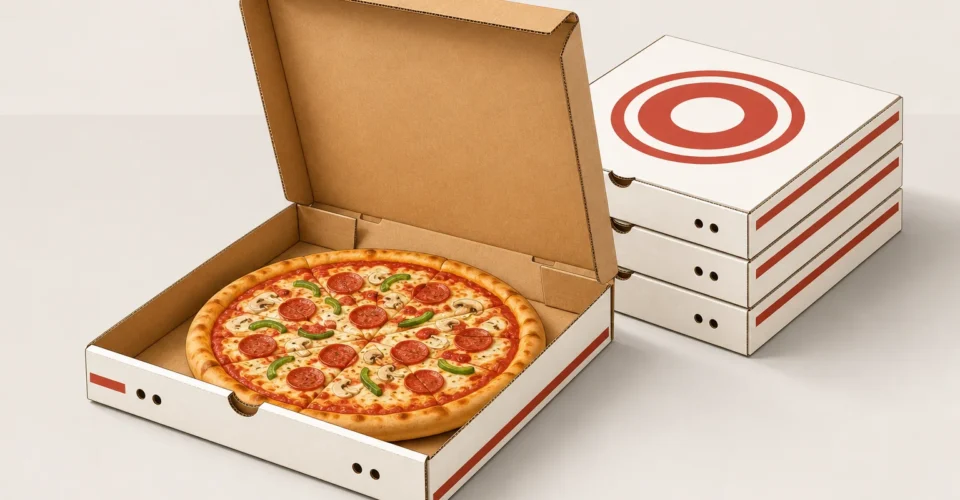
A printed pizza box puts your brand in front of every customer, their family and anyone who sees the box arrive. The lid is the main print area, and it’s large enough to work like a small poster. It’s one of the clearest branding benefits of packaging for a food business.
What to Put on the Lid
Logo and name, large enough to read across a room.
Phone number, website or QR code so customers can reorder easily.
One clear message, such as a signature pizza, a slogan or a social handle.
Enough empty space so the design reads at a glance. Busy lids look cheap.
Using the Sides and Inside the Lid
The side walls are visible when boxes are stacked on a counter or in a delivery bag, which makes them a good place for the logo or website. Printing inside the lid adds a surprise when the box opens, but keep ink to the outer surface wherever the pizza could touch it.
Print Methods for Pizza Boxes
Print method
Best for
Trade-off
Flexographic printing
High volumes in one to three spot colors
Simple artwork prints best; fine detail and photos are limited
Digital printing
Short runs, full color and frequent design changes
Corrugated board traps air in its flutes, which helps insulate the pizza. Balance that with venting so the crust doesn’t steam, keep the lid locked so heat stays in, and make sure the box fits the delivery bags you use. Fast, tight-fitting boxes stay hotter than loose, oversized ones.
Folding, Storage and Stacking
Pizza boxes are stored flat and folded during service, so speed matters. A design that folds in one or two moves saves real time at peak hours. Stacked boxes also press on each other, especially on delivery runs with several orders. Stiffer board and a well-locked lid prevent crushed corners and sagging lids. To check how much weight a corrugated box can carry when stacked, try our stacking strength check.
Cost Drivers
The price of a custom pizza box depends mainly on:
Size and board: larger boxes and thicker flutes use more material.
Print colors and coverage: one-color flexo costs less than full-color litho-laminated printing.
Quantity: setup costs spread over more boxes, so price per box falls as volume rises.
Extras: liners, inserts, special shapes and inside printing add cost.
Pizza boxes are recyclable in many areas even with some grease. A 2020 study by WestRock, released through the American Forest & Paper Association, found that grease and cheese at typical levels don’t harm the recycling process. Customers should still remove leftover food and liners and follow local recycling rules, which vary. Printing a simple recycling note on the box helps. If sustainability is part of your brand, look at eco-friendly box options and only print claims you can support.
Pizza Box Design Mistakes to Avoid
Ordering by size name without checking the inside dimensions.
Choosing thin board for a large pizza, which leads to sagging lids and bent bases.
Sealing the box completely so steam turns the crust soggy.
Cramming the lid with text so the logo gets lost.
Placing the logo or phone number across a fold or flap.
Printing ink on surfaces that touch the pizza.
Skipping a sample run before ordering thousands of boxes.
Pizza Box Design Checklist
Measure your baked pizzas for each menu size, including height.
Set inside dimensions with clearance and space for any liner.
Choose the board: E-flute for smaller pies, B-flute for larger ones.
Decide on vents based on your typical delivery time.
Choose liners or supports only where they solve a real problem.
Design the lid with your logo, reorder details and one clear message.
Confirm food-contact compliance and PFAS-free materials with your supplier.
Order a sample, fold it, fill it with a hot pizza and test a delivery run.
Frequently Asked Questions About Pizza Box Design
What is the standard pizza box size?
There’s no single standard, but the most common sizes are 10, 12, 14 and 16 inches, named after the pizza they hold. Most stock boxes are about 1.5 to 2 inches deep. Inside dimensions vary between suppliers, so check them before ordering.
What size box do I need for a 12-inch pizza?
A box sold as a 12-inch pizza box is designed for a 12-inch pizza, but check that its inside measures at least your baked pizza’s diameter plus about 1/4 inch per side. If your pizzas bake larger than 12 inches, choose a custom size or the next size up.
How deep should a pizza box be?
For thin and regular crust pizzas, about 1.5 to 2 inches is typical. Measure the baked pizza at its tallest topping and add space above it, plus any liner. Deep-dish and loaded pizzas need a taller box.
What paper are pizza boxes made of?
Most pizza boxes are made of corrugated board: a fluted middle layer between two flat liners, often with a white printing surface outside and kraft inside. Small and mini boxes can also be made from folding paperboard.
Are pizza boxes food safe?
They are when the board, adhesives and any coatings that touch the food are approved for food contact. Ask your supplier to confirm food-contact compliance and that grease-resistant treatments are PFAS-free.
Do I need a pizza box liner?
Not always. Liners help with greasy or heavily topped pizzas and keep the box looking clean, but they add cost. Many pizzerias use liners only for certain menu items.
Can I print my logo on a pizza box?
Yes. Logos are usually printed on the lid with flexographic printing for high volumes or digital printing for shorter runs. For small quantities, branded stickers or labels on plain boxes are a cheaper way to start.
Are greasy pizza boxes recyclable?
In many areas, yes. A 2020 industry study found that typical amounts of grease and cheese don’t harm the recycling process. Remove leftover food and liners first and follow your local recycling rules.
How much does a custom printed pizza box cost?
Cost depends on size, board, print colors and quantity. Price per box drops significantly as order quantity increases because setup costs are shared across more boxes. Request a quote with your sizes and quantities for an exact price.
Design Pizza Boxes That Work as Hard as Your Kitchen
The best pizza box design starts with the pizza: measure it, size the box around it, choose board that supports it and vents that keep it crisp. Then make the lid work for your brand with a clear logo and an easy way to reorder.
If you’re planning custom pizza boxes, BoxNovo can help with sizing, board choice, printing and samples for every pie on your menu. Request a custom quote or browse our full range of takeout food packaging.
BoxNovo Packaging Experts share practical insights on custom packaging, box styles, printing, labels, dimensions, materials, and product presentation. Our content helps businesses understand packaging options, choose the right solutions for their products, and create packaging that looks professional while supporting a stronger brand experience.