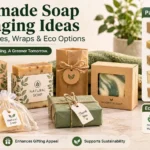
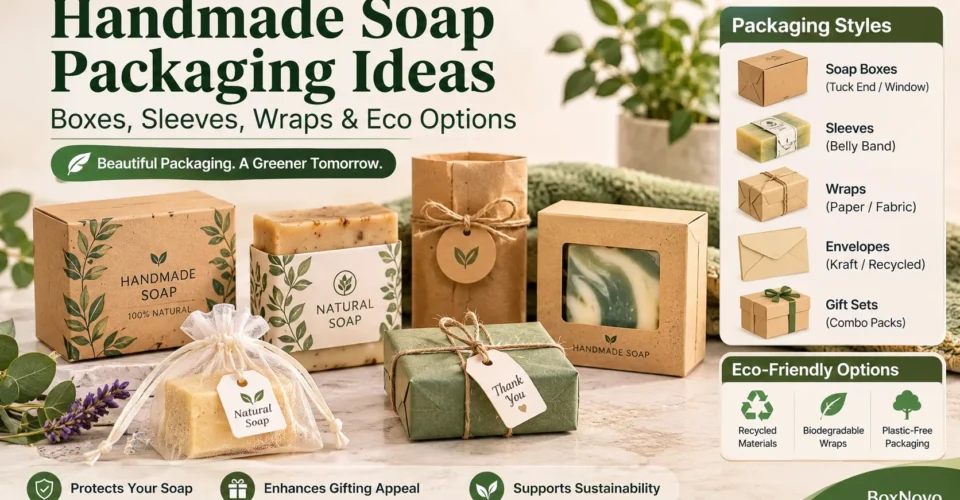
Quick answer: The best soap packaging ideas match the format to the soap. Use breathable boxes, sleeves and paper envelopes for fully cured cold process soap, tight wraps for melt and pour soap, and window boxes when shoppers need to see the bar. Size the pack from the cured bar, line oily bars with grease-resistant paper, leave room for the net weight in ounces and grams, and only print eco claims you can back up.
Key facts at a glance
- Cure before you pack: four to six weeks is enough for most cold process recipes, and bars are ready when they stop losing weight
- Breathe or seal: cold process soap needs airflow, while melt and pour soap should be wrapped tightly to stop “glycerin dew”
- Common bar size: a standard 8 in loaf mold cut into 1 in slices gives bars of about 3.5 x 2.5 x 1 in
- Net weight: shown in ounces and grams, in the bottom 30% of the front panel unless that panel is 5 sq in or less
- Oil stains: soap oils can bleed through plain paper; grease resistance is rated with the TAPPI T559 KIT test on a 1 to 12 scale
- Eco claims: an unqualified “recyclable” claim needs recycling access for at least 60% of consumers, and “compostable” claims often need a qualifier
Facts in this guide come from soap supply specifications, FDA, CPSC and FTC rules, FSC, McKinsey and testing labs listed in the Sources section. This is general guidance, not legal advice.
In this guide
- Choose packaging by soap type
- Box vs sleeve vs envelope vs wrap vs window box
- Breathable packaging for cold process soap
- Grease-resistant inner paper
- Common soap bar sizes and how to measure
- Soap box design and label space
- Gift sets and seasonal packaging
- Wholesale and retail display
- Shipping soap bars
- Eco friendly soap packaging
- Common mistakes
- Soap packaging checklist
- Frequently asked questions
- Sources
Choose Soap Packaging by Soap Type
Most soap packaging ideas online jump straight to pretty wraps. For handmade soap packaging, the better starting point is the soap itself, because cold process, melt and pour and syndet bars behave differently once they are packed. Pick the wrong format and the bar can sweat, spot, stain the paper or end up with a label that is missing required text.
| Soap Type | How It Behaves | Best Packaging | Avoid |
|---|---|---|---|
| Cold process | Cures for four to six weeks and keeps losing water; needs airflow | Open-ended sleeves, paper envelopes, vented boxes, paper wraps | Sealed plastic, especially before the cure is complete |
| Hot process | Cooked, but still benefits from about a month of curing for a harder bar | Same breathable formats as cold process | Packing bars while they are still damp |
| Melt and pour (glycerin) | Extra glycerin pulls moisture from the air, so bars “sweat” in humid rooms | Tight plastic wrap or shrink film, then a box, sleeve or label over it | Paper-only packaging in humid climates |
| Syndet bars, including detergent-based shampoo bars | Made with synthetic detergents, so FDA treats them as cosmetics | Boxes or wide sleeves with room for a full ingredient list | Narrow bands with no space for required text |
Cure and moisture details come from Lovely Greens and Bramble Berry; the syndet rule comes from FDA’s soap guidance. Whatever the format, BoxNovo’s full soap box range covers the boxes, sleeves and envelopes in this guide.
Soap Packaging Ideas Compared: Box vs Sleeve vs Envelope vs Wrap vs Window Box
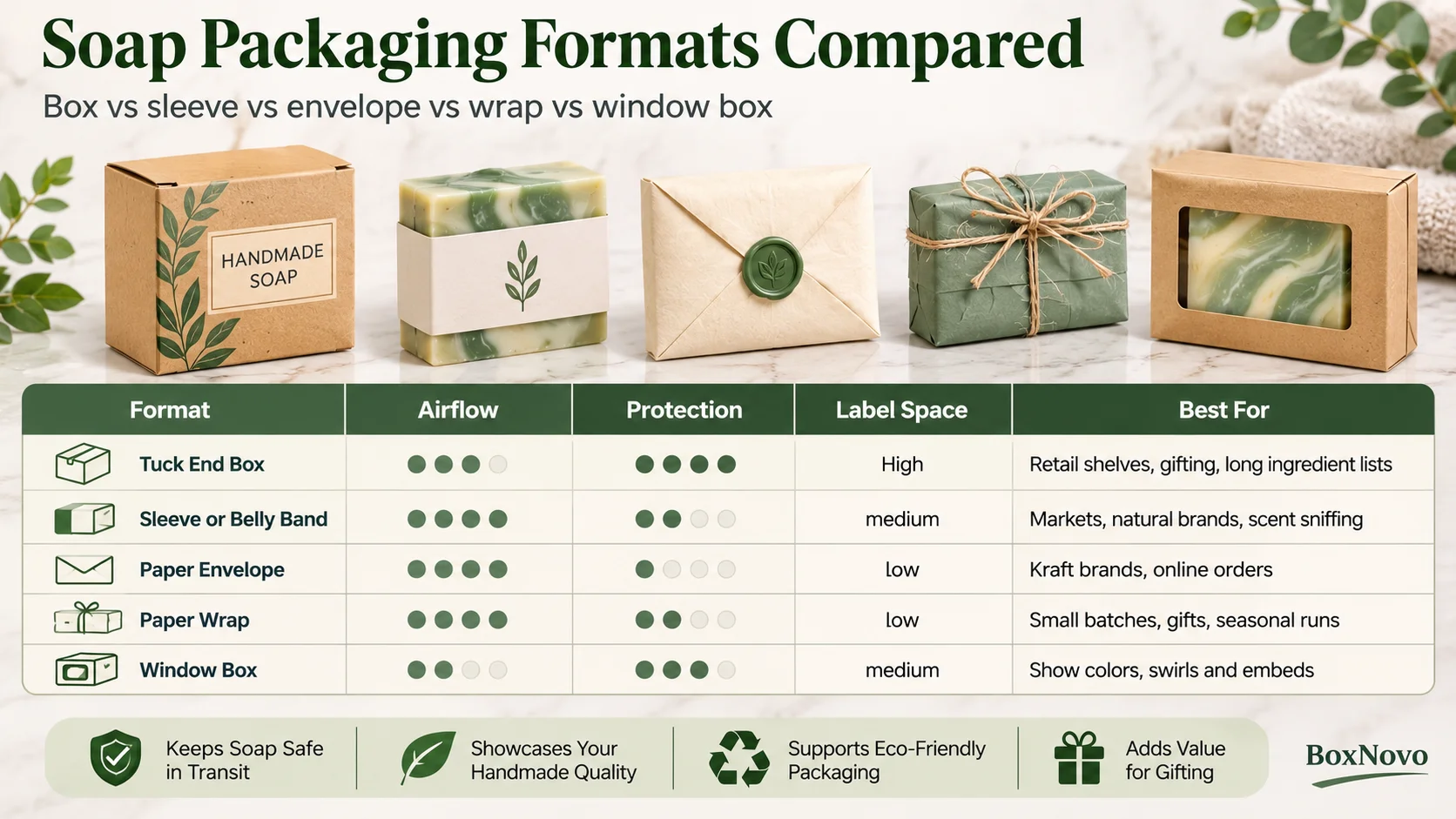
Every soap packaging format trades off airflow, protection, label space and shelf look. This comparison shows where each one fits:
| Format | Airflow | Protection | Label Space | Best For |
|---|---|---|---|---|
| Tuck end box | Medium (add vents) | High | High: front, back, sides and flaps | Retail shelves, gifting, cosmetic soaps with long ingredient lists |
| Window box | Medium | High | Medium: the window uses front space | Showing colors, swirls, embeds and botanicals |
| Sleeve or belly band | High (ends open) | Low to medium | Low to medium | Markets, natural brands, letting shoppers smell the bar |
| Paper envelope | Medium to high | Medium: covers faces and corners | Medium | Kraft-style brands, online orders packed inside a mailer |
| Paper wrap | Medium | Low to medium | Low: usually a sticker label | Small batches, gifts, seasonal runs |
| Fabric wrap or muslin bag | High | Low | Low: hang tag or card | Gifts and zero-plastic positioning |
| Shrink film or plastic wrap | Low | Medium: blocks moisture and handling | Sticker only | Melt and pour soap, or a liner under a printed box |
Soap Boxes
A folding box gives the most protection and the most room for branding. Ideas that work well:
- Kraft tuck end box: natural look with one-color print. Simple handmade bar tuck boxes suit most small-batch lines.
- Vented box: die-cut holes or a leaf pattern on the sides let cold process soap breathe and let shoppers smell the scent.
- Heavier carton: for bigger bars, sets or long shipping routes, sturdy cardboard soap cartons resist crushed corners.
- One base box, many scents: print one box and add a scent sticker or colored band, so you do not stock a different box for every fragrance.
Soap Sleeves and Belly Bands
Soap sleeves are paper tubes or bands that wrap the middle of the bar and leave the ends open. They use the least material, keep the soap visible and let it breathe. The trade-off is protection: the exposed ends can chip or pick up dust on a market table. Printed soap sleeves work best when the bar is fully cured and sold face to face. For more design ideas, see this guide to packaging sleeves.
Paper Soap Envelopes
A paper envelope closes the bar in on every face while still letting some air through the paper. It is a strong middle ground for online sellers, because the bar arrives clean and the envelope gives more print area than a band. Choose paper envelope packaging with a gusset or extra size for thick bars, and check that the closure flap does not cover required text.
Window Soap Boxes
Handmade soap often sells on looks: swirls, layers, embeds or pressed flowers. A window shows the bar without opening the box. Keep a solid border around the window so the panel stays stiff and still has room for the scent name and net weight. A die-cut window without film keeps the box all paper. Compare soap boxes with windows for shapes and window positions.
Wraps: Paper, Fabric and Film
- Paper wraps: kraft, printed tissue or glassine, folded like a gift and closed with a printed sticker. See these sticker seal ideas for closures that double as labels.
- Fabric wraps: a washcloth, muslin bag or square of cotton tied with twine. The wrap becomes part of the gift and keeps the bar breathable.
- Shrink film: the right choice for melt and pour soap. Breathable polyolefin shrink films are sold for soap, but one soapmaker reports that sealed cold process bars still began to sweat over time.
Breathable Packaging for Cold Process Soap
Breathability is the biggest technical difference between handmade soap packaging and packaging for commercial soap. Cold process soap is still changing after you cut it:
- Curing: four to six weeks is enough for most cold process recipes. High olive oil and Castile bars benefit from at least six weeks.
- Water loss: curing can cut a bar’s water content by more than half. Weigh a few bars each week; when the weight stops dropping, the bar is ready to pack.
- Trapped moisture: sealed containers and plastic wrap can cause condensation, sweating and spoilage, which soapmakers call “dreaded orange spots.”
- Heat: plastic in sunlight heats up, and the soap inside can begin to sweat.
Practical ideas for breathable soap packaging:
- Pack only cured bars and record the cure date on your batch sheet.
- Use open-ended formats such as sleeves, cigar bands and envelopes with a small vent.
- Add vents to boxes: small die-cut holes on the side panels let air move without exposing the bar.
- Store packed soap in a cool, dry room out of direct sunlight, and use a dehumidifier if your workspace is humid.
- Keep plastic for melt and pour: Bramble Berry recommends wrapping melt and pour bars tightly in plastic wrap and shrinking it with a heat gun, because glycerin pulls moisture from the air.
Grease-Resistant Inner Paper: Stop Oil Stains
Soap made with butters, high superfats or heavy fragrance can leave oil rings on plain kraft or uncoated paperboard. Packaging material maker Chase Corp notes that oil from soap can bleed through packaging and distort the printed graphics. The fix is a grease-resistant layer between the bar and the printed pack:
| Option | How It Works | Best Use |
|---|---|---|
| Glassine wrap or bag | Dense, smooth paper that resists oil and stays translucent | Inner wrap under a sleeve or box, with a natural paper feel |
| Greaseproof or parchment paper | Paper treated to resist grease | Hand-wrapped bars and gift wraps |
| Coated paperboard | A barrier coating on the inside of the board | Boxes for oily or butter-rich bars |
| Film-laminated wrap | A polymer film inside the laminate blocks oil | High-oil bars where print must stay clean |
Ask your supplier for a grease resistance rating. Papers are tested with the TAPPI T559 KIT test, which uses oil mixtures numbered from 1, the least aggressive, to 12, the most aggressive. The rating is the highest-numbered mixture that does not stain the paper, so a higher number means better grease resistance. Before a full run, leave one of your cured bars on a sample of the paper in a warm spot for two weeks and check for oil marks.
Common Soap Bar Sizes and How to Measure Them
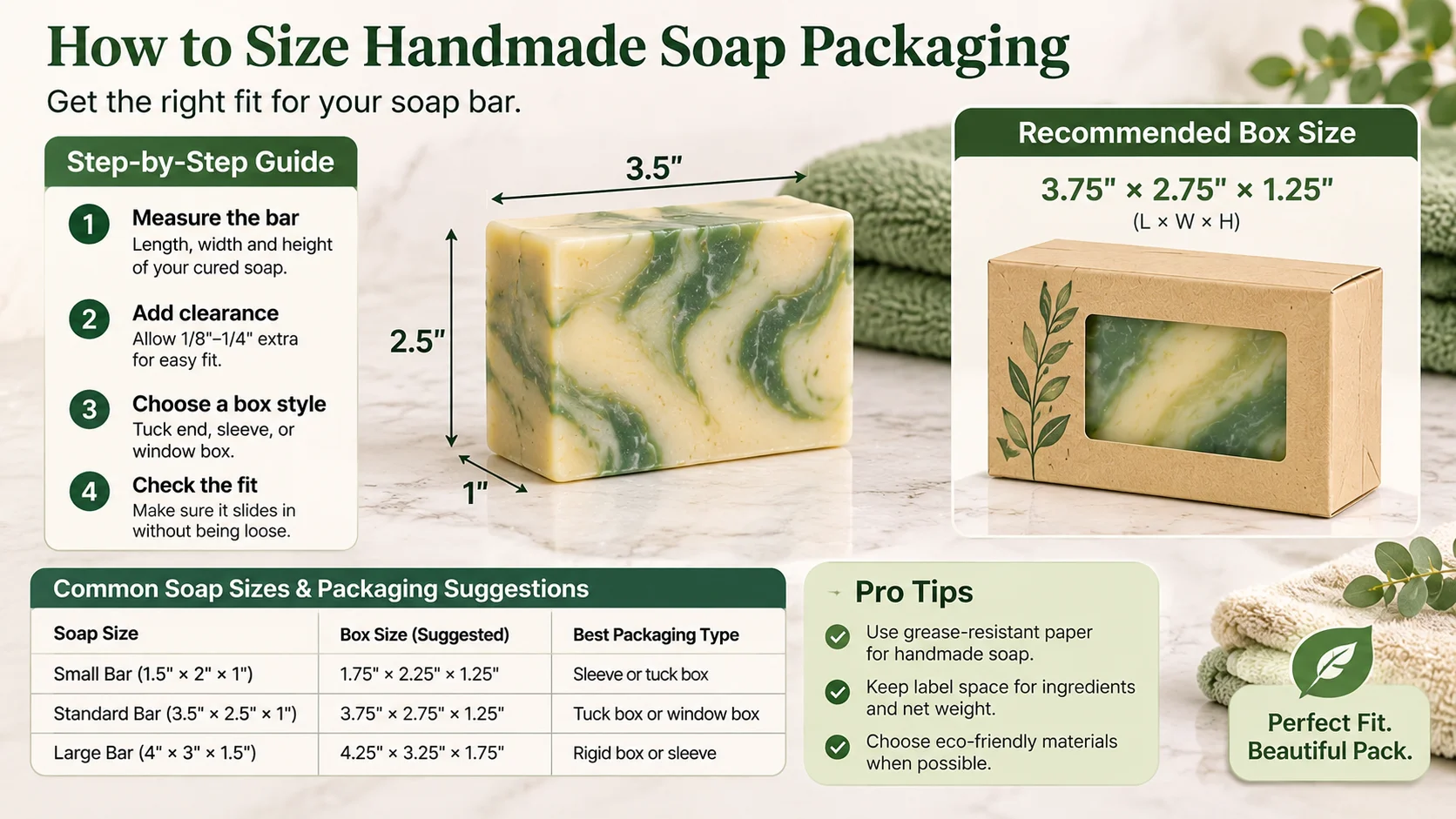
There is no single standard soap size. Your mold decides the bar, so size the packaging from your own cured bars. These supplier specifications show common starting points:
| Mold (Supplier Spec) | Cavity Size | Typical Bar | Approximate Weight |
|---|---|---|---|
| Crafter’s Choice Regular Loaf 1501 | 8 x 3.5 x 2.5 in, 44 oz | Eight 1 in slices: 3.5 x 2.5 x 1 in | About 5.5 oz |
| Bramble Berry 10 in Silicone Loaf | 10 x 3.375 x 2.5 in, 50 oz | 1 in slices: 3.375 x 2.5 x 1 in | About 5 oz |
| Crafter’s Choice Rectangle Basic (4 cavity) | 3.5 x 2.5 x 1.25 in | Molded bar, same size as cavity | 6.5 oz cavity capacity |
| Crafter’s Choice Euro Rectangle (15 cavity) | 2.8 x 1.8 x 1.5 in | Compact retail bar | 4.8 oz cavity capacity |
| Crafter’s Choice Rectangle Guest (8 cavity) | 2.5 x 1.5 x 0.75 in | Guest or sample bar | About 2 oz |
Loaf weights are mold capacity divided by the number of 1 in slices. Your bars will vary with recipe, slice thickness, beveling and water lost during the cure.
How to Measure a Soap Bar for Packaging
- Measure after the cure, not on cutting day.
- Measure three bars from the same batch and use the largest length, width and thickness.
- Include raised details: stamps, toppings and embeds add height.
- Add clearance: about 1/16 in per side for boxes and sleeves, so the bar slides in without scuffing.
- Test a sample with a real bar before ordering a full run.
Here is how one 3.5 x 2.5 x 1 in bar translates into each format:
| Format | Sizing Rule | Example for a 3.5 x 2.5 x 1 in Bar |
|---|---|---|
| Tuck end or window box | Bar + 1/16 in per side (inside dimensions) | 3.625 x 2.625 x 1.125 in |
| Sleeve or band | Distance around = 2 x (width + thickness), plus clearance and a glue flap | 2 x (2.5 + 1) = 7 in around, so about 7.5 to 7.75 in flat |
| Flat paper envelope | Inside at least (length + thickness) x (width + thickness) | At least 4.5 x 3.5 in inside |
| Glassine bag | Same rule as the envelope, then fold or seal the top | At least 4.5 x 3.5 in, plus room to close |
Use this free box sizing tool to check inside and outside dimensions before you order.
Soap Box Design: Planning Label Space
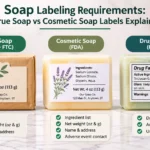
Good soap box design starts with what must fit on the pack, then builds the brand around it. The required text depends on what your soap is:
| Soap Category | Regulated By | Must Appear on the Package |
|---|---|---|
| True soap (fats plus lye, sold only to clean) | CPSC for safety; FTC for package labeling | Statement of identity, net quantity, name and place of business |
| Cosmetic soap (“moisturizing,” “deodorizing,” or a syndet bar) | FDA | The above, plus an ingredient list and a US contact for adverse event reports |
| Drug soap (“antibacterial,” “treats acne”) | FDA | A Drug Facts panel and OTC drug compliance |
The front panel size decides where the net weight goes and how big it must be. Two worked examples for a 3.5 x 2.5 x 1 in bar:
- 2 in wide band: the front face is 2 x 2.5 = 5 sq in. At 5 sq in or less, the net weight needs letters at least 1/16 in tall, and the bottom-30% placement rule does not apply.
- Tuck box: the front panel is about 3.625 x 2.625 = 9.5 sq in. That falls in the over 5 to 25 sq in range, so the net weight needs letters at least 1/8 in tall in the bottom 30% of the panel.
For cosmetic soaps, the ingredient list needs letters at least 1/16 in tall, or 1/32 in when the package has less than 12 sq in available for labeling. Design tips that save reprints:
- Weigh cured bars and declare a net weight your bars actually meet. Under 16 CFR 500.25, the average of a shipment must not fall below the stated weight.
- Write the weight in both units, for example “Net Wt 5 oz (141 g)”.
- Make the scent name the hero: shoppers choose soap by scent first.
- Keep claims clean: “moisturizing” makes the bar a cosmetic and “antibacterial” makes it a drug.
- Leave a batch code area so you can trace any complaint back to a batch.
For bars sold in plain wraps, labels for soap bars carry the required text, and this label sizing tool helps match the label to the face of the bar.
Handmade Soap Packaging for Gift Sets and Seasonal Sales
Gift packaging lets one bar become a higher-value product. Ideas that sell:
- Three-bar sampler: a long box with a paperboard divider so bars do not rub and scents stay apart.
- Soap and dish set: a fitted insert holds a wooden or ceramic dish next to the bar.
- Soap and accessory set: add a soap saver bag, loofah or washcloth that doubles as the wrap.
- Wedding and event favors: guest-size 2 oz bars in small favor boxes with the couple’s names on a sticker.
- Seasonal sleeves: keep the base box and switch only the sleeve for holidays, so last season’s stock is not wasted.
For premium sets, printed gift boxes with a custom insert keep heavy items from shifting.
Wholesale and Retail Display Packaging for Soap
Packaging that works at a craft fair may not work on a store shelf. Match the pack to the channel:
| Channel | What Buyers Expect | Packaging Idea |
|---|---|---|
| Farmers markets and craft fairs | To smell and handle the soap | Open sleeves, one unwrapped tester bar, a crate or tray display |
| Boutiques and gift shops | Shelf appeal and consistent sizes; many do not need barcodes | Sleeves or window boxes in a countertop display |
| Spas, hotels and rentals | Small, neat guest bars | Guest-size bars in envelopes or paper wraps |
| Chains and online marketplaces | GS1 barcodes, case packs, protected bars | Fully printed cartons with a UPC, packed in shipping cases |
Wholesale tips:
- Standardize sizes: one bar size and one box size make case packs, shelf space and reorders simple.
- Plan barcodes early: many independent shops do not require UPCs, but national chains and some marketplaces do, and codes come from GS1.
- Ship in shelf-ready units: countertop display boxes let a shop put twelve bars out without unpacking each one.
- Order at volume: soap boxes in bulk lower the cost per unit once your sizes are fixed.
Shipping Soap Bars Safely
Soap is dense, so corners dent and edges chip when bars slide around in a carton. For online orders:
- Keep each bar in its retail pack (box, envelope or wrap) so it arrives clean and labeled.
- Fill empty space so bars cannot shift. A snug outer pack also keeps postage down.
- Use a printed mailer: branded mailer boxes protect multi-bar orders and create an unboxing moment.
- Check billable weight: carriers bill the greater of actual weight and dimensional weight, and since July 12, 2026 USPS uses a 139 divisor for parcels over 1 cubic foot. Oversized boxes cost more, so run your carton through this dimensional weight tool.
Eco Friendly Soap Packaging Ideas
Handmade soap buyers often expect low-waste packaging, and McKinsey’s 2023 US survey shows why the materials matter:
| McKinsey US Survey Finding (2023) | What It Means for Soap Packaging |
|---|---|
| 43% of consumers say environmental impact is an extremely or very important packaging characteristic | A large group of shoppers looks at packaging materials before buying |
| 72% rate compostable packaging as extremely or very sustainable; plant-based packaging scores 70% | Paper-based formats line up with what shoppers see as sustainable |
| Only 29% say the same of packaging that combines plastic, paper and aluminum foil | Mixed-material packs work against an eco story |
| About half of consumers would pay 1 to 3% more for sustainable packaging | Shoppers accept only a small premium, so keep eco packaging cost-efficient |
Eco friendly soap packaging ideas that hold up:
- Single-material paper: kraft sleeves, envelopes and boxes without plastic windows or film laminates. Kraft paperboard material suits natural soap brands.
- Recycled content: boxes and labels made from recycled stock. Learn more about printing on recycled stock.
- Film-free windows: a die-cut opening shows the soap without adding plastic.
- Glassine instead of plastic: for oily bars, a glassine inner wrap keeps the pack paper-based.
- Reusable wraps: washcloths, cotton bags and soap saver bags keep their use after the soap is gone.
- Less packaging: a band instead of a full box, where the channel allows it.
Make sure the claims on the pack are as solid as the materials:
| Claim | FTC Green Guides Rule |
|---|---|
| “Recyclable” | Unqualified only when recycling facilities are available to a substantial majority (at least 60%) of consumers or communities where the item is sold (16 CFR 260.12) |
| “Compostable” | All materials must break down into usable compost in a safe and timely manner; qualify the claim if it is not home compostable, or if composting facilities are not available to a substantial majority (16 CFR 260.7) |
| “Biodegradable” | Unqualified claims are deceptive for items that do not completely decompose within one year after customary disposal, and landfills do not allow that (16 CFR 260.8) |
| FSC logo | Printers that use FSC trademarks or make FSC claims must be chain-of-custody certified (FSC US) |
Explore eco packaging options for paper-based formats that fit these rules.
Common Soap Packaging Mistakes
- Packing before the cure ends: damp bars sweat, shrink inside the pack and fall below the stated weight.
- Sealing cold process soap in plastic: trapped moisture and heat can cause sweating and spots.
- Using paper-only packs for melt and pour soap in humid climates.
- Sizing from fresh bars: bars shrink as they cure, so packs sized on cutting day end up loose.
- Ignoring oil: plain kraft can show oil rings within days on butter-rich bars.
- Window cut-outs over required text: plan the window around the net weight and scent name.
- Accidental claims: “moisturizing” or “antibacterial” change which rules apply.
- Unqualified eco claims: “compostable” or “biodegradable” without the support the Green Guides call for.
Soap Packaging Checklist
- Soap type confirmed: cold process, hot process, melt and pour or syndet
- Bars fully cured and weighed
- Largest bar measured after cure, with stamps and toppings
- Format chosen for airflow, protection and sales channel
- Grease-resistant liner tested for oily bars
- Clearance added: about 1/16 in per side
- Front panel area worked out for net weight size and placement
- Net weight in ounces and grams that cured bars meet
- Ingredient list and contact details added for cosmetic soaps
- Barcode planned for chains and marketplaces
- Eco claims checked against the Green Guides
- Sample tested with a real bar before the full run
Frequently Asked Questions
What are the best soap packaging ideas?
Kraft tuck boxes, window boxes, printed soap sleeves, paper envelopes, paper wraps and fabric wraps. Choose by soap type: breathable formats for cold process soap and tight wraps for melt and pour.
How do you package handmade soap?
Cure the bars, weigh and measure them, then pack them in a breathable box, sleeve or envelope sized with about 1/16 in clearance per side. Add the scent name, net weight and your business details.
Should cold process soap be wrapped in plastic?
Generally no. Cold process soap needs airflow, and sealed plastic can trap moisture and cause sweating or orange spots. Use paper sleeves, envelopes or vented boxes instead.
How do you package melt and pour soap?
Wrap it tightly in plastic wrap or shrink film soon after it sets, because its extra glycerin pulls moisture from the air. Add a box, sleeve or label over the wrap.
How long should soap cure before packaging?
Four to six weeks for most cold process soap, and longer for high olive oil or Castile bars. Weigh bars weekly; they are ready when the weight stops dropping.
What is the standard size of a soap bar?
There is no official standard, but a common loaf mold cut into 1 in slices gives bars of about 3.5 x 2.5 x 1 in, weighing about 5 to 5.5 oz. A typical guest mold makes bars of about 2 oz.
What size box fits a 3.5 x 2.5 x 1 inch soap bar?
About 3.625 x 2.625 x 1.125 in inside, which adds 1/16 in clearance per side. Test with a cured bar before ordering.
Are soap sleeves enough protection?
For markets and boutiques, yes, if the bar is fully cured. For shipping, place sleeved bars in a box or mailer so the open ends do not chip.
How do I stop soap oil from staining the packaging?
Use a grease-resistant inner layer such as glassine, greaseproof paper or coated board. Ask suppliers for a TAPPI T559 KIT rating and test a sample with your own bar.
What is the most eco friendly soap packaging?
Single-material paper packaging with no plastic window or laminate, such as kraft sleeves or envelopes. Using less packaging, or reusable wraps, also helps.
Can I call my soap box recyclable or compostable?
Only with support. “Recyclable” needs recycling access for at least 60% of consumers where you sell, and “compostable” must be qualified when it is not home compostable or facilities are not widely available.
What must be printed on soap packaging?
For true soap: the product identity, net weight and your name and place of business. Cosmetic soaps also need an ingredient list and an adverse event contact; drug claims need a Drug Facts panel.
Where does net weight go on a soap sleeve?
On the front panel. If that panel is 5 sq in or less, the bottom-30% placement rule does not apply, but letters must be at least 1/16 in tall.
Do I need a barcode to sell soap wholesale?
Many independent shops do not require one, but national chains and some online marketplaces do. Barcodes for retail come from GS1.
Do soap boxes need holes?
Not always, but vents help cold process soap breathe and let shoppers smell the scent. They are useful for boxes that sit on shelves for months.
How should I ship handmade soap?
Keep each bar in its retail pack, fill empty space so bars cannot shift, and use a snug mailer box to protect corners and keep dimensional weight low.
Final Takeaway
The strongest soap packaging ideas start with the soap: breathable formats for cured cold process bars, tight wraps for melt and pour, and boxes with room for full labels on cosmetic soaps. Measure cured bars, add a grease-resistant layer where oils need it, plan the front panel for the net weight, and keep eco claims within the Green Guides. Then choose boxes, sleeves, envelopes or window boxes for the channel you sell in.
Ready to upgrade your handmade soap packaging? Get a soap quote with your bar size and quantities, or compare printed soap packaging styles.
Sources
- Lovely Greens: How to Cure Handmade Soap
- Bramble Berry: Explaining and Preventing Glycerin Dew
- Making Soap Naturally: Should You Shrink Wrap Your Soap?
- Wholesale Supplies Plus: Crafter’s Choice Regular Loaf Silicone Mold 1501
- Bramble Berry: 10 inch Silicone Loaf Mold
- Wholesale Supplies Plus: Rectangle Basic Silicone Mold
- Wholesale Supplies Plus: 15 Cavity Euro Rectangle Silicone Mold
- Windy Point Soap: Crafter’s Choice Rectangle Guest Silicone Mold
- Chase Corp: Soap Wrapping and Grease Resistance
- Measurlabs: KIT Grease Resistance Test (TAPPI T559)
- FDA: Frequently Asked Questions on Soap
- CPSC: Soap Business Guidance
- 16 CFR 500.6: Net quantity location
- 16 CFR 500.21: Type size
- 16 CFR 500.25: Net quantity, average quantity, permitted variations
- 21 CFR 701.3: Designation of ingredients
- McKinsey: Sustainability in Packaging, US Survey Insights (2023)
- FTC Green Guides, 16 CFR 260.12: Recyclable claims
- FTC Green Guides, 16 CFR 260.7: Compostable claims
- FTC Green Guides, 16 CFR 260.8: Degradable claims
- FSC US: Paper and Printing
- Growing Steady: Do Retailers Expect UPC Codes on Makers’ Products?
- DCL Logistics: USPS DIM Weight Changes, July 12, 2026