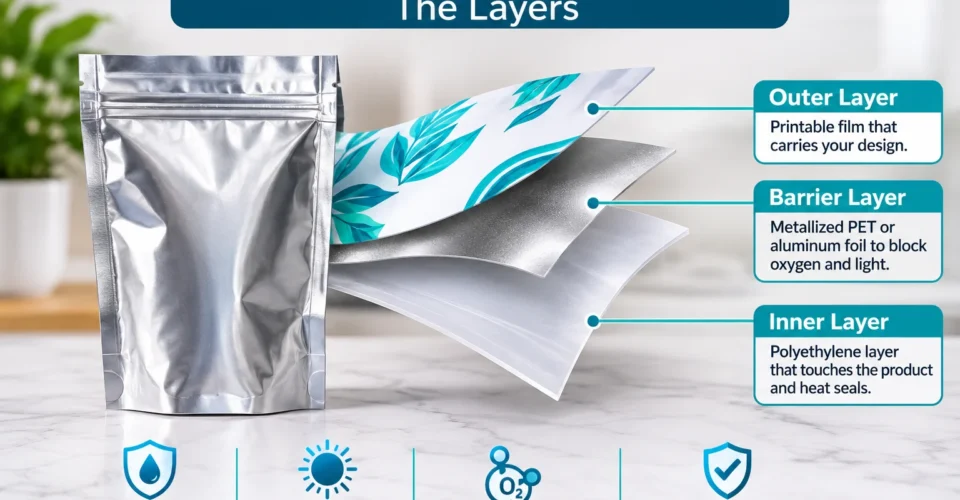
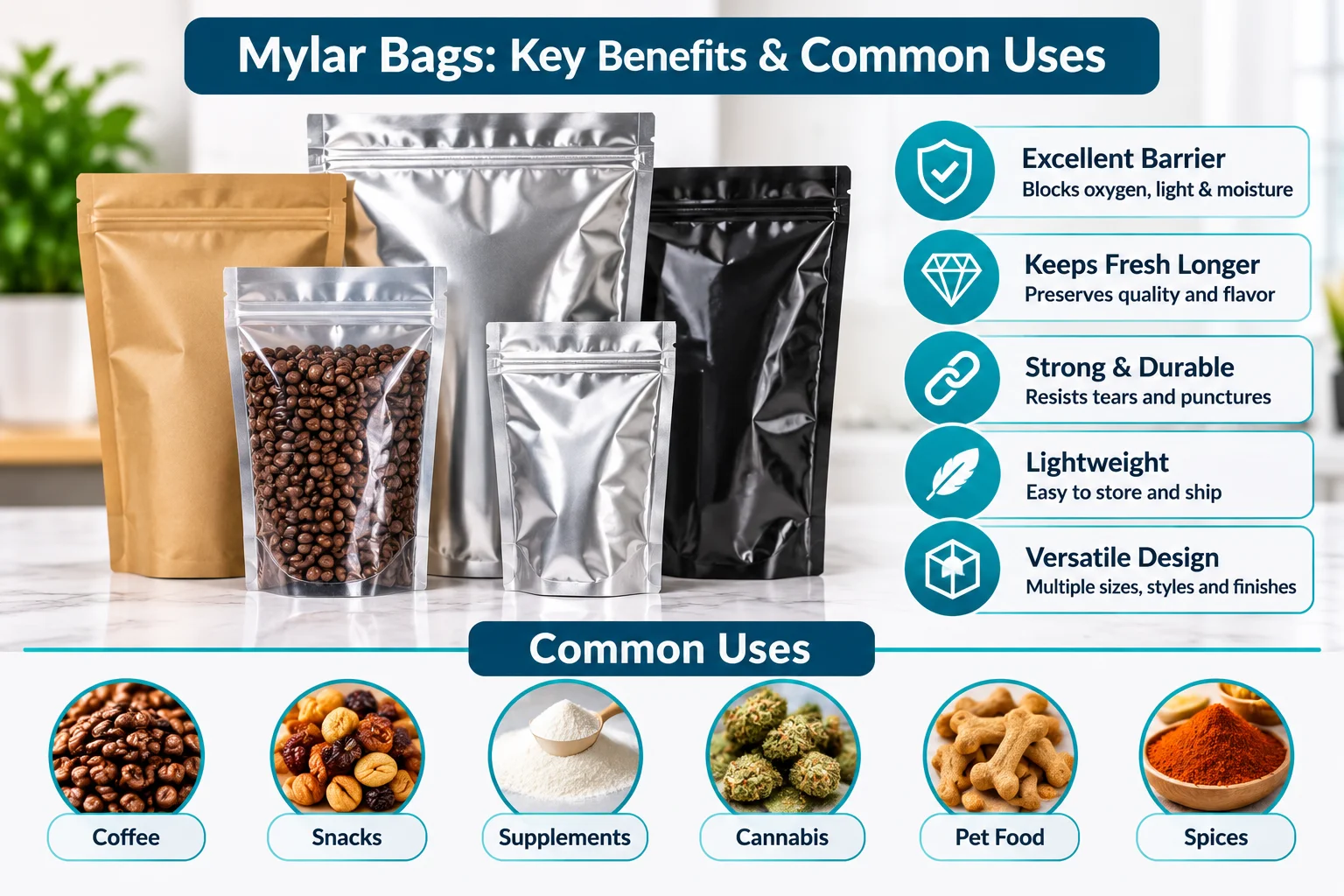
Quick answer: Mylar bags are flexible pouches made with polyester film. “Mylar” is a trade name for BoPET (biaxially oriented polyethylene terephthalate) film. Most bags sold as mylar bags are laminates: a printable outer film, a barrier layer of metallized PET or aluminum foil, and a polyethylene inner layer that touches the product and heat seals shut. That layered build blocks far more oxygen, light and moisture than a plain plastic bag, which is why mylar bags are used for coffee, snacks, supplements, cannabis and long-term food storage.
Key facts at a glance
- The name: Mylar® is a trademark of Mylar Specialty Films (formerly DuPont Teijin Films), a Celanese and Teijin joint venture; most “mylar bags” are generic PET laminates
- The build: outer print film + barrier (metallized PET or 6 to 12 micron foil) + polyethylene sealant
- The barrier gap: on one supplier chart, 2 mil LDPE lets through 275 cc of oxygen per 100 sq in per day, while 48 gauge metallized polyester lets through 0.08 to 0.14 cc
- Food contact: FDA does not “approve” bags; it clears the substances in them, such as PET (21 CFR 177.1630), polyethylene (21 CFR 177.1520) and adhesives (21 CFR 175.105)
- Long-term storage: use it only for dry foods with about 10% moisture or less, because low-oxygen packs of moist food carry a botulism risk
- Recycling: multilayer laminates are usually landfilled or incinerated, and How2Recycle lists foil as “Not Yet Recyclable”
Facts in this guide come from Mylar Specialty Films, FDA and CPSC regulations, Utah State University Extension, How2Recycle, film datasheets and the packaging sources in the Sources section. This is general guidance, not legal advice.
In this guide
- What are mylar bags?
- What mylar bags are made of
- How mylar blocks oxygen, light and moisture
- Mylar vs plastic bags
- Types of mylar bags
- Zippers, tear notches, hang holes and finishes
- How heat sealing works
- Are mylar bags food safe?
- Child-resistant mylar bags
- Mylar bag packaging uses by industry
- Printing and branding
- Why multilayer bags are hard to recycle
- Common mistakes
- Mylar bag checklist
- Frequently asked questions
- Sources
What Are Mylar Bags?
What are mylar bags, in plain terms? They are barrier pouches built around polyester film. The film itself is BoPET: PET plastic that is melted, cast into a sheet, stretched about 3 to 4 times in both directions and heat set above 200°C. Stretching it both ways is what makes the film strong, stable and much less permeable to gas than most plastics.
Mylar is one brand of that film. It was introduced in the 1950s, and its maker describes it as the first biaxially oriented PET film. The company that owns the trademark renamed itself from DuPont Teijin Films to Mylar Specialty Films. It is a joint venture between Celanese and Teijin and also sells Melinex® PET film. So “mylar” works like “Kleenex”: people use the brand name for a whole category, and most mylar bags on the market contain generic PET film rather than Mylar-brand film.
The other point most guides skip: a bag is rarely just PET. Standard BoPET film does not heat seal on its own (special heat-seal-coated grades exist, mostly for lidding), so converters laminate it to a polyethylene (PE) sealant and usually add a barrier layer in between. When someone says “mylar bag,” they nearly always mean one of these laminates. BoxNovo’s full mylar bag range uses the same layered approach across stand-up, window, kraft, die-cut and child-resistant styles.
Mylar, BoPET, Metallized PET and Foil: What the Words Mean
| Term | What It Actually Is | Looks Like |
|---|---|---|
| PET | Polyethylene terephthalate, the polyester plastic used in bottles and films | Clear resin or film |
| BoPET | PET film stretched in two directions for strength and barrier | Clear, glossy film |
| Mylar® | A trademarked brand of BoPET film from Mylar Specialty Films | Clear, white or metallized film |
| Metallized PET (VMPET) | PET film with a vacuum-deposited aluminum layer measured in nanometers | Silver, mirror-like, not see-through |
| Aluminum foil layer | Solid rolled aluminum, about 6 to 12 microns thick in flexible packaging | Silver or white (when printed), fully opaque |
| Mylar bag | A trade term for a laminated pouch that uses PET film, usually with a barrier layer and a PE sealant | Silver, clear, kraft, black, white or fully printed |
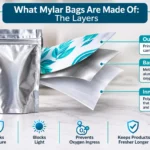
What Mylar Bags Are Made Of: The Layers
Every laminated mylar bag has the same three jobs split across its layers. The outer layer carries the print and takes scuffs. The middle layer is the barrier. The inner layer is the only one that touches the product, and it melts to form the seal.
| Common Structure | Look | Barrier | Light Block | Best For |
|---|---|---|---|---|
| Clear PET / PE | Fully transparent | Moderate oxygen barrier | None | Candy, cookies and products shoppers want to see, with short shelf lives |
| PET / metallized PET / PE | Silver or printed, not see-through | High | High (metallized film reflects up to 99% of light) | Snacks, coffee, tea, supplements, retail food |
| PET / aluminum foil / PE | Silver, matte or printed, fully opaque | Highest (as long as the foil is not cracked or punctured) | Complete | Long-term food storage, powders, sensitive products |
| Kraft paper / metallized PET or foil / PE | Natural brown paper outside | High (from the inner barrier, not the paper) | High to complete | Coffee, tea, natural and artisan brands |
| Clear front / metallized or foil back | Window on one side | Lower through the clear side | Partial | Retail products that need visibility and some protection |
BoxNovo’s kraft-look barrier pouches follow the kraft structure in the table: the paper gives the natural look, and the film underneath does the protecting. For a wider view of paperboard, corrugated, film and rigid options, see our packaging materials compared guide.
How Thick Are Mylar Bags?
Bag thickness is usually given in mils, and film layers in microns or gauge. One mil is 0.001 inch, or 25.4 microns, and 100 gauge equals 1 mil, so a 48 gauge PET film is about 12 microns. Some real reference points:
- Stock retail pouches: one food-service supplier lists 3 mil metallized and clear pouches, 4 mil white foil pouches, 4.5 mil clear PVDC-coated PET/poly and 5 mil white foil for its printed line
- Military-spec pouch: a Defense Logistics Agency spec for a PE / foil / printable outer laminate calls for a total of 0.0055 in (5.5 mil), with heat seals at least 1/8 in wide
- Heavy-duty storage bags: one storage-bag supplier sells bags of 7 mil and up as its heavy-duty, high-barrier range
Thickness mainly adds puncture and tear resistance. It does not decide the oxygen barrier; the barrier layer does. The next section shows the numbers.
Foil vs Metallized: The Real Difference
Foil and metallized bags both look silver, but they are built very differently. Foil in flexible packaging is about 6 to 12 microns of solid aluminum. A metallized layer is aluminum vapor deposited onto PET in a vacuum, and catalog metallized films list layers of 20 or 40 nanometers. That makes the foil layer roughly 150 to 600 times thicker. Foil gives the most complete barrier, but it is stiffer, and a film maker’s technical summary notes that metallized films resist “flex-cracking” better than foil in the folded gussets of stand-up pouches. Metallized laminates are lighter and more flexible, and they still block most light.
How Mylar Blocks Oxygen, Light and Moisture
Barrier is measured as a transmission rate: how much oxygen (OTR) or water vapor (MVTR or WVTR) passes through a set area of film in 24 hours. Lower is better. This table uses one supplier’s published comparison chart, so the figures can be compared with each other, but the chart does not state test conditions. Treat them as relative values, not as specifications.
| Film | Oxygen (cc/100 sq in/24 h/atm) | Moisture Vapor (g/100 sq in/24 h) | See-Through? |
|---|---|---|---|
| LDPE, 2 mil (typical plastic bag film) | 275 | 0.6 | Yes |
| Oriented polypropylene, 0.9 mil | 80 | 0.45 | Yes |
| Polyester (PET), 48 gauge | 9 | 2.8 | Yes |
| Metallized polyester, 48 gauge | 0.08 to 0.14 | 0.05 | No |
Source: Sorbent Systems barrier film comparison chart. Four things stand out:
- Oxygen: 2 mil LDPE lets through roughly 2,000 to 3,400 times more oxygen than 48 gauge metallized polyester on this chart.
- Metallizing beats thickness: on Mylar OL datasheet figures, tripling clear PET from 50 to 150 gauge only cuts oxygen transmission from 9 to 3. Metallizing a 48 gauge film cuts it to 0.08 to 0.14.
- Moisture: clear PET on its own is a weaker moisture barrier than 2 mil LDPE (2.8 vs 0.6). That is one reason bags pair PET with a PE layer.
- Windows: a clear PET window lets through roughly 60 to 110 times more oxygen per square inch than the metallized area around it, and it lets in light. Keep windows small on oxygen- or light-sensitive products.
Light matters too. Light speeds up oxidation, fades colors and can make fats go rancid sooner. Metallized film reflects up to 99% of light, and foil blocks it completely, so opaque bags suit coffee, nuts, oils, powders and supplements better than clear ones.
Mylar vs Plastic Bags: Which Protects Better?
Strictly speaking, mylar is plastic too. When people compare mylar vs plastic bags, they usually mean a laminated barrier pouch against a single-layer polyethylene or polypropylene bag. Here is how they differ in practice:
| Factor | Plain Plastic Bag (PE or PP) | Mylar Bag (PET Laminate) |
|---|---|---|
| Structure | Usually one material | Two to four bonded layers |
| Oxygen barrier | Low (275 for 2 mil LDPE on the chart above) | High to very high with metallized PET or foil (0.08 to 0.14 for metallized polyester) |
| Light barrier | Little, unless pigmented | High with metallized film, complete with foil |
| Moisture barrier | Fair to good | Very good with a metal layer |
| Puncture and stiffness | Soft and stretchy | Stiffer, holds shape on a shelf |
| Print quality | Good | Excellent, with metallic, matte and gloss effects |
| Recyclability | Many clean PE films can go to store drop-off where available | Usually not recyclable as a multilayer laminate |
| Typical uses | Produce, apparel, mailers, short-shelf-life items | Coffee, snacks, supplements, cannabis, long-term storage |
Plain plastic is still the better choice when barrier is not the goal. Shipping apparel is a good example, and our poly mailer guide covers that use. Clear cellophane bags suit bakery treats and favors sold within days. Choose mylar when the product loses flavor, aroma, crunch or potency to air, light or humidity.
Types of Mylar Bags
The main types of mylar bags differ in how they stand, open and display. This table covers the styles you will see most often:
| Bag Type | How It Is Built | Best For | Watch For |
|---|---|---|---|
| Stand-up pouch (doypack) | Front and back panels with a folded bottom gusset that opens into a base | Retail shelves, coffee, snacks, supplements, pet treats | The gusset uses height; test-fill before you order |
| Flat pouch (three-side seal) | Two panels sealed on three sides, filled through the top | Single servings, samples, flower, tea, hang-hole display | Does not stand on its own |
| Flat-bottom (box) pouch | Square base and side gussets, five printable faces | Premium coffee, larger volumes, shelf presence | Costs more than a stand-up pouch |
| Side gusset bag | Folded sides that expand, often with a block bottom | Coffee by the pound, bulk products | Usually needs a tin tie or clip unless a zipper is added |
| Die-cut and shaped bags | Cut to a custom outline after sealing | Gummies, candy, launches and novelty products | Leave a wide enough seal around tight curves |
| Window bags | A clear area in the front panel or a clear front with a barrier back | Products that sell on looks | Lower oxygen and light barrier through the window |
| Vacuum-seal bags | Barrier laminate built for vacuum sealers | Food storage, freeze-dried food, bulk dry goods | Match the bag to the sealer type |
| Child-resistant bags | A special zipper or closure tested under 16 CFR 1700.20 | Cannabis, edibles, regulated products | Ask for the test certificate for that exact design |
For retail, BoxNovo offers resealable zipper pouches and pouches with clear windows for products that need to be seen. If the shape is the selling point, shaped die-cut bags and round shaped barrier pouches stand out on a crowded shelf. For storage and bulk goods, compare vacuum-seal barrier bags with long-term storage bags.
Common Stand-Up Pouch Sizes
Many stock stand-up lines use the same four footprints. One food-service supplier lists them as width x height with the bottom gusset in inches:
| Width x Height | Bottom Gusset | Typical Use |
|---|---|---|
| 4 x 6 in | 2.5 in | Samples, tea, small snacks |
| 5 x 8.5 in | 3 in | Snacks, candy, small coffee bags |
| 6 x 9.5 in | 3.5 in | Coffee, granola, pet treats |
| 7.5 x 11.5 in | 3.5 in | Larger coffee bags, bulk dry goods |
Capacity depends on how dense the product is: a pouch that holds 8 oz of coffee beans holds far less popcorn. Fill a sample with your actual product. Leave about an inch of empty film above the fill line for the zipper and the heat seal, then size from that.
Zippers, Tear Notches, Hang Holes and Finishes
Features turn a barrier bag into a usable retail package. Each one has a trade-off worth knowing before you order:
- Press-to-close zipper: lets customers reseal the bag. It does not make the bag airtight; the heat seal above it does that until the bag is first opened.
- Tear notch: a small cut in the side seal so the top tears off cleanly above the zipper. Never heat seal through or below it.
- Hang hole: a round hole or a “sombrero” (delta) slot for peg displays. Place it in the top seal area, above the zipper.
- Window: shows the product, but lowers the barrier and lets in light, as the numbers above show.
- One-way degassing valve: for freshly roasted coffee. About 80% of the gas coffee releases is CO2; the valve lets it out and keeps oxygen from getting in, so bags do not swell or burst.
- Rounded corners: stop the sharp corners of a sealed pouch from scratching hands or puncturing neighboring bags.
- Gloss, matte or soft-touch: gloss makes colors pop; matte reads as premium and natural; soft-touch adds a velvety feel. Spot gloss on a matte bag highlights a logo or product name.
- Kraft look: a paper outer layer laminated over the barrier gives a natural look without losing protection.
How Heat Sealing Works
A mylar bag is closed by melting its inner PE layer against itself. Bags usually arrive with the bottom and sides sealed and the top open. You fill through the top, then seal across it above the zipper. That seal keeps air out and shows the bag has not been opened. The customer tears it off at the notch and uses the zipper from then on.
One pouch supplier publishes these starting settings for its bag materials:
| Bag Material | Sealer Temperature | Pressure | Dwell Time |
|---|---|---|---|
| Clear PET laminate | 350 to 375°F | 40 PSI | 1 sec |
| Metallized PET (VMPET) laminate | 350 to 400°F | 40 PSI | 1 sec |
| Aluminum foil laminate | 400 to 450°F | 40 PSI | 1 to 1.5 sec |
| Kraft paper laminate | 400 to 425°F | 50 PSI | 2 sec |
Source: CarePac. Start there, then run test seals on your own bags, because laminates vary from one supplier to the next. Other practical rules:
- Seal width: the same supplier recommends at least a 5 mm seal for most bags and 8 mm or more for heavy products; the military pouch spec above calls for at least 1/8 in.
- Clean seal area: powder or crumbs in the seal zone weaken it, so wipe the inside of the top before sealing.
- Temperature vs time: lower heat held longer often seals better than high heat for a moment.
- Check it: a good seal is even and flat with no wrinkles, channels or burn marks. Pull the panels of a test seal apart: a good seal holds, while one that peels open easily needs more heat or dwell time.
Are Mylar Bags Food Safe?
Are mylar bags food safe? They can be, but the word “mylar” does not tell you. What counts is whether every substance in the bag is cleared for food contact under your conditions of use. FDA does not certify or “approve” finished bags. FDA says a food contact material’s regulatory status is “dictated by the regulatory status of each individual substance” in it. It also says the manufacturer is responsible for compliance.
| Component | Where It Sits | US Rule That Usually Applies |
|---|---|---|
| PET film | Outer or middle layer | 21 CFR 177.1630 (polyethylene phthalate polymers), which covers general food packaging at temperatures up to 250°F |
| Polyethylene sealant | Inner layer touching food | 21 CFR 177.1520 (olefin polymers, which includes polyethylene) |
| Laminating adhesives | Between layers | 21 CFR 175.105: separated from food by a functional barrier, or within set limits |
| Retort and high-heat laminates | Whole structure | 21 CFR 177.1390 (laminate structures for use at 250°F and above) |
| Newer substances | Any layer | A Food Contact Notification (FCN), which applies only to that manufacturer’s substance |
In a typical laminate, food only touches the PE sealant. The PET, foil and inks sit behind it. To confirm a bag is food safe, ask your supplier for:
- A written food-contact compliance statement or letter of guaranty naming the regulations each layer meets. FDA notes these letters rest on Section 303(c)(2) of the Food, Drug, and Cosmetic Act.
- The food types it covers (dry, fatty, acidic, alcoholic) and the temperature limits: room temperature, hot fill, frozen, boil-in-bag or microwave.
- Confirmation that the inner layer is the food-contact layer and that inks are on the outside or sealed between layers.
- Any EU or Canadian compliance you need if you sell outside the US.
If you buy plain stock bags, add printed food labels for the details the bag lacks. Our guide to required food label information covers the statement of identity, net quantity, ingredients and allergens.
Using Mylar Bags for Long-Term Food Storage
Utah State University Extension gives two rules that matter more than bag thickness. First, products must be dry, at “about 10 percent or less moisture content.” Second, it warns that “botulism poisoning can occur if moist products are stored in packaging that reduces oxygen.” An oxygen absorber removes the oxygen, and what remains is about 99% nitrogen. That keeps out insects and protects flavor, but only for dry foods.
- Good candidates: white rice, dried beans, wheat, oats, pasta, sugar, freeze-dried meals
- Poor candidates: moist or oily foods such as brown rice, nuts, granola with nuts, jerky and anything not fully dry
- Pests: film can be chewed through, so storage guides recommend keeping filled bags in lidded buckets or bins
Child-Resistant Mylar Bags
“Child-resistant” is a tested claim, not a style. Under the Poison Prevention Packaging Act, a package passes only if it meets these limits in the 16 CFR 1700.20 test:
- Children: at least 85% of the child panel cannot open it before a demonstration, and at least 80% still cannot after one. Panels are groups of 50 children aged 42 to 51 months, up to 200 in total.
- Adults: at least 90% of a panel of 100 adults aged 50 to 70 can open it and, where it is reclosable, close it again.
Children get 5 minutes, then a demonstration, then 5 more minutes. State cannabis rules lean on this standard. California, for example, requires child-resistant packaging for all cannabis goods. Edibles and other multi-use products must stay child-resistant after opening. A single-use package must carry “This package is not child-resistant after opening.” BoxNovo’s child-resistant zipper bags, cannabis flower pouches and edibles packaging bags are built for these products. Always ask for the test certificate that matches the exact bag size and closure you buy.
Mylar Bag Packaging Uses by Industry
Mylar bag packaging shows up wherever a product goes stale, oxidizes or absorbs moisture. Here is how the structure and features change by product:
| Product | Main Threat | Suggested Structure | Key Features |
|---|---|---|---|
| Coffee | Oxygen, aroma loss, trapped CO2 | Foil or metallized laminate, often kraft outside | One-way valve, zipper, flat-bottom or side gusset |
| Tea | Aroma loss, light, moisture | Metallized or foil laminate | Zipper, small window if any |
| Snacks and candy | Moisture (loss of crunch), oxygen | Metallized laminate; clear for short-life treats | Tear notch, zipper, hang hole |
| Supplements and powders | Moisture, light | Foil laminate | Wide zipper, clean seal area for powder |
| Pet treats | Oxygen (fats go rancid), odor | Metallized or foil laminate | Stand-up pouch, zipper, window if needed |
| Cannabis and edibles | Light, oxygen, child access | Opaque laminate | Child-resistant closure, compliance label space |
| Bath salts and cosmetics | Moisture, fragrance loss | Metallized laminate, matte finish | Zipper, window, hang hole |
| Emergency food storage | Oxygen, moisture, light, insects | Thick foil laminate | Oxygen absorbers, heat seal, storage bucket |
Coffee shows why barrier matters. An equipment maker cites oxidation as the difference between a shelf life of about 10 days and four months.
Printing and Branding Mylar Bags
There are two routes to a branded bag: print the film itself, or label a stock bag.
- Digital printing: needs no plates or cylinders, so it suits short runs, multiple flavors or SKUs, and seasonal versions. ProAmpac says digital tends to cost less for orders under about 15,000 feet of film, roughly 30,000 pouches depending on size.
- Plate or cylinder printing (flexo and rotogravure): each color needs its own plate or cylinder. The setup cost pays off on long runs of a stable design.
- Labels on stock bags: the fastest start for small batches. See these sticker packaging ideas and use our label sizing tool to fit the label to the flat front panel.
When you design a printed pouch, keep text and logos out of the seal areas, the zipper line and the bottom gusset fold. Check bleed and safe zones before sending files. Ready to compare structures and finishes? Browse printed mylar pouch options, or get an instant price estimate first.
Why Multilayer Mylar Bags Are Hard to Recycle
The layers that make a mylar bag work are the same layers that make it hard to recycle. PET, aluminum and polyethylene are bonded together, and recyclers cannot pull them apart in normal sorting. A review of multilayer packaging recycling in the journal Recycling found that, because of poor recyclability, “most multilayers are usually incinerated or landfilled.” Separating layers by mechanical impact is “an exception,” because the layers stick together strongly.
- Store drop-off is for PE film: How2Recycle’s store drop-off guidance covers polyethylene films. It lists foil as “Not Yet Recyclable,” and metallized PE needs an extra metal-sorting test.
- “Recyclable” claims need access: the FTC Green Guides (16 CFR 260.12) allow an unqualified “recyclable” claim only when recycling programs are available to at least 60% of consumers where the item is sold.
- California is stricter: SB 343 limits the chasing-arrows symbol and recyclable claims. A July 2026 court injunction paused enforcement only against the plaintiffs in that case, and How2Recycle notes the law is still active.
Better options exist if sustainability matters to your brand:
- Mono-material PE pouches: designed for store drop-off, with a lower barrier than foil. Test shelf life before you switch.
- Right-size the bag: less film per product.
- Add a zipper: customers reuse the bag instead of moving the product into another container.
- Keep claims honest: never print a recycling symbol on a foil or mixed laminate.
For paper-based and lower-impact alternatives, see BoxNovo’s eco packaging options.
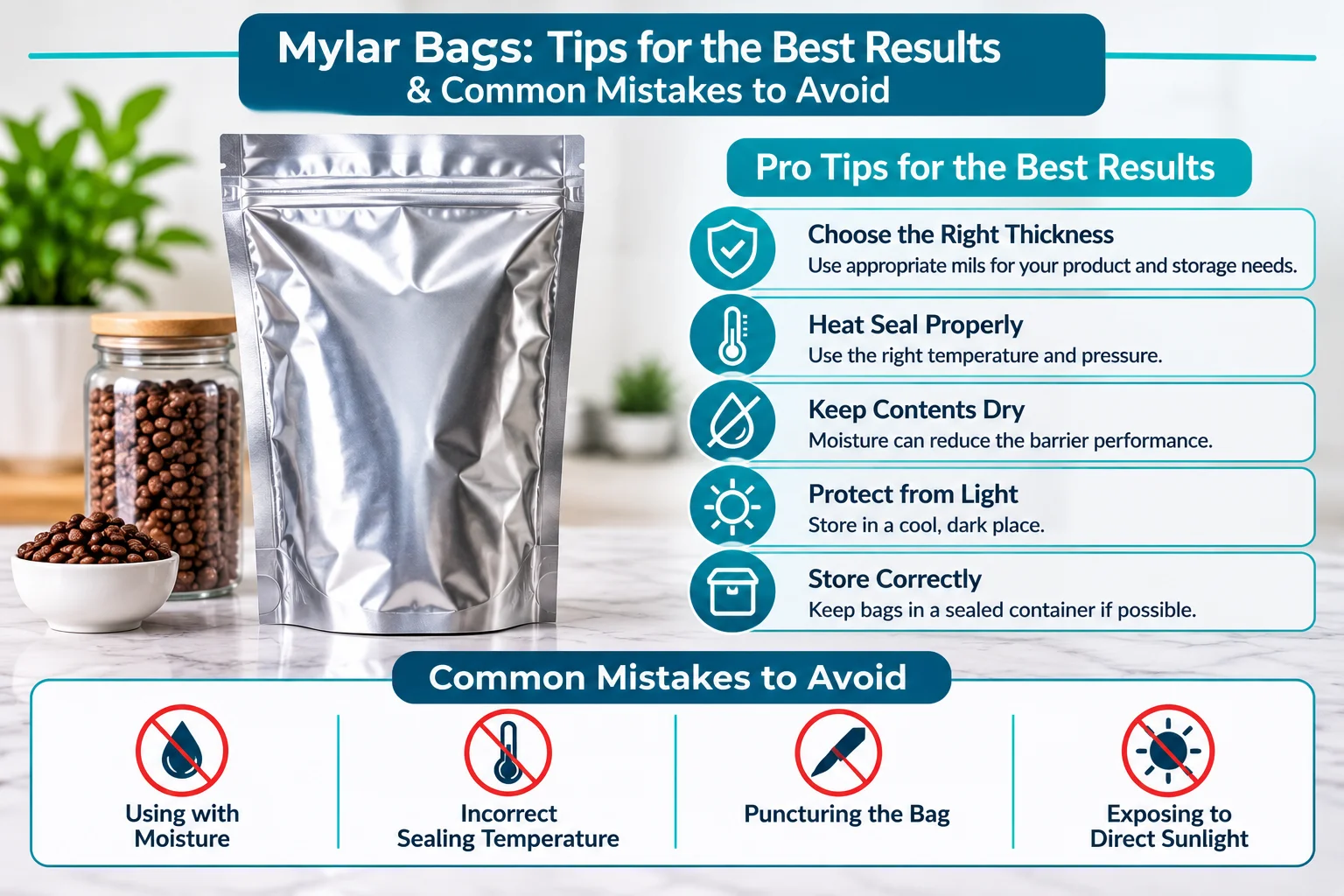
Common Mylar Bag Mistakes
- Buying by thickness alone: a thick clear bag still lets in light and far more oxygen than a thin metallized one.
- Assuming “mylar” means food safe: ask for a written food-contact statement for every layer.
- Storing moist food with oxygen absorbers: above about 10% moisture, this creates a botulism risk.
- Big windows on sensitive products: a window can let roughly 60 to 110 times more oxygen through than the metallized panel around it.
- Sealing below the tear notch: customers then need scissors to open the bag.
- Calling a bag child-resistant without a test: the claim needs a 16 CFR 1700.20 test of that exact package.
- Printing recycling symbols on laminates: this risks Green Guides and California SB 343 problems.
- Skipping a test fill: gussets and zippers use space, so a bag can look right on paper and still be too small.
Mylar Bag Checklist
- Main threat identified: oxygen, light, moisture, odor or child access
- Structure chosen: clear PET, metallized PET, foil or kraft laminate
- Thickness chosen for puncture risk and product weight
- Bag type picked: stand-up, flat, flat-bottom, side gusset, die-cut or vacuum-seal
- Sample filled with the real product, with headspace for the zipper and seal
- Features set: zipper, tear notch, hang hole, valve, window, rounded corners
- Written food-contact statement received for every layer and use condition
- Child-resistant certificate received for the exact bag, if required
- Sealer settings tested, with a seal at least 5 mm wide
- Artwork kept clear of seals, the zipper line and gusset folds
- Eco and recycling claims checked against the Green Guides and California SB 343
Frequently Asked Questions
What are mylar bags?
Mylar bags are flexible pouches made with BoPET polyester film, usually laminated to a metallized PET or aluminum foil barrier and a polyethylene sealant. They block oxygen, light and moisture far better than plain plastic bags.
What are mylar bags made of?
Most are laminates of three layers: a printable PET or kraft paper outer layer, a metallized PET or aluminum foil barrier, and a polyethylene inner layer that touches the product and heat seals.
Is mylar the same as aluminum foil?
No. Mylar is a brand of polyester film. Foil is solid aluminum about 6 to 12 microns thick, while metallized PET carries an aluminum layer measured in nanometers. Many mylar bags combine PET film with foil or metallized film.
Are mylar bags food safe?
They can be. A bag is food safe when every layer is cleared for food contact for your food type and temperature, for example PET under 21 CFR 177.1630 and polyethylene under 21 CFR 177.1520. Ask the supplier for a written compliance statement.
Are mylar bags FDA approved?
FDA does not approve or certify finished bags. It clears the substances used to make them, and the manufacturer is responsible for compliance. Suppliers usually confirm this with a letter of guaranty.
How do mylar vs plastic bags compare?
Mylar bags are multilayer PET laminates with a much higher oxygen and light barrier. On one supplier chart, 2 mil LDPE lets through 275 cc of oxygen per 100 sq in per day versus 0.08 to 0.14 cc for 48 gauge metallized polyester. Plain plastic bags are cheaper and easier to recycle.
What are the types of mylar bags?
The main types of mylar bags are stand-up pouches, flat three-side-seal pouches, flat-bottom pouches, side gusset bags, die-cut shaped bags, window bags, vacuum-seal bags and child-resistant bags.
What thickness of mylar bag should I use?
Stock retail pouches are often 3 to 5 mil, and heavy-duty storage bags run 7 mil and up. Thickness mainly adds puncture resistance; the barrier comes from the metallized or foil layer.
What temperature seals a mylar bag?
One supplier lists 350 to 400°F for metallized laminates, 400 to 450°F for foil and 400 to 425°F for kraft laminates, at about 40 to 50 PSI for 1 to 2 seconds. Always test on your own bags.
Do mylar bags block light?
Metallized and foil bags do. Metallized film reflects up to 99% of light, and foil blocks it completely. Clear PET bags and clear windows let light through.
Does a window reduce a mylar bag’s protection?
Yes. A clear PET window lets through roughly 60 to 110 times more oxygen per square inch than metallized film, and it lets in light. Keep windows small on oxygen- or light-sensitive products.
Are mylar bags recyclable?
Usually not. Multilayer laminates of PET, aluminum and PE cannot be separated in normal recycling, and How2Recycle lists foil as Not Yet Recyclable. Mono-material PE pouches are the store drop-off alternative.
Can you store any food in mylar bags long term?
No. Utah State University Extension says products should have about 10% or less moisture, because moist foods stored in reduced-oxygen packaging can cause botulism. Rice, dried beans, wheat and oats are typical choices.
Are mylar bags rodent proof?
No. Rodents can chew through the film, so keep filled storage bags in lidded buckets or bins.
Are mylar bags child-resistant?
Only when the bag design has passed the 16 CFR 1700.20 test: at least 85% of children cannot open it before a demonstration, 80% after one, and at least 90% of adults can use it.
Why do coffee mylar bags have a valve?
Freshly roasted coffee gives off gas that is about 80% CO2. A one-way degassing valve lets that gas out and keeps oxygen from getting in, so the bag does not swell or burst.
Final Takeaway
So, what are mylar bags? They are barrier pouches built from PET film. In most cases they are laminated to metallized film or foil and sealed with polyethylene. Choose the barrier layer for the threat your product faces, the thickness for puncture risk, and the bag type and features for how it sells. Get food-contact and child-resistant claims confirmed in writing, and keep recycling claims honest.