How Sticker Packaging Works
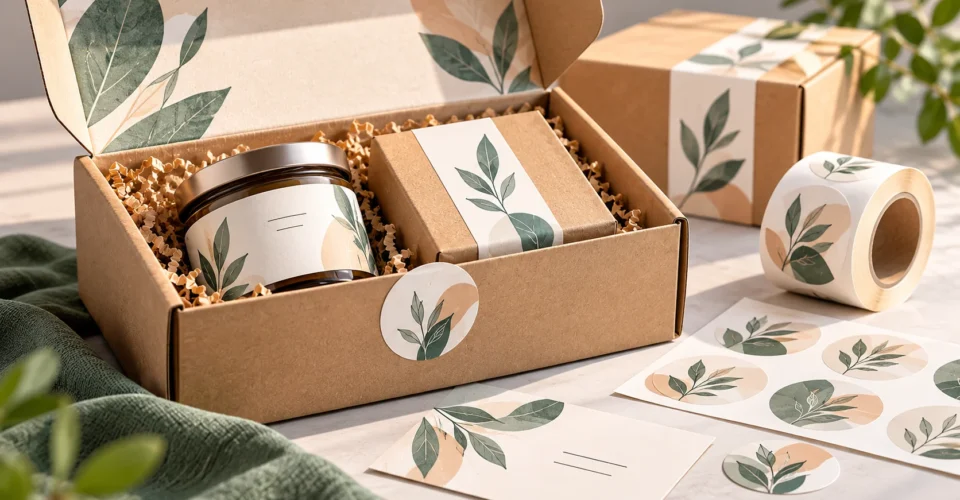
Sticker packaging means using stickers, labels, seals, and other adhesive printed pieces as part of a product’s packaging system. They can identify a product, distinguish SKUs, close a package, add information, reinforce branding, or create a more intentional unboxing experience.
The strongest approach is to choose the sticker after you understand the package. Start with the job the sticker needs to perform, the usable surface, the opening or folding structure, and the information that must remain visible. A front-panel product label has different requirements from a box seal, a shipping label, or a small thank-you sticker.
A useful five-part system is:
- Identify: define exactly what the sticker needs to accomplish.
- Fit: measure the usable packaging surface.
- Place: avoid folds, seams, closures, curves, and important information.
- Finish: match the material, adhesive, and finish to the package and handling conditions.
- Integrate: make the sticker work with the box, product label, insert, and overall brand system.
For a broader view of how these pieces fit together, see BoxNovo’s broader custom packaging system.
What Is Sticker Packaging?
In practical packaging terms, sticker packaging can include a branded sticker on a box, a product label on a jar or bottle, a closure seal, a shipping label, or an interior sticker used during the unboxing experience.
Sticker Packaging vs. Packaging for Stickers
The phrase can be ambiguous. Some searches use “sticker packaging” to mean packaging used to sell or ship stickers as products. This guide uses the term differently: it focuses on stickers and labels that become part of a product’s packaging system.
What Packaging Stickers Actually Do
- Identify a product, variant, scent, flavor, size, or collection.
- Add a brand mark without redesigning the entire package.
- Seal a box flap, tissue fold, or inner wrap.
- Carry product information when available packaging space is limited.
- Support seasonal, promotional, or limited-edition packaging.
- Create a small branded moment inside an ecommerce shipment.
Sticker vs. Label vs. Seal: What’s the Difference?
These terms overlap in everyday packaging conversations, and suppliers may use them differently. The most useful way to distinguish them is by the job they perform.
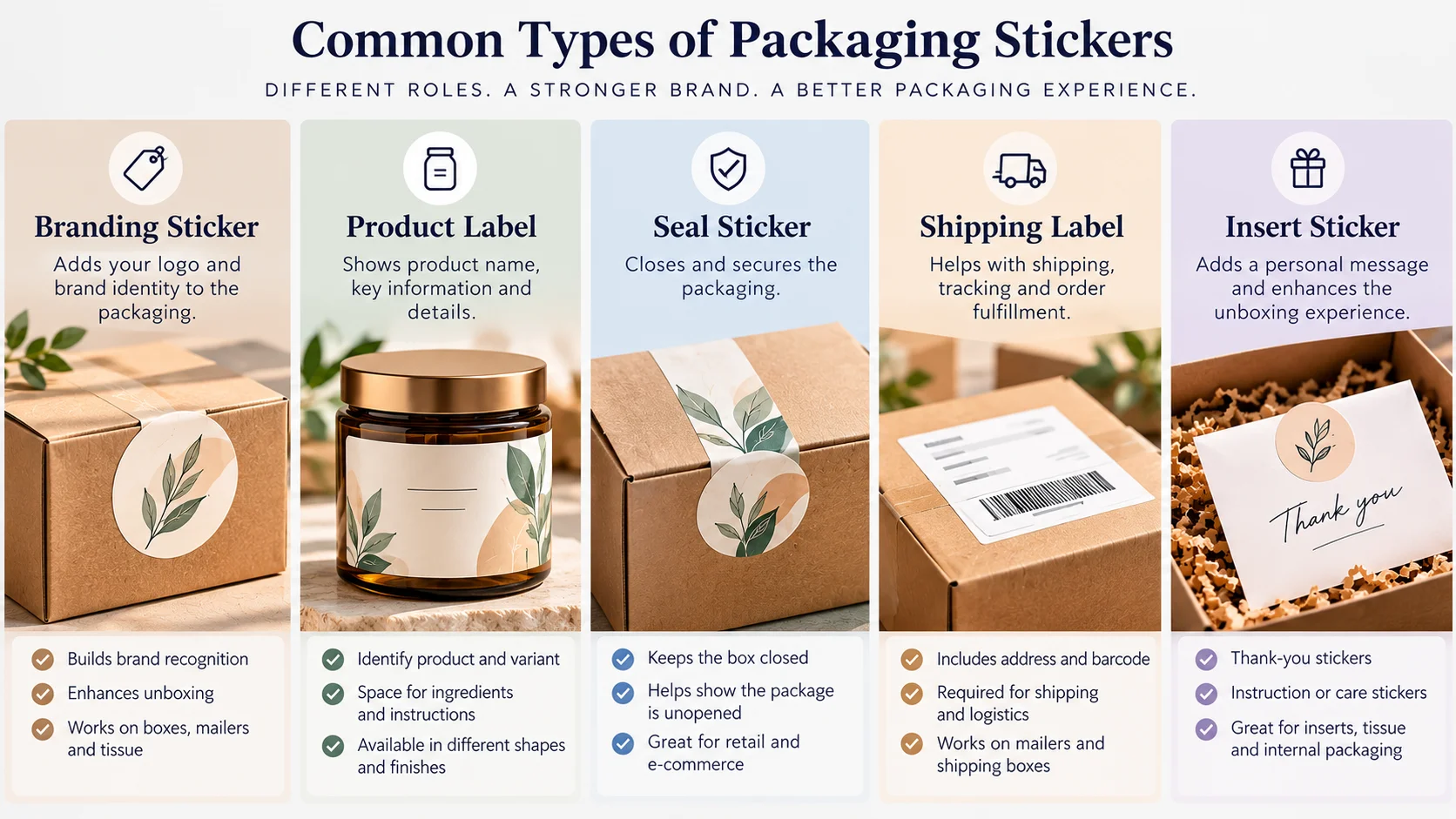
| Format | Primary job | Typical placement | Main decision |
|---|---|---|---|
| Branding sticker | Recognition or visual branding | Box front, lid, mailer, tissue | Visibility and contrast |
| Product label | Product identification and information | Jar, bottle, pouch, carton | Readable content and usable area |
| Seal sticker | Closure or packaging presentation | Flap, lid, tissue fold | Placement and adhesion |
| Shipping label | Carrier and fulfillment information | Outer shipping surface | Carrier requirements and scannability |
| Insert sticker | Inside-box branding or messaging | Insert card, inner wrap, product | Unboxing experience |
If you want to explore the broader role of stickers in packaging, BoxNovo’s guide to sticker customization for packaging can be a useful next step. This article remains focused on how stickers function within the complete packaging system.
Where Can You Use Stickers on Product Packaging?
Custom Boxes
A sticker on a custom box can serve as a brand mark, product identifier, promotional element, or closure. Before choosing its size, check where the box folds, opens, closes, and comes into contact with other surfaces.
For businesses comparing packaging structures, the product packaging options page provides a broader commercial context for matching the package to the product.
Mailer Boxes
Ecommerce mailers often provide a natural place for a lid sticker, closure seal, variant label, or interior message. The sticker should complement the opening structure rather than interfere with it.
For shipping-focused presentation, ecommerce-ready mailer packaging can be planned alongside the sticker system.
Folding Cartons
Stickers can identify a variant or add a small branding layer to a folding carton. Keep folds, tuck flaps, seams, windows, and required information clear when selecting the placement.
Rigid Boxes
Rigid presentation boxes can use a restrained label or seal while keeping the structural design clean. When the product and insert are important parts of the presentation, rigid presentation packaging with an integrated insert can provide a stronger foundation for the complete experience.
Jars and Bottles
Jars and bottles introduce curved surfaces, limited front-facing areas, closures, and sometimes separate front and back information areas. Measure the actual container and test the label on the filled package before approving production.
Pouches and Bags
Flexible packaging can move, crease, and curve during filling and handling. Place stickers on a stable area and verify material and adhesive compatibility with the actual substrate.
Tissue and Inner Wraps
A small seal can close tissue or an inner wrap while adding a branded touch. Because this sticker is encountered during opening, it can contribute to the unboxing sequence without competing with the outer package.
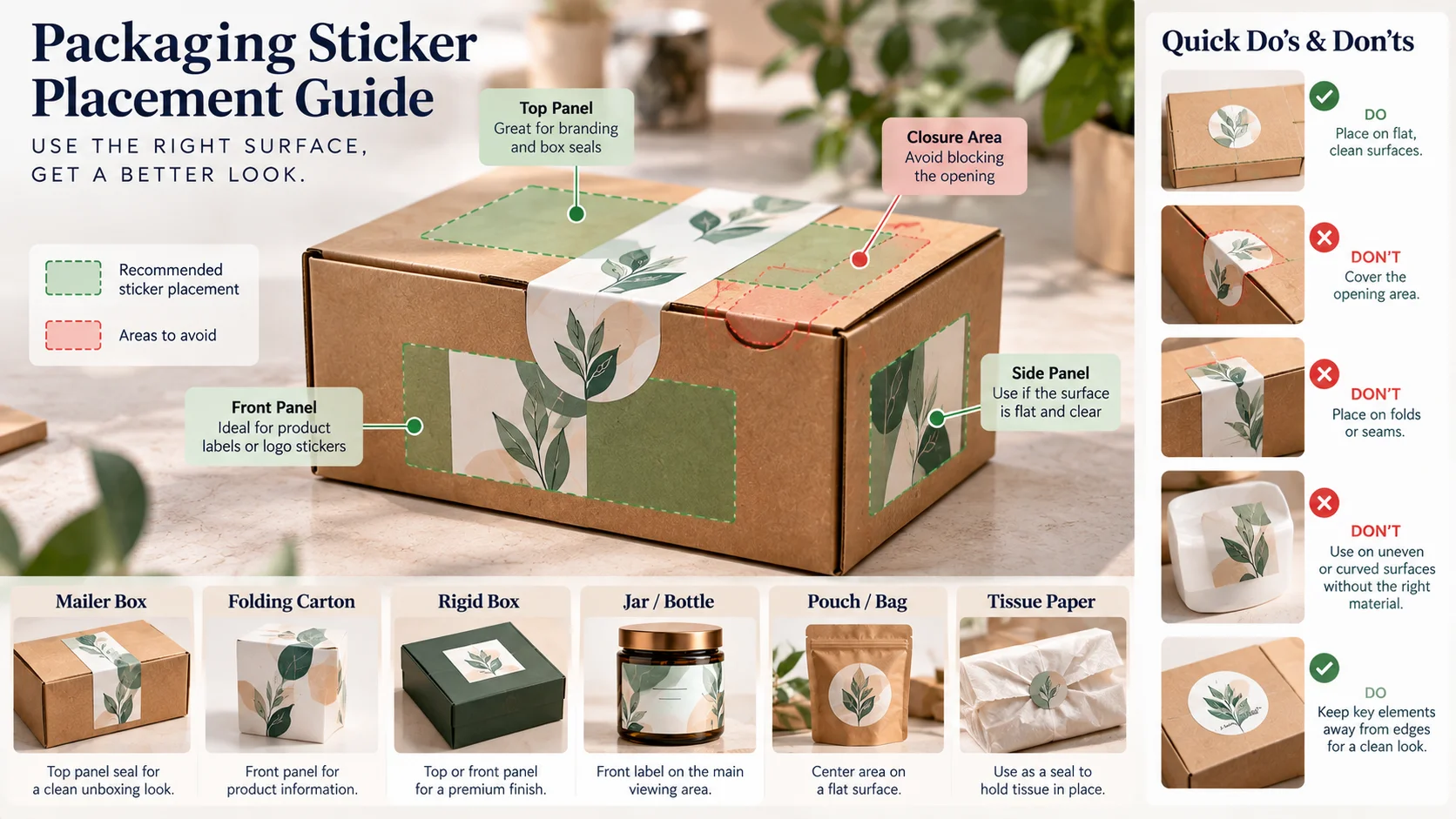
How to Choose the Right Sticker Placement
Front Panel Placement
Use a front panel when the sticker’s main job is product identification or brand recognition. Keep the hierarchy simple so the most important message remains the easiest element to understand.
Top and Lid Placement
A lid sticker can create a strong opening cue, especially on gift boxes and ecommerce mailers. Make sure the lid can open as intended and decide whether the sticker is decorative, informational, or specifically intended to act as a closure.
Box Flap Seals
A flap seal should bridge the intended opening area without crossing a structural feature that makes reliable application difficult. If the package is intended to be opened and closed repeatedly, do not assume a normal sticker will function as a permanent closure.
Side Panel Placement
Side panels can work well for secondary information, SKU identification, or a smaller brand mark. They are usually less prominent than the main presentation panel.
Interior Packaging Placement
Inside-the-box stickers can carry thank-you messages, product-care reminders, QR codes, or secondary branding. They are particularly useful when the outside of the package already has a strong visual hierarchy.
Where Not to Place a Sticker
- Across a fold, crease, or seam unless the exact application has been tested.
- Over a closure that must operate freely.
- Over required product information or a barcode/QR code that must remain readable.
- On a surface with dust, oil, condensation, heavy texture, or an untested coating.
- Where the sticker becomes hidden after the package is packed, shipped, or placed on a shelf.
How to Choose the Right Sticker Size
Measure the Usable Packaging Area First
The correct sticker size is the size that fits the actual usable area while leaving enough clearance for folds, seams, edges, closures, and surrounding artwork. Do not start with a favorite sticker size and try to force the package around it.
For box projects, start with the right box dimensions, then identify the flat panel that remains usable after structural features are accounted for.
Sticker Size for Boxes and Mailers
A larger front-panel label can work when the package has a clean, flat face and the sticker carries substantial information. A smaller logo or seal is usually better when the box already has strong printed graphics.
Sticker Size for Jars and Bottles
For containers, consider the straight portion of the surface rather than assuming the entire circumference is usable. A label that wraps too far into a tight curve can wrinkle, lift, or distort visually.
Sticker Size for Seals
A seal should be large enough to bridge the intended closure area and remain easy to apply, but not so large that it interferes with opening or leaves a large unsupported span.
Why There Is No Universal Best Size
Sticker size depends on package geometry, information volume, viewing distance, application method, brand hierarchy, and whether the sticker is functioning as a label, seal, or decorative element. A common supplier size can be a starting point, but it should not replace measuring the actual package.
Choosing the Best Sticker Shape
| Shape | Useful for | Consideration |
|---|---|---|
| Round | Logo seals, lid stickers, simple badges | Less efficient for long text |
| Square | Compact branding and short messages | Corners need clean alignment |
| Rectangle | Product information and SKU details | Works best when aligned with the package panel |
| Oval | Jars, bottles, premium labels | Less efficient for dense copy than a well-sized rectangle |
| Custom die-cut | Distinctive brand marks and shaped graphics | Requires careful cutting and application alignment |
For simple circular branding or closure applications, you can also explore round label formats for packaging.
Choosing Sticker Materials
Paper
Paper can be a strong fit for many dry, indoor applications where a printed-paper appearance is desired. Exact performance depends on the paper stock, coating, adhesive, and environment.
Film and Vinyl
Film-based materials may be considered when additional durability or moisture resistance is needed. The correct material still depends on the specific substrate, exposure, and adhesive system.
Clear
Clear labels can create a printed-on-the-package effect, but transparent areas change how colors appear over kraft, white, dark, or patterned packaging. Proof them on the intended substrate.
Kraft-Style
Kraft-look labels can support a natural or handmade visual direction. Contrast needs special attention because muted artwork can blend into brown surfaces.
Material Choice by Handling and Exposure
Think about moisture, friction, refrigeration, oils, repeated handling, sunlight, temperature changes, and how long the label needs to remain intact. The printer or label supplier should confirm the appropriate face material and adhesive for the actual application.
For the wider package, compare the material choices available for packaging alongside the sticker decision.
Sticker Finishes for Packaging
| Finish | Visual effect | Useful consideration |
|---|---|---|
| Matte | Soft, low-reflection appearance | Can support comfortable reading under direct light |
| Gloss | Bright, reflective appearance | Can make colors appear vivid but may reflect light |
| Clear | Minimal-background appearance | Requires careful color and contrast planning |
| Metallic or specialty | Premium or attention-grabbing appearance | Use selectively so the package hierarchy remains clear |
The right finish is the one that supports both the packaging surface and the viewing conditions. A visually impressive finish can still be a poor choice if it reduces readability or conflicts with the box’s texture and print.
How to Design Branded Packaging Stickers
Primary Message and Hierarchy
Decide what the viewer should understand first. A product name, SKU, flavor, or brand mark may deserve priority over secondary copy. Avoid giving every element the same visual weight.
Contrast With the Packaging
The sticker must remain legible against the package underneath it. This is especially important with clear labels, kraft-style surfaces, dark boxes, and patterned packaging.
Design at Actual Size
A design that looks comfortable on a large monitor can become crowded when printed small. Review the artwork at its intended physical size and inspect fine type, small icons, QR codes, and spacing.
Print-Ready Artwork and Proofing
Follow the printer’s current specifications for color mode, bleed, safe area, cut lines, file format, and resolution. These requirements vary by production process, so do not treat a competitor’s technical specification as a universal standard.
How Stickers Work With Custom Boxes
Printed Box + Minimal Sticker
A fully branded box can use a small sticker for a changing detail such as a variant, promotion, or seasonal message. This keeps the core box artwork stable while selected elements can change.
Custom Box + Product Labels
The box can establish the brand while the product container carries more detailed product identity. This is useful when the outer package and inner product need different information hierarchies.
Custom Box + Seal
A seal can add a simple opening cue without filling the entire package with additional graphics.
Custom Box + Label + Insert
For premium or gift packaging, the outer box, product label, and insert can divide communication across the customer journey. gift-ready box solutions can provide the structural foundation while stickers and inserts handle flexible messaging.
Using Stickers for SKU Variations
Stickers are useful when several variants share the same base package. A common box can carry the master brand while a smaller label identifies scent, flavor, color, size, or edition.
Packaging Sticker Ideas for Ecommerce
Box Seals
Use a small seal as a final branded touch on the outside or inside of a mailer, provided it does not interfere with opening or shipping labels.
Thank-You Stickers
A short thank-you message can work well on tissue, an insert, or an inner flap where it becomes part of the unboxing sequence.
Variant Stickers
Use consistent placement and a predictable visual system so fulfillment staff can identify variants without guessing.
QR Code Stickers
A QR code should be tested at its final printed size and under realistic lighting and scanning conditions. Do not place it where folds, glare, texture, or curvature can make scanning unreliable.
Seasonal and Limited Editions
A seasonal sticker can update a stable packaging program without changing every printed box. Keep the base branding consistent so the limited-edition element feels intentional.
Packaging Stickers for Retail Products
Product Identification
Retail packaging needs a clear product identity. A sticker can carry part of that information when the packaging system and applicable labeling requirements permit it.
Shelf-Facing Information
Think about how the package is actually displayed. A label that looks excellent on a flat worktable may be partly hidden when boxes are stacked or containers are rotated on a shelf.
Barcode and Required Information
Barcodes, required statements, ingredients, warnings, net contents, and other regulated information should be planned from the applicable rules first—not added after the decorative sticker design is finished.
For food-focused packaging projects, food product labeling options may be relevant when the product needs a dedicated label rather than relying entirely on box printing.
Sticker Packaging for Jars, Bottles and Containers
Curved Surfaces
Measure the stable label area and test the label on the actual filled container. A curved surface can change how a rectangular design looks and can create lifting or wrinkling if the construction is unsuitable.
Front and Back Labels
A front label can establish product identity while a back label carries additional information. The exact division depends on the product category, market, container, and applicable requirements.
Lid Seals
A lid sticker can work as a brand cue or closure element. If tamper evidence is required, use a construction specifically designed and tested for that purpose rather than assuming an ordinary sticker provides tamper evidence.
Clear Labels
Clear material can reduce the visual boundary between the label and the container, but the underlying package color becomes part of the label’s design. Physical proofing is essential.
For jar applications, see label solutions designed for jar packaging. For bottles, bottle-ready labeling options can be evaluated against the actual container shape and surface.
When Should You Use Stickers Instead of Printing Directly on the Box?
Stickers are often useful when artwork changes frequently, multiple SKUs share the same base package, a small amount of information must change, or you want to add a branding layer without changing the entire box design.
Direct printing may make more sense when the artwork is stable, a large portion of the package needs graphics, the application process would add unnecessary labor, or a seamless printed appearance is central to the design.
Decision rule: Choose the packaging method that minimizes unnecessary complexity while preserving the required information, desired appearance, production workflow, and customer experience. Sticker versus direct print is a packaging-system decision, not a universal rule.
How to Build a Complete Packaging Sticker System
Step 1 — Define the Job
Write one sentence describing what the sticker must accomplish: identify, seal, inform, brand, direct, or enhance.
Step 2 — Measure the Surface
Record the usable flat or curved area and mark folds, seams, closures, corners, windows, and other restricted zones.
Step 3 — Select the Format
Choose a sticker, label, seal, insert sticker, or another format based on the job rather than choosing a shape first.
Step 4 — Choose Material and Finish
Match substrate, adhesive, and finish to the package material and handling environment.
Step 5 — Design the Artwork
Build a clear hierarchy, test contrast, and keep critical information readable at actual size.
Step 6 — Test on the Actual Package
Apply a physical sample to the real package and check fit, adhesion, appearance, opening, handling, and scanning where relevant.
Step 7 — Approve the Production Proof
Confirm the final artwork, material, finish, cut, placement, and production specifications before the full run.
Common Packaging Sticker Mistakes
- Choosing the sticker before measuring the package.
- Treating every sticker as a branding sticker when the real job is product identification.
- Placing labels across folds, seams, or closures without testing.
- Using too much text for the available area.
- Assuming one adhesive or material works on every substrate.
- Ignoring how the package looks after filling, shipping, or shelving.
- Putting a QR code in a location that is difficult to scan.
- Covering required product information with a decorative sticker.
- Assuming a generic seal is tamper-evident without a construction designed and tested for that purpose.
- Approving artwork from a screen proof without checking the physical package.
Sustainable Sticker Packaging Considerations
Sustainability should be evaluated across the whole packaging system. A paper label is not automatically the best environmental choice, and a film label is not automatically the worst. Consider the package substrate, sticker face material, adhesive, liner, printing process, expected use, and the recycling or disposal system available where the package will be handled.
- Ask whether the sticker is necessary or whether the information can be integrated into the primary package.
- Choose materials appropriate for the package and intended handling rather than adding unnecessary specialty layers.
- Check compatibility with the relevant recycling stream instead of relying on generic “eco” language.
- If sustainability claims appear on the sticker, verify that the wording is supportable in the target market.
When the packaging itself needs an environmentally focused structure, BoxNovo’s eco-conscious packaging options can be evaluated alongside the label strategy.
Packaging Sticker Placement Checklist
| Check | Question |
|---|---|
| Purpose | What exact job does the sticker perform? |
| Surface | Is the application area flat, curved, textured, coated, or flexible? |
| Structure | Will folds, seams, flaps, windows, or closures interfere? |
| Size | Does the sticker fit the usable area with appropriate clearance? |
| Readability | Can the important information be read at actual size? |
| Material | Is the face stock and adhesive appropriate for the surface and exposure? |
| Finish | Does the finish support readability and the package’s visual hierarchy? |
| Application | Can staff or machinery apply it consistently? |
| Scanning | If a barcode or QR code is used, does it scan reliably at final size? |
| Compliance | Have applicable labeling requirements been checked for the product and market? |
| Testing | Has the sticker been tested on the actual package before production? |
Frequently Asked Questions About Sticker Packaging
What is sticker packaging?
Sticker packaging is the use of adhesive printed pieces—such as branding stickers, product labels, seals, and insert stickers—as part of a product’s packaging system.
What is the difference between a sticker and a packaging label?
A sticker is a broad practical term for an adhesive printed piece. A packaging label usually has an identification or information role. The terms overlap, so the actual job and required information matter more than the name.
What is a sticker seal used for?
A sticker seal can close or visually secure a flap, tissue fold, lid, or inner wrap. If tamper evidence is required, use a purpose-designed and tested tamper-evident construction rather than assuming an ordinary sticker provides that function.
Where should I place a sticker on a product box?
Place it on a clean, usable surface that supports its purpose and does not interfere with folds, seams, closures, required information, barcodes, or opening.
What size should a packaging sticker be?
There is no single universal size. Measure the usable package area first, then choose a size that fits the available surface and the amount of information the sticker must carry.
What sticker material is best for packaging?
The best material depends on the package surface, handling, moisture, temperature, expected life, appearance, and adhesive requirements. Paper, film, clear, and specialty materials can each be appropriate in different situations.
Are paper or vinyl stickers better for packaging?
Neither is universally better. Paper may suit many dry, indoor applications and certain visual styles, while film-based materials may be considered where additional durability or moisture resistance is needed. The actual substrate and adhesive should be tested.
Can stickers replace printing directly on a box?
Sometimes. Stickers are useful for changing SKUs, seasonal messages, small information areas, or flexible branding. Direct printing can be preferable when artwork is stable and a large or seamless printed area is needed.
How do stickers work for different product SKUs?
A shared base package can carry the core brand while a smaller, consistently placed sticker identifies the SKU, scent, flavor, color, size, or edition.
What stickers work best for jars and bottles?
The best option depends on the container material, curvature, usable panel, exposure, and information required. Always test the label on the actual filled container.
Should packaging stickers be matte or glossy?
Choose based on the desired appearance and viewing conditions. Matte reduces visual reflection; gloss creates a brighter reflective look. Neither is automatically better for every package.
Should a box seal match the product label?
They should feel coordinated, but they do not need to be identical. Consistent color, typography, logo treatment, or a repeated design detail can connect them without making every sticker visually redundant.
Can a QR code be placed on a packaging sticker?
Yes, when the final printed size, contrast, quiet area, surface, curvature, and finish allow reliable scanning. Test the actual production sample rather than relying only on an on-screen preview.
Should ecommerce packaging use stickers?
Stickers can be useful for ecommerce packaging because they can add branding, close tissue, identify variants, or support a small unboxing message without changing every part of the shipping package.
How should required product information be handled?
Start with the rules that apply to the specific product and market. For U.S. cosmetics, FDA guidance covers identity, net quantity, business information, ingredients, warnings, and other labeling requirements. Food and other regulated categories have their own requirements, so a decorative sticker should never be allowed to obscure required information.
U.S. Labeling Note for Regulated Products
For U.S. cosmetics, FDA states that required labeling includes an identity statement and accurate net quantity on the principal display panel, with additional information such as name and place of business, material facts, warnings, and ingredients subject to applicable requirements. FDA also explains that required information must be presented prominently and conspicuously.
For food, use the current FDA regulations and guidance applicable to the product. The Food Labeling Guide is useful background, but product-specific requirements should be verified before production.
Compliance reminder: This article is packaging guidance, not legal advice. Requirements vary by product category, country, state or jurisdiction, and intended market. Verify applicable rules before production.
A Practical Way to Plan Your Packaging Sticker System
The strongest packaging sticker programs are simple to operate. Define the role first, measure the real package, reserve clear areas for structural and regulatory needs, select a material that fits the surface, and test the physical result before ordering the full run.
For projects where the box itself is part of the brand experience, the sticker should support the packaging rather than compete with it. If the package needs to be built around a particular product, made-to-fit product packaging can be considered alongside the sticker system.
When the box, insert, and sticker all need to work together, a complete box-and-insert packaging system can provide a useful starting point for the overall presentation.
Conclusion
Sticker packaging works best when it is treated as part of the package, not as an afterthought. The right sticker is determined by its job, usable surface, placement constraints, material, finish, and relationship with the rest of the packaging system.
For a small ecommerce mailer, that may mean a simple seal and a short inside message. For a retail product, it may mean a carefully measured product label. For a premium presentation box, it may mean a restrained sticker that complements the box and insert rather than covering them.
The most reliable process is straightforward: identify the purpose, measure the package, choose the format, match the material and finish, test the physical sample, and verify any applicable labeling requirements before production.