Honey Labels: Design, Information & Packaging Label Ideas
Good honey labels do three jobs. They tell buyers exactly what’s in the jar, they meet food labeling rules, and they make your honey look worth picking up. In the US, a honey label needs the word “honey,” the net weight in ounces and grams, and the name and address of the packer or seller. […]
Good honey labels do three jobs. They tell buyers exactly what’s in the jar, they meet food labeling rules, and they make your honey look worth picking up. In the US, a honey label needs the word “honey,” the net weight in ounces and grams, and the name and address of the packer or seller. It also needs an ingredient list if anything is added, and a Nutrition Facts label unless the business qualifies for an exemption.
This guide is for beekeepers, small honey brands and food businesses. It covers what has to go on the label and the rules most often missed, as well as label sizes for bears, jars and bottles. You’ll also find materials that stand up to sticky hands and practical design ideas. The planner below works out your net weight statement, its minimum text size and how many labels to order.
What Goes on a Honey Label?
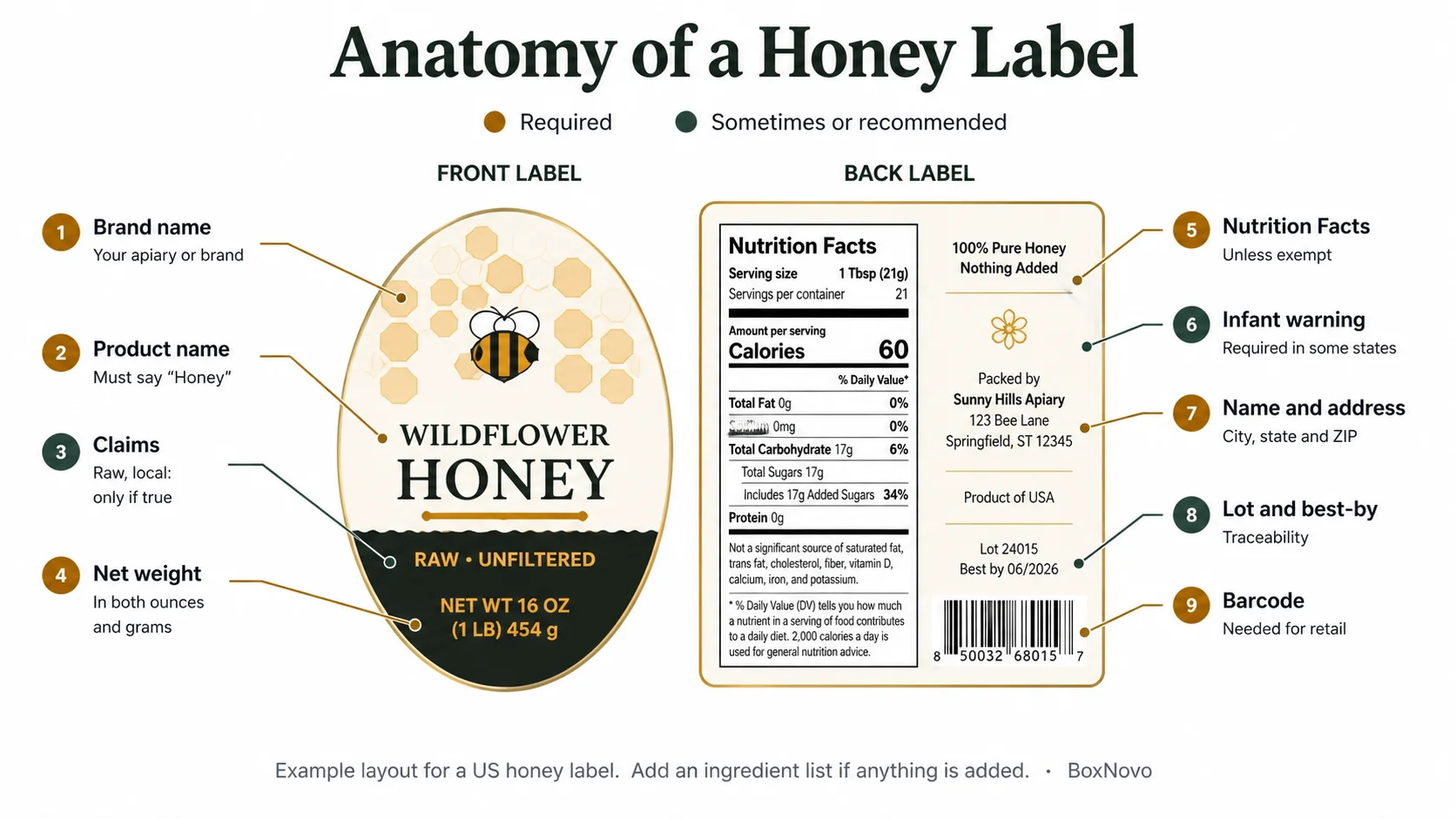
Here’s what a typical US honey label includes, and where each item belongs:
Label element
Required?
Where and how
The word “Honey”
Yes
Front label, clear and prominent; a floral source such as “Clover Honey” is optional
Net weight
Yes
Bottom 30% of the front label, in ounces and grams, such as “NET WT 16 OZ (1 LB) 454 g”
Name and address
Yes
Packer, producer or distributor, with city, state and ZIP code
Ingredient list
Only if anything is added
Flavored, infused and blended honey; ingredients in order of weight
Nutrition Facts
Yes, unless exempt
Many small producers qualify for an exemption
Country of origin
Imported honey
Required for imported products
Infant warning
Recommended; required in some states
“Do not feed honey to infants under 1 year of age”
Best-by date and lot number
Recommended
Helps with quality and traceability
Barcode
Retail requirement
Needed by most stores, not by law
Claims (raw, organic, local, grade)
Only if true
Some need certification or must meet a standard
What goes on a honey label: required details in amber, recommended ones in teal.
Honey Labeling Rules Explained
Name Your Honey Correctly
FDA’s guidance on proper labeling of honey says a product that contains only honey must be named “honey.” You may add the plant or blossom source, such as “Clover Honey” or “Orange Blossom Honey,” if you have information showing it’s the chief floral source.
Anything that isn’t pure honey needs a name that shows the difference:
Blends: honey mixed with sugar or syrup can’t be called simply “honey.” Use a name such as “Blend of honey and corn syrup,” and list each sweetener in order of weight.
Flavored honey: name the flavor, for example “raspberry-flavored honey,” following FDA’s flavor labeling rules.
Infused or spiced honey: list every added ingredient, including honey, in the ingredient statement.
Make sure “honey” is easy to read. Some states, such as Kansas, say the word “Honey” must be predominant on the label (NEKBA).
Net Weight: Honey Is Sold by Weight
Because honey is viscous, its net quantity is stated by weight, not volume (21 CFR 101.7). This is the most common mistake on homemade labels. Honey is much denser than water: one fluid ounce of honey weighs about 1.5 ounces (WebstaurantStore). That’s why a jar that holds 12 fluid ounces of water is sold as a 16 oz (1 lb) honey jar.
Weigh only the honey, not the jar or lid.
Show ounces and grams, for example “NET WT 12 OZ (340 g).”
Place it in the bottom 30% of the front label, parallel to the base.
Size the text by the area of the front panel, measured on a lowercase letter:
Front panel area
Minimum letter height
5 sq in or less
1/16 in
More than 5 to 25 sq in
1/8 in
More than 25 to 100 sq in
3/16 in
More than 100 to 400 sq in
1/4 in
More than 400 sq in
1/2 in
For a round jar, the front panel area is 40% of the body height times the circumference, leaving out the shoulder, neck and lid (21 CFR 101.1). For a flat-sided bear or jar, it’s the height times the width of the front.
Name and Address
The label must show who packed or distributed the honey: the business name, city, state and ZIP code. If you’re not the producer, add a phrase such as “Packed for” or “Distributed by.” A street address is needed unless your business is listed in a public directory, and a phone number or website makes it easy for customers to reorder.
Ingredient Labels for Flavored and Infused Honey
Pure honey doesn’t need an ingredient list, because the name already says what it is. Once you add anything, such as cinnamon, lavender, hot peppers, nuts or bee pollen, you need ingredient labels:
List every ingredient by its common name, in descending order by weight.
Declare major food allergens such as tree nuts or milk, either in the list or in a “Contains” statement.
Make the product name match: “Honey with Cinnamon,” not just “Honey.”
Small retailers: businesses with annual gross sales of no more than $500,000, or annual food sales to consumers of no more than $50,000. No notice to FDA is needed.
Low-volume products: businesses with fewer than 100 full-time equivalent employees selling fewer than 100,000 units of the product in the US a year. A notice must be filed with FDA every year.
The exemption is lost if the label makes a nutrition claim, such as “low sodium.” If you do include Nutrition Facts on pure honey, FDA doesn’t require the grams of added sugars, but the percent Daily Value for added sugars must still appear, with an optional “†” footnote explaining it (IFT).
Food Safety Labels for Honey
Infant warning: honey can contain spores that cause infant botulism, so many producers add “Do not feed honey to infants under 1 year of age.” It’s recommended everywhere and required for retail honey in some states. Mississippi, for example, requires “Warning! Do not feed to infants under 1 year of age” on honey sold in stores (MSU Extension).
Lot number and best-by date: these help you trace a batch if there’s ever a problem.
Crystallization note: a short line such as “Crystallization is natural. Warm the jar gently to liquefy” stops customers thinking the honey has gone bad.
Tamper-evident seals: a seal label over the lid shows the jar hasn’t been opened.
Claims: Raw, Organic, Local, Pure and Grade
Raw, unfiltered, unheated: there’s no federal definition, so these words must simply be true and not misleading.
Organic: honey sold as organic must meet USDA organic rules. Operations with $5,000 or less in gross organic sales can use the word “organic” without certification but can’t use the USDA organic seal (USDA AMS).
Local and pure: make sure you can back them up; “pure” means nothing has been added.
U.S. Grade: if you print a grade such as “U.S. Grade A,” the honey must meet USDA grade standards.
State Rules and Cottage Food Laws
States add their own rules on honey labeling, permits and inspection. Some treat honey as a raw agricultural product, others as a cottage food with extra label wording. Check with your state’s department of agriculture before you sell, especially at stores and farmers’ markets.
Honey Bottle Labels and Jar Labels: Shapes and Sizes
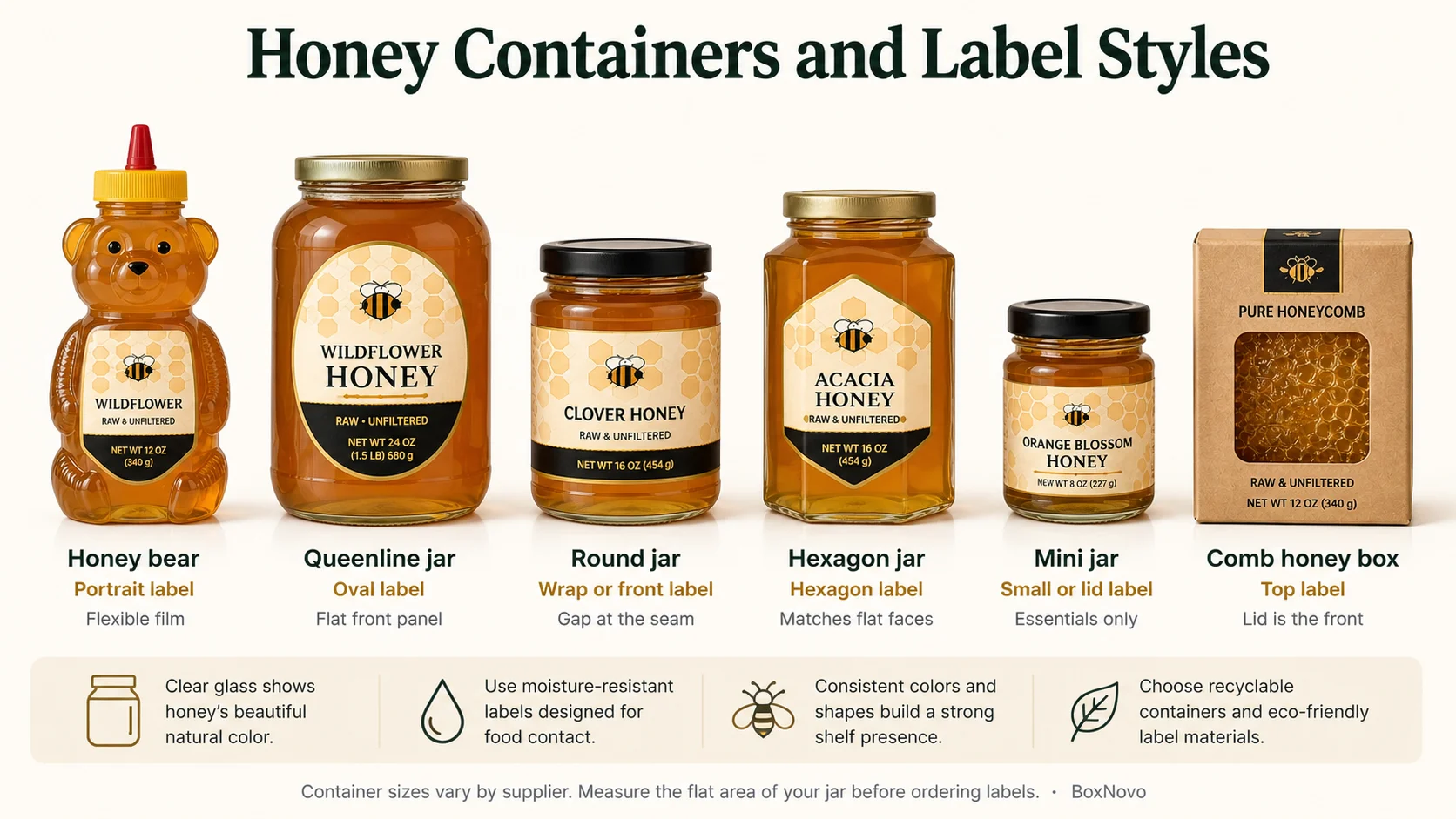
The container decides the label shape. Common honey containers and the label styles that suit them:
Container
Typical label style
Tips
Plastic honey bear (squeeze bottle)
Portrait rectangle or shaped label on the belly
Use flexible film so it doesn’t crease when squeezed
Classic queenline glass jar
Oval label on the flat front
The flat front panel makes an oval easy to apply straight
Round glass or plastic jar
Wrap-around or front label
Leave a gap at the seam on wrap labels
Hexagon jar
Hexagon or rectangle front label
Match the label to the jar’s flat faces
Mini jars and sticks (1 to 2 oz)
Small labels or lid labels
Keep only the essentials; move details to a hang tag or box
Comb honey boxes
Top label or band
The front panel is often the lid
Label styles by container from Honey Stickers. Jar sizes vary between suppliers, so measure your own container.
Match the label shape to the container: portrait for bears, oval for queenline jars, hexagon for hex jars and small labels for minis.
How to Measure a Honey Container for Labels
Measure the body, below the shoulder and above the curve at the base. Labels lift on curves.
For round jars, measure the circumference with a paper strip, or the diameter times 3.14.
For bears and flat jars, measure the flat front face.
Leave a margin of about 1/8 in around the label so it sits flat.
For other packaging, you can pick a label size with our recommender tool.
Small Labels for Lids, Samples and Seals
Small labels do a lot on honey packaging: lid tops, tamper seals over the cap, flavor stickers on a range, and sample-size jars. Round lid labels are a simple way to brand the top of the jar or seal it closed. For extra seals and promotional stickers, see our guide to packaging seal stickers.
Use the planner to work out your net weight statement, its minimum text size and how many labels you need:
Honey Label Materials and Finishes
Honey jars get sticky. Drips run down the side when you fill and when customers pour, so the label must be wipe-clean.
Material
Water and oil resistance
Look
Best for
Coated or kraft paper
Low unless laminated
Natural, handmade, rustic
Glass jars for markets and gifts; add a laminate or varnish
White BOPP film
Waterproof and oil-resistant
Bright, glossy or matte
Most jars and bears; easy to wipe clean
Clear BOPP film
Waterproof
“No-label” look that shows the honey’s color
Glass jars of light or colorful honey
Metallic or gold film
Waterproof
Premium
Gift jars and special varieties
Flexible squeezable film
Waterproof
Gloss or matte
Squeeze bears and bottles
Use a permanent adhesive for glass and plastic, applied to clean, dry, room-temperature containers.
Label before drips can reach the label area, or wipe the jar fully dry first; honey residue stops adhesive from sticking.
Choose flexible film for squeeze bottles so the label bends with the bottle.
Add a laminate or varnish to paper labels to protect them from sticky fingers.
For a deeper comparison of waterproof film and paper in wet, cold conditions, our beverage label materials guide covers BOPP, wet-strength paper and adhesives in detail.
Honey Label Design Ideas
These honey label ideas help a jar stand out at a market stall or on a store shelf:
Let the honey show. Clear labels or a smaller front label let the honey’s color sell itself.
Use a hexagon shape for a label or lid seal that echoes the honeycomb.
Color-code varieties, such as a light gold for clover and a deep amber for buckwheat, so customers find their favorite.
Feature the place. A simple map, the apiary name or the county gives local honey a story.
Add bees and botanicals from the floral source, such as orange blossom, lavender or wildflowers.
Print the harvest season and batch number for a small-batch, collectible feel.
Go premium with black and gold foil for gift jars and special harvests.
Keep “Honey” readable. Decorative fonts are fine for the brand name, but the product name and net weight must stay clear.
Design a range system. Keep the logo and layout the same and change only the color and floral name for each variety.
Labeling honey in fluid ounces instead of net weight.
Putting the net weight at the top of the label or on the back.
Calling a blend or flavored honey just “honey.”
Leaving out the address, or listing only an email.
Using paper labels with no protection on sticky jars.
Claiming “organic” or “Grade A” without meeting the standard.
Making a nutrition claim while relying on the small business exemption.Forgetting a state-required infant warning.
Honey Label Checklist
Product name includes the word “Honey” and any floral source you can support.
Net weight in ounces and grams, in the bottom 30% of the front, at the right text size.
Name and address with city, state and ZIP code.
Ingredients and allergens listed if anything is added.
Nutrition Facts included, or an exemption confirmed.
Infant warning included where required or recommended.
Claims checked: raw, organic, local, pure, grade.
Lot number and best-by date for traceability.
Waterproof material and permanent adhesive.
Test label checked on a filled jar.
Frequently Asked Questions About Honey Labels
What information is required on a honey label?
In the US, a honey label needs the word “honey,” the net weight in ounces and grams in the bottom 30% of the front, and the name and address of the packer or distributor. It also needs an ingredient list if anything is added, and a Nutrition Facts label unless the business qualifies for an exemption.
Do I need a nutrition label on my honey?
Not always. Small businesses can be exempt if annual gross sales are no more than $500,000 or food sales to consumers are no more than $50,000. Low-volume products from businesses with fewer than 100 full-time employees and fewer than 100,000 units a year can also be exempt with a yearly notice to FDA. Making a nutrition claim removes the exemption.
Should honey be labeled in ounces or fluid ounces?
In ounces by weight. Honey is viscous, so its net quantity must be stated by weight, such as “NET WT 16 OZ (1 LB) 454 g.” A container that holds 12 fluid ounces holds about 16 ounces of honey by weight.
Does a honey label need an infant botulism warning?
It’s not a federal requirement, but it’s widely recommended and some states require it for retail sale. A common wording is “Do not feed honey to infants under 1 year of age.”
Can I call my honey raw?
There’s no federal definition of “raw” honey, so you can use it only if it’s true and not misleading. Many producers use it for honey that hasn’t been heated or finely filtered.
Can I put “organic” on my honey label?
Only if the honey meets USDA organic rules. Operations with $5,000 or less in gross organic sales can call the honey organic without certification but can’t use the USDA organic seal.
What size label fits a 1 lb honey jar?
It depends on the jar. Queenline jars usually take an oval label on the flat front, and round jars take a front or wrap-around label. Measure the flat area of the jar body and leave about 1/8 in of margin.
What is the best material for honey labels?
Waterproof BOPP film is the most practical choice because it wipes clean when honey drips. Use flexible film for squeeze bottles, and add a laminate if you prefer paper or kraft labels.
How do I label flavored or infused honey?
Name the flavor, such as “raspberry-flavored honey” or “honey with cinnamon,” and list every ingredient in order of weight. Declare any major food allergens, such as tree nuts, in the list or in a “Contains” statement.
Create Honey Labels That Sell and Comply
The best honey labels are simple: a clear product name, the right net weight in the right place, your name and address, and a design that lets the honey shine. Get those right and choose a material that survives sticky jars, and your honey will look as good on the shelf as it tastes.
If you’re ready to print, BoxNovo can help with label sizes, materials, shapes and finishes for every jar in your range. Request honey label pricing or browse our label printing range.
BoxNovo Packaging Experts share practical insights on custom packaging, box styles, printing, labels, dimensions, materials, and product presentation. Our content helps businesses understand packaging options, choose the right solutions for their products, and create packaging that looks professional while supporting a stronger brand experience.