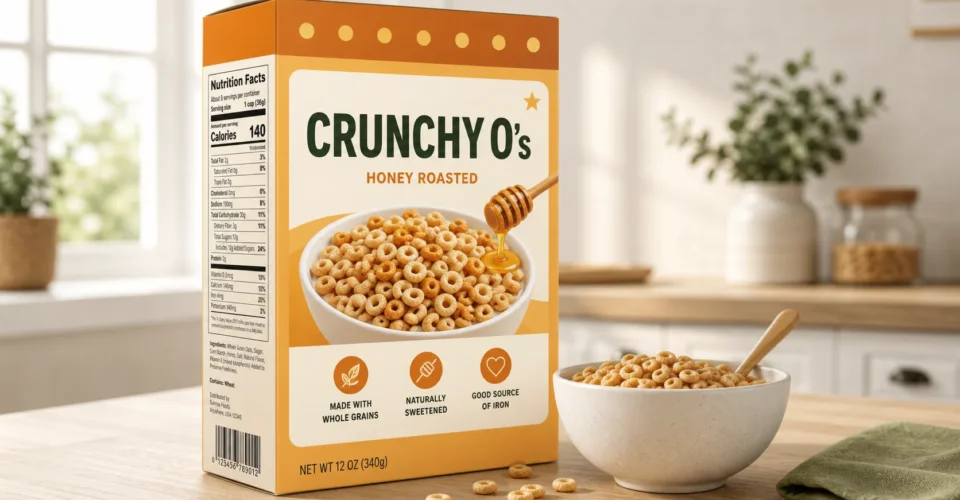
The back of a cereal box is usually the brand’s marketing panel: games, puzzles, recipes, brand stories and promotions. The legally required details, such as the Nutrition Facts label, ingredient list, allergen statement and company address, usually sit on the side panel to the right of the front. Some brands place nutrition and ingredients on the back instead, and the rules allow that in certain cases.
This guide explains what goes on every panel of a cereal box, why the nutrition label is where it is, and what US food labeling rules require. It also covers what’s changing in 2026 and how to plan the back panel if you’re designing your own cereal packaging. A panel planner below works out the size of each panel and the minimum net weight text size for your carton.
What’s on the Back of a Cereal Box? A Quick Answer
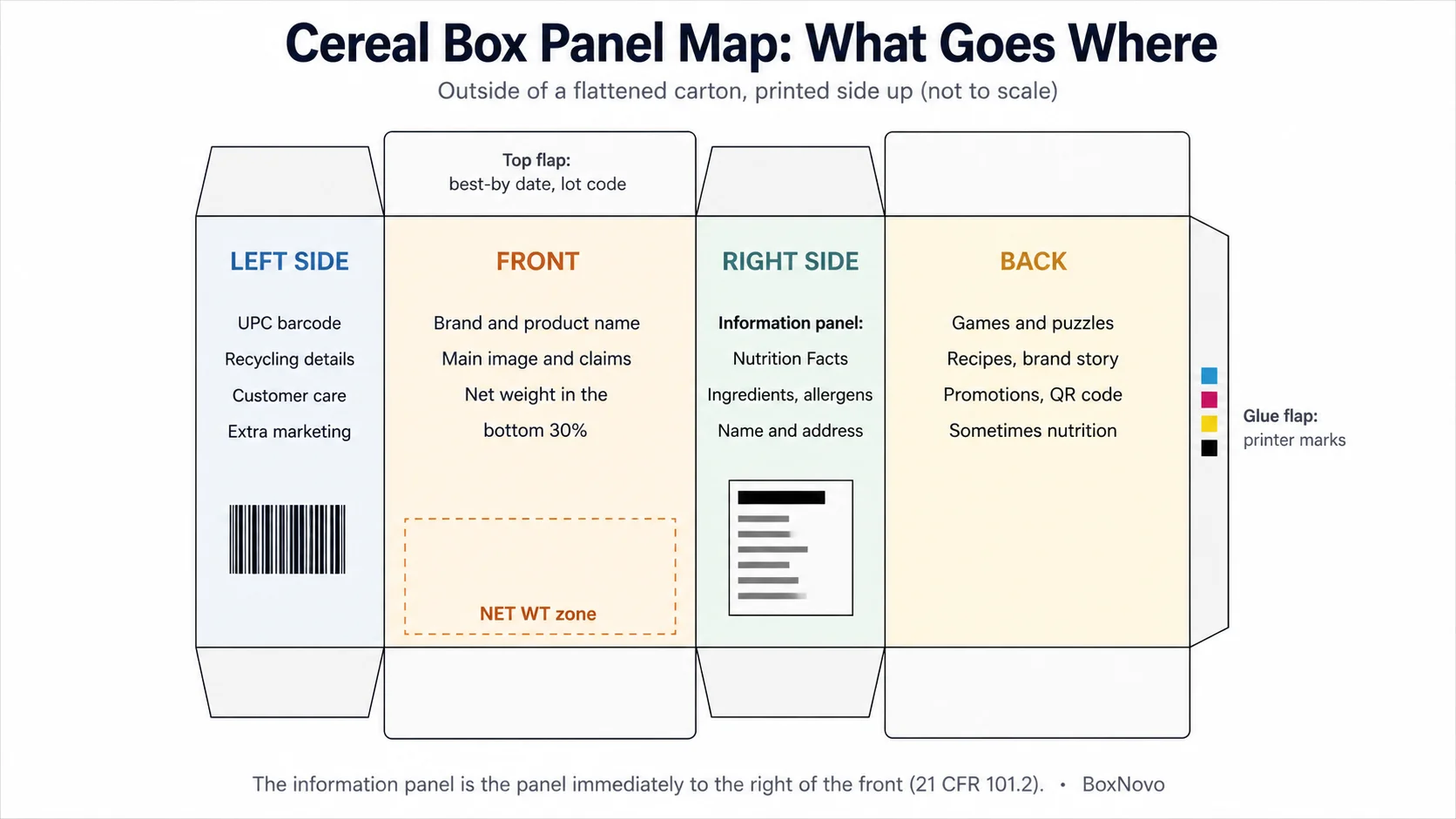
A cereal box has six printed panels, and each one has a job. Here’s what usually goes where on a US cereal box:
| Panel | What usually goes there | Required by law? |
|---|---|---|
| Front (principal display panel) | Brand, product name, main image, claims, net weight | Product name and net weight are required here |
| Back | Games, puzzles, recipes, brand story, promotions, QR codes; sometimes nutrition and ingredients | No, unless it’s used as the information panel |
| Right side (information panel) | Nutrition Facts, ingredients, allergens, name and address of the company | Yes, this information must be on the front or the information panel |
| Left side | Barcode, recycling information, customer service details, extra marketing | Barcode is a retail requirement, not a legal one |
| Top | Best-by date, lot code, opening instructions | Dates are usually voluntary; lot codes support recalls |
| Bottom and inside | Manufacturing codes, printer’s color bars and registration marks | No |
Why the Nutrition Label Is Usually on the Side, Not the Back
The answer comes from two FDA definitions in 21 CFR 101.2:
-
- The principal display panel (PDP) is the part of the package most likely to be seen at the time of purchase. On a cereal box, that’s the front.
- The information panel is the panel “immediately contiguous and to the right of” the principal display panel, as you face the front. On a cereal box, that’s the right side panel.
FDA requires the Nutrition Facts label, ingredient list, allergen information and the name and place of business to appear on either the principal display panel or the information panel. On the information panel, they must appear together, with no unrelated material in between, in type at least 1/16 inch high.
Because the front is reserved for branding, most cereal makers put the required information on the right side panel. That leaves the large back panel free for marketing. If the panel to the right is too small or otherwise unusable, the next panel along, usually the back, can serve as the information panel. That’s why some boxes show nutrition and ingredients on the back.
The Cereal Box Nutrition Label, Explained
The Nutrition Facts label on a cereal box follows the same rules as other packaged foods, with one cereal-specific detail: how the serving size is set.
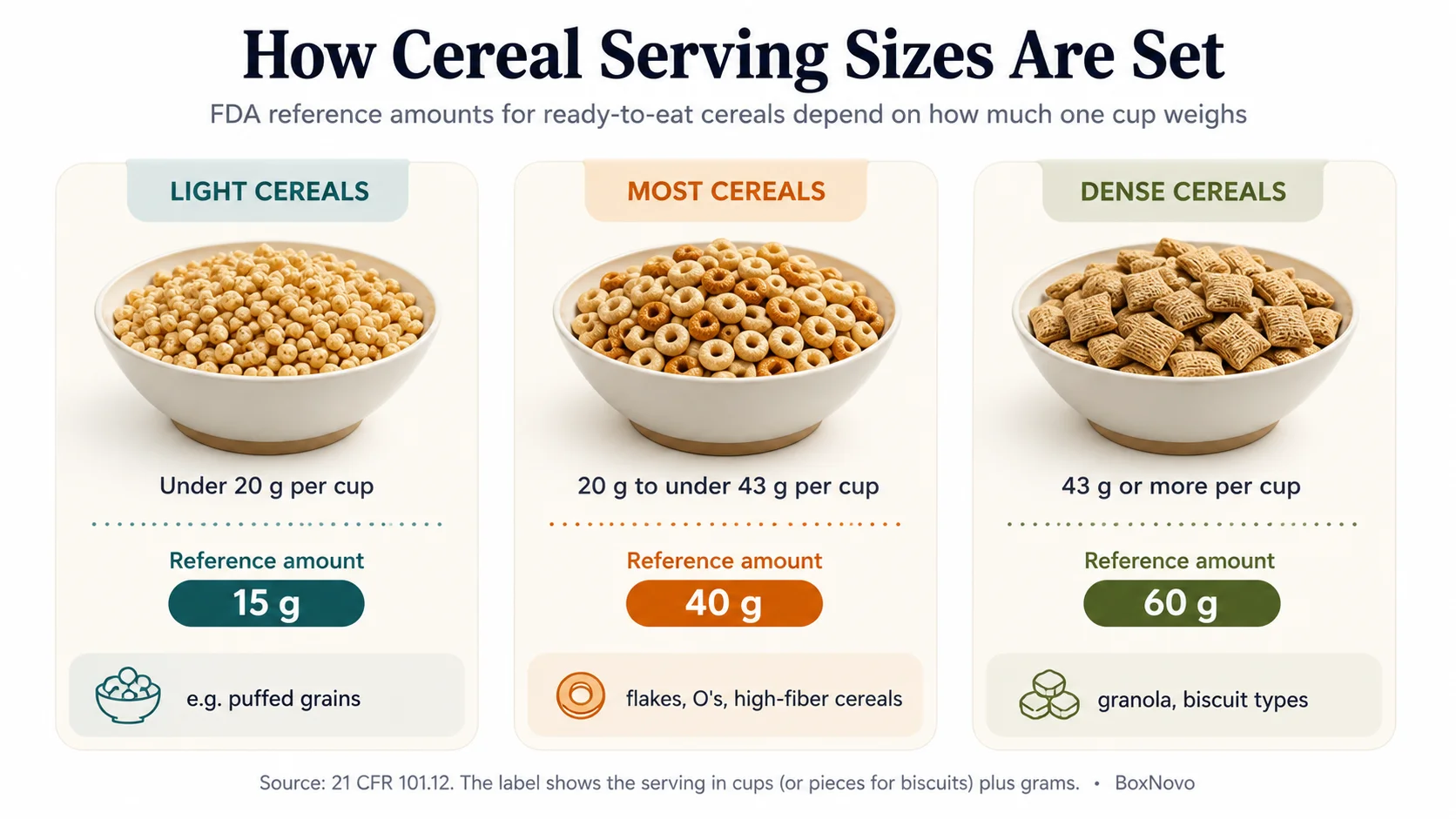
How Cereal Serving Sizes Are Set
Serving sizes are based on FDA reference amounts customarily consumed (RACCs), which depend on how much a cup of the cereal weighs (21 CFR 101.12):
| Type of cereal | Reference amount | Shown on the label as |
|---|---|---|
| Ready-to-eat, under 20 g per cup (for example, puffed grains) | 15 g | Cups and grams |
| Ready-to-eat, 20 g to under 43 g per cup; high-fiber cereals | 40 g | Cups and grams |
| Ready-to-eat, 43 g or more per cup; biscuit types | 60 g | Pieces for biscuits; cups for others |
| Hot cereal | 40 g plain dry, 55 g flavored or sweetened, or 1 cup prepared | Cups and grams |
That’s why a light puffed cereal and a dense granola can list very different serving sizes in grams.
What the Updated Label Shows
FDA’s updated Nutrition Facts label has been required since January 1, 2020 for manufacturers with $10 million or more in annual food sales, and since January 1, 2021 for smaller ones. Compared with the old label:
-
- Calories, servings per container and serving size are larger and bolder.
- Added sugars are listed in grams and as a percent Daily Value.
- Vitamin D and potassium are required; vitamins A and C are now optional.
- “Calories from fat” has been removed.
Many cereal labels also add a second column showing nutrition with milk. It’s a common way to show the cereal as it’s usually eaten, alongside the required “as packaged” column.
Size and Format Rules for the Label
21 CFR 101.9 sets minimum type sizes. The word “Calories” must be at least 16 point, the calorie number at least 22 point, and most other information at least 8 point, with some details allowed down to 6 point. The standard layout is a tall, vertical panel. When a package doesn’t have enough vertical space, FDA allows a side-by-side tabular layout instead.
On a tall cereal box, the side panel usually has room for the standard vertical label. That’s another reason the side panel works so well.
Ingredients and Allergens
-
- Ingredients are listed in descending order by weight, so the first ingredient is the one used most.
- The nine major food allergens are milk, egg, fish, crustacean shellfish, tree nuts, wheat, peanuts, soybeans and sesame. Sesame has been required since January 1, 2023 (FDA).
- Allergens must be declared either in the ingredient list, such as “whey (milk),” or in a “Contains” statement immediately after or next to the ingredients.
- “May contain” statements are voluntary, not required.
Name and Place of Business
The label must name the manufacturer, packer or distributor with a city, state and ZIP code. If the company named isn’t the manufacturer, a phrase such as “Distributed by” must explain its role (FDA Food Labeling Guide). Most brands add a customer service phone number or website here too.
Net Weight on the Front
The net weight belongs on the front panel, not the back. It must sit in the bottom 30% of the front panel and appear in both US units and metric, such as “NET WT 12 OZ (340 g).” The minimum letter height depends on the area of the front panel:
| Front panel area | Minimum letter height |
|---|---|
| 5 sq in or less | 1/16 in |
| More than 5 to 25 sq in | 1/8 in |
| More than 25 to 100 sq in | 3/16 in |
| More than 100 to 400 sq in | 1/4 in |
| More than 400 sq in | 1/2 in |
For a rectangular box, the front panel area is simply height times width.
Marketing Content on the Back of Cereal Boxes
With the required information on the side, the back panel becomes the brand’s biggest storytelling space. It’s often the panel people read longest, at the breakfast table, so it’s valuable.
-
- Games and puzzles: mazes, word searches, spot-the-difference and cut-out activities are classic for children’s cereals. They keep the box on the table and the brand in front of the family.
- Recipes: cereal bars, toppings, coatings and snacks give adults a reason to buy another box.
- Brand and ingredient stories: where the grains come from, how the cereal is made, or the founder’s story.
- Nutrition education: what whole grains are, or how to build a balanced breakfast, as long as the content is truthful and not misleading.
- Promotions: contests, collectibles, codes and partnerships, often with a QR code linking to the details.
- Range cross-sells: other flavors and sizes in the line.
Keep claims accurate. Nutrient content claims such as “high fiber” or “good source of” must meet FDA definitions. FDA updated the definition of “healthy” in a final rule issued in December 2024, with a compliance date of February 25, 2028 (Covington).
Recycling Information and the 2026 Changes
Most cereal boxes have two parts: a paperboard carton and a plastic bag liner inside. They’re handled differently, so recycling instructions usually address each part separately.
California’s SB 343, the “truth in labeling” law, now limits when the chasing-arrows symbol and other recyclability claims can be used. It applies to products and packaging manufactured after October 4, 2026 (Anthesis). How2Recycle, the most common US recycling label program, redesigned its Store Drop-Off label in 2025 and removed the circular arrows, partly because of the California rules.
What this means for the back or side of a cereal box:
-
- Only claim what’s true for the carton and for the liner separately.
- Keep recycling details current with your label program and the states you sell in.
- Avoid coatings, windows or materials that can stop the carton from being recycled if you want to keep a recyclable claim.
If sustainability is part of your brand, our recyclable packaging options are a good starting point.
Barcodes, Dates and Printer Marks
The UPC Barcode
Retailers scan the UPC barcode at checkout, so it needs space and contrast. A UPC-A barcode at 100% size is about 1.46 × 1.02 inches, and printers usually allow 80% to 200% of that size. Use dark bars on a light background, and avoid red bars, which most scanners can’t read (Barcode Graphics). The left side panel or bottom is a common spot, away from folds and edges.
Best-By Date and Lot Code
The best-by date and lot code are usually added on the packing line, often by inkjet on the top flap, rather than printed with the artwork. Leave a clear, uncoated or unvarnished area there so the ink dries and stays readable. Lot codes matter because they let a company trace and recall a specific batch.
Color Bars and Registration Marks
Small colored squares, crosshairs and lines on a glue flap or inside the carton are printer’s marks. They help the press operator check that each ink color lines up and prints at the right density. They’re placed where customers won’t normally see them once the box is glued.
Cereal Packaging Panels: Planning the Whole Box
Most cereal boxes are glued, sealed-end paperboard cartons. They ship flat, are formed and filled on the packing line, and are sealed at both ends. Their structure is similar to our glued sealed-end cartons. Designing all six panels together on the printer’s dieline avoids the most common problems: text crossing folds, the information panel ending up on the wrong side, or the barcode landing on a flap.
Plan the box in this order:
-
- Measure the carton: front width, height and depth. Our guide to measuring carton dimensions explains inside and outside sizes.
- Fix the front: product name, brand, main image, claims and net weight in the bottom 30%. Our notes on shelf-ready front panels cover the design side.
- Set the information panel: usually the right side; keep Nutrition Facts, ingredients, allergens and the address together.
- Plan the back: choose one main job, such as a game, a recipe or a brand story.
- Use the left side and top for the barcode, recycling details, date and lot code space.
- Check folds and flaps: nothing important on glue areas, scores or flaps that get covered.
Use the planner to work out your panel sizes and net weight text size.
How to Design a Back Panel That Works
-
- Give it one job. A back panel that tries to be a game, a recipe and a brand story at once usually does none of them well.
- Design for the breakfast table. It’s read at arm’s length while someone eats, so use larger type and simple layouts.
- Match the audience. Children’s cereals lean on characters and games; adult and premium cereals use recipes, sourcing and nutrition stories.
- Keep it truthful. Health and nutrition claims must meet FDA rules wherever they appear on the box.
- Add a reason to come back. A series of puzzles, a collectible or a recipe card set encourages repeat purchases.
- Set up the artwork properly. Use the printer’s dieline, keep text inside the safe zone setup and run backgrounds into the bleed.
- Check colors before proofing; you can check CMYK values for your brand colors.
- See it in 3D. Mock up the carton to check how the back reads next to the side panels.
For layout principles that apply to any food or product label, see our product label layout guide. Smaller brands selling granola or cereal in plain boxes or bags can start with printed food labels before moving to fully printed cartons.
What’s Changing on Cereal Boxes in 2026 and Beyond
-
- Front-of-package nutrition box: In January 2025, FDA proposed a “Nutrition Info box” on the front of most packaged foods, rating saturated fat, sodium and added sugars as Low, Med or High (Federal Register). It was still a proposal when we last checked, but it would change how much front space is free.
- “Healthy” claims: the updated definition has a compliance date of February 25, 2028, and FDA is still developing a “healthy” symbol.
- Recycling claims: California’s SB 343 applies to packaging made after October 4, 2026.
Leaving some flexible space in your panel layout makes these changes easier to absorb in the next print run.
Common Mistakes on the Back and Sides of Cereal Boxes
-
- Splitting Nutrition Facts, ingredients and allergens across different panels.
- Putting the required information on the left side instead of the panel to the right of the front.
- Forgetting sesame or another major allergen in the “Contains” statement.
- Placing the net weight on the back or too high on the front.
- Varnishing the area where the best-by date will be inkjet printed.
- Printing the barcode in red or across a fold.
- Making unqualified recyclable claims for the plastic liner.
- Cramming the back panel with too many activities and too much text.
Cereal Box Labeling Checklist
-
- Front: product name, brand and net weight in US and metric units in the bottom 30%.
- Information panel: Nutrition Facts, ingredients, allergen statement, name and address, all together.
- Serving size based on the correct reference amount for your cereal’s weight per cup.
- Allergens: all nine major allergens checked, including sesame.
- Claims checked against FDA definitions.
- Barcode at a scannable size, dark on light, away from folds.
- Top flap left clear for the best-by date and lot code.
- Recycling details accurate for the carton and the liner.
- Back panel with one clear job, designed for the breakfast table.
- Printed proof checked on a folded sample carton.
Frequently Asked Questions About the Back of Cereal Boxes
What is on the back of a cereal box?
Usually marketing content: games, puzzles, recipes, brand stories, promotions and QR codes. On some boxes, the back also carries the Nutrition Facts label, ingredients and allergen information when it’s used as the information panel.
Why is the nutrition label on the side of the cereal box?
FDA requires nutrition, ingredient and allergen information on the front or on the information panel, which is the panel immediately to the right of the front. On most cereal boxes, that’s the right side panel, which leaves the back free for marketing.
Can the Nutrition Facts label go on the back of a cereal box?
Yes, in some cases. If the panel to the right of the front is too small or otherwise unusable, the next panel along, usually the back, can be used as the information panel. The required details still need to appear together in one place.
How is the serving size on a cereal box decided?
It’s based on FDA reference amounts that depend on how much a cup of the cereal weighs: 15 g for very light cereals, 40 g for most cereals and 60 g for dense cereals and biscuit types.
Do cereal boxes have to list allergens?
Yes. All nine major food allergens, including sesame, must be declared in the ingredient list or in a “Contains” statement next to it.
Where is the expiration date on a cereal box?
It’s usually printed on the top flap along with a lot code, often by inkjet on the packing line. Most cereals use a “best if used by” date, which is about quality rather than safety.
What are the colored squares and crosshairs on a cereal box?
They’re printer’s marks: color bars and registration marks used to check that each ink prints in the right place and at the right strength. They usually sit on a glue flap or inside the carton.
Are cereal boxes recyclable?
The paperboard carton is widely recycled in many areas, but the plastic bag liner usually isn’t accepted in curbside bins. Check the recycling label on the box and your local rules.
What goes on the front of a cereal box?
The brand, the product name, the main image, any claims and the net weight, which must sit in the bottom 30% of the front panel in both US and metric units.
Plan Every Panel of Your Cereal Box
The back of a cereal box gets its freedom from the side: once the required information sits together on the information panel, the back can tell a story, entertain or sell. Planning all six panels together, with the right rules for each, gives you a box that’s compliant, easy to read and worth a second look at breakfast.
For more on cereal carton structure, materials and sizing, read our full cereal carton guide, or compare paperboard carton options. When you’re ready to print, BoxNovo produces printed cereal boxes with full panel artwork support. Request a carton quote or browse our food packaging range.