Quick answer: Hot sauce labels sold in the US need six core elements: the product name, net contents in fluid ounces and milliliters, an ingredient list, any major allergens, the maker’s name and address, and Nutrition Facts unless the product is exempt. A 5 oz woozy bottle usually takes a label about 4 × 3 inches, printed on waterproof BOPP.
Key facts at a glance
- Front label: product name and net contents, such as 5 FL OZ (148 mL), in the bottom 30% of the front panel
- Back label: Nutrition Facts, ingredients, a “Contains” allergen line and the business name and address
- Serving size: the FDA reference amount for hot sauce is 1 teaspoon (5 mL)
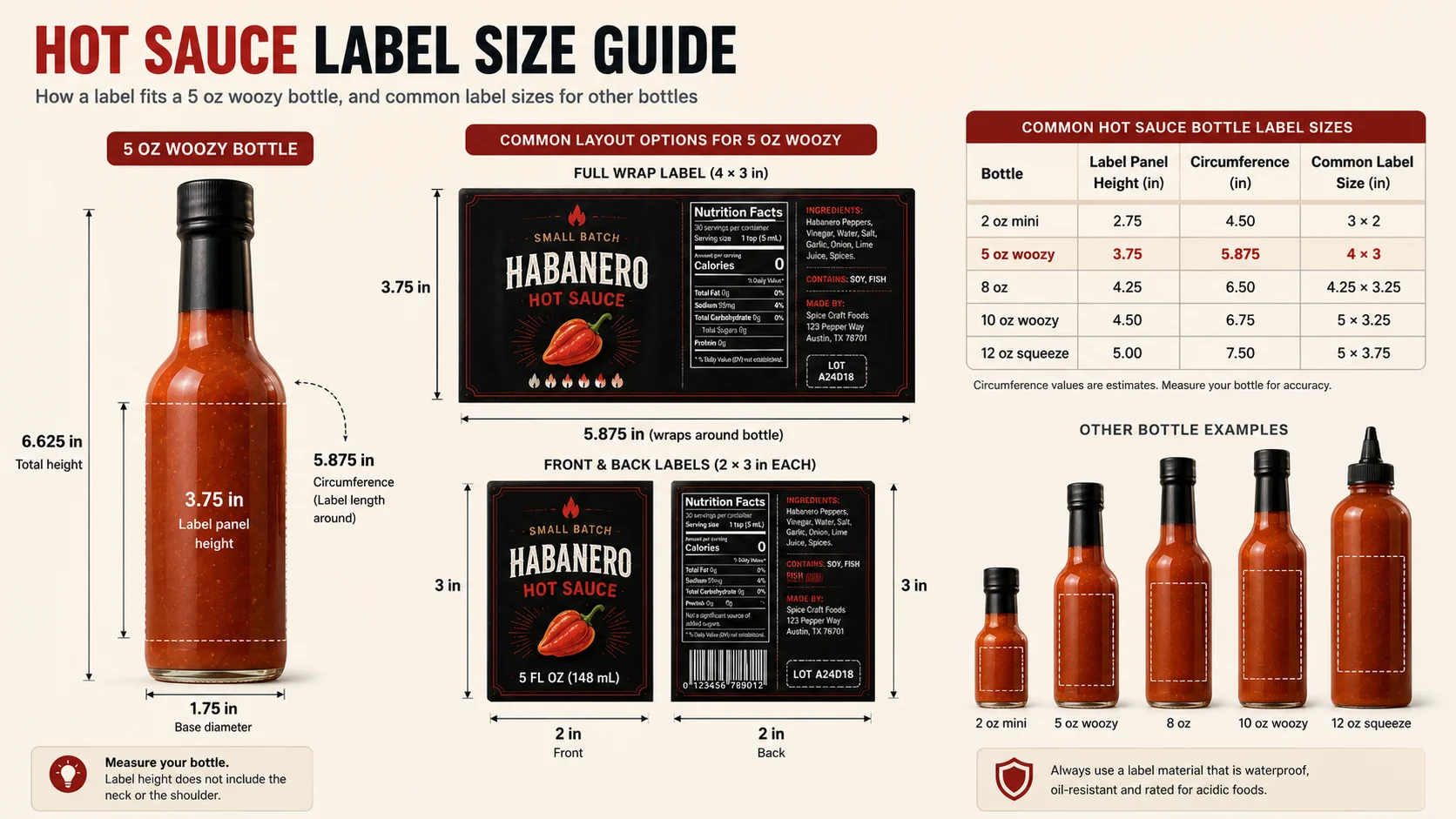
- 5 oz woozy bottle: label panel about 3.75 in tall and 5.875 in around; common labels are 4 × 3 in, or 2 × 3 in front and back
- Best material: white or clear BOPP film with a vinegar- and oil-resistant adhesive
- Acidified hot sauces also need a permanent lot code on every bottle
Labeling rules in this guide are checked against FDA regulations and state extension guides, listed in the Sources section. This is general information, not legal advice.
In this guide
- What hot sauce labels must include
- Nutrition Facts for hot sauce
- Lot codes for acidified hot sauce
- Hot sauce bottle label size
- Hot sauce label template
- Hot sauce warning label
- Hot sauce label designs
- Hot sauce stickers
- Label materials and finishes
- Printing and application tips
- Common hot sauce label mistakes
- Pre-print checklist
- Frequently asked questions
- Sources
What Do Hot Sauce Labels Need to Include?
Hot sauce labels for retail sale in the US follow the same FDA rules as other packaged foods. The required information is split between two areas: the principal display panel (the front of the bottle a shopper sees first) and the information panel, which is the panel immediately to the right of the front as the shopper looks at it.
| Label Element | Where It Goes | Key Rule |
|---|---|---|
| Statement of identity (product name) | Front panel | The common name of the food, such as “Habanero Hot Sauce,” in bold type parallel to the base of the bottle |
| Net quantity of contents | Bottom 30% of the front panel | Fluid ounces and metric, for example 5 FL OZ (148 mL), at or above the minimum type height |
| Ingredient list | Information panel | All ingredients in descending order of predominance by weight |
| Major food allergens | With the ingredient list | Declared in the ingredient list or in a “Contains” statement |
| Name and place of business | Information panel | Manufacturer, packer or distributor, with city, state and ZIP code |
| Nutrition Facts | Information panel | Required unless the product or business qualifies for an exemption |
| Lot code (acidified foods) | On the bottle or label | A permanent code showing the plant, product and packing date |
Product Name and Front Panel
The statement of identity tells shoppers what the product is. It must be one of the most prominent pieces of text on the front panel and run parallel to the base of the bottle. Your brand name can be larger, but the front still needs the plain name of the food, such as “Hot Sauce,” “Chipotle Pepper Sauce” or “Fermented Habanero Sauce.”
Net Contents and Minimum Type Size
Hot sauce is a liquid, so net contents are stated by volume. The statement goes in the bottom 30% of the front panel, in both US customary and metric units, such as 5 FL OZ (148 mL). Its minimum type height depends on the area of the front panel:
| Front Panel Area | Minimum Height of Net Contents Text |
|---|---|
| 5 sq in or less | 1/16 inch |
| More than 5 to 25 sq in | 1/8 inch |
| More than 25 to 100 sq in | 3/16 inch |
| More than 100 to 400 sq in | 1/4 inch |
For round bottles, the front panel area is 40% of the label height × the bottle’s circumference, leaving out the neck and shoulders (21 CFR 101.1). A 5 oz woozy bottle with a 3.75-inch label panel and a 5.875-inch circumference works out to 0.40 × 3.75 × 5.875 ≈ 8.8 square inches. That falls in the 5 to 25 square inch range, so the net contents must be at least 1/8 inch tall.
Ingredient List and Allergens
List every ingredient by its common name, from the largest amount by weight to the smallest. Peppers, vinegar, water, salt, garlic and spices are typical. If an ingredient has its own sub-ingredients, such as Worcestershire sauce or soy sauce, list those too.
US law recognizes nine major food allergens: milk, eggs, fish, crustacean shellfish, tree nuts, peanuts, wheat, soybeans and sesame. Sesame became the ninth on January 1, 2023 (FDA). Hot sauces often contain soy, wheat, fish (anchovies in Worcestershire), sesame or tree nuts, so check every component. Declare allergens in the ingredient list or in a statement starting with “Contains,” such as Contains: Soy, Wheat.
All text on the information panel must be at least 1/16 inch tall, measured by the lowercase letter “o.”
Name and Place of Business
Show the name of the manufacturer, packer or distributor with the city, state and ZIP code. The street address can be left out only if the business is listed in a current city or telephone directory. If someone else makes the sauce for you, qualify your name with a phrase such as “Distributed by” or “Manufactured for.”
Optional Information Buyers Look For
- Heat level on a simple scale, such as mild, medium, hot and extra hot.
- Flavor notes and pairing ideas, such as tacos, wings or eggs.
- A UPC barcode, which most retailers require.
- Storage instructions, such as “Refrigerate after opening,” when your process review calls for it.
- Claims such as “Gluten Free,” “Low Sodium” or “Organic.” These are regulated, so only use a claim the product meets.
Nutrition Facts for Hot Sauce
Most hot sauce sold in stores carries a Nutrition Facts panel. The FDA reference serving for hot sauce is 1 teaspoon (5 mL), so a 5 oz bottle has about 30 servings. At that serving size, most values except sodium round to zero, which is why many hot sauce bottles use the shorter, simplified format.
Three exemptions can apply:
- Small business, low volume: businesses with fewer than an average of 100 full-time equivalent employees selling fewer than 100,000 units of the product in the US in 12 months, with an annual notice filed with FDA. Products making nutrition claims do not qualify (FDA).
- Small retailers: businesses with annual gross sales of no more than $500,000, or annual food sales to consumers of no more than $50,000, with no notice needed.
- Small packages: packages with less than 12 square inches of total label space, as long as they make no nutrition claims and show an address or phone number where buyers can get nutrition information.
Even when you qualify, many retailers and distributors still ask for a Nutrition Facts panel, so plan space for it if you want to grow into stores.
Lot Codes for Acidified Hot Sauce
Many hot sauces are acidified foods: low-acid ingredients such as peppers, with acid such as vinegar added to bring the finished sauce to an equilibrium pH of 4.6 or below. Sauces whose acidity comes only from natural fermentation are treated differently, so a process authority should confirm which group your recipe falls into.
For acidified foods, FDA requires every container to carry a permanent identifying code that is visible to the naked eye and shows the plant, the product and the year, day and period of packing (21 CFR 114.80). If the bottle cannot be embossed or inked, the label can carry the code, as long as it is securely attached. Leave a clear spot on your label for a printed or stamped lot code.
Commercial acidified food makers must also register with FDA as a food canning establishment and file a process for each product and bottle size. State cottage food rules for home-made hot sauce vary widely. Some states allow acidified foods with a required disclaimer in a set type size, and others do not allow them at all, so check with your state agriculture or health department before you print.
Hot Sauce Bottle Label Size
The right hot sauce bottle label size depends on the bottle’s smooth label panel, not its capacity. Two 5 oz bottles from different suppliers can need different labels. These are common starting sizes; always measure your exact bottle before ordering.
| Bottle | Common Label Sizes (Inches) | Typical Layout |
|---|---|---|
| 2 oz sample or mini bottle | 1.5 × 2, 2 × 3 | One small wrap or front label |
| 5 oz woozy bottle | 4 × 3 (W × H), 4 × 2, 2 × 3 | One wrap label, or a front and a back label |
| 8 oz bottle | 3 × 4, 4 × 5 | Front label, often with a separate back label |
| 10 oz woozy bottle | 3 × 5, 6 × 2 | Tall front label or a wide wrap |
| 12 oz bottle or squeeze bottle | 3 × 5, 4 × 6 | Large front label with room for the full information panel |
A standard 5 oz glass woozy bottle has a label panel about 3.75 inches tall and a circumference of about 5.875 inches (TricorBraun). A 4 × 3 inch label wraps about two-thirds of the way around and leaves room above and below.
How to Measure a Bottle for a Label
- Find the smooth panel. Measure the height of the straight part of the bottle between the shoulder and the base curve. Labels do not sit flat on curves or tapers.
- Set the label height. Take the panel height and leave clearance at the top and bottom. About 1/8 inch on each side is a common starting point.
- Measure the circumference. Wrap a strip of paper or a soft tape around the panel and mark where it meets.
- Choose the label width. For a full wrap, stay slightly under the circumference so the ends do not overlap unevenly. For separate front and back labels, keep each well under half the circumference.
- Test on a real bottle. Print the design at full size on paper and tape it to the bottle before ordering.
The BoxNovo label size recommender can help you narrow down a size once you have your bottle measurements.
Hot Sauce Label Template
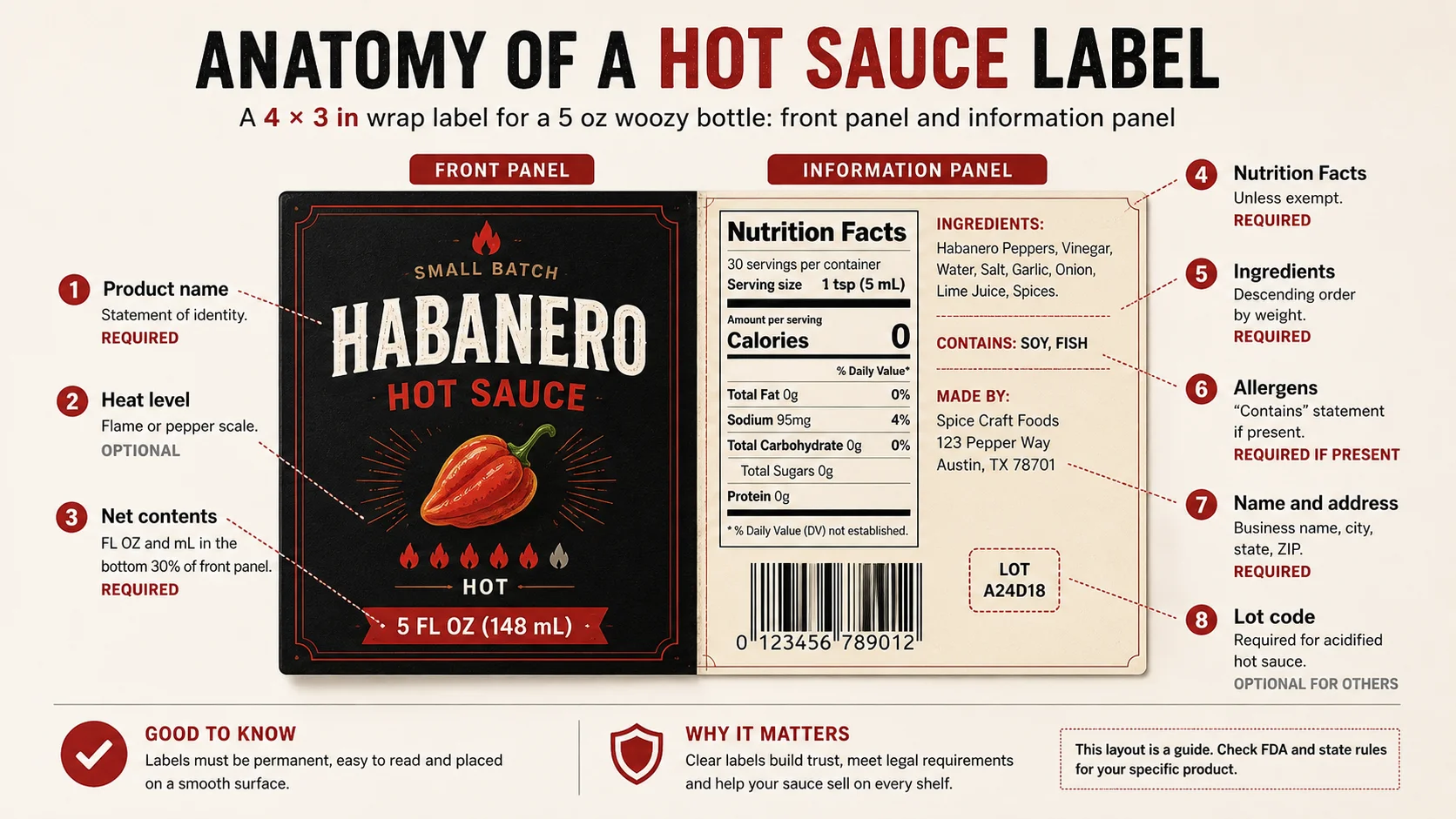
A good hot sauce label template sets out the front panel and the information panel before any artwork is added. Use this layout as a hot sauce bottle label template for a 4 × 3 inch wrap label on a 5 oz woozy bottle, or split it into separate front and back labels.
| Zone | Front Panel (Left Half) | Information Panel (Right Half) |
|---|---|---|
| Top | Brand name or logo | Nutrition Facts (simplified format) |
| Middle | Product name (statement of identity), flavor and heat level | Ingredients, then the “Contains” allergen statement |
| Bottom | Net contents, such as 5 FL OZ (148 mL), in the bottom 30% | Business name, city, state and ZIP; UPC barcode; lot code space |
Hot Sauce Bottle Label Template Setup
- Canvas size: the finished label size, for example 4 × 3 inches.
- Bleed: extend backgrounds about 1/8 inch past the trim line on every side.
- Safe zone: keep text and logos about 1/8 inch inside the trim line. The bleed and safe zones guide shows how to set this up.
- Color: design in CMYK for print. Check brand colors with a CMYK color converter.
- Resolution: use images at 300 DPI at the final printed size, and keep small text and barcodes as vector art.
- File type: export a print-ready PDF. If you design in Canva, follow these steps for print-ready Canva files.
Hot Sauce Warning Label
US federal law does not require a heat warning on hot sauce. A hot sauce warning label is still a smart addition for very hot sauces, and some warnings are required in specific cases:
| Warning Type | Required? | When It Applies |
|---|---|---|
| Allergen declaration | Yes | Any time the sauce contains one of the nine major food allergens |
| California Proposition 65 | Sometimes | Products sold in California that expose buyers to a listed chemical above set levels. Businesses with fewer than 10 employees are exempt (OEHHA). |
| Heat and handling warning | Voluntary in the US | Extremely hot sauces, capsaicin extracts and challenge sauces |
| Storage instruction | When needed for safety or quality | Sauces that must be refrigerated after opening |
For extreme sauces, a short warning protects both the customer and the brand. Common wording includes:
- “Extremely hot. Use sparingly.”
- “Keep out of reach of children.”
- “Avoid contact with eyes and skin. Wash hands after use.”
- “Not for use in eating challenges.” (for extract-based sauces)
Germany’s Federal Institute for Risk Assessment (BfR) has recommended warning notes and child-resistant closures for very hot chilli sauces, and advises keeping them out of the reach of small children (BfR). If you export, check the rules in each market you sell to.
Hot Sauce Label Designs
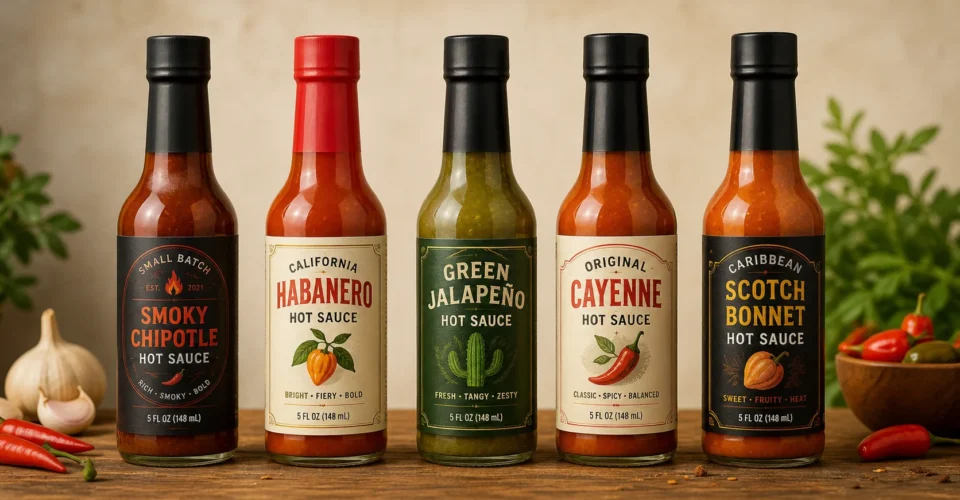
Great hot sauce label designs tell shoppers three things in about three seconds: what the sauce is, how hot it is and why it is different. Proven approaches include:
- Heat-level color coding: green or yellow for mild, orange for medium, red for hot and black for extreme, used the same way across every flavor.
- A heat meter: a thermometer, flame or pepper scale near the product name.
- Pepper-forward illustration: show the actual pepper used, such as a habanero, jalapeño or chipotle.
- Vintage or regional styles: hand-drawn type, badges and borders that suggest a place or tradition.
- Minimal premium design: plenty of white space, one accent color and a matte finish.
- Series consistency: one layout for the whole range, with only the color, pepper and flavor name changing.
- Limited editions: seasonal or collaboration labels that sit alongside the core range.
- A QR code: linking to recipes, the brand story or sourcing details.
Whatever the style, keep the product name and heat level readable from about an arm’s length. The principles in this product label design guide apply to every sauce bottle, and the honey jar labels and beer bottle labels guides show how other food and drink brands handle small, curved labels.
Using the Scoville Scale on a Label
A Scoville figure gives heat claims credibility, but only print one you can support. These are typical ranges for common peppers:
| Pepper | Typical Scoville Heat Units (SHU) | Common Label Heat Level |
|---|---|---|
| Bell pepper | 0 | No heat |
| Jalapeño | 2,500 to 5,000 | Mild to medium |
| Serrano | 5,000 to 15,000 | Medium |
| Cayenne | 30,000 to 50,000 | Hot |
| Habanero | 100,000 to 300,000 | Very hot |
| Carolina Reaper | About 1.64 million (record average) | Extreme |
| Pepper X | About 2.69 million (record average) | Extreme |
A sauce is far milder than the pepper itself, because the pepper is diluted with vinegar and other ingredients. Use a “made with” statement, such as “Made with Carolina Reaper peppers,” rather than printing the pepper’s own rating as if it were the sauce’s.
Hot Sauce Stickers
People often say “hot sauce stickers” when they mean bottle labels, and the two overlap. A label is the printed piece that carries the required information. Hot sauce stickers usually means the extras: cap seals, neck stickers, flavor dots and promotional stickers for customers.
- Roll labels: the best choice for bottling more than a few hundred units, and the only format most labeling machines accept.
- Sheet labels: good for small batches, markets and hand application.
- Cap and seal stickers: small round cap stickers mark the flavor on the lid or work as a simple seal over the cap.
- Promotional stickers: logo stickers for laptops, coolers and gift bags spread the brand after the sauce is gone.
For more ways to use stickers, see these seal and sticker ideas and this guide to custom packaging stickers.
Hot Sauce Label Materials and Finishes
Hot sauce labels face vinegar, oil, drips, fridge condensation and handling, so the material matters as much as the design.
| Material | Water and Oil Resistance | Best For |
|---|---|---|
| White BOPP film | High | Most hot sauce bottles, including refrigerated sauces |
| Clear BOPP film | High | A “no-label” look that shows the sauce color through the bottle |
| Metallic or silver BOPP | High | Premium and extreme-heat ranges |
| Coated paper | Low unless laminated | Short runs, samples and dry storage only |
| Shrink sleeve | High | Full 360-degree coverage, including curved shoulders and necks |
- Adhesive: choose a permanent adhesive rated for moisture, oil and vinegar. Standard paper-label adhesives can lift at the edges.
- Finish: gloss lamination makes colors pop on the shelf; matte or soft-touch gives a craft, premium feel. Lamination also protects the ink from drips.
- Shrink sleeves: artwork must be pre-distorted so text, the Nutrition Facts panel and the barcode read correctly after shrinking.
BoxNovo prints custom bottle labels and printed food labels for sauce makers. For salsas and chili pastes in jars, see salsa jar labels.
Printing and Application Tips
- Digital printing suits short runs, test batches and several flavors at once, with no plate costs.
- Flexographic printing lowers the cost per label on large, repeat runs.
- Apply to clean, dry bottles at room temperature. Wet, oily or cold glass stops the adhesive from bonding. If you hot-fill, let the bottles cool and wipe away any condensation first.
- Press from the center out to push out air bubbles, then smooth the edges firmly.
- Confirm roll details with your label printer, including the core size and which way the labels come off the roll, if you use a labeling machine.
- Relabeling stock: if a rule or recipe changes, these tips for removing old labels help you reuse bottles without damage.
Barcode Tips for Round Bottles
- Print a UPC-A barcode between 80% and 200% of its standard size of about 1.47 × 1.02 inches.
- Use dark bars on a light background. Red bars do not scan, because most scanners read red as white.
- On a narrow round bottle, turn the barcode so the bars run around the bottle, which GS1 recommends for small-diameter products (GS1 UK).
- Keep clear space on both sides of the bars and test-scan a printed proof on a real bottle.
Common Hot Sauce Label Mistakes
| Mistake | Fix |
|---|---|
| Net contents shown only as “5 oz” | Use fluid ounces and metric, such as 5 FL OZ (148 mL), in the bottom 30% of the front |
| Net contents text too small | Work out the front panel area and use at least the minimum height, usually 1/8 inch on a woozy bottle |
| Missing sub-ingredients and allergens | List what is inside soy sauce, Worcestershire and spice blends, and add a “Contains” line |
| No space for a lot code | Leave a clear panel for a printed or stamped code on acidified sauces |
| Paper labels peeling in the fridge | Switch to BOPP with a moisture- and oil-resistant adhesive |
| Label wider than the smooth panel | Measure the straight part of the bottle and leave clearance top and bottom |
| Barcode printed in red or on a dark color | Use black bars on a white or light background |
| Printing a pepper’s Scoville rating as the sauce’s heat | Use “made with” wording or test the finished sauce |
| Unsupported claims such as “Healthy” or “Gluten Free” | Only print claims the product meets under FDA rules |
Hot Sauce Label Pre-Print Checklist
- Product name on the front, parallel to the base of the bottle.
- Net contents in fluid ounces and mL, in the bottom 30% of the front, at the right height.
- Ingredients in order by weight, including sub-ingredients.
- All major allergens declared.
- Business name, city, state and ZIP code.
- Nutrition Facts, or a confirmed exemption.
- Lot code space for acidified sauces.
- Information panel text at least 1/16 inch tall.
- Barcode size, color and orientation checked, with a test scan.
- Bleed, safe zone, CMYK color and 300 DPI images confirmed.
- Full-size paper proof tested on a real bottle.
- Material and adhesive suited to fridge storage and vinegar.
Packaging Beyond the Label
The label is only one part of a hot sauce brand’s packaging. Three-bottle and five-bottle gift sets sell well in divided gift boxes that keep glass from knocking together. Online orders need bottle shipping boxes that protect the bottle in transit, and stores and markets can show a full flavor range in countertop bottle displays.
Frequently Asked Questions
What size label for a 5 oz hot sauce bottle?
Most 5 oz woozy bottles take a label about 4 × 3 inches (width × height), or a 2 × 3 inch front label with a matching back label. A typical 5 oz woozy has a label panel about 3.75 inches tall and 5.875 inches around, but measure your exact bottle first.
What has to be on a hot sauce label?
The product name, net contents in fluid ounces and metric, the ingredient list, major allergens, the business name and address, and Nutrition Facts unless the product is exempt. Acidified sauces also need a permanent lot code.
Does hot sauce need a Nutrition Facts label?
Usually yes for retail sale, but small businesses, small retailers and very small packages can qualify for exemptions. Products that make nutrition claims lose most of these exemptions.
What is the serving size for hot sauce?
The FDA reference amount for hot sauce is 1 teaspoon (5 mL), so a 5 fl oz bottle holds about 30 servings.
Do I need a warning label on hot sauce?
US law does not require a heat warning, but allergen declarations are required, California’s Proposition 65 can apply, and a voluntary warning such as “Extremely hot. Keep out of reach of children.” is wise for extreme sauces.
What is the best material for hot sauce labels?
White or clear BOPP film with a permanent adhesive rated for moisture, oil and vinegar. It resists drips and fridge condensation far better than paper.
Are hot sauce labels waterproof?
BOPP film labels are waterproof and hold up in the fridge. Paper labels are not, unless they are laminated, and even then the edges can lift.
Where does the net weight go on a hot sauce bottle?
In the bottom 30% of the front label, stated by volume, such as 5 FL OZ (148 mL), at or above the minimum type height for the front panel area.
Do I need a barcode on my hot sauce?
No law requires one, but most retailers do. Use a UPC between 80% and 200% of the standard size, with dark bars on a light background.
Is hot sauce an acidified food?
Many hot sauces are, because acid such as vinegar is added to low-acid peppers to reach a pH of 4.6 or below. Naturally fermented sauces may be treated differently, so have a process authority review your recipe.
Can I sell homemade hot sauce?
It depends on your state. Some cottage food laws allow acidified foods with a required label disclaimer, and others exclude them. Check with your state agriculture or health department.
Can I use a free hot sauce label template?
Yes, as long as you resize it to your bottle, keep text inside the safe zone, add bleed and fill in every required element. Test a full-size paper print on the bottle before ordering.
What size should a hot sauce bottle label template be?
Make the template the exact finished label size, such as 4 × 3 inches for a 5 oz woozy bottle, then add about 1/8 inch of bleed on every side and keep text about 1/8 inch inside the trim line.
Should hot sauce labels be glossy or matte?
Gloss makes colors brighter and stands out on retail shelves. Matte or soft-touch gives a craft or premium look. Both protect the ink when laminated.
What is the difference between hot sauce stickers and labels?
Labels carry the product name and required information on the bottle. Stickers are usually the extras, such as cap seals, flavor dots and promotional logo stickers.
Can I put the Scoville rating on my hot sauce label?
Yes, if you can support it. A pepper’s rating is not the sauce’s rating, so use “made with” wording or have the finished sauce tested.
How do I keep hot sauce labels from peeling?
Use BOPP with a moisture- and oil-resistant adhesive, apply labels to clean, dry, room-temperature bottles, and press firmly from the center out.
Final Takeaway
The best hot sauce labels do two jobs at once: they meet the FDA’s labeling rules and they sell the sauce in a few seconds on the shelf. Put the product name and net contents on the front, the Nutrition Facts, ingredients, allergens and address on the information panel, and a lot code on acidified sauces. Size the label to the bottle’s smooth panel, print on waterproof BOPP, and test a full-size proof before every new run.
Ready to print? BoxNovo produces waterproof sauce labels, cap stickers and the boxes that hold your bottles. Request a label quote to get started.
Sources
- 21 CFR 101.1: principal display panel area for cylindrical containers
- Oregon Department of Agriculture: food labeling requirements, net quantity type sizes and allergen statements
- FDA Food Labeling Guide: information panel and minimum type size
- FDA: food allergies and the nine major food allergens
- FDA: small business nutrition labeling exemption
- FDA: NLEA requirements for small packages
- 21 CFR 114.80: container coding for acidified foods
- Minnesota Department of Agriculture: acidified foods, including hot sauce
- Mississippi State University Extension: cottage food operations and acidified foods
- TricorBraun: 5 oz glass woozy bottle specifications
- OEHHA: businesses and Proposition 65
- BfR: foods with very high capsaicin concentrations
- North Dakota State University Extension: Scoville heat units of common peppers
- Tasting Table: Pepper X and Carolina Reaper Guinness World Records
- GS1 UK: barcode orientation on small cylindrical products