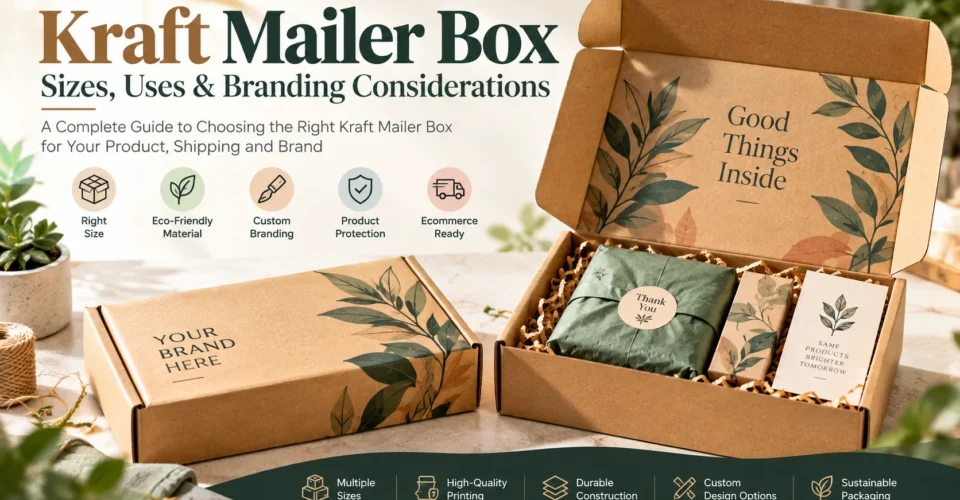
A kraft mailer box is a strong choice when you want one package to handle product protection, ecommerce fulfillment, and branded presentation without losing the natural character of kraft. The important decision is not simply whether the box looks brown or “eco.” It is whether the structure, internal dimensions, material, inserts, printing, and finish match the product and the way the package will be shipped.
The best way to choose one is product-first: measure the finished product or packed arrangement, define the usable internal space, account for inserts or protection, select the mailer structure, then decide how the kraft surface should be printed and finished. That approach avoids one of the most common packaging mistakes, choosing a box size or appearance first and trying to make the product fit afterward.
What Is a Kraft Mailer Box?
A kraft mailer box is a mailer-style package that uses a kraft paper or kraft-faced substrate as part of its material specification. “Kraft” describes the paper or fiber material or surface; “mailer” describes the package structure and opening system. Those are related decisions, but they are not the same thing.
For ecommerce, a mailer commonly uses scored panels, side flaps, a lid, and a tuck or locking closure so the package can be assembled and shipped as a finished presentation piece. Depending on the construction, the board may be paperboard or corrugated. The correct choice depends on product weight, dimensions, handling, shipping conditions, and the desired presentation.
A natural kraft appearance does not automatically tell you how protective the package is. A lightweight folding carton, a corrugated mailer, and a rigid box can all use kraft-colored or kraft-faced materials while performing very different jobs.
Why Choose a Kraft Mailer Box?
Kraft mailers are especially useful when a brand wants a natural, understated package that still feels deliberately designed. They can work well for apparel, accessories, cosmetics, subscription products, gifts, small home goods, and many other ecommerce orders when the structure is matched to the product.
| Goal | Why kraft can work | What to verify |
|---|---|---|
| Natural brand identity | The substrate can become part of the visual design. | Actual material, shade, texture, and print behavior. |
| Ecommerce presentation | A mailer can combine shipping and branded opening. | Closure, board specification, fit, and handling. |
| Minimalist graphics | Black, dark ink, line art, and restrained layouts can suit kraft. | Contrast, small text, and final proof. |
| Sustainability positioning | Paper-based kraft can support a sustainability strategy when the complete specification is appropriate. | Fiber content, coatings, inks, components, local recycling, and claim substantiation. |
| Flexible branding | Kraft can carry exterior graphics, interior messages, labels, and inserts. | Print method, color expectations, label placement, and dieline. |
Kraft is a material and design choice, not proof that a package is automatically environmentally preferable. Sustainability should be evaluated from the actual substrate and construction through printing, coatings, inserts, shipping, and disposal conditions.
Kraft Mailer Box Sizes and Dimensions
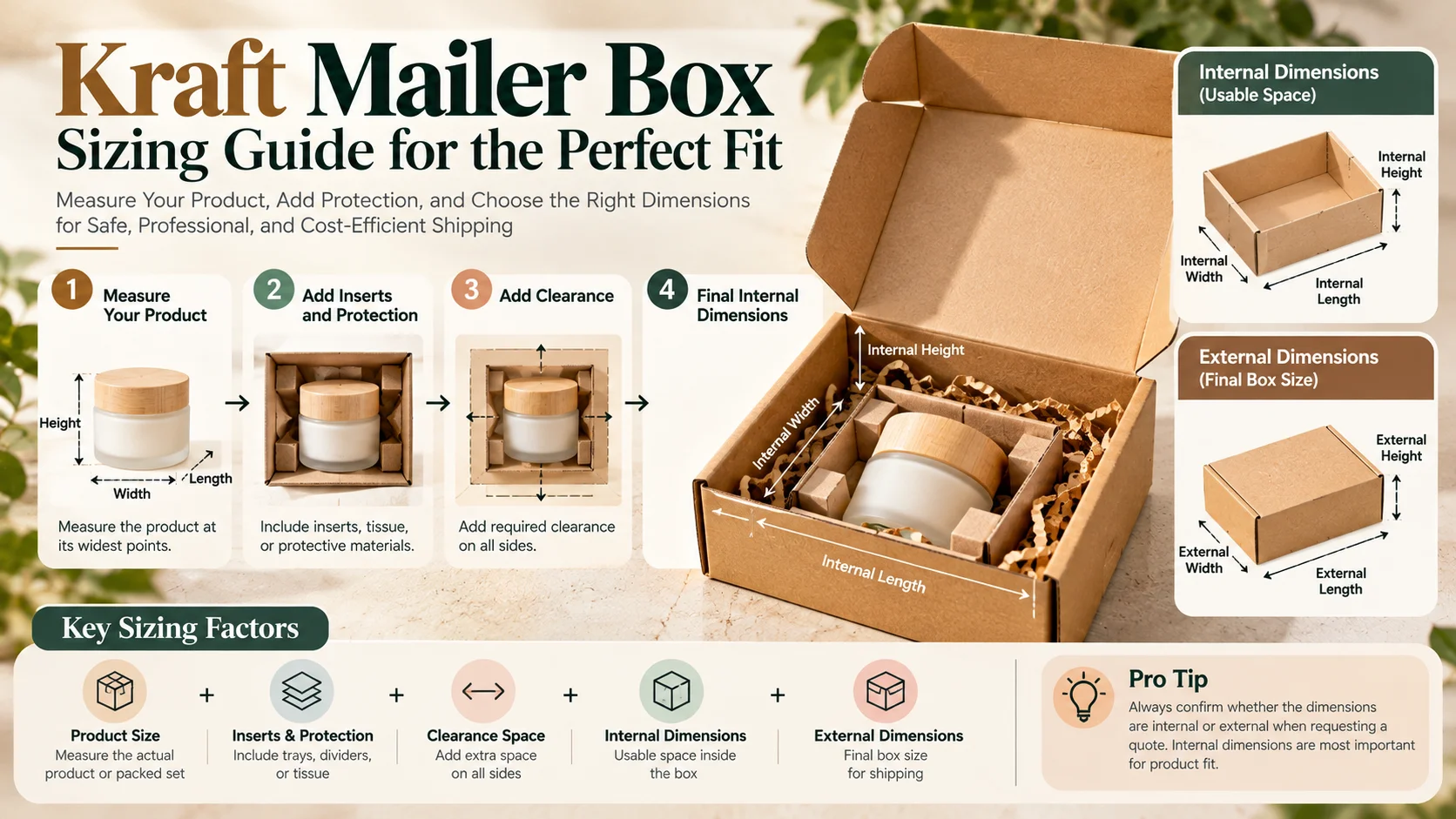
The right mailer box size is the smallest practical package that safely accommodates the finished product, required protection, inserts, and the way the package must open and close. There is no single “standard” kraft mailer dimension that fits every product.
For a custom project, treat internal dimensions as the starting point for product fit, then evaluate external dimensions separately for shipping, storage, carton packing, and fulfillment.
How to Measure the Product
Measure the product at its maximum usable length, width, and height, not just dimensions from a product listing.
If the product has a pouch, retail carton, sleeve, bottle cap, accessory, or other component that will ship inside the mailer, measure the packed configuration.
For multiple products, arrange them exactly as they should sit inside the package before measuring the overall footprint.
Record product weight and note fragile, sharp-edged, scratch-sensitive, moisture-sensitive, or pressure-sensitive areas.
Decide how the customer should see the product when the box opens. That layout can change the required internal dimensions.
For a more detailed product-first approach, use custom box sizing guidance before finalizing the mailer dimensions.
Internal vs. External Dimensions
Internal dimensions describe the usable cavity. External dimensions describe the finished package footprint. For a mailer, internal size is usually the more important number for product fit, while external size matters for carrier rating, storage, carton packing, and warehouse space.
Always state which convention you are using when requesting a quote. A size such as 10 × 8 × 3 inches is incomplete as a production specification if the supplier and buyer have not agreed whether those are internal or external dimensions.
Board thickness, folds, locking geometry, and manufacturing tolerances can affect the relationship between the two. Final production dimensions should be confirmed against the supplier’s dieline and sample rather than inferred from a stock-size listing.
How Inserts and Protection Change the Size
Do not size the outer mailer around the product alone when the package includes a tray, divider, protective wrap, tissue, molded component, paperboard insert, or other internal feature. Measure the product-and-insert system as a complete assembly.
- A divider consumes usable width or length.
- A tray creates defined product cavities and may add height.
- Protective material can require space on more than one side.
- Finger access or removal gaps can require extra room even when the product itself fits.
- The lid must clear the highest part of the packed assembly without pressing on it.
Preliminary internal dimension = product dimension + protection/insert space + required clearance
If clearance is specified per side, it is added twice on that axis. This is a planning calculation, not a final dieline specification, because structure, insert geometry, folds, and closure tolerances can change the finished requirement.
Choosing the Right Mailer Box Size
The correct mailer box size is not simply the closest catalog dimension. It is the dimension that works for the packed product, protection system, closure, fulfillment process, and shipping requirements together.
| Product/use case | Sizing priority | Practical direction |
|---|---|---|
| Flat apparel or soft goods | Shallow depth and clean folding. | Use a shallow mailer with enough room for tissue or a simple insert. |
| Small accessories | Compact footprint and organized presentation. | Avoid excessive empty height; use a fitted insert if items move. |
| Cosmetics or skincare sets | Multiple components and controlled positioning. | Measure the complete set with its tray/divider before fixing the box size. |
| Candles, jars, or glass | Clearance and protection. | Coordinate the mailer with an insert or cushioning system. |
| Subscription kits | Repeatable size and flexible SKU mix. | Size around common order configurations without making the box oversized. |
| Gift or PR packages | Presentation plus protection. | Allow deliberate presentation space; make extra volume an intentional choice. |
| Books or flat printed products | Low profile and corner protection. | Consider a bookfold/literature-style structure when appropriate. |
Kraft Mailer Box Construction and Closure
Structure determines how the mailer folds, closes, protects its edges, and behaves during fulfillment. Common ecommerce approaches include tuck-front mailers, roll-end tuck-front constructions, locking-tab designs, bookfold/literature mailers, and other custom die-cut structures.
If the product is heavy, fragile, or unusually shaped, a standard mailer may not be the best answer. A stronger corrugated construction, an insert, or a separate outer shipper may be more appropriate. For shipping-focused material guidance, explore corrugated packaging options.
| Construction consideration | What it affects | What to confirm |
|---|---|---|
| Board construction | Rigidity, crush resistance, print surface, and package weight. | Product weight, shipping environment, and protection needs. |
| Tuck/locking closure | Opening sequence and resistance to accidental opening. | How packers assemble it and whether extra sealing is needed. |
| Dust flaps / side walls | Edge coverage and internal presentation. | Whether product or insert interferes with folding. |
| Dieline geometry | Final cavity, fold positions, artwork areas, and closure fit. | Approved structural template before final artwork. |
| Flat-packed format | Storage and fulfillment efficiency. | Assembly time and packing workflow. |
For brands comparing mailer construction with other folding packaging formats, custom die-cut packaging can also be considered when the structure needs a tailored shape or presentation.
Kraft Mailer Boxes for Ecommerce
Ecommerce packaging has two jobs that can conflict if the box is designed in the wrong order: it must survive fulfillment and delivery, and it should present the product well when the customer opens it.
- Right-size the package before investing in decorative features.
- Design the opening sequence so the product is presented intentionally.
- Use inserts when they solve movement, separation, or presentation problems.
- Keep artwork clear of likely shipping-label areas.
- Consider how many packaging SKUs the warehouse can realistically store and manage.
- Test the packed box in the actual packing workflow before committing to a large production run.
Shipping cost can depend on both actual weight and package dimensions. Carriers can apply dimensional-weight methods to customer packaging, so a larger box can cost more to transport even when the product itself is light. Exact rating rules and divisors depend on the carrier, service, origin, destination, and account terms; use the applicable carrier’s current guide for a real shipment.
Kraft Mailer Box Branding and Printing
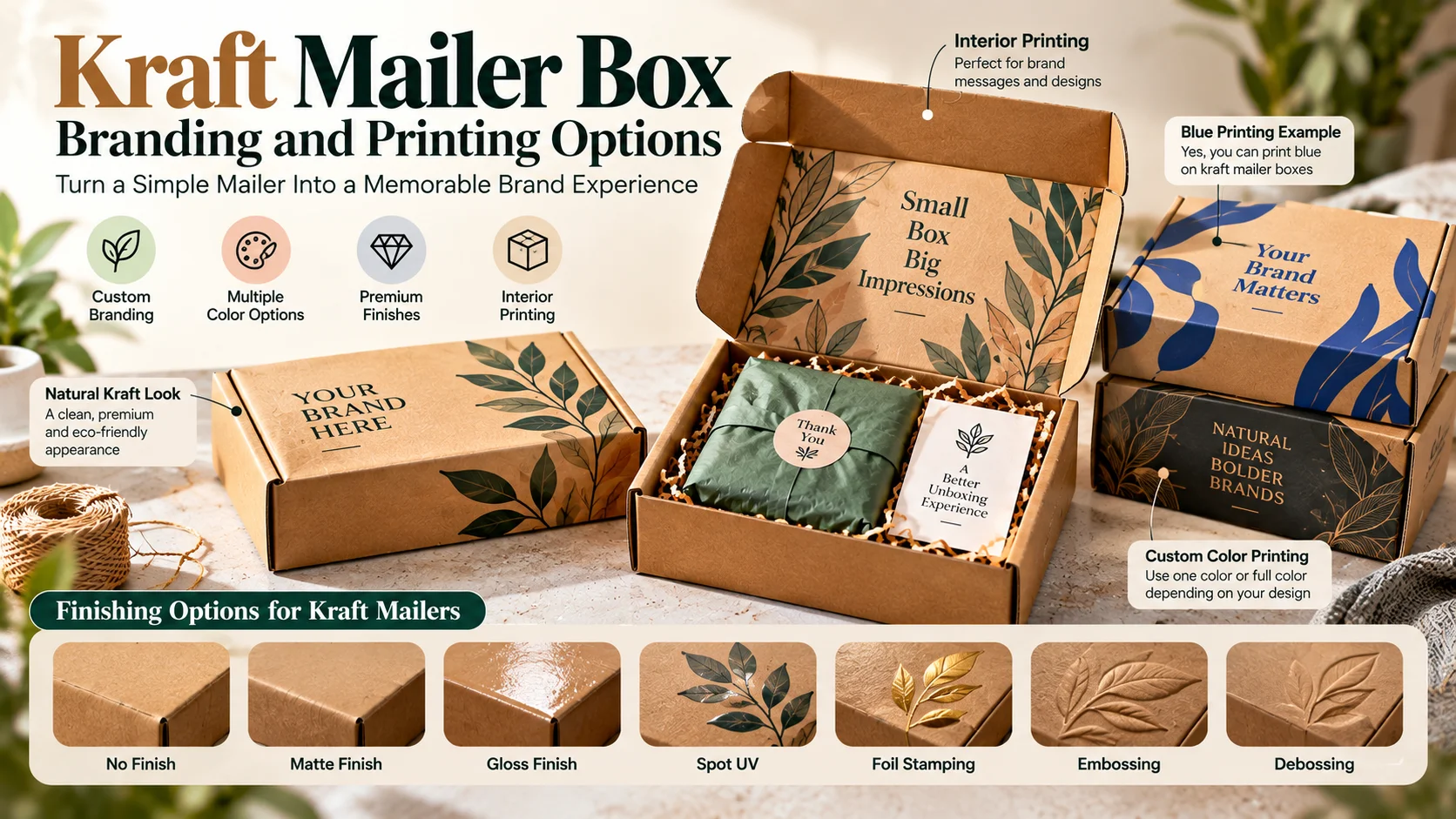
Kraft gives you a visible substrate color that becomes part of the artwork. That can be an advantage when the design is built around the material rather than treating it as a white canvas.
Uncoated kraft generally absorbs ink differently from a coated white surface. Colors can therefore appear more muted or warmer, and fine reversed text can be less forgiving. If exact brand color is important, request a material-specific proof rather than judging only from a screen or a coated color reference.
For broader artwork and pre-press planning, explore custom packaging design.
| Branding approach | Best suited to | Key consideration |
|---|---|---|
| Black or dark one-color graphics | Minimal, natural, artisan, or understated brands. | Use strong contrast and keep small type readable. |
| Limited-color printing | Brands that want a restrained palette. | Expect the kraft substrate to influence color appearance. |
| White underprint + color | Logos or colors that need stronger separation. | Confirm the print process and proof on the actual substrate. |
| Interior branding | Unboxing messages, patterns, care notes, or storytelling. | Coordinate interior with inserts and product presentation. |
| Label + plain kraft | Brands testing packaging before a fully printed run. | Plan label placement around the final package surface. |
Can a Kraft Mailer Box Be Blue?
Yes. A kraft mailer can carry blue printing, blue graphics, or a broader blue-and-kraft brand palette. The question is how the blue will behave against the natural substrate. Darker blue may integrate naturally with brown kraft, while a bright or highly saturated blue may need a different print treatment or a white underprint to reach the intended appearance.
If “blue mailer box” is part of the brand brief, specify whether you want the natural kraft substrate visible around the blue artwork or a more opaque, color-accurate appearance. Those are different design and print decisions.
Kraft Mailer Box Inserts
Inserts are not only for fragile products. They can organize a multi-item order, control movement, create a presentation layer, or keep accessories from shifting.
The most reliable sequence is product → insert → internal dimensions → outer structure. Reversing that order often creates either a tight package that does not close comfortably or a large package filled with unnecessary void material.
| Insert type | Useful for | Sizing implication |
|---|---|---|
| Paperboard divider | Multiple bottles, jars, or components. | Divider thickness changes usable cavity dimensions. |
| Die-cut tray | Sets that need repeatable positioning. | Cavity layout and finger access must be measured. |
| Corrugated insert | Shipping-oriented separation and protection. | Can add meaningful thickness to the interior. |
| Paper wrap / tissue | Soft goods and presentation. | Usually adds less structure but still affects fit. |
| Custom platform/holder | Premium presentation or a defined product reveal. | Outer box should be designed around the assembled system. |
Finishing Options for Kraft Mailers
- No finish: preserves the raw, natural character of the substrate.
- Matte or gloss coating: changes surface feel and visual contrast; the effect depends on the material and construction.
- Spot UV: creates selective gloss contrast on suitable printed surfaces.
- Foil: adds a metallic accent when the structure and production process support it.
- Embossing or debossing: adds tactile depth to selected artwork.
- Specialty effects: evaluate against folds, scuffing, recyclability goals, and the intended natural look.
For a brand built around natural kraft, excessive coating or decorative effects can work against the intended identity. For sustainability claims, verify the complete material and finish specification rather than relying on the kraft color alone.
For a broader material comparison, explore kraft packaging materials.
What Affects Kraft Mailer Box Cost?
There is no universal per-box price because custom packaging quotes depend on the complete specification.
- Finished dimensions and material usage
- Board or paper specification
- Structural complexity and die-cutting requirements
- Print coverage and printing process
- Interior versus exterior printing
- Finishing and special effects
- Inserts, dividers, sleeves, labels, or other components
- Order quantity and production economics
- Sampling, proofing, and tooling where applicable
- Packing and shipping requirements
The useful comparison is total packaging cost, not only unit price. A better-fitting package can reduce filler, packing time, product movement, or shipping volume. Conversely, unnecessary finishes or oversized dimensions can add cost without solving a real customer or operational problem.
Common Kraft Mailer Box Mistakes
| Mistake | What can go wrong | Better approach |
|---|---|---|
| Choosing by appearance first | The box looks right but does not fit the packed product. | Start with the product and internal dimensions. |
| Confusing internal and external size | The finished cavity is too small or shipping footprint is larger than expected. | State the dimension convention in every specification. |
| Forgetting inserts | Product or tray does not fit after the box is fixed. | Measure the complete product-and-insert assembly. |
| Assuming kraft means eco-friendly | The claim ignores coatings, mixed materials, sourcing, or disposal. | Evaluate and substantiate the complete specification. |
| Ignoring print behavior | Brand colors look different on the brown substrate. | Proof on the actual kraft material. |
| Finalizing art before the dieline | Graphics land on folds, tabs, or glue areas. | Approve the structural dieline first. |
| Using one size for everything | Some orders are oversized while others are cramped. | Plan sizes around common order profiles. |
| Skipping a sample | Fit, closure, color, or assembly issues appear after production. | Test a physical sample when the project warrants it. |
Kraft Mailer Box Selection Checklist
- ☐ Product dimensions measured at the final packed configuration
- ☐ Product weight recorded
- ☐ Internal vs. external dimension convention confirmed
- ☐ Required clearance identified
- ☐ Insert, tray, divider, tissue, or protective material included
- ☐ Mailer structure and closure selected
- ☐ Board/material matched to product and shipping environment
- ☐ Exterior artwork planned around labels and handling
- ☐ Interior printing considered only where it adds value
- ☐ Kraft substrate and print behavior reviewed
- ☐ Finish selected for a specific purpose
- ☐ Quantity aligned with expected usage and storage capacity
- ☐ Physical sample/proof requested when fit or print accuracy matters
- ☐ Final quote based on the approved specification
Kraft Mailer Boxes by Use Case
| Use case | What matters most | Potential approach |
|---|---|---|
| Apparel | Shallow depth, neat folding, presentation. | Kraft mailer with tissue or simple insert. |
| Beauty/skincare | Bottle stability, organization, branding. | Mailer with fitted divider or tray. |
| Candles | Glass protection, clearance, movement control. | Corrugated mailer with protective insert when appropriate. |
| Accessories | Compact fit and clean presentation. | Small mailer with controlled interior layout. |
| Subscription products | Repeatable size and flexible SKU mix. | Mailer sized around common monthly configurations. |
| Gifts | Presentation and opening experience. | Kraft mailer with intentional interior reveal and inserts. |
| Books/prints | Flat profile and edge protection. | Bookfold or literature-style mailer where appropriate. |
| Lightweight home goods | Fit, protection, and shipping efficiency. | Right-sized mailer with simple internal protection. |
When a project needs a broader product-box format rather than a specific mailer construction, custom cardboard packaging can provide another route to evaluate against the product and fulfillment requirements.
FAQs About Kraft Mailer Boxes
What is a kraft mailer box?
A kraft mailer box is a mailer-style package made with a kraft paper or kraft-faced material specification. The kraft component describes the material or surface; the mailer structure determines how the package folds, closes, and functions.
Are kraft mailer boxes good for shipping?
They can be, when the structure, board specification, dimensions, closure, and internal protection match the product and shipping conditions. Fragile or heavy products may need inserts, stronger corrugated construction, or a separate outer shipper.
What size kraft mailer box should I use?
Choose internal dimensions around the finished packed product, including inserts and protective materials, then confirm the structure and closure. There is no universal size that fits every product.
How do I measure a product for a mailer box?
Measure the maximum length, width, and height of the configuration that will actually go inside the package. For multiple products, arrange them as they will ship and measure the complete layout.
What are mailer box dimensions?
Mailer box dimensions normally describe length, width, and depth or height, but confirm whether a supplier means internal or external dimensions before ordering.
Can I print a kraft mailer box in full color?
Printing is possible, but the natural substrate affects color appearance. If exact or bright colors matter, discuss the print process and whether an opaque or white underprint or another substrate is appropriate, then review a proof.
Can a kraft mailer box be blue?
Yes. Blue can be printed on kraft, but the natural brown substrate will influence the result. Specify whether you want the kraft to remain visible or want a more opaque color treatment.
Do kraft mailer boxes need inserts?
Not always. Inserts are useful when the product needs positioning, separation, protection, or a more controlled presentation. The insert should be included in the dimensional plan.
Are kraft mailer boxes eco-friendly?
They can support a sustainability-focused packaging strategy, but kraft color alone does not prove environmental performance. Consider material content, coatings, inks, inserts, sourcing, shipping, and local recycling conditions.
How much do custom kraft mailer boxes cost?
Pricing varies with dimensions, material, structure, printing, finishing, inserts, quantity, tooling or sampling requirements, and shipping. A complete specification is needed for a meaningful quote.
Should I get a sample before ordering?
For tight-fit, fragile, premium, or highly customized packaging, a physical sample or proof is a useful way to verify fit, closure, artwork, color, and opening before a larger production run.
Final Kraft Mailer Box Decision Guide
Use this sequence when turning a product into a production-ready kraft mailer specification:
- PRODUCT — define exactly what will ship and how it will be arranged.
- INTERNAL DIMENSIONS — measure the usable cavity needed for the packed configuration.
- INSERTS — add trays, dividers, protection, tissue, or other internal components.
- STRUCTURE — select the mailer style and closure that suit the product and fulfillment workflow.
- MATERIAL — choose the kraft, paperboard, or corrugated specification based on performance and presentation.
- BRANDING — decide what should appear outside, inside, or through supporting inserts.
- FINISHING — add only finishes that serve a clear visual, tactile, or functional purpose.
- SHIPPING — review final external dimensions, weight, carrier requirements, and dimensional-weight exposure.
- SAMPLE — verify the physical package when fit, print, structure, or presentation is important.
- PRODUCTION — approve the final specification, artwork, quantity, and delivery requirements before production.
For a broader packaging project, custom packaging options can be evaluated across structures and materials.
If the project is specifically centered on individual product presentation, made-to-fit product packaging is another relevant route to consider.