Retail packaging design has to do more than make a product look attractive. In a store, the package competes for attention, communicates what the product is, establishes brand recognition, presents key information, and helps protect the product at the same time. The strongest retail packaging connects those jobs instead of treating graphics, structure, and materials as separate decisions.
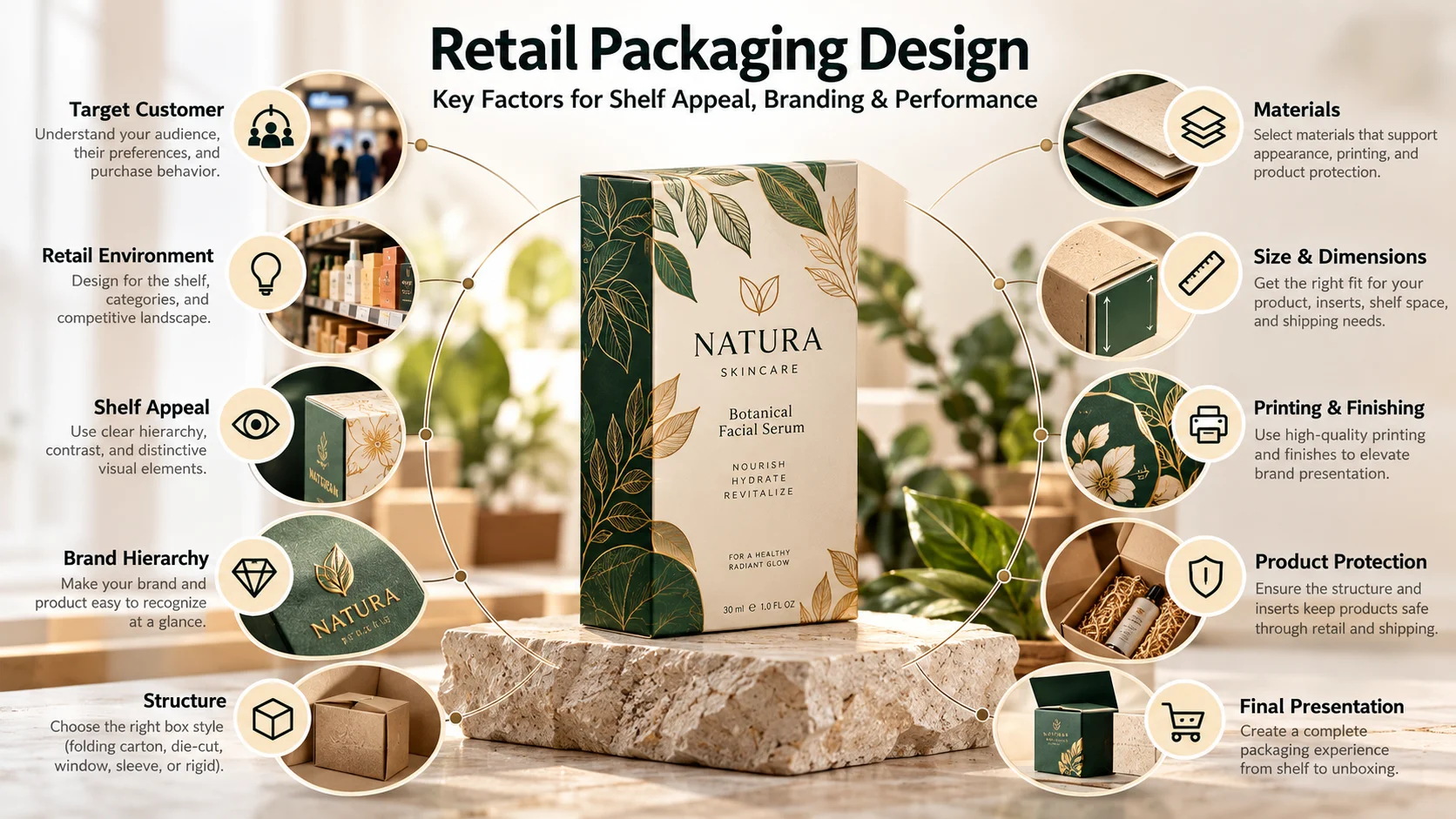
A practical approach is to work from the product outward: define the customer and retail environment, establish the visual hierarchy, choose the structure and material, determine the right size, then develop printing, finishing, protection, and testing around the finished package. That sequence helps a brand create packaging that looks intentional on the shelf and still works through handling, storage, shipping, and the customer experience.
What Is Retail Packaging Design?
Retail packaging design is the planning of a product’s package as a combined visual, structural, and functional system for sale or presentation in a retail environment. It includes the box or package structure, dimensions, material, graphics, typography, product information, finishes, openings, inserts, and the way the finished package is displayed and handled.
Unlike shipping packaging, which is primarily concerned with transport protection, retail packaging also has a communication job. The front panel may need to identify the product immediately, distinguish a SKU from neighboring products, communicate important benefits, and make the brand recognizable before a shopper reads every detail.
Why Retail Packaging Design Matters
Retail packaging is often the physical interface between a brand and a shopper before purchase. A strong package makes the product easier to understand and easier to recognize while supporting the practical requirements of storage, handling, opening, and protection.
- Creates a recognizable visual identity across a product range.
- Helps shoppers understand the product and its key proposition.
- Creates differentiation when similar products share the same retail environment.
- Supports product protection during storage and handling.
- Creates a more deliberate opening and unboxing experience.
- Can coordinate physical retail presentation with ecommerce imagery and brand identity.
The goal is not maximum decoration. It is clarity, distinction, and functional performance working together.
What Makes Retail Packaging Stand Out on the Shelf?
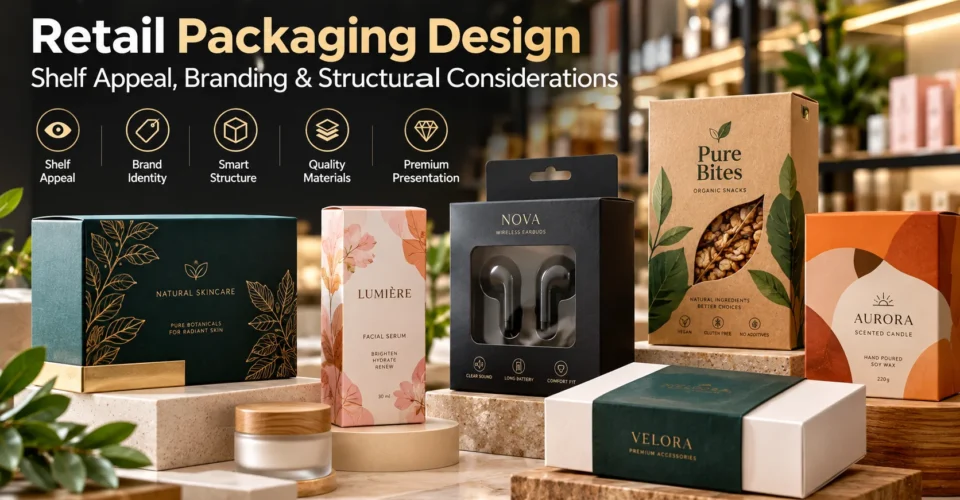
Shelf appeal comes from the combined effect of hierarchy, contrast, product visibility, shape, and consistency. A package does not need the loudest colors or the most effects to stand out. It needs a clear reason for the eye to notice it and a logical path for the shopper to understand it.
Visual Hierarchy
The most important information should have the strongest visual priority. Brand, product name, product type, key differentiator, and supporting information should not all compete at the same level. A shopper should be able to identify the product category and brand without decoding a crowded front panel.
Color and Contrast
Color can separate a product from nearby packages and help shoppers recognize a brand family. Contrast also affects legibility. Final decisions should be evaluated on the actual packaging substrate because printed color and contrast can differ from what appears on a screen.
Product Visibility
When seeing the actual product helps a shopper judge quality, color, shape, or quantity, a window or other display feature can be useful. If the product does not need to be physically visible, strong product photography or illustration may communicate the offer more consistently while protecting the package interior.
Shape and Structure
Structure can become part of the visual identity. A distinctive die-cut profile, controlled opening, sleeve, window, or rigid construction can help a product feel different from a generic carton. The structural feature should still support production, packing, storage, and product protection.
Retail Packaging Branding
Branding should be designed across the complete package rather than treating the front panel as the only important surface. The front may need immediate product identification, while side and back panels can carry supporting information, usage details, product specifications, brand story, or required content.
A consistent system is particularly important when several SKUs share a shelf. Keep core brand elements recognizable while using controlled differences in color, imagery, typography, or secondary graphics to distinguish variants. For a broader packaging-artwork and brand-development resource, explore custom packaging design.
Choosing the Right Retail Packaging Structure
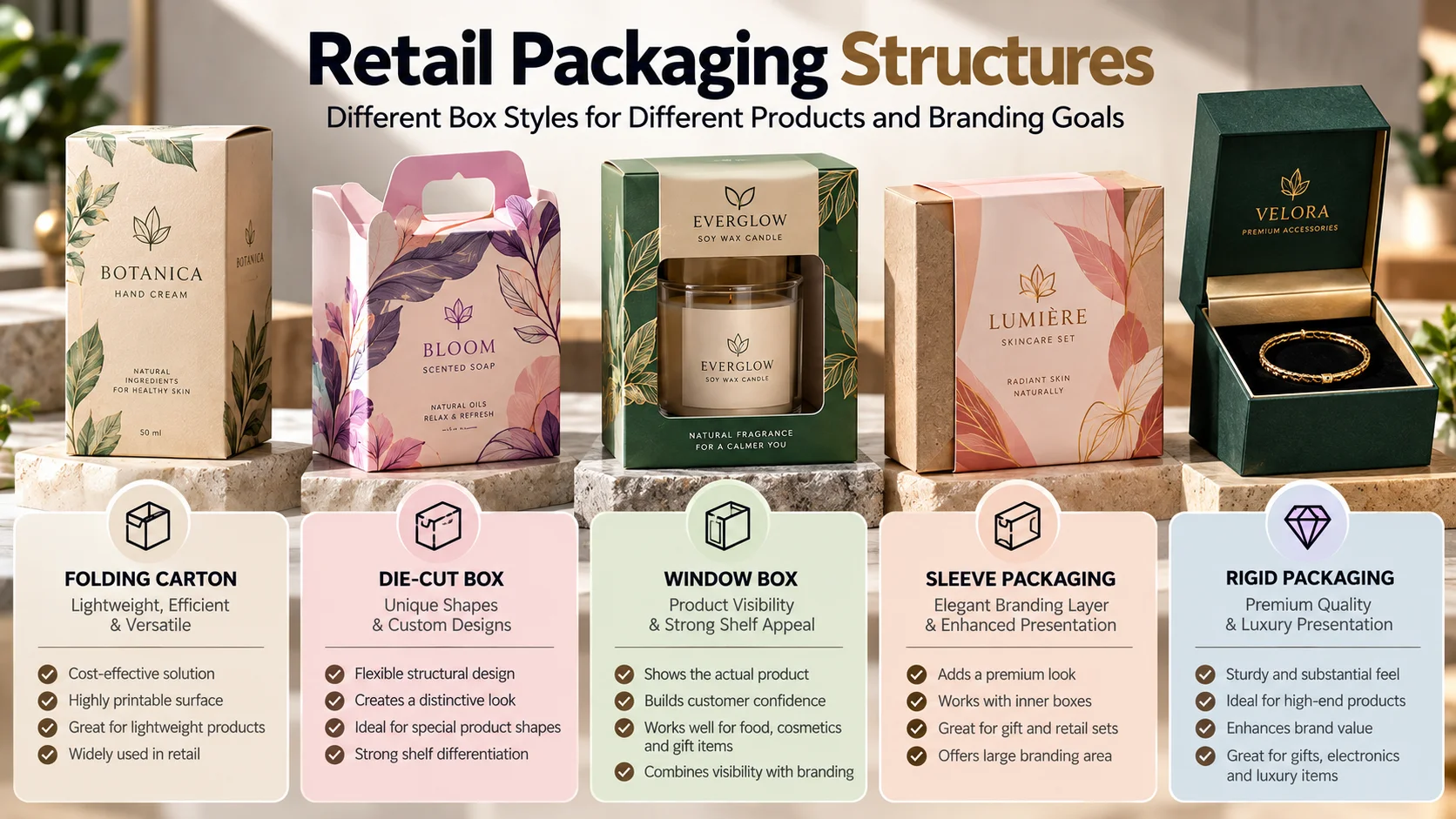
The best retail box style depends on the product, how it is displayed, how it is opened, the protection required, and how the package must be produced and handled. There is no universally best structure.
| Structure | Best For | Main Strength | Main Consideration |
|---|---|---|---|
| Folding carton | Lightweight retail products | Efficient, printable retail presentation | Less substantial than rigid packaging |
| Die-cut box | Distinctive shapes or custom openings | Flexible geometry and presentation | Structural planning is important |
| Window box | Products where visibility helps the purchase decision | Shows the actual product | Window placement affects structure and artwork |
| Sleeve | Secondary branding or presentation layer | Adds visual impact around an inner package | Requires a compatible inner structure |
| Rigid box | Premium and high-end products | Substantial feel and elevated presentation | More material-intensive and substantial |
Retail Packaging Materials
Material selection affects more than appearance. It influences rigidity, print surface, product protection, package weight, finishing possibilities, and the way the package behaves during handling. Paperboard is commonly suited to printed retail packaging, kraft can provide a natural visual character, corrugated is commonly selected where added shipping protection is important, and rigid board can provide a more substantial premium presentation.
For a deeper material comparison, select the material based on the complete packaging system rather than appearance alone. BoxNovo’s kraft packaging materials can be useful when a natural material direction fits the brand, while premium rigid packaging is relevant when structure and presentation call for a more substantial format.
Retail Packaging Size and Dimensions
Start with the product, not a stock box. Measure the product at its maximum relevant points, define how it will sit inside the package, account for inserts or protective components, and determine the internal dimensions needed. Then review the external dimensions when shelf footprint, storage, shipping, or outer-carton packing matters.
Always distinguish internal dimensions from external dimensions in a packaging specification. Board thickness, folds, closures, inserts, and structural geometry affect the relationship between the usable cavity and the finished outside dimensions.
For product-first sizing guidance, see BoxNovo’s box sizing guidance.
If an insert, tray, divider, or protective component is part of the finished package, include it before the final internal size is approved. A package that fits the product but not the complete packed configuration is not correctly sized.
Product Protection and Structural Considerations
Retail packaging still has to survive the real handling environment. A package may be stored, stacked, moved through a warehouse, placed on a shelf, handled by shoppers, and then carried home or shipped to a customer. The correct protection level depends on the product, structure, material, and distribution conditions.
- Identify fragile, scratch-sensitive, liquid, sharp-edged, or pressure-sensitive components.
- Consider inserts or dividers when movement inside the package could damage the product.
- Check whether the closure remains secure during normal handling.
- Review stacking and shelf stability when the package will be displayed vertically or in rows.
- Consider shipping requirements if the same retail package will also be used for direct-to-consumer orders.
Protection is a system property. A thicker board does not automatically solve every packaging problem; fit, structure, inserts, closure, and handling conditions matter together.
High-End Retail Packaging Design
High-end retail packaging is usually created through control rather than decoration overload. Material feel, proportion, typography, color restraint, structural precision, interior presentation, and selective finishing can create a premium impression without using every available effect.
- Use a clear and disciplined visual hierarchy.
- Choose materials that support the intended brand position.
- Use foil, embossing, debossing, spot UV, soft-touch, or other effects selectively.
- Coordinate the exterior and interior so the unboxing experience feels intentional.
- Keep premium details aligned with the product rather than adding effects simply because they are available.
Retail Packaging Printing and Finishing
Printing should be planned around the actual material and structural layout. Final artwork should be placed on the approved dieline, with important graphics kept away from cut, fold, and glue areas according to the packaging supplier’s specifications.
| Print / Finish | Potential Use | Important Check |
|---|---|---|
| Full-color printing | Photography, illustrations, strong brand systems | Color behavior on the selected substrate |
| PMS / spot colors | Brand colors requiring controlled reproduction | Printer capability and approved proof |
| Matte finish | Understated, modern, low-glare appearance | Surface feel and scuff behavior |
| Gloss finish | High visual contrast and color impact | Reflection and intended viewing conditions |
| Spot UV | Highlighting selected logos or graphics | Registration and contrast |
| Foil stamping | Metallic accents and premium details | Artwork detail, foil color, and substrate suitability |
| Emboss / deboss | Tactile branding | Line detail and structural placement |
A digital mockup is useful for design approval, but a physical proof or sample is more informative when material color, finish, fit, or structural performance is critical.
Retail Packaging for Ecommerce and Store Shelves
Brands selling through both stores and ecommerce need packaging that performs in two environments. Retail shelves reward clear product communication, stable display, recognizable branding, and visual differentiation. Ecommerce adds shipping, handling, dimensional efficiency, and unboxing considerations.
| Environment | Primary Packaging Priorities |
|---|---|
| Physical retail | Shelf visibility, product clarity, brand recognition, stable display, information hierarchy |
| Ecommerce | Protection, dimensional efficiency, handling, opening experience, product presentation |
| Omnichannel | A structure and design system that works across both environments |
This does not mean every retail package must become a shipping carton. It means the distribution path should be understood before the structure is finalized.
Common Retail Packaging Design Mistakes
| Mistake | Problem | Better Approach |
|---|---|---|
| Designing only for appearance | The package looks good but performs poorly | Balance visual, structural, and protection requirements |
| Too much information | The front panel becomes difficult to scan | Build a clear hierarchy |
| Weak contrast | Important information disappears on the shelf | Test contrast on the actual substrate |
| Wrong size | Excessive void or a tight fit | Start with the packed product dimensions |
| Ignoring structure | Artwork and functionality conflict | Approve structure and dieline before final artwork |
| Too many finishes | Cost and visual noise increase | Use finishing where it supports the concept |
| Hiding the product | The shopper cannot easily understand what they are buying | Consider windows or strong product imagery |
| Ignoring ecommerce | Retail packaging may fail during direct shipping | Review the full distribution path |
| Skipping a physical sample | Fit, color, closure, or finish surprises appear in production | Sample and test before larger production when appropriate |
Retail Packaging Design Checklist
- Product dimensions and weight confirmed.
- Target customer and retail environment defined.
- Front-panel hierarchy established.
- Brand identity and SKU differentiation planned.
- Product visibility decision made.
- Structure selected around product and handling needs.
- Material selected around protection, presentation, and printing.
- Internal and external dimensions clearly distinguished.
- Inserts or protective components included in the sizing plan.
- Artwork placed on the approved structural dieline.
- Print and finishing requirements confirmed.
- Shipping/ecommerce use considered where applicable.
- Physical sample or proof reviewed when necessary.
- Final artwork and production specification approved.
Retail Packaging by Product Type
| Product Type | Typical Design Priority | Potential Direction |
|---|---|---|
| Beauty and cosmetics | Shelf differentiation, premium appearance, product information | Folding carton, window structure, sleeve, or rigid packaging depending on product |
| Food and specialty products | Product visibility, information, brand recognition | Printed folding carton or window format where appropriate |
| Apparel and accessories | Brand presentation and efficient storage | Folding box, mailer-style format, sleeve, or premium rigid presentation |
| Jewelry and luxury goods | Premium feel and organized interior | Rigid box with fitted insert |
| Electronics and small devices | Protection, organization, clear product identification | Structured carton with inserts or stronger construction where required |
| Gifts and premium sets | Unboxing and presentation | Rigid, sleeve, or structured multi-component packaging |
| Subscription products | Brand consistency and efficient fulfillment | Mailer-style or folding structure with controlled interior layout |
For a product-focused commercial route, explore made-to-fit product boxes.
For custom structural geometry, explore distinctive die-cut boxes.
For packaging where product visibility is central, explore windowed retail boxes.
For an added branded outer layer, explore branded box sleeves.
Frequently Asked Questions About Retail Packaging Design
What is retail packaging design?
Retail packaging design is the planning of a product package’s structure, dimensions, materials, graphics, information, finishes, and presentation for retail use. It combines visual communication with practical packaging performance.
What makes retail packaging stand out on a shelf?
Clear visual hierarchy, strong contrast, recognizable branding, useful product visibility, distinctive structure, and consistent SKU design can all contribute to shelf appeal. The package does not need to be the loudest; it needs to be easy to notice and understand.
What is the best box style for retail products?
There is no universal best style. Folding cartons suit many lightweight retail products, die-cut structures can support distinctive shapes, window boxes can improve product visibility, sleeves can add a branded presentation layer, and rigid boxes are often used when premium structure is important.
Are window boxes good for retail packaging?
They can be effective when seeing the actual product helps the shopper evaluate it. The window should be considered together with product visibility, structure, artwork area, protection, and the material specification.
How important is packaging structure?
Structure is fundamental because it determines how the package holds the product, opens, closes, displays, and behaves during handling. A visually strong package can still fail if the structure is poorly matched to the product.
What materials are used for retail packaging?
Common directions include paperboard or cardboard, kraft-based materials, corrugated board where protection is important, and rigid board for more substantial premium packaging. The correct choice depends on the product, structure, printing, protection, and presentation requirements.
How can packaging make a product look premium?
Premium presentation usually comes from disciplined design, material quality, proportion, typography, structural precision, tactile details, and selective finishing. Adding more effects is not automatically better.
Should retail packaging be designed differently for ecommerce?
It may need to account for shipping and handling in addition to shelf presentation. If the same package is used in both channels, protection, dimensional efficiency, closure, and unboxing should be considered alongside retail visibility.
How do I choose the right packaging size?
Measure the packed product at its maximum relevant points, determine how it will sit inside the package, account for inserts or protection, and establish the required internal dimensions. Then review the finished external dimensions for shelf, storage, and shipping needs.
How important are printing and finishing?
They can strongly influence brand recognition and perceived quality, but they should support the design rather than replace it. Printing and finishing also need to be compatible with the selected substrate and structural layout.
What should I test before producing retail packaging?
Review fit, closure, product protection, artwork placement, color, finish, shelf presentation, and the intended handling environment. A physical sample or proof is especially useful when the package is tightly fitted, structurally complex, premium, or used across multiple channels.
Final Retail Packaging Design Decision Guide
A strong retail packaging project can be evaluated in this order:
- PRODUCT — define the product, packed configuration, weight, and sensitivities.
- CUSTOMER — identify what the shopper needs to understand quickly.
- RETAIL ENVIRONMENT — consider shelf position, neighboring products, display orientation, and handling.
- SHELF APPEAL — establish hierarchy, color, contrast, product visibility, and visual differentiation.
- BRAND HIERARCHY — decide what the shopper should recognize first, second, and third.
- STRUCTURE — select the box format, closure, opening, and display features.
- MATERIAL — choose the substrate and board construction around product, presentation, and protection.
- SIZE — set internal dimensions around the complete packed configuration, then check external dimensions.
- PRINTING — prepare artwork around the approved dieline and actual substrate.
- FINISHING — add only effects that improve the intended visual or tactile result.
- PROTECTION — confirm inserts, movement control, closure, stacking, and distribution requirements.
- SAMPLE — review a physical sample or proof when fit, color, structure, or finish is important.
- PRODUCTION — approve the final specification, artwork, quantity, and production requirements.
The best retail packaging is not simply attractive. It is a coordinated system in which the product, customer, shelf environment, brand, structure, material, graphics, protection, and production requirements support one another.