Quick answer: Rolls of stickers are labels printed and cut on one continuous backing, wound around a cardboard core. They make sense when you apply hundreds or thousands of the same sticker, use a dispenser, label printer or applicator, or need a fast, tidy way to label products. For a few dozen stickers or mixed designs, sheets are usually better.
Key facts at a glance
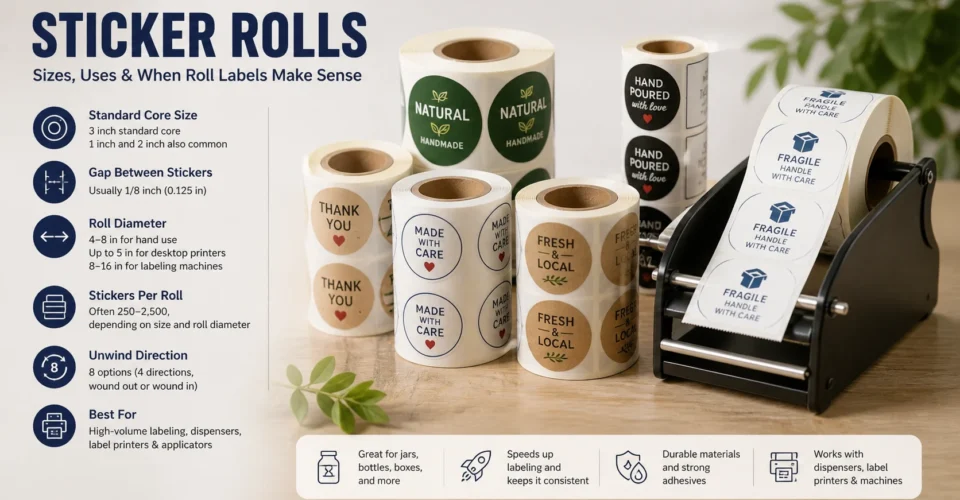
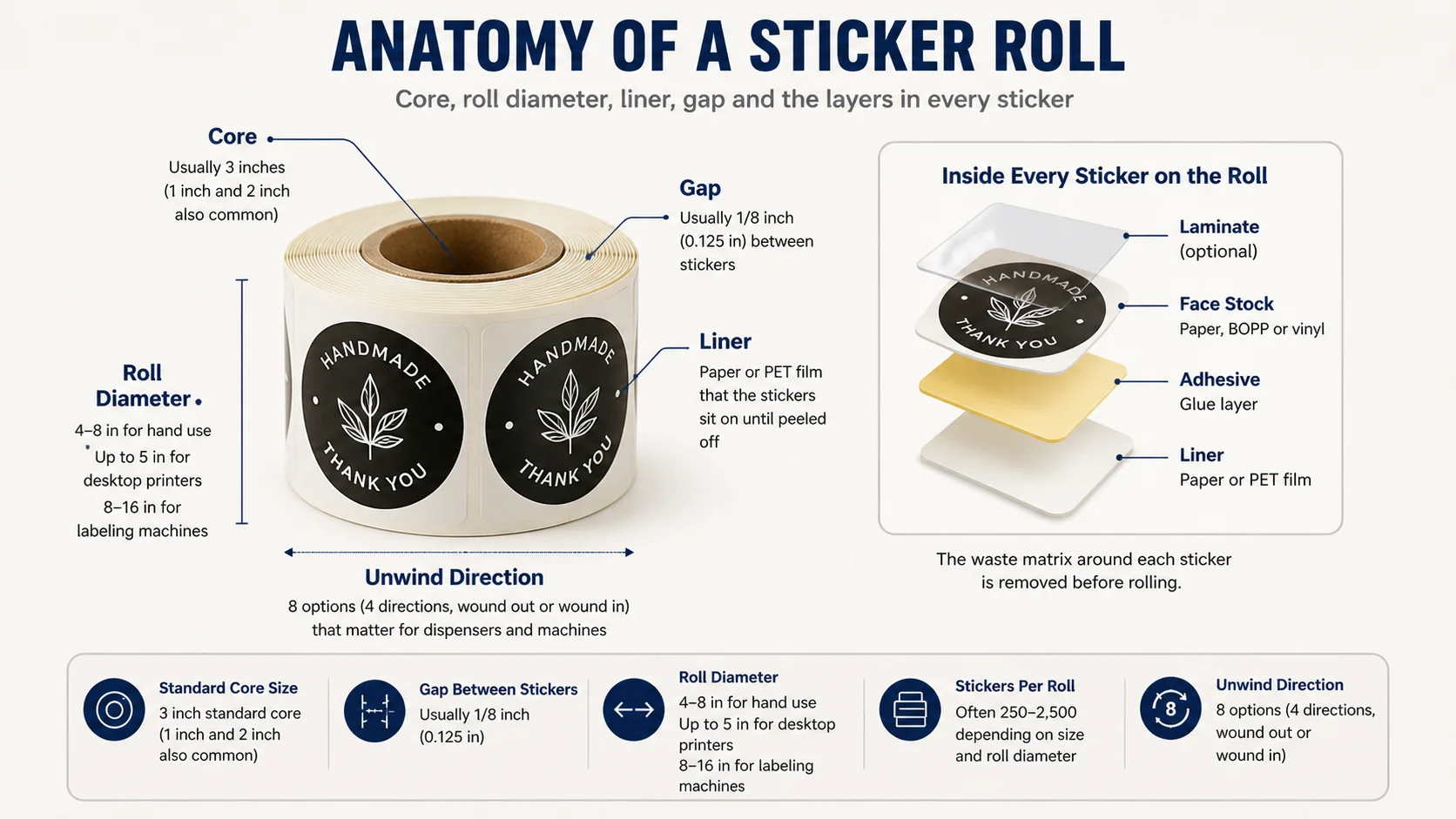
- Standard core: 3 inches; 1-inch and 2-inch cores are common on desktop label printers
- Gap between labels: usually 1/8 inch (0.125 in)
- Roll diameter: about 4 to 8 inches for hand use, up to 5 inches for many desktop printers, and 8 to 16 inches for labeling machines
- Stickers per roll: often 250 to 2,500 for hand use, depending on sticker size and roll diameter
- Unwind direction: 8 options (4 directions, wound out or wound in) that matter for dispensers and machines
- Minimum orders: commonly 50 to 250 stickers per design, depending on the printer
Specifications in this guide are checked against label printer, label material and equipment maker documentation, listed in the Sources section.
In this guide
- What rolls of stickers are
- Sticker rolls vs. sheets
- Sticker roll sizes, cores and diameters
- How many stickers are on a roll
- Unwind direction
- Materials and finishes
- Personalized sticker rolls
- Rolls stickers for jars
- Common uses
- How to order custom stickers rolls
- Applying stickers from a roll
- Storage and liner recycling
- Common mistakes
- Frequently asked questions
- Sources
What Are Rolls of Stickers?
Rolls of stickers, also called roll labels or stickers on rolls, are self-adhesive stickers printed side by side on one long strip of backing paper or film, then wound onto a core. Each sticker is kiss-cut: the cutting die slices through the sticker but not the backing, so the stickers stay on the strip until you peel them off.
After cutting, the printer strips away the leftover material around the stickers, called the waste matrix. What remains is a clean line of stickers on the liner that peels easily by hand or feeds through a dispenser (FINAT).
| Part of the Roll | What It Is |
|---|---|
| Face stock | The printed sticker material, such as paper, BOPP film or vinyl |
| Adhesive | The glue layer, usually permanent, sometimes removable or freezer-grade |
| Liner (backing) | The coated paper or PET film the stickers sit on until they are peeled off |
| Core | The cardboard tube in the center, usually 3 inches across |
| Gap | The space between stickers, usually 1/8 inch |
| Outside diameter (OD) | The width of the finished roll, which sets how many stickers fit on it |
Rolls come in two styles. Die-cut rolls have stickers already cut to a set size and shape. Continuous rolls are one unbroken strip, used in label printers that cut each label to length (Brady). Printed custom sticker rolls are almost always die-cut.
Sticker Rolls vs. Sheets: When Do Rolls of Stickers Make Sense?
Choose rolls of stickers when speed and volume matter. Choose sheets when you need a small quantity, many different designs or stickers to hand out as a set.
| Factor | Sticker Rolls | Sticker Sheets |
|---|---|---|
| Best quantity | Hundreds to many thousands of one design | A few to a few hundred |
| Designs per order | One size and design per roll | Several designs and sizes on one sheet |
| Application | By hand, dispenser, label printer or applicator | By hand only |
| Speed | Fast: the next sticker is always in the same place | Slower: each sticker is picked from the sheet |
| Printing at home or in the office | Only with a roll label printer | Works with ordinary inkjet and laser printers |
| Storage | Compact and easy to dispense | Flat, easy to file or mail |
| Cost per sticker | Usually lower at larger quantities | Usually lower for small runs |
Rolls Make Sense When You:
- Label products in volume, such as jars, bottles, boxes or bags.
- Seal ecommerce orders and add a thank-you sticker to every package.
- Use a dispenser, label printer or applicator, all of which need rolls.
- Hand out one design at events, where a roll is quicker than peeling from sheets.
- Print shipping, barcode or price labels on a thermal printer.
Sheets Are Better When You:
- Need only a few dozen stickers or are testing a design.
- Want several designs or sizes in one order, such as a sticker pack.
- Print labels yourself on a regular office printer.
- Sell or mail stickers to customers as a set.
For packaging-focused ideas beyond rolls, see this guide to custom packaging stickers and these seal and sticker ideas.
Sticker Roll Sizes: Labels, Cores and Roll Diameters
Sticker roll size means three things: the size of each sticker, the size of the core and the outside diameter of the finished roll. Most printers offer stickers from about 0.5 × 0.5 inches up to about 6 × 12 inches on rolls (PrintRunner). Common sticker sizes include:
| Sticker Size | Typical Uses |
|---|---|
| 1 in circle | Price dots, flavor dots, small seals |
| 1.5 to 2 in circle | Package seals, logo and thank-you stickers, jar lids |
| 2 × 2 in square | Logo stickers, box seals, sample labels |
| 2 × 3 in rectangle | Small bottles and jars, candle bases, product labels |
| 3 × 3 in square | Jar fronts, bags, gift packaging |
| 4 × 3 in rectangle | Wrap labels for small bottles and jars |
| 4 × 6 in rectangle | Shipping labels and large product labels |
Core Sizes
| Core Size | Where It Is Used |
|---|---|
| 3 in | The standard for custom printed rolls, dispensers and labeling machines |
| 2 in | Some desktop color label printers, such as the Primera LX500 |
| 1 in and 0.5 in | Many desktop thermal printers, such as the Zebra ZD421 (which also takes 1.5, 2 and 3 in cores with an adapter) |
Roll Outside Diameter
- Hand use: rolls of about 4 to 8 inches are typical and easy to handle.
- Desktop printers: often a maximum of 5 inches, as on the Zebra ZD421 and Primera LX500.
- Labeling machines: 8 to 16 inches; choose the largest your machine accepts so you reload less often (Maverick Label).
If you are unsure which sticker size fits your product, the BoxNovo label size recommender is a quick place to start.
How Many Stickers Are on a Roll?
The number of stickers on a roll depends on the roll diameter, the core, the material thickness and the sticker length along the roll. For hand use, rolls of 250 to 2,500 stickers are typical. You can estimate any roll with this formula:
Stickers per roll ≈ 0.785 × (OD² − core²) ÷ (thickness × (sticker length + gap))
The 0.785 is π ÷ 4, which turns the ring of material on the roll into an area.
- OD: outside diameter of the roll, in inches.
- Core: core diameter, in inches.
- Thickness: sticker plus liner, in inches. Ask your printer for the figure; Sticker Mule, for example, lists its labels at about 6.4 mil (0.0064 in) including the liner (Sticker Mule).
- Sticker length: the sticker’s size in the direction the roll unwinds, plus the gap (usually 0.125 in).
Example: a 6-inch roll on a 3-inch core, 6.4 mil thick, with 2-inch stickers: 0.785 × (36 − 9) ÷ (0.0064 × 2.125) ≈ 1,550 stickers.
| Sticker Length Along the Roll | 6 in Roll, 3 in Core | 8 in Roll, 3 in Core |
|---|---|---|
| 1 in | About 2,900 | About 6,000 |
| 2 in | About 1,550 | About 3,150 |
| 3 in | About 1,050 | About 2,150 |
| 4 in | About 800 | About 1,600 |
These are estimates for one sticker across, a 1/8-inch gap and 6.4 mil material. Thicker material, a larger gap or a thick-walled core means fewer stickers. Most printers will also wind a set number per roll, such as 250, 500 or 1,000, if you ask.
Unwind Direction: Why It Matters
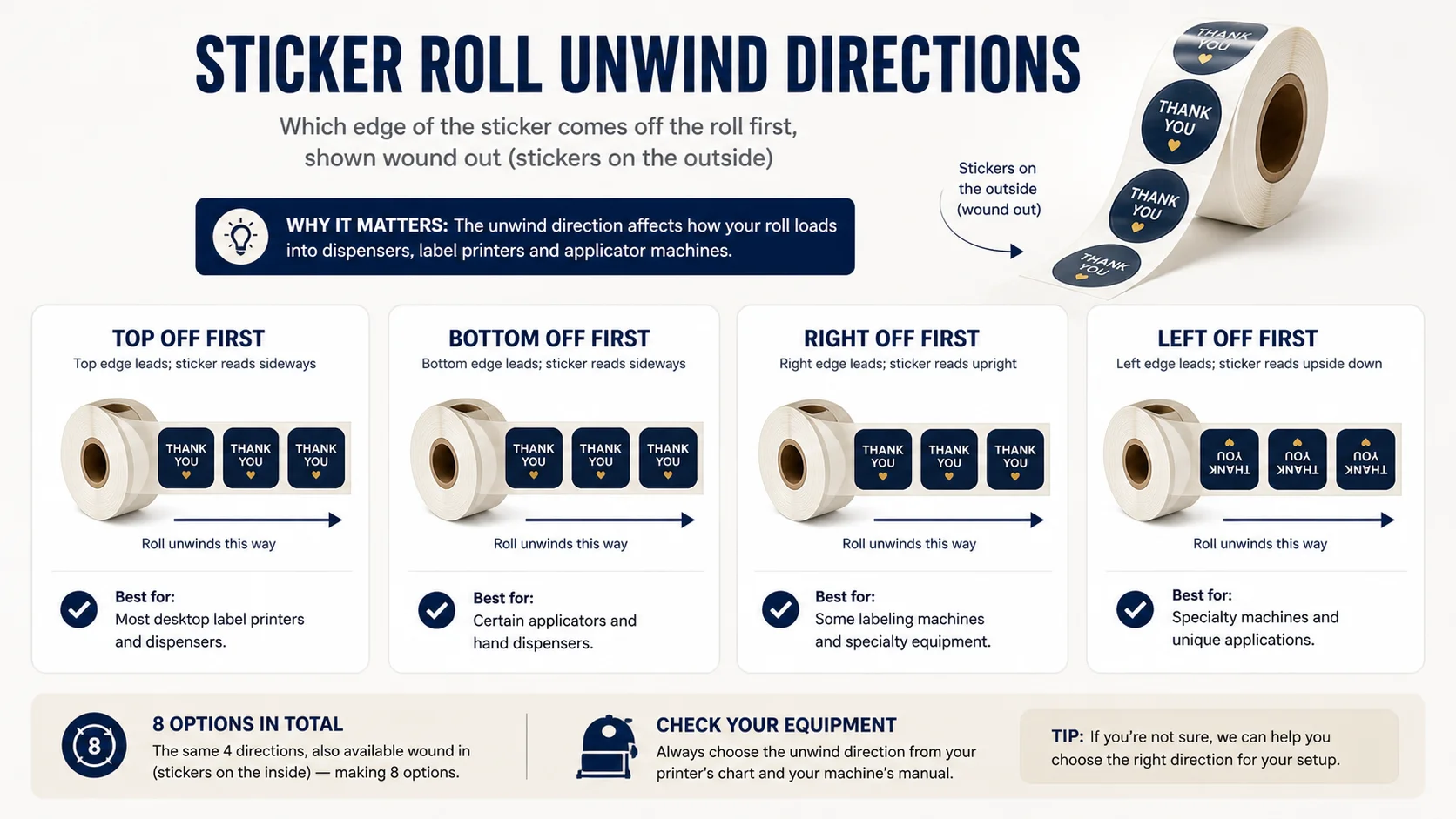
Unwind direction describes which edge of the sticker comes off the roll first. It does not matter when you peel stickers by hand, but it matters a lot for dispensers, label printers and applicators, which only apply stickers the right way up if the roll is wound correctly.
There are 8 options: 4 directions, each either wound out (stickers on the outside of the roll, the most common) or wound in (stickers on the inside):
| Direction | What Comes Off First | How the Sticker Reads as It Unwinds |
|---|---|---|
| Top off first | The top edge of the sticker | Turned on its side, top leading |
| Bottom off first | The bottom edge | Turned on its side, bottom leading |
| Right off first | The right edge | Upright, reading left to right |
| Left off first | The left edge | Upside down |
Many printers number the wound-out options 1 to 4 (top, bottom, right, left off first) and offer the same four wound in as extra options (SheetLabels). Numbering is not the same at every printer, so always choose from your printer’s own chart, and check your machine’s manual for the direction it needs.
Materials and Finishes for Stickers on Rolls
| Material | Water Resistance | Best For |
|---|---|---|
| White paper (gloss, matte or uncoated) | Low | Dry goods, box seals, mailers, price and date labels |
| Kraft paper | Low | Natural, rustic and handmade brands |
| White BOPP film | High | Food, drinks, cosmetics and anything refrigerated or handled when wet |
| Clear BOPP film | High | A “no-label” look on glass and clear plastic |
| Silver or holographic film | High | Premium products, seals and promotional stickers |
| Vinyl | High, plus outdoor durability | Stickers for bottles, laptops, coolers and outdoor gear |
- Finishes: gloss lamination makes colors bright; matte or soft-touch looks premium and cuts glare. Lamination also protects against scuffs and moisture.
- Adhesives: permanent for most products, removable for temporary labels and price stickers, and freezer-grade for frozen foods.
- Liners: paper liners suit most hand and dispenser use; PET film liners are stronger and are preferred on many high-speed labeling machines.
Personalized Sticker Rolls
Personalized sticker rolls carry different text or codes on each sticker, all printed in one run. Digital label presses do this with variable data printing: names, numbers or codes come from a spreadsheet and the press changes the artwork from one sticker to the next without new printing plates (Resource Label Group).
- Names: wedding favors, party bags, event badges and gift tags.
- Sequential numbers: tickets, raffles, limited editions and asset tags.
- Barcodes and QR codes: inventory, warranty registration and product information.
- Batch and date codes: food and cosmetic batches.
- Flavors or scents: one roll with several product versions in sequence.
Every sticker in a personalized run must be the same size and shape, because they share one cut. Large brands use the same idea at scale: Coca-Cola’s “Share a Coke” campaign printed first names on bottle labels. For one-off name labels, personalized label printing is a simple place to start.
Rolls Stickers for Jars: Labeling Round Containers
Rolls stickers for jars are one of the most common uses of roll labels. Jam, honey, candles, sauces, spices and skincare are all sold in round jars, and labeling them one by one from sheets is slow. Rolls make the process faster and more consistent:
- Front labels: a rectangle or oval on the straight side of the jar. Keep it inside the flat, smooth part so the edges do not lift.
- Wrap labels: a long rectangle that goes most of the way around. Leave a small gap so the ends do not overlap unevenly.
- Lid labels: a circle slightly smaller than the lid top, often 1.5 to 2 inches for small jars.
- Seals: a narrow strip over the lid edge that shows the jar has not been opened.
For speed, mount the roll on a tabletop dispenser, which peels each label from the liner, or use a semi-automatic wrap applicator built for round containers. Check that the core and roll diameter fit the equipment before you order. See BoxNovo’s custom jar labels, candle jar labels and the guides to honey jar labels and hot sauce bottle labels for product-specific advice.
Common Uses for Rolls of Stickers
| Business or Use | Typical Roll Stickers |
|---|---|
| Food and drink | Jar and bottle labels, flavor dots, best-by and batch labels |
| Ecommerce | Box and mailer seals, thank-you stickers, return labels |
| Beauty and candles | Jar fronts, base labels with scent and warnings |
| Retail | Price stickers, barcodes, promotional stickers |
| Events and weddings | Favor stickers, name labels, envelope seals |
| Warehouses and shipping | Thermal shipping labels, inventory and barcode labels |
| Brands and merch | Logo stickers to hand out or add to every order |
Matching labels across a product line helps a brand look consistent. BoxNovo prints round roll labels, custom bottle labels and food label printing to suit each of these uses.
How to Order Custom Stickers Rolls
Ordering custom stickers rolls goes smoothly when you decide these details before you request a quote:
- Size and shape: measure the surface and leave a margin around the sticker.
- Material and finish: paper for dry indoor use; BOPP or vinyl for moisture, oils or outdoor use.
- Quantity: per design. Minimums commonly start around 50 to 250 stickers, and the price per sticker drops as quantity rises.
- Core size: 3 inches unless your printer, dispenser or applicator needs something else.
- Stickers per roll or roll diameter: match your dispenser or machine limits.
- Unwind direction: required for dispensers and applicators; pick from your printer’s chart.
- Extras: perforations between stickers, numbering or other variable data.
- Proof: approve a digital or printed proof before production.
Artwork Checklist
- Set up the file at the exact sticker size, with about 1/8 inch of bleed past the cut line. The bleed and safe zones guide shows how.
- Keep text and logos about 1/8 inch inside the cut line.
- Design in CMYK; check brand colors with a CMYK color converter.
- Use 300 DPI images and keep small text, logos and barcodes as vector art.
- For custom shapes, supply the cut line as a separate vector path.
- Export a print-ready PDF. If you design in Canva, follow these steps for print-ready Canva files.
Good sticker artwork follows the same rules as any product label; this product label design guide covers layout and readability in more detail.
Applying Stickers From a Roll
- By hand: bend the liner sharply at the next sticker so its edge lifts, then peel and place.
- With a dispenser: tabletop dispensers peel the liner away and present each sticker ready to grab. They need the right core size and maximum roll width.
- With an applicator: semi-automatic and automatic applicators place stickers on bottles, jars or boxes at speed, and they need the exact unwind direction and roll diameter.
- Surface prep: apply to clean, dry surfaces at room temperature, and press firmly from the center out.
- Mistakes: if a sticker goes on crooked, these tips for removing sticker residue help you start again without damage.
Storing Sticker Rolls and Recycling Liners
Adhesive and film age faster in heat and humidity. Avery Dennison recommends storing labels at about 72°F (22°C) and 50% relative humidity, keeping finished labels in their original box and pouch, and using them within about six months of delivery as good practice (Avery Dennison). Avoid hot storerooms, vehicles and spaces near the ceiling.
Every roll leaves behind its liner. The label industry’s Liner Recycling Initiative, run by TLMI with Celab, is building collection routes so paper release liner can be recycled rather than thrown away (Labels & Labeling). Ask your label printer whether liner collection is available in your area.
Common Sticker Roll Mistakes
| Mistake | Fix |
|---|---|
| Wrong core size for the dispenser or printer | Check the equipment manual before ordering |
| Rolls too large for the machine | Set a maximum outside diameter or stickers per roll |
| Wrong unwind direction, so stickers go on sideways | Choose from your printer’s unwind chart and confirm with your machine |
| Paper stickers on products that get wet | Use BOPP or vinyl with a laminate |
| Ordering rolls for a dozen mixed designs | Use sheets for small, mixed orders |
| Text too close to the cut line | Keep text and logos about 1/8 inch inside the edge |
| Wrap labels that overlap unevenly on jars | Measure the circumference and leave a small gap |
| Storing rolls somewhere hot | Keep them near 72°F and 50% humidity in their box |
Sticker Roll Ordering Checklist
- Sticker size and shape measured on the real product.
- Material, finish and adhesive suited to where the sticker will live.
- Quantity per design and stickers per roll decided.
- Core size matched to your dispenser, printer or applicator.
- Maximum roll diameter confirmed.
- Unwind direction chosen from your printer’s chart.
- Artwork with bleed, safe zone, CMYK color and 300 DPI images.
- Variable data file ready, if personalizing.
- Proof checked and approved.
Stickers and the Rest of Your Packaging
A sticker roll works best as part of a packaging system. A logo seal on branded mailer boxes or a label on a plain jar can make a simple package look finished. Plan sticker sizes around the box or container so every piece fits together.
Frequently Asked Questions
What are rolls of stickers?
Stickers printed and kiss-cut on one continuous backing strip, wound around a cardboard core so they can be peeled by hand or fed through a dispenser, printer or applicator.
Are stickers on rolls cheaper than sheets?
At larger quantities of one design, rolls are usually cheaper per sticker. For small or mixed orders, sheets usually cost less.
How many stickers come on a roll?
It depends on sticker size and roll diameter. Rolls for hand use often hold 250 to 2,500 stickers; a 6-inch roll of 2-inch stickers holds roughly 1,500.
What is the standard core size for sticker rolls?
3 inches is the standard for custom printed rolls and most applicators. Many desktop thermal printers use 1-inch or 0.5-inch cores, and some color label printers use 2-inch cores.
What is the gap between stickers on a roll?
Usually 1/8 inch (0.125 in) between each sticker.
What does unwind direction mean?
It describes which edge of the sticker comes off the roll first: top, bottom, right or left, with the stickers wound out or in. It matters for dispensers and machines, not for hand peeling.
Can I get personalized sticker rolls with different names?
Yes. Digital printers use variable data printing to change names, numbers or codes on every sticker in one run, as long as all stickers share the same size and shape.
How do I order custom stickers rolls?
Decide the size, shape, material, finish, quantity, core size, roll diameter and unwind direction, then upload print-ready artwork and approve a proof.
What is the minimum order for custom sticker rolls?
It varies by printer, commonly from about 50 to 250 stickers per design.
Are sticker rolls waterproof?
Rolls printed on BOPP or vinyl, especially with a laminate, resist water and oils. Paper rolls do not, unless they are laminated.
Can I print my own sticker rolls?
Yes, with a roll label printer. Thermal printers suit one-color shipping and barcode labels; color inkjet label printers can print full-color product stickers on blank rolls.
What is the difference between kiss-cut and die-cut stickers?
Kiss-cut stickers are cut through the sticker but not the backing, so they stay on the roll or sheet. Die-cut stickers are cut through both, so each sticker is a separate piece.
Can I put sticker rolls in a dispenser?
Yes, if the core size, roll width and roll diameter fit the dispenser. Dispensers peel each sticker from the liner so you can grab and apply it quickly.
What size stickers work best for jars?
It depends on the jar, but 2 × 3 inch and 3 × 3 inch front labels and 1.5 to 2 inch lid circles are common for small jars. Measure the flat part of the jar before ordering.
How should I store sticker rolls?
In their original box, at about 72°F and 50% humidity, away from heat and sunlight, and ideally used within about six months.
Can sticker roll liners be recycled?
Paper liners can be recycled through specialist programs such as the industry’s Liner Recycling Initiative, but not usually in household recycling. Ask your printer about collection options.
Final Takeaway
Rolls of stickers make sense when you apply the same sticker again and again: product labels, package seals, event giveaways and anything going through a dispenser or machine. Match the core and roll diameter to your equipment, choose the unwind direction from your printer’s chart, pick a material that suits the product, and use sheets when you need only a few or many different designs.
Planning stickers for your products or packaging? BoxNovo prints custom roll labels for jars, bottles, boxes and more. Request a sticker quote to get started.
Sources
- FINAT: waste matrix removal in label production
- Brady: die-cut and continuous label materials
- Avery: spacing between roll labels
- Resource Label Group: labels and rolls 101
- Maverick Label: unwind direction and roll label terms
- SheetLabels: unwind directions
- PrintRunner: roll sticker sizes, core and roll diameter
- Vistaprint: roll label minimums and core size
- Zebra: ZD421 media roll specifications
- Primera LX500 specifications (CDW)
- Sticker Mule: label thickness
- Resource Label Group: variable data printing for labels
- Avery Dennison: label storage conditions
- Labels & Labeling: TLMI and Celab release liner collection