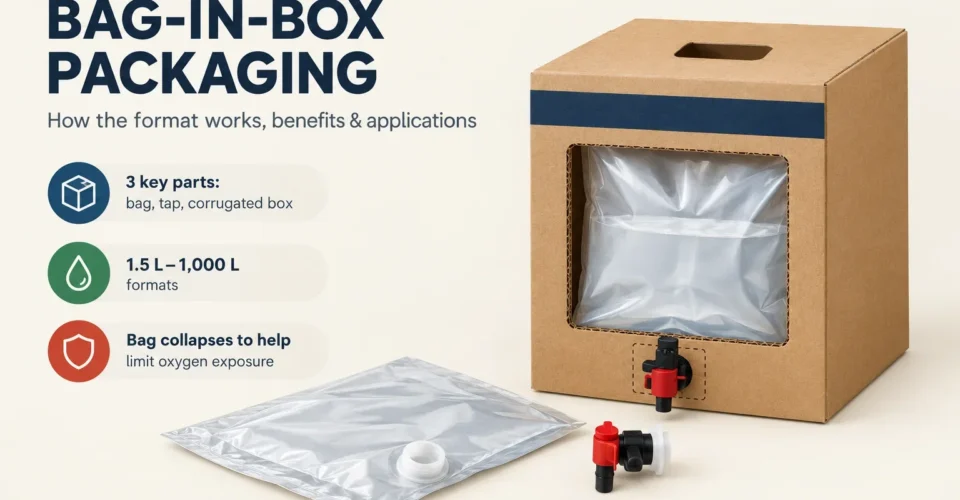
Quick answer: A bag in a box is a liquid package made of three parts: a flexible multi-layer plastic bag, a tap or fitting welded into the bag, and an outer corrugated box. As the liquid is poured, the bag collapses instead of letting air in, which keeps wine, juice, syrup, dairy and chemicals fresh. Bags range from 1.5 to 1,000 liters.
Key facts at a glance
- Also called: bag-in-box, BIB, boxed wine or wine cask
- Parts: multi-layer bag, spout and tap (fitment), corrugated outer box
- Sizes: 1.5 L to 1,000 L; common sizes are 3 L wine boxes, 2.5 and 5 gallon soda syrup and 200 L or 1,000 L industrial bags
- Invented: 1955 by William R. Scholle, for battery acid; the wine cask followed in Australia in the 1960s
- Freshness: opened boxed wine keeps for about 3 to 4 weeks, as the bag collapses instead of letting air in
- Carbon footprint: one study found glass bottles produce over 4 times the CO2 of bag-in-box per liter of wine
- Recycling: the corrugated box is recyclable; the bag and tap usually go in the trash unless a local program accepts them
Facts in this guide are checked against manufacturer data, university research and recycling authorities, listed in the Sources section.
In this guide
- What a bag in a box is
- How bag-in-box packaging works
- Bags, films and taps
- Sizes and applications
- Benefits
- Limitations
- Bag-in-box vs bottles, jugs and pouches
- Filling lines and high-speed solutions
- Designing the outer box
- Choosing a bag in box supplier
- Sustainability and recycling
- Frequently asked questions
- Sources
What Is a Bag in a Box?
A bag in a box is a container for liquids and semi-liquids in which a sealed, flexible bag sits inside a rigid outer box. The bag holds and protects the product, a spout and tap let you dispense it, and the box gives the package its shape, strength, stacking ability and printed branding.
Bag in box packaging is often shortened to BIB. Consumers know it best as boxed wine, but the same format carries fountain soda syrup, milk and cream, liquid eggs, sauces, juices, water, detergents and industrial chemicals.
The name is sometimes used for a different, dry-goods package: a sealed liner bag inside a folding carton, as with cereal or crackers. That format has no tap and works differently. This guide covers the liquid bag-in-box format.
A Short History
- 1955: American chemist William R. Scholle invented the first commercial bag-in-box system to transport and dispense battery acid.
- 1964: South Australian winemaker Thomas Angove’s company patented the wine cask. Early casks used 1 imperial gallon (4.55 L) bags that were cut open at the corner and resealed with a peg.
- 1967: Charles Malpas and Penfolds Wines patented an airtight plastic tap welded into a metallized film bag, the basis of the modern wine box.
These milestones are recorded in the history of bag-in-box.
How Bag-in-Box Packaging Works
- The empty bag arrives flat, either as single bags or as a perforated web of bags on a roll for automatic lines.
- The filler removes the cap, fills the bag through the spout, and refits the cap or tap.
- The filled bag goes into a corrugated box, which is then closed and palletized.
- At the point of use, the customer tears out a perforated panel, pulls the tap through and dispenses the product.
- As the liquid flows out, the bag collapses. Air does not replace the liquid, so the product left inside has little contact with oxygen.
Syrup bags work slightly differently: instead of a tap, they have a port with a one-way valve that opens only when a dispenser connector is attached, as described in the bag-in-box overview.
Bag-in-Box Components: Bags, Films and Taps
A typical packaging bag in box system has three parts, and each is chosen for the product inside. Getting all three right is what makes bag in box packaging protect the product from filling to the last pour.
Bag Films
| Bag Type | Film | Barrier | Typical Uses |
|---|---|---|---|
| Metallized bag | Metallized PET (Met-PET) laminated to polyethylene | High oxygen and light barrier | Wine, juice, oxygen-sensitive foods |
| Clear EVOH bag | Co-extruded film with an EVOH barrier layer | High oxygen barrier, see-through | Wine, juice, dairy, liquid foods |
| EVOH and nylon bag | Reinforced EVOH with nylon | High barrier, tougher film | Long transport and demanding filling conditions |
| Hot-fill bag | Heat-resistant polyethylene | Barrier for hot-filled products | Products filled hot, such as some juices and sauces |
| Nylon bag | Semi-barrier nylon | Aroma barrier | Chemicals and agrochemicals |
| Standard PE bag | Polyethylene only | No oxygen barrier | Water, detergents, basic liquids |
Bag types follow the Smurfit Kappa bag range. Larger bags, from 15 L up, often use two plies of film for extra strength. Bags can be filled at temperatures from chilled up to 85 °C (185 °F), according to the bag-in-box overview cited above.
Taps, Spouts and Connectors
| Fitment | How It Works | Typical Uses |
|---|---|---|
| Self-closing wine tap (such as Vitop) | Press or turn to pour; closes on its own and limits air intake | Wine, juice, beverages |
| Quick-connect fitment | Clicks onto a dispenser line; valve opens only when connected | Soda syrup, wine on tap |
| Flat cap and gland | Sealed cap pierced or connected by the dispensing machine | Milk, cream, dairy dispensers |
| Pouring cap | Screw or snap cap for pouring the full contents | Liquid eggs, sauces, dairy |
| High-flow tap | Wider flow path with flow control | Thick, viscous products |
| Push or turn tap for non-food | Self-closing tap for chemicals | Detergents, cleaning products |
Fitment types follow the Smurfit Westrock closure range.
The Outer Box
The box is usually corrugated board. It protects the bag from punctures, lets the package stack on pallets and shelves, carries the printed brand and product information, and often includes a carry handle and a perforated panel for the tap. For more on board grades, see this guide to corrugated board grades.
Bag-in-Box Sizes and Applications
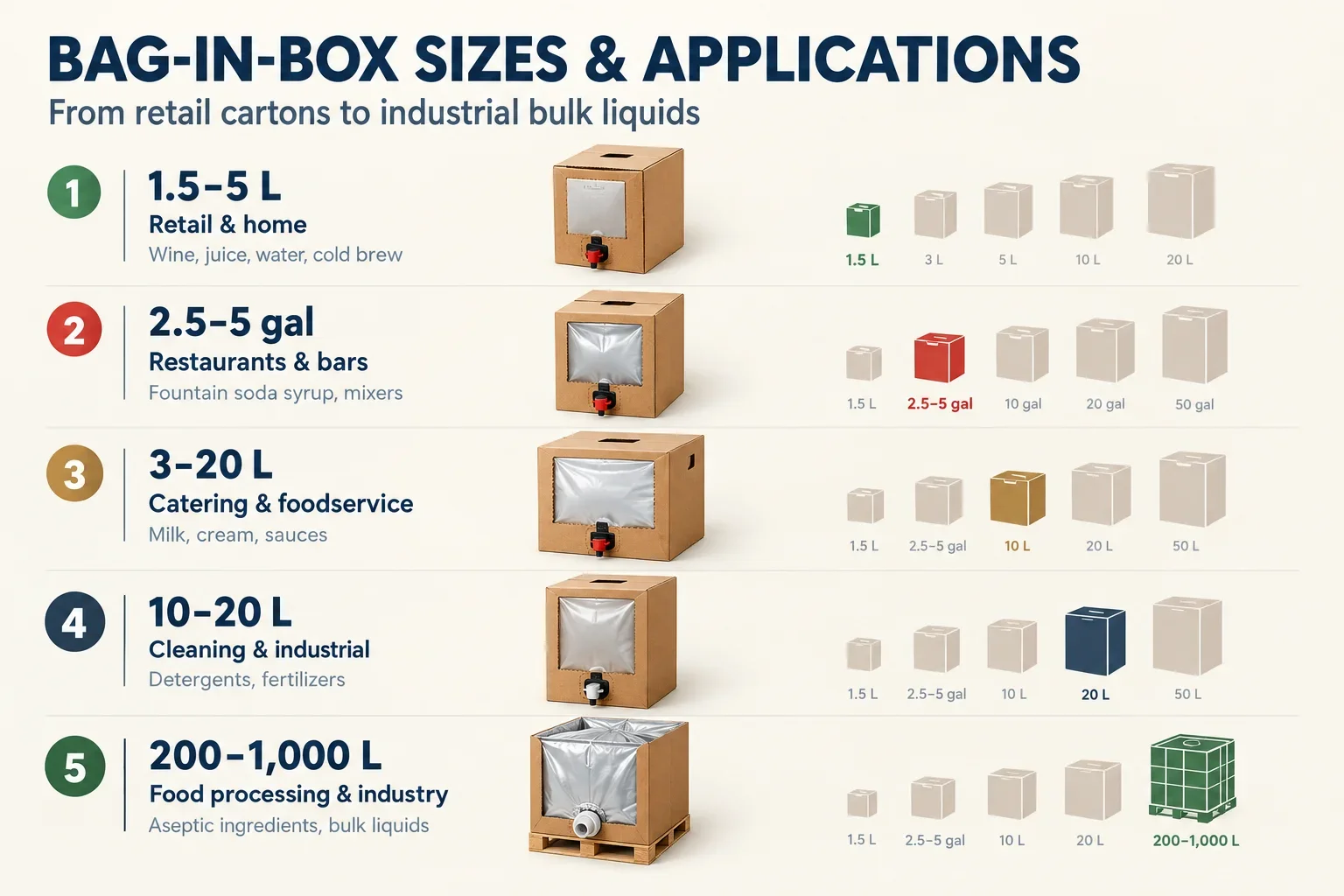
Bags hold from 1.5 L to 1,000 L of liquid. The size depends on who uses the product and how it is dispensed.
| Size | Equivalent | Where It Is Used | Example Products |
|---|---|---|---|
| 1.5 L to 5 L | A 3 L box holds the same as four 750 mL bottles | Retail and home | Boxed wine, juice, water, cold brew coffee |
| 2.5 gal and 5 gal | About 9.5 L and 19 L | Restaurants and bars | Fountain soda syrup, tonic and mixers |
| 3 L to 20 L | About 0.8 to 5.3 gal | Catering and foodservice | Milk, cream, liquid eggs, sauces, condiments, wine on tap |
| 10 L to 20 L | About 2.6 to 5.3 gal | Cleaning and industrial | Detergents, cleaning chemicals, fertilizers |
| 200 L and 1,000 L | About 53 and 264 gal | Industrial and food processing | Aseptic fruit and dairy products, bulk ingredients |
Soda syrup in the US is commonly sold in 2.5 and 5 gallon bag-in-box packs, such as 5 gallon fountain syrup. Aseptic fillers from Alfa Laval handle 3 to 20 L bags for catering and 200 L and 1,000 L bags for industry.
Industries That Use Bag-in-Box
- Wine and spirits: 1.5 L, 3 L and 5 L consumer boxes, plus larger bags for wine on tap in bars and restaurants.
- Soft drinks: syrup for fountain machines, mixed with carbonated water at the dispenser.
- Dairy: milk, cream and soft-serve mix for dispensers in cafes and foodservice.
- Food and foodservice: liquid eggs, ketchup, mustard, sauces, edible oils and juices.
- Coffee and tea: cold brew concentrate and ready-to-drink coffee.
- Water: drinking water for homes, offices and emergency supplies.
- Chemicals and agriculture: detergents, sanitizers, battery acid and fertilizer.
Food brands that also need dry or retail cartons can compare BoxNovo’s food packaging boxes.
Benefits of Bag in Box Packaging
- Freshness after opening: the collapsing bag and self-closing tap keep air out. Decanter advises using opened boxed wine within three to four weeks of opening (Decanter).
- Lower carbon footprint: a UCLA study for Fetzer Vineyards found a 750 mL glass bottle produces 0.69 kg CO2e per liter of wine, against 0.172 kg for bag-in-box, over 4 times more (UCLA).
- Lighter and smaller to ship: less packaging weight per liter than glass, and rectangular boxes fill pallets with little wasted space.
- Less packaging per liter: one large package replaces several bottles, labels and closures.
- No cork taint: wine casks avoid cork-related faults.
- Unbreakable: no glass to break in transit, at events or by the pool.
- Easy dispensing: taps and connectors pour cleanly and plug straight into dispensers.
- Large print area: four box sides and the top carry branding, serving suggestions and product details.
- Shelf-stable options: aseptically filled products can be stored without refrigeration; some last up to 2 years depending on the bag.
For more on how packaging protects and sells products, see these benefits of good packaging.
Limitations to Consider
- Not for long aging: bag films are very slightly permeable, so boxed wine is made for drinking young, not for cellaring. Check the best-before date on the box.
- Recycling takes an extra step: the box is easy to recycle, but most bags and taps are multi-layer plastic that curbside programs do not accept.
- Bag damage: poor box fit, sharp edges or rough handling can cause pinholes or flex cracks; bag films and boxes must be matched to the shipping route.
- Two packaging suppliers: the bag and the box often come from different companies, so sizes and fitments must be coordinated.
- Premium perception: some shoppers still see glass as more premium, which makes the box design more important.
Bag-in-Box vs Bottles, Jugs and Pouches
| Feature | Bag in a Box | Glass Bottle | Rigid Plastic Jug | Spouted Pouch |
|---|---|---|---|---|
| Air enters as it empties | No, the bag collapses | Yes | Yes | No, the pouch collapses |
| Typical size | 1.5 L to 1,000 L | Mostly 750 mL | 1 L to 20 L | Single-serve to a few liters |
| Breakable | No | Yes | No | No |
| Stacking and pallets | Excellent, rectangular box | Needs dividers and cases | Fair | Needs an outer case |
| Print area | Large box panels | Label only | Label only | Full pouch surface |
| Recycling | Box recyclable; bag usually trash | Widely recyclable | Often recyclable | Usually not curbside recyclable |
Shipping wine in glass instead? See this wine bottle box guide and these tips on shipping wine safely.
Bag-in-Box Filling Lines and High-Speed Solutions
Bag-in-box filling equipment ranges from tabletop fillers for small wineries to fully automatic aseptic lines. The right level depends on volume, product type and bag size.
| Filler Type | How It Works | Best For |
|---|---|---|
| Manual or semi-automatic | An operator places each bag on the filling head; the machine uncaps, fills and recaps | Small wineries, craft producers, short runs |
| Fully automatic (web-fed) | Bags feed from a perforated web; the machine separates, fills, caps and drops them for boxing | High volumes of 1.5 to 20 L bags |
| Aseptic | Pre-sterilized bags are filled in a sterile zone so the product stays commercially sterile | Shelf-stable dairy, juices and food ingredients |
| Large-format | Fills 200 L and 1,000 L bags, often inside drums or bulk containers | Industrial food processing and chemicals |
High-speed bag-in-box packaging solutions combine an automatic filler with case erecting, bag insertion and case sealing. For scale, the Smurfit Westrock ProFill range fills 1.5 to 20 L bags at 15 to 51 bags per minute depending on the number of heads (Smurfit Westrock), while Alfa Laval’s aseptic fillers run up to 600 bags per hour.
At those speeds the boxes must be consistent: square, the right size for the bag and strong enough to stack. Boxes that are out of square or the wrong size slow down automatic case erecting and bag insertion.
Designing the Outer Box for Bag-in-Box
The corrugated box is the part shoppers see and the part that protects the bag in transit. Plan it alongside the bag.
- Size to the filled bag: the box should hold the filled bag snugly so it cannot shift, but without squeezing the seams. Use the box size calculator and this guide to custom box dimensions as a starting point.
- Board strength: liquid is heavy (water weighs about 1 kg per liter), so a 5 L box weighs over 5 kg and pallets stack high. Check stacking strength with the box compression strength calculator.
- Tap panel: a perforated knock-out near the bottom of one face lets the tap be pulled through without tools.
- Carry handle: a die-cut handle on top makes 3 L and 5 L boxes easy to carry, like these boxes with carry handles.
- Print and finish: full color printing on all panels turns the box into a shelf display. These retail packaging design tips help the box compete with bottles.
- Required information: leave room for the product name, volume, ingredients or warnings, barcode and any regulatory text.
- Shipping costs: right-sized boxes lower freight; compare options with the dimensional weight calculator.
BoxNovo prints custom corrugated boxes that can be sized for bag-in-box packs, with handles, tap panels and full color branding. Preview a design with the 3D packaging mockup generator.
How to Choose a Bag in Box Supplier
A bag in box supplier provides the bags and fitments, and often the filling equipment; the printed outer box may come from the same company or from a box maker. Use this checklist when comparing suppliers:
- Barrier match: ask which film suits your product and target shelf life, and request oxygen barrier data.
- Fitment compatibility: confirm the tap or connector fits your filler and your customers’ dispensers.
- Filling method: check that the bags suit your process: cold fill, hot fill or aseptic.
- Food-contact compliance: request compliance documents for food-contact materials in your market, such as FDA requirements in the US.
- Sizes and formats: single bags for semi-automatic fillers or web bags for automatic lines.
- Testing: ask for samples to run drop, transport and shelf-life tests with your actual product.
- Box coordination: share the bag dimensions and tap position with your box maker before the box artwork is final.
- Lead times and support: confirm minimum orders, delivery times, spare parts and technical support for the filler.
For the full process from structure to printed box, see these steps for packaging design planning.
Sustainability and Recycling
- Lower emissions than glass: the UCLA study found bag-in-box produces about a quarter of the CO2e of a glass bottle per liter of wine, and that doubling the box size from 1 L to 2 L cuts emissions by over 20%.
- Less board, less impact: the same study found 15% less carton material lowers CO2 emissions by about 5%, so right-sizing the box matters.
- Recycle the box: empty the bag, remove it from the box, then flatten the box for paper and cardboard recycling. Rhode Island’s recycling authority, for example, says to remove the inner bladder and put it in the trash (RIRRC).
- Check local rules: some programs treat bag-in-box differently. In California, wine and spirits in bag-in-box containers are part of the beverage container refund program and must be returned intact (CalRecycle).
- Choose recyclable board: a printed corrugated box with water-based inks and minimal plastic lamination is easier to recycle. Explore eco-friendly packaging options and compare packaging material types.
Frequently Asked Questions
What is a bag in a box?
A liquid package made of a flexible, multi-layer bag with a tap or fitting, inside a corrugated box. The bag collapses as it empties, so little air reaches the product.
What is bag in box packaging used for?
Wine, fountain soda syrup, milk and cream, liquid eggs, sauces, juices, water, coffee concentrate, detergents and industrial chemicals.
Who invented the bag in a box?
William R. Scholle invented the first commercial system in 1955 for battery acid. The wine cask was developed in Australia by Thomas Angove in the 1960s, and Penfolds and Charles Malpas added the airtight tap in 1967.
How long does bag-in-box wine last after opening?
About three to four weeks, ideally kept in the fridge. Unopened, follow the best-before date on the box.
What sizes does bag-in-box come in?
From 1.5 L to 1,000 L. Common sizes are 3 L and 5 L for wine, 2.5 and 5 gallons for soda syrup, and 200 L and 1,000 L for industrial use.
What is the bag made of?
Layers of plastic film, usually polyethylene with an oxygen barrier such as metallized PET or EVOH. Basic bags for water or detergents can be polyethylene only.
How does the tap stop air getting in?
The tap is self-closing, and the bag collapses as liquid flows out, so air does not replace the liquid.
Is bag-in-box packaging recyclable?
The corrugated box is recyclable. Most bags and taps are multi-layer plastic and go in the trash unless a local program accepts them.
Is bag-in-box better for the environment than glass?
For wine, yes on carbon: a UCLA study found glass bottles produce over 4 times the CO2e of bag-in-box per liter.
How many bottles are in a 3 liter box of wine?
A 3 L box holds the same as four standard 750 mL bottles.
How fast can bag-in-box be filled?
Semi-automatic fillers suit small runs; automatic lines fill 1.5 to 20 L bags at about 15 to 51 bags per minute, depending on the number of filling heads.
What is aseptic bag-in-box?
Pre-sterilized bags filled in a sterile zone, so products like juices and dairy stay shelf-stable without refrigeration.
What should I ask a bag in box supplier?
Which film and fitment suit your product, whether bags fit your filler, food-contact compliance, sample testing, minimum orders and lead times.
Can I get custom printed boxes for bag-in-box?
Yes. The outer corrugated box can be printed in full color and made with a handle and tap panel, sized to your filled bag.
What is the difference between bag-in-box and a pouch?
Both collapse as they empty, but a bag-in-box has a rigid outer box for stacking and printing, while a spouted pouch stands on its own.
Can bag-in-box be used for carbonated drinks?
Not for finished carbonated drinks. Soda syrup is packed in bag-in-box and mixed with carbonated water at the dispenser.
Final Takeaway
A bag in a box pairs a collapsing barrier bag and tap with a strong corrugated box, giving liquid products freshness after opening, a lower carbon footprint than glass and easy dispensing from 1.5 L up to 1,000 L. Choose the bag film and fitment for your product, match your filling line to your volume, and design the outer box to protect the bag, stack on pallets and sell on the shelf.
Need printed outer boxes for your bag-in-box product? BoxNovo makes custom corrugated boxes with handles, tap panels and full color branding. Get a quick figure with the instant price estimate tool, or request a box quote.
Sources
- Wikipedia: Bag-in-box (history, construction, sizes, applications)
- Smurfit Kappa: Bag-in-Box bags and films
- Smurfit Westrock: Bag-in-Box closures
- Smurfit Westrock: Vitop taps
- Smurfit Westrock: fully automatic bag-in-box filling machines
- Alfa Laval: aseptic bag-in-box fillers
- Decanter: how long does bag-in-box wine last?
- UCLA Institute of the Environment and Sustainability: Fetzer wine packaging life cycle assessment
- Rhode Island Resource Recovery Corporation: boxed wine recycling
- CalRecycle: bag-in-box beverage containers
- Costco Business Delivery: 5 gallon bag-in-box fountain syrup