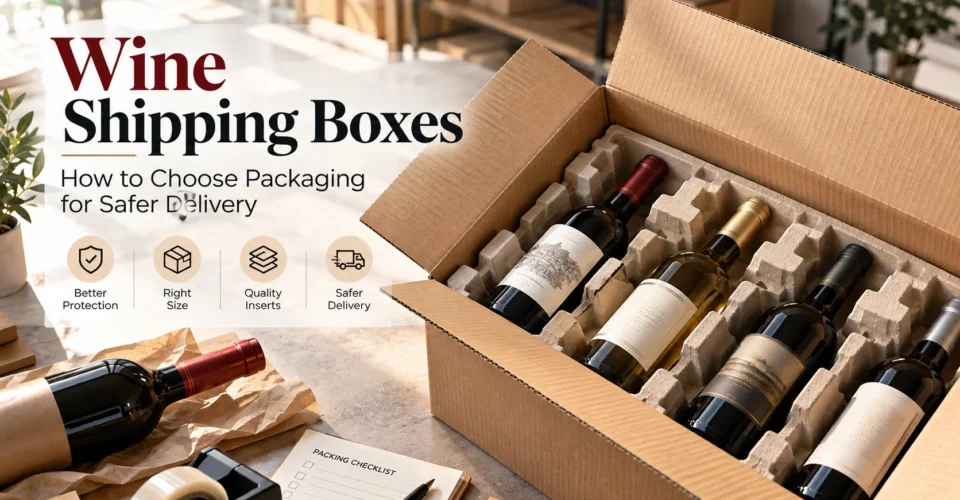
Choosing wine shipping boxes is not simply a matter of finding a carton that fits a bottle. The package has to control movement, separate glass from impact points, work with the bottle’s actual shape and dimensions, and fit the way the order will move through fulfillment and delivery. For branded ecommerce shipments, the package also has to balance protection, shipping efficiency, and presentation.
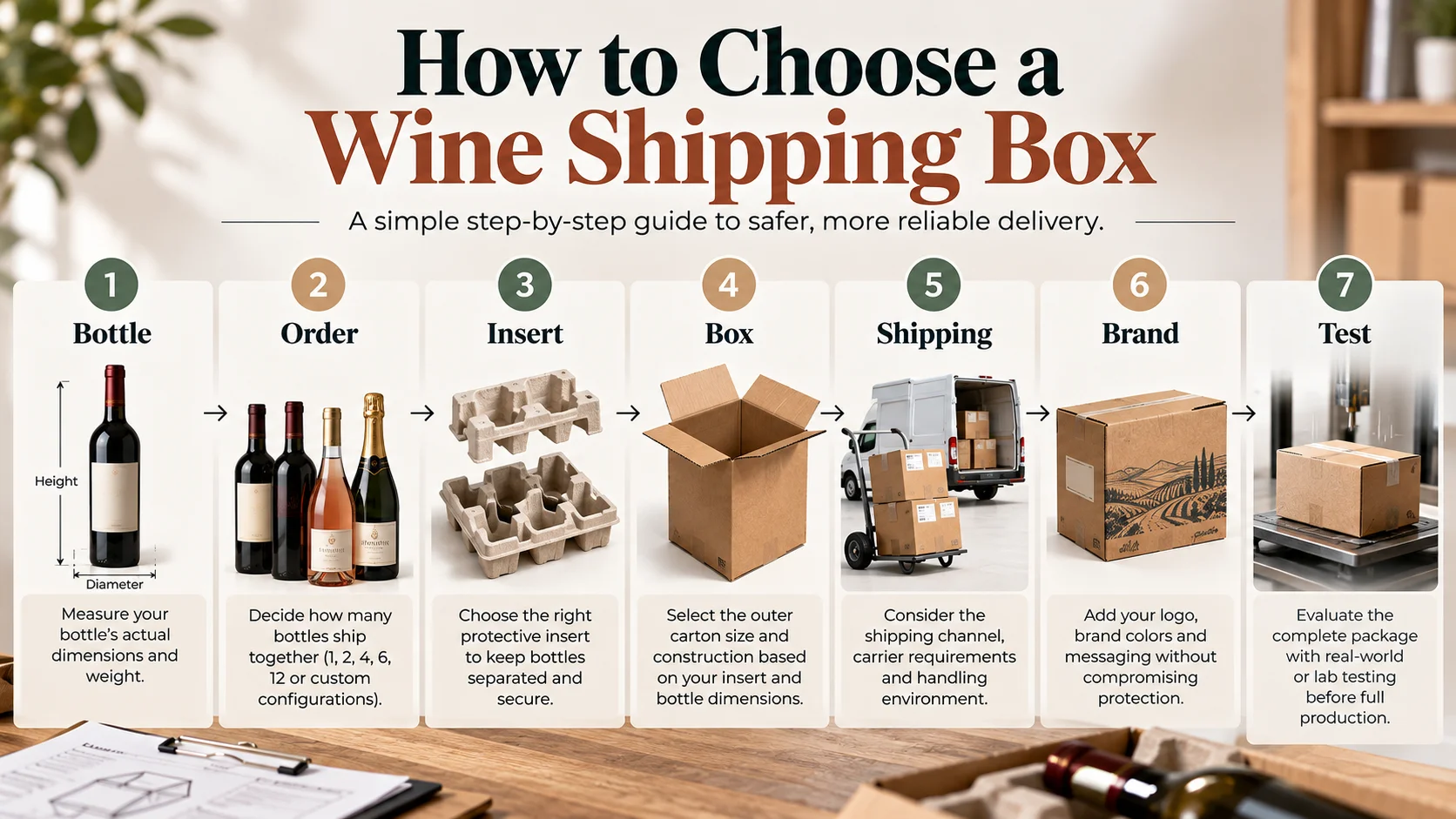
A practical way to plan the package is to work in this order:
Bottle → Order → Insert → Box → Shipping → Brand → Test
Start with the bottle you actually ship, then define how many bottles travel together, choose the protective insert system, size the outer carton around that system, account for the shipping environment, add branding where it helps, and test the finished package before committing to a large production run.
This guide explains how to choose a wine shipping box, compare insert approaches, account for bottle shape and dimensions, decide between stock and custom packaging, plan ecommerce shipments, and avoid common mistakes that can turn a good-looking package into a poor shipping system.
What Are Wine Shipping Boxes?
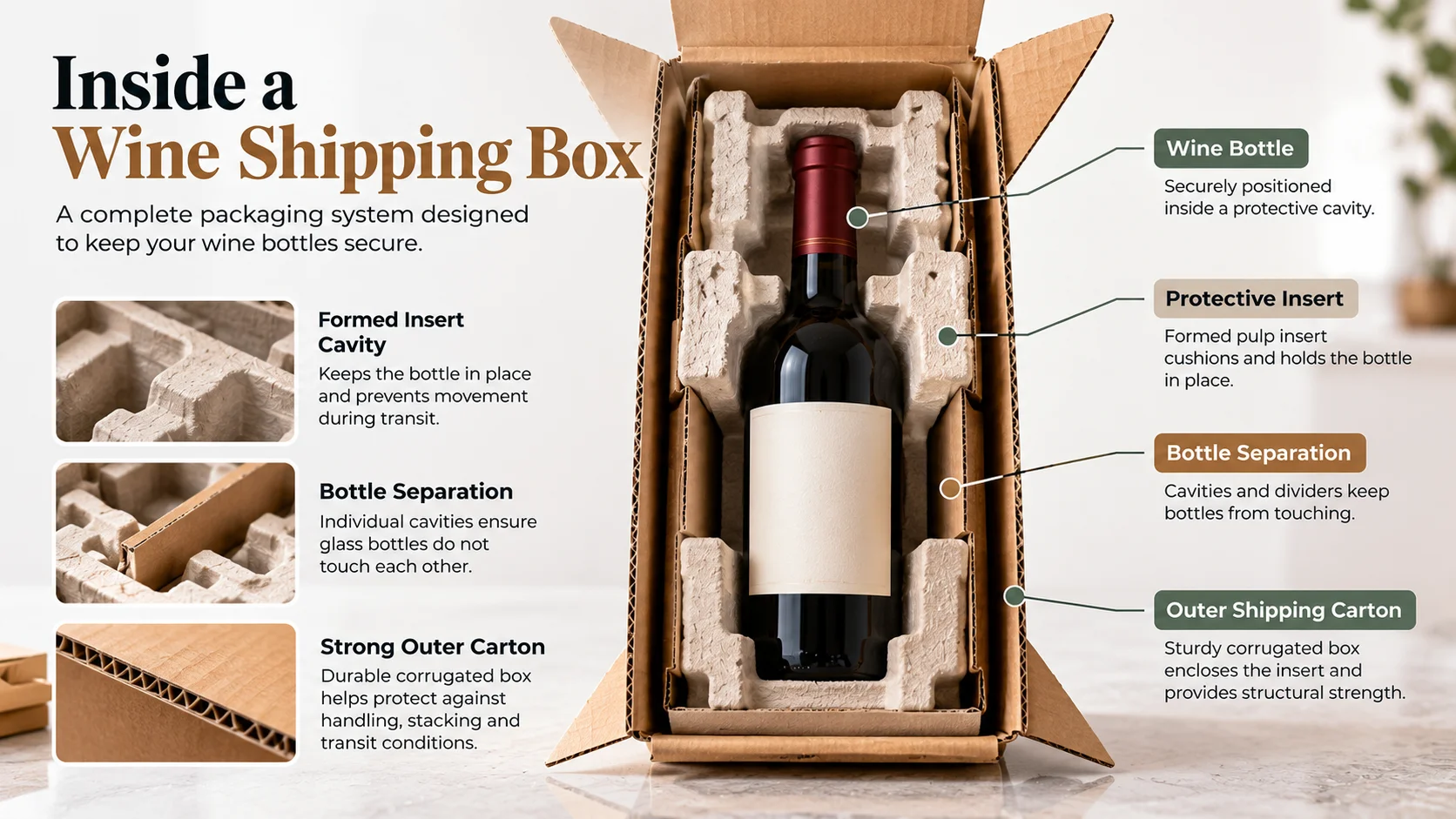
Wine shipping boxes are shipping packages designed to transport wine bottles with a protective system that helps keep the glass separated from the outer carton and reduces unwanted movement during handling. In practice, the shipping system is usually more than the outer box: the insert, bottle fit, cushioning, and closure all contribute to the package’s performance.
A useful distinction is that a wine shipping box is a transport package, not automatically a gift box. A presentation box can prioritize appearance and opening experience, while a shipping system has to account for handling, drops, vibration, compression, movement, and the specific distribution channel.
How a Wine Shipping Box Protects the Bottle
- Positions the bottle so it is not loose inside the carton.
- Separates bottles so glass does not strike glass.
- Keeps the bottle away from vulnerable outer walls where practical.
- Uses an insert or cushioning system suited to the bottle shape and distribution conditions.
- Controls empty space so the bottle and protective system do not shift unnecessarily.
- Creates a sturdy outer package appropriate to the product and shipping environment.
Wine Shipping Boxes vs. Standard Shipping Boxes
A standard shipping carton can be suitable for many products, but wine introduces a fragile glass container, liquid contents, and a product whose shape may not match a generic box cavity. A carton by itself is therefore not the complete protection strategy.
The key question is not simply, “Is the box strong enough?” It is, “Does the complete box-and-insert system control the bottle throughout the shipment?”
Wine Shipping Boxes vs. Wine Gift Boxes
| Package type | Primary job | Typical design priority | Key question |
|---|---|---|---|
| Wine shipping box | Transport | Bottle protection, movement control, and outer-carton performance | Will the complete package protect the bottle through distribution? |
| Wine gift or presentation box | Presentation | Appearance, opening experience, and product display | Does it present the bottle the way the brand wants? |
| Hybrid package | Presentation + transport | Protection and brand experience together | Can the presentation structure work within the intended shipping environment? |
How to Choose the Right Wine Shipping Box
The most useful selection process starts with the product rather than a preselected carton. A stock configuration can work well when the bottle, quantity, and shipping method match it. A custom system becomes more valuable when the bottle shape, order mix, branding requirements, or protective needs do not fit a standard configuration.
Before selecting the carton, review BoxNovo’s box sizing guidance so the package dimensions are based on the actual product and protective system rather than guessed from bottle volume alone.
Start With the Bottle, Not the Box
A bottle’s nominal volume does not fully define its packaging requirements. Two bottles can contain a similar volume while having different heights, diameters, shoulders, necks, bases, or overall profiles.
Before selecting a cavity or divider, record the actual bottle measurements for the SKU or SKU family you intend to ship. If several bottle shapes are sold together, identify the largest and most difficult-to-fit combination instead of designing around the easiest bottle.
Measure the Bottle
- Overall bottle height.
- Maximum body diameter or width.
- Neck and shoulder profile where it affects the insert.
- Base geometry if the bottle sits in a formed or structured cavity.
- Filled shipping weight, not only empty-bottle weight.
- Any closure, foil, cap, wax, sleeve, or other feature that changes the usable envelope.
The goal is not to create one universal bottle dimension. It is to establish a measured product envelope that the insert and outer package can be designed around.
Determine How Many Bottles Ship Together
Order quantity changes the entire packaging architecture. A one-bottle direct-to-consumer shipment has different space and handling priorities from a six-bottle club order or a twelve-bottle wholesale case.
Do not assume that more bottles automatically means the same box multiplied by more cavities. Outer dimensions, center of gravity, divider layout, handling exposure, and shipping efficiency can change as the pack configuration changes.
Consider Bottle Shape and Size
Bordeaux-style, Burgundy-style, sparkling-wine, and oversized bottles can have materially different profiles. A cavity that works for one shape may be too tight, too loose, or poorly positioned for another.
This is one of the clearest reasons to treat the insert and outer box as a single system. The insert should control the bottle at the points that matter, while the outer carton provides the protective enclosure around the system.
Consider How the Package Will Be Shipped
- Direct-to-consumer parcel delivery.
- Wine-club or recurring subscription fulfillment.
- Retail replenishment or licensed business-to-business distribution.
- Gift shipments where presentation matters as well as protection.
- Mixed-SKU fulfillment where one packaging format may need to accommodate more than one bottle profile.
The shipping channel matters because the package may encounter different handling, stacking, vibration, temperature, and delivery conditions. It also affects carrier and legal requirements; packaging alone does not establish whether a wine shipment is legally eligible for a particular route.
Wine Shipping Box Sizes and Bottle Configurations
There is no single universal wine shipping box size. Common commercial configurations include one-, two-, three-, four-, six-, and twelve-bottle formats, but the actual finished dimensions depend on the bottle profile, insert geometry, protective clearances, and outer-carton construction.
| Configuration | Common use | Design focus | When custom design becomes useful |
|---|---|---|---|
| 1 bottle | DTC orders, gifts, samples | Compact protection and presentation | Bottle profile or branding does not fit a stock cavity |
| 2–3 bottles | Gifts and small ecommerce orders | Bottle separation and balanced layout | Mixed bottle shapes or unusual order combinations |
| 4–6 bottles | Wine clubs, DTC bundles, retail orders | Efficient cavity arrangement and load balance | SKU mix, bottle dimensions, or shipping constraints vary |
| 12 bottles | Case quantities, wholesale, fulfillment | Divider structure, compression, and handling | Non-standard bottle mix or specialized fulfillment requirements |
When Standard Configurations Do Not Fit
A stock package can be the right answer when it fits the bottle, quantity, and shipping process without excessive empty space or unwanted movement. Custom packaging becomes more compelling when the standard format forces compromises in bottle fit, insert protection, order configuration, branding, or shipping efficiency.
For example, a winery shipping one distinctive bottle shape may gain more from a purpose-built cavity than from forcing the bottle into a generic insert. A subscription brand with several bottle combinations may need a different approach, such as a configurable internal structure.
Choosing the Right Insert for Wine Bottles
The insert is one of the most important parts of a wine shipping system because it establishes how the bottle is held inside the outer carton. The right choice depends on protection needs, bottle geometry, weight, material goals, manufacturing constraints, and the package’s end-of-life considerations.
Do not treat foam, pulp, or corrugated as automatic winners. The useful comparison is how the complete system performs for the actual bottle and distribution environment.
Molded Fiber or Pulp
Molded fiber or pulp inserts can provide shaped cavities and bottle separation while supporting packaging programs that prioritize fiber-based materials. Final performance depends on the specific design, material construction, and distribution requirements.
Foam
Foam can provide cushioning and shaped support, and it is used in protective packaging systems for fragile products. Its suitability depends on the specific foam, geometry, environmental goals, and shipping conditions.
Corrugated Cell Dividers or Trays
Corrugated structures can separate bottles and organize a multi-bottle pack while integrating naturally with corrugated outer cartons. They can be useful when the packaging system needs efficient flat-pack components and a fiber-based construction.
| Insert approach | Potential strengths | Trade-offs to evaluate | Best question to ask |
|---|---|---|---|
| Molded fiber / pulp | Shaped support and fiber-based construction | Fit, material specification, cushioning behavior, end-of-life | Does the formed cavity control this bottle securely? |
| Foam | Cushioning and shaped support | Material choice, end-of-life, weight, and fit | Does the cushioning system match the distribution risk? |
| Corrugated cells / trays | Bottle separation and integration with corrugated systems | Cavity geometry and cushioning limits | Does the structure prevent contact and unwanted movement? |
For broader material decisions, see BoxNovo’s packaging material guide and compare the material choice against the complete packaging system rather than choosing a substrate in isolation.
How Bottle Shape Affects Wine Shipping Box Design
Bottle shape affects the amount and location of space required inside the insert. A tall, narrow bottle and a wider-shouldered bottle can require different cavity geometry even when their nominal volume is similar.
For sparkling bottles or oversized formats, body diameter, shoulder profile, neck geometry, and closure can change the balance of the package. The insert should be developed around the measured bottle rather than around a generic label such as “750 mL bottle.”
- Bordeaux-style profiles: confirm the actual body and shoulder dimensions before choosing a cavity.
- Burgundy-style profiles: wider shoulders and body dimensions may require more cavity width.
- Sparkling bottles: pay particular attention to body diameter, shoulder profile, neck, and closure geometry.
- Magnum and oversized formats: treat these as separate packaging specifications rather than assuming a standard single-bottle system will fit.
Stock vs. Custom Wine Shipping Boxes
| Decision | Stock packaging may fit when… | Custom packaging is more useful when… |
|---|---|---|
| Dimensions | A standard cavity fits the measured bottle with appropriate protection. | The bottle or insert needs a non-standard footprint or height. |
| Order mix | Orders follow predictable standard quantities. | Orders combine unusual bottle shapes or SKU combinations. |
| Branding | Basic or minimal exterior identification is enough. | The package is part of a branded DTC or unboxing experience. |
| Insert | An available insert provides the needed bottle control. | A made-to-fit cavity or structural insert is required. |
| Shipping efficiency | The stock format does not create problematic empty space. | The stock format is inefficient for the actual bottle and order mix. |
Custom Shipping Boxes With a Logo
Branding can be added without making the package a gift box. A shipping carton can carry a restrained logo, handling message, brand color system, or other approved artwork while the internal structure remains focused on protection.
The most useful approach is to treat branding as part of the package specification rather than as an afterthought. Final print areas should be checked against the structural design, folds, seams, labels, and any required shipping markings.
How to Design Wine Shipping Boxes for Ecommerce
Direct-to-Consumer Orders
DTC packaging has to survive parcel handling while also arriving as a branded customer touchpoint. Keep the protection system predictable enough for fulfillment staff to pack consistently and make the opening experience intentional without compromising the transport function.
Wine Club Shipments
Recurring wine-club shipments benefit from repeatable pack-outs. If the bottle assortment changes by shipment, the packaging specification should account for the actual combinations rather than assuming every month uses the same configuration.
Gift Orders
Gift orders create a presentation challenge: the outer package may need to look polished, but the internal protection still has to be appropriate for shipping. If presentation packaging is used inside a shipping carton, treat the two layers as separate functions.
Retail and Wholesale
Wholesale and retail distribution can place different demands on case strength, stacking, palletization, and handling. The final box specification should be based on the actual distribution environment rather than a generic ecommerce assumption.
For ecommerce packaging projects where a folding shipping format is appropriate, review BoxNovo’s mailer box options, but select the final construction from the product and distribution requirements rather than from the box name alone.
How Box Dimensions Affect Shipping Efficiency
A package should not be made smaller at any cost. The goal is an efficient package that provides the required protection without unnecessary empty space, while leaving enough room for the insert and protective structure to work as intended.
Package dimensions can also influence dimensional-weight calculations and carrier charges, depending on the carrier service and shipment. That makes box sizing a system-level decision: reducing external dimensions may help, but only if the protective system still performs.
- Measure the finished protective system, not just the bare bottle.
- Avoid empty space that allows the bottle or insert to move.
- Do not compress the bottle or protective structure simply to reduce carton size.
- Compare finished package weight and dimensions with the intended carrier service.
- Consider whether a small change in insert geometry can improve fit without reducing protection.
When the outer package itself needs a protective corrugated construction, BoxNovo’s corrugated packaging information provides a relevant material-level reference.
How to Specify a Custom Wine Shipping Box
A clear specification prevents one of the most common custom-packaging mistakes: starting with a box style before defining what the package must actually do. Use the following checklist when preparing a packaging brief.
| Specification item | What to provide | Why it matters |
|---|---|---|
| Bottle measurements | Height, maximum diameter or width, neck and shoulder details | Defines the actual product envelope. |
| Bottle quantity | 1, 2, 3, 4, 6, 12, or actual order mix | Determines internal layout and outer dimensions. |
| Filled weight | Actual shipping weight per bottle and order | Affects structural and shipping decisions. |
| Bottle shape | SKU/profile and any unusual geometry | Prevents poor cavity fit. |
| Insert | Material direction, separation, and cavity requirements | Controls bottle movement and contact. |
| Outer box | Target dimensions, construction, and closure | Encloses and supports the complete system. |
| Shipping channel | DTC, wine club, retail, wholesale, etc. | Sets the distribution context. |
| Branding | Logo, colors, artwork, and print areas | Integrates brand experience with structure. |
| Testing | Prototype quantity and intended evaluation | Reduces production risk. |
Packaging Specification Checklist
- Product SKU(s) and exact bottle samples available.
- Measured height and maximum body diameter.
- Bottle quantity per shipment.
- Filled package weight.
- Insert type and cavity strategy.
- Outer carton dimensions and construction target.
- Closure and sealing method.
- Shipping channel and carrier/service target.
- Branding and print requirements.
- Prototype and testing plan.
- Approval process before production.
For the wider packaging workflow, see BoxNovo’s custom packaging planning guide so the wine box specification can be developed as a complete packaging system.
How to Pack Wine Shipping Boxes for Safer Delivery
- Inspect the bottle and packaging components before packing.
- Place each bottle into the intended insert or protective cavity so it is fully seated.
- Confirm bottles are separated and cannot strike one another.
- Check that the bottle-and-insert assembly does not move excessively inside the outer carton.
- Close the carton according to the approved packaging design and seal it securely.
- Perform a final movement check before applying the shipping label and releasing the order.
Packing consistency matters as much as the box specification. A well-designed package can perform poorly if bottles are placed incorrectly, inserts are omitted, or the pack-out process varies between fulfillment operators.
Wine Shipping Regulations and Carrier Requirements
Wine shipping rules are separate from packaging design. A protective box does not create legal permission to ship alcohol. U.S. requirements can depend on federal law, state and local law, the shipper’s license, the destination, the carrier agreement, and the exact shipment type.
For U.S. shipments, always check the current requirements before shipping. TTB explains that wineries must comply with applicable federal, state, and local requirements and notes that federal law prohibits sending alcohol beverages through the U.S. mail. USPS Publication 52 separately treats intoxicating liquors as nonmailable subject to limited statutory exceptions. UPS and FedEx have their own alcohol-shipping programs and requirements for eligible licensed shippers.
- Federal and state rules: Confirm requirements for the origin, destination, license type, product, and shipment.
- USPS: Check the current Postal Explorer restrictions before considering any mailing route for alcohol.
- UPS: Wine shipments are subject to UPS eligibility, agreement, packaging, labeling, adult-signature, and destination requirements.
- FedEx: Eligible licensed businesses must follow the applicable alcohol-shipping program and packaging requirements.
Important: This article is packaging guidance, not legal advice. Do not use the package design itself as evidence that a shipment is legally eligible.
Should You Test a Wine Shipping Box Before Production?
For a fragile glass product, prototype testing is a practical way to identify fit and handling problems before a large production run. The exact test plan should reflect the distribution environment and the package configuration.
ISTA describes Procedure 3A as a general-simulation performance test for individual packaged products shipped through parcel delivery systems at 150 lb (70 kg) or less. Testing procedures should be selected for the actual package and distribution conditions. An ISTA procedure does not itself grant carrier approval or legal permission to ship wine.
- Test the actual bottle or a representative production-equivalent sample.
- Test the complete package, including insert, outer carton, and closure.
- Evaluate bottle movement, glass contact, insert deformation, and visible package damage.
- Re-evaluate when the product, package, materials, or distribution process changes materially.
- Keep test records with the approved packaging specification.
Common Wine Shipping Box Mistakes
- Choosing the box before measuring the bottle.
- Assuming all bottles of the same nominal volume have the same packaging needs.
- Using dividers without considering how the bottle is restrained vertically and laterally.
- Leaving enough empty space for the bottle or insert to shift.
- Choosing a material only because it is cheaper without evaluating the complete protective system.
- Treating a presentation box as if it automatically functions as a shipping system.
- Adding branding before the structural and print areas are finalized.
- Skipping prototype evaluation before a large production order.
- Assuming a packaging test replaces carrier approval or alcohol-shipping compliance.
- Assuming a carrier’s current rules are permanent instead of checking current requirements before shipping.
Wine Shipping Box Selection Checklist
- ☐ Bottle height measured
- ☐ Maximum bottle diameter or width measured
- ☐ Bottle shape/profile identified
- ☐ Filled shipping weight confirmed
- ☐ Bottle quantity per shipment defined
- ☐ Insert strategy selected
- ☐ Bottle-to-bottle contact prevented
- ☐ Unwanted internal movement addressed
- ☐ Outer carton sized around the complete protective system
- ☐ Shipping channel and carrier requirements checked
- ☐ Branding and print areas approved
- ☐ Prototype evaluated
- ☐ Final packaging specification documented
- ☐ Current legal and carrier eligibility verified before shipment
Frequently Asked Questions
What is the best box for shipping wine?
There is no single best box for every wine shipment. The appropriate package depends on the bottle’s measured dimensions and weight, the number of bottles, the insert system, the outer-carton construction, and the distribution environment.
What size box do I need to ship a wine bottle?
Use the actual bottle height and maximum diameter to determine the insert cavity and then size the outer carton around the complete protective system. Do not choose a carton from bottle volume alone.
Can I use a regular shipping box for wine?
A regular carton is not automatically a complete wine-protection system. If wine is being shipped, the package should securely control the bottle and meet the applicable carrier and legal requirements for the shipment.
What should go inside a wine shipping box?
A protective insert or cushioning system should position the bottle, separate bottles where multiple units are shipped, and reduce unwanted movement inside the outer carton.
Are molded pulp inserts good for wine shipping?
Molded pulp can be useful when the design provides the required bottle support and fits the distribution environment. Evaluate the complete system rather than choosing a material in isolation.
Are foam inserts better than corrugated inserts?
Neither material is universally better. Compare the specific insert design for bottle control, cushioning, weight, end-of-life considerations, cost, and shipping conditions.
Can I use custom shipping boxes with a logo for wine?
Yes. Branding can be integrated into a shipping carton when the print areas are compatible with the structural design and any required shipping or regulatory markings.
Can wine shipping boxes be used for ecommerce?
Yes. Ecommerce wine packaging should be designed around the actual DTC order configuration, fulfillment process, carrier requirements, and customer unboxing experience.
Can I ship wine through USPS?
For U.S. shipments, USPS Publication 52 treats intoxicating liquors as nonmailable subject to limited exceptions, and TTB states that federal law prohibits sending alcohol beverages through the U.S. mail. Check current official requirements before shipping.
Does an ISTA test make a wine shipment legal?
No. ISTA testing evaluates package performance under a defined test procedure. Carrier acceptance, licensing, and alcohol-shipping laws are separate requirements.
Should I test a custom wine shipping box before production?
For a fragile glass product, prototype and performance evaluation can help identify fit, movement, and damage risks before a large production run. The test method should match the actual distribution environment.
Final Takeaway
The strongest wine shipping boxes are not chosen by box name alone. They are specified from the product outward: measure the bottle, define the order configuration, choose the insert, size the outer carton, account for the shipping environment, integrate branding where useful, and evaluate the finished package before production.
That process gives a wine brand something more valuable than a generic carton recommendation: a packaging specification that can be communicated to a packaging supplier, reproduced by a fulfillment team, and improved through testing.
When the project requires a purpose-built packaging format, explore BoxNovo’s bottle shipping box solutions and divided bottle packaging as relevant starting points for the packaging conversation.
For broader product-packaging requirements, BoxNovo’s product packaging solutions can help connect the wine-specific shipping requirement with the wider packaging system.