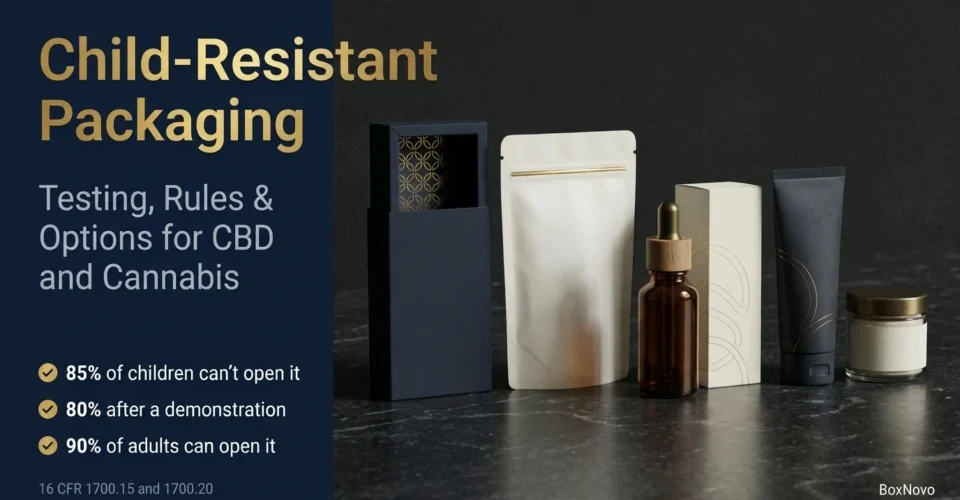
Quick answer: Child resistant packaging is packaging that young children find significantly difficult to open, while adults can still open and close it properly. A package only counts as child-resistant after it passes the federal test in 16 CFR 1700.20. At least 85% of children aged 42 to 51 months must fail to open it before a demonstration, and at least 80% after one. At least 90% of adults aged 50 to 70 must be able to use it. Cannabis and many hemp CBD rules are set by states, and most of them point back to this federal test. What changes from state to state is which products need CR packaging, whether it must stay child-resistant after opening, and whether a child-resistant exit bag at checkout counts.
Key facts at a glance
- The law: the Poison Prevention Packaging Act of 1970, enforced by the Consumer Product Safety Commission (CPSC), with rules in 16 CFR parts 1700 to 1702
- The test: 16 CFR 1700.20, with up to 200 children aged 42 to 51 months and 100 adults aged 50 to 70
- The pass marks: at least 85% of children cannot open it without a demonstration, at least 80% after one, and at least 90% of adults can use it (16 CFR 1700.15)
- The package types: ASTM D3475 sorts child-resistant packages into 13 types, including Type X (box or tray) and Type XI (reclosable flexible)
- Cannabis and CBD: federal rules do not name cannabis, hemp or CBD; states such as California, Colorado, New York, Rhode Island and Florida write the federal test into their own rules
- Why it matters: poison center reports of young children eating cannabis edibles rose from 207 in 2017 to 3,054 in 2021
Facts in this guide come from the CPSC and 16 CFR Part 1700, ASTM D3475, state cannabis and hemp regulators, the journal Pediatrics and the Congressional Research Service. All are listed in the Sources section. Rules change often, so check your state’s current text before you order. This is general guidance, not legal advice.
In this guide
- What is child resistant packaging?
- Why CR packaging matters for cannabis and CBD
- The federal law: the Poison Prevention Packaging Act
- How the 16 CFR 1700.20 test works
- ASTM D3475 package types
- Single-use vs reclosable packaging
- Primary, secondary and exit packaging
- Child resistant packaging requirements by state
- Hemp CBD products and the 2026 federal change
- CR packaging options by product
- Certificates to ask your supplier for
- Designing CR packaging that sells
- Common mistakes
- Child-resistant packaging checklist
- Frequently asked questions
- Sources
What Is Child Resistant Packaging?
The CPSC defines special packaging as packaging that is “significantly difficult for children under 5 years of age to open within a reasonable time.” It must also not be difficult for normal adults to use properly. In everyday terms, it is a package that takes two coordinated actions, a hidden release point or a tool to open. Examples are a cap you push down while turning, a box tray you release by pressing two points, or a pouch zipper you pinch in a marked spot before pulling.
Three terms are often mixed up:
- Child-resistant (CR): a federally defined, tested claim. The package has passed the 16 CFR 1700.20 protocol.
- Child-proof: not a real standard. No package is child-proof; the test itself allows up to 20% of children to get in after a demonstration.
- Child-deterrent: a lower bar used by some states. Vermont, for example, accepts tear-resistant child-deterrent packaging for plain flower and pre-rolls, but requires full child-resistant packaging for edibles, concentrates and infused pre-rolls.
Why CR Packaging Matters for Cannabis and CBD
A study in Pediatrics by Tweet, Nemanich and Wahl looked at poison center reports of children under 6 eating edible cannabis. Reports climbed from 207 in 2017 to 3,054 in 2021, a total of 7,043 cases over five years. Of the cases with known outcomes, 8.1% of the children went to critical care and 14.6% were admitted to other hospital care. Ninety-seven percent of exposures happened in a home, most often the child’s own.
Edibles look and taste like ordinary candy, cookies and drinks, which is why regulators focus on the package. CR packaging also decides real business outcomes. A brand cannot sell in most licensed markets without it. A failed inspection can mean a stop-sale order. And the wrong package style can force a full reprint. If you sell through BoxNovo’s CBD and cannabis boxes, the right closure choice comes before artwork.
The Federal Law: The Poison Prevention Packaging Act
The Poison Prevention Packaging Act (PPPA) was enacted in 1970 and is enforced by the CPSC. Its rules are in 16 CFR parts 1700 to 1702. Three sections matter most:
| Section | What It Does |
|---|---|
| 16 CFR 1700.14 | Lists the 33 categories of substances that need special packaging, such as aspirin, prescription drugs, iron supplements, mouthwash and over-the-counter drugs. None of the categories names cannabis, hemp or CBD. |
| 16 CFR 1700.15 | Sets the pass marks: child-resistant effectiveness of at least 85% without a demonstration and 80% after one (80% for unit packaging), and senior adult use effectiveness of at least 90%. The package must keep working for the number of openings and closings customary for its size and contents. |
| 16 CFR 1700.20 | Sets the test procedure: who is tested, how long they get, and how openings are counted. |
Two federal points catch brands out. First, liquid nicotine is covered by a separate law. The Child Nicotine Poisoning Prevention Act requires liquid nicotine containers to meet 16 CFR 1700.15, and its requirements took effect on July 26, 2016. Brands that sell refill liquids in e-liquid bottle boxes need a CR bottle closure inside. Second, makers of products the CPSC regulates must issue a certificate of compliance under Section 14(a) of the Consumer Product Safety Act. For cannabis, the paperwork requirement comes from the state instead.
How the 16 CFR 1700.20 Test Works
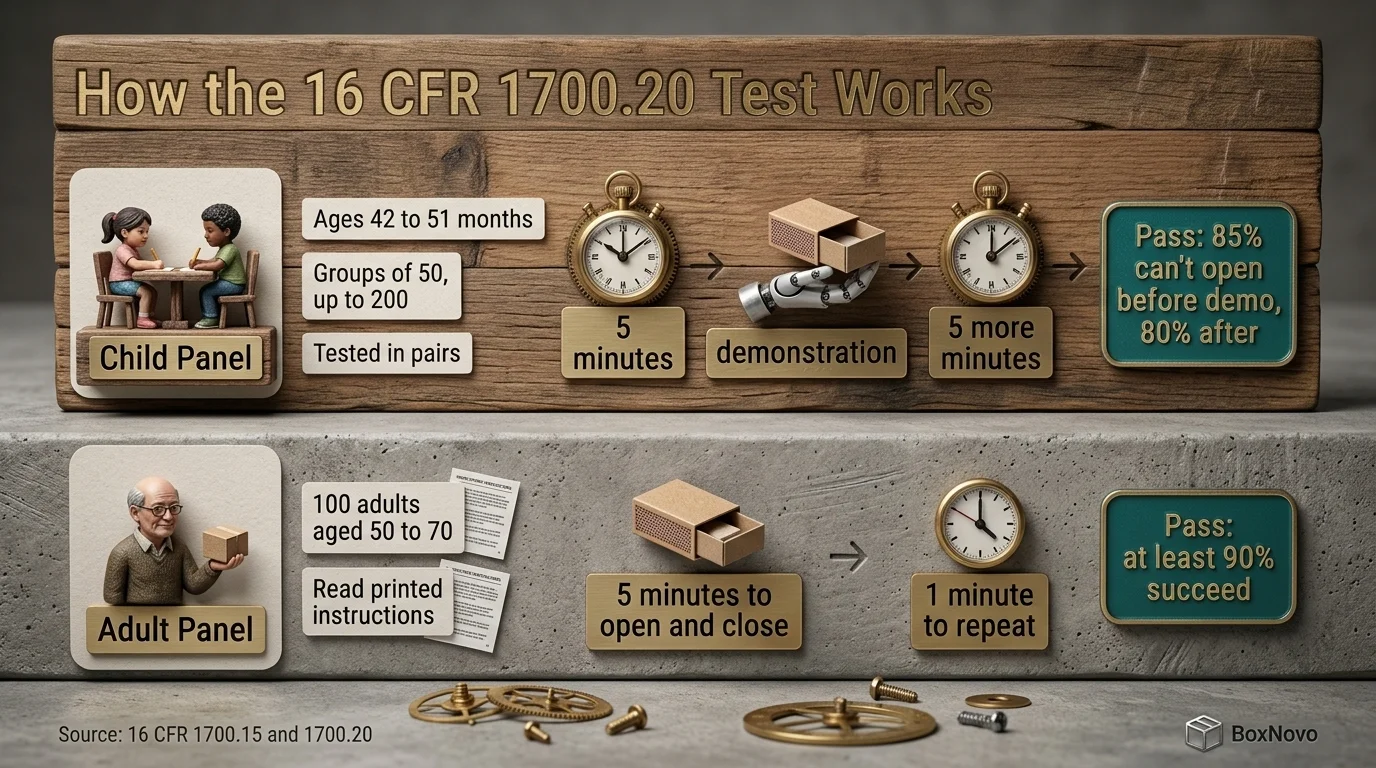
16 CFR 1700.20 is a human panel test, not a machine test. An independent lab runs it on the exact package design, with the closure and container tested together.
The Child Panel
- Ages: 42 to 51 months, split 30% aged 42 to 44 months, 40% aged 45 to 48 months and 30% aged 49 to 51 months.
- Group size: groups of 50 children, tested one group at a time, up to 200 in total. Boys and girls are balanced in each age range, and no more than 20% of a group can come from one site.
- Pairs: children are tested in pairs in a familiar setting, and no child tests more than two packages.
- Timing: each pair gets up to 5 minutes. The tester then demonstrates how to open the package and gives up to 5 more minutes. If neither child has used their teeth, the tester tells them they can.
- Failure: any child who opens the package or reaches the contents counts as a failure. For unit packaging such as blisters, a child fails by reaching more than 8 units, or fewer if that number could seriously harm a 25-pound child.
How Pass or Fail Is Decided
Results are judged in steps of 50 children, using the cumulative number who opened the package:
| Children Tested | Pass (First 5 min / Full 10 min) | Test Another 50 | Fail (First 5 min / Full 10 min) |
|---|---|---|---|
| 50 | 0 to 3 / 0 to 5 | 4 to 10 / 6 to 14 | 11+ / 15+ |
| 100 | 4 to 10 / 6 to 15 | 11 to 18 / 16 to 24 | 19+ / 25+ |
| 150 | 11 to 18 / 16 to 25 | 19 to 25 / 26 to 34 | 26+ / 35+ |
| 200 | 19 to 30 / 26 to 40 | None | 31+ / 41+ |
Source: 16 CFR 1700.20, Table 1. A strong design can pass with the first 50 children. A borderline design needs more groups, which adds cost and time.
The Adult Panel
- Who: 100 adults aged 50 to 70, split 25% aged 50 to 54, 25% aged 55 to 59 and 50% aged 60 to 70, and 70% female.
- Timing: each adult reads only the printed instructions on the package and gets 5 minutes to open it and, if it is reclosable, close it properly. Those who succeed then get 1 minute to open and close it again.
- Pass mark: the senior adult use effectiveness (SAUE) must be at least 90%.
Adults who cannot open the package in the first 5 minutes take a screening test with two ordinary closures. Anyone who cannot open those within 1 minute each is replaced, so the test measures the package rather than the adult’s hand strength. Aerosols and some metal containers use a younger adult panel aged 18 to 45 instead. That adult test is why a package that is very hard to open can still fail: child-resistant packaging has to be usable as well as secure.
ASTM D3475 Package Types
ASTM D3475, the Standard Classification of Child-Resistant Packages, does not test anything. It sorts packages by the motion, skill or tool needed to open them, so buyers, regulators and labs use the same names. The CPSC’s Special Packaging Index lists 13 types:
| Type | ASTM D3475 Name | Cannabis and CBD Example |
|---|---|---|
| I | Reclosable packaging, continuous thread closure | Push-and-turn cap on a tincture bottle or concentrate jar |
| II | Reclosable packaging, lug finish closure | Lug-style CR jar lid |
| III | Reclosable packaging, snap closure | Squeeze-to-open pop-top vial or pre-roll tube |
| IV | Unit non-reclosable packaging, flexible (strip or pouch) | Single-dose heat-sealed pouch |
| V | Unit non-reclosable packaging, rigid | Single-unit rigid pack |
| VI | Unit reclosable package | Reclosable single-unit pack |
| VII | Aerosol package | Topical spray |
| VIII | Non-reclosable packaging, semi-rigid (blister) | Push-through or peel-push blister for gummies or cartridges |
| IX | Dispensers (not intended to be removed) | Fixed dispensing closure |
| X | Box or tray package | Press-and-slide CR tray box for pre-rolls or edibles |
| XI | Reclosable packaging, flexible | CR zipper mylar bag |
| XII | Dispenser (may be removed) | Removable dispensing closure |
| XIII | Reclosable packaging, semi-rigid (blister) | Reclosable CR clamshell |
Two rules from the standard itself are worth knowing. A package’s listing in ASTM D3475 “is not an indication of whether or not it has been successfully tested.” Functionality must be confirmed by the packager or manufacturer. Florida’s hemp extract rule cites ASTM D3475-20 directly.
Single-Use vs Reclosable Packaging
This is where most ordering mistakes happen. California’s Department of Cannabis Control (DCC) explains it in plain terms:
- Single-use (“initial”) CR: the package is child-resistant until it is first opened. A heat-sealed pouch you tear open is the typical example. In California, it must carry the warning “This package is not child-resistant after opening.”
- Reclosable (“lifetime”) CR: the package stays child-resistant every time it is closed. It “can be opened and closed, but still remains child-resistant.”
| Product (California Example) | CR Needed |
|---|---|
| Flower, pre-rolls, topicals, dab, shatter and wax, vape cartridges | Single-use (initial) CR is allowed, with the warning |
| Edibles, orally consumed concentrates such as tinctures and capsules, suppositories | Reclosable (lifetime) CR, unless each serving is individually packaged in CR packaging |
Other states follow the same logic. Colorado requires every multiple-serving edible to be in a child-resistant container that is resealable. New York requires packaging to be child-resistant for the entire lifespan of the product and resealable if it holds multiple servings. Rhode Island requires multi-serving edibles to be in certified, continually resealable CR packaging.
Primary, Secondary and Exit Packaging
| Layer | What It Is | Does It Need to Be CR? |
|---|---|---|
| Primary (immediate) package | The container touching the product: jar, bottle, pouch, tube, blister | Usually yes; this is where most states want the CR feature |
| Secondary package | A printed carton or sleeve around the primary package | Only if the primary package is not CR, or the state requires it |
| Exit package | The bag a retailer puts purchases in at checkout | Allowed as the CR layer in only some states and for some products |
Exit packaging used to be a common shortcut, but it is disappearing:
- California: ended it on January 1, 2020, when packages of cannabis goods had to become child-resistant themselves before retail sale.
- Colorado: still requires a child-resistant exit package when flower or trim is sold in a container that is not child-resistant.
- Rhode Island: its medical program guide allows CR exit packages only for medical flower and concentrates.
- Minnesota: lets packaging that is plain, child-resistant, tamper-evident and opaque be added at the final point of sale.
A tincture shows why the layers matter. The bottle’s push-and-turn cap is the CR feature, and the printed carton around it, like BoxNovo’s tincture bottle cartons, is secondary packaging that carries branding and label space.
Child Resistant Packaging Requirements by State
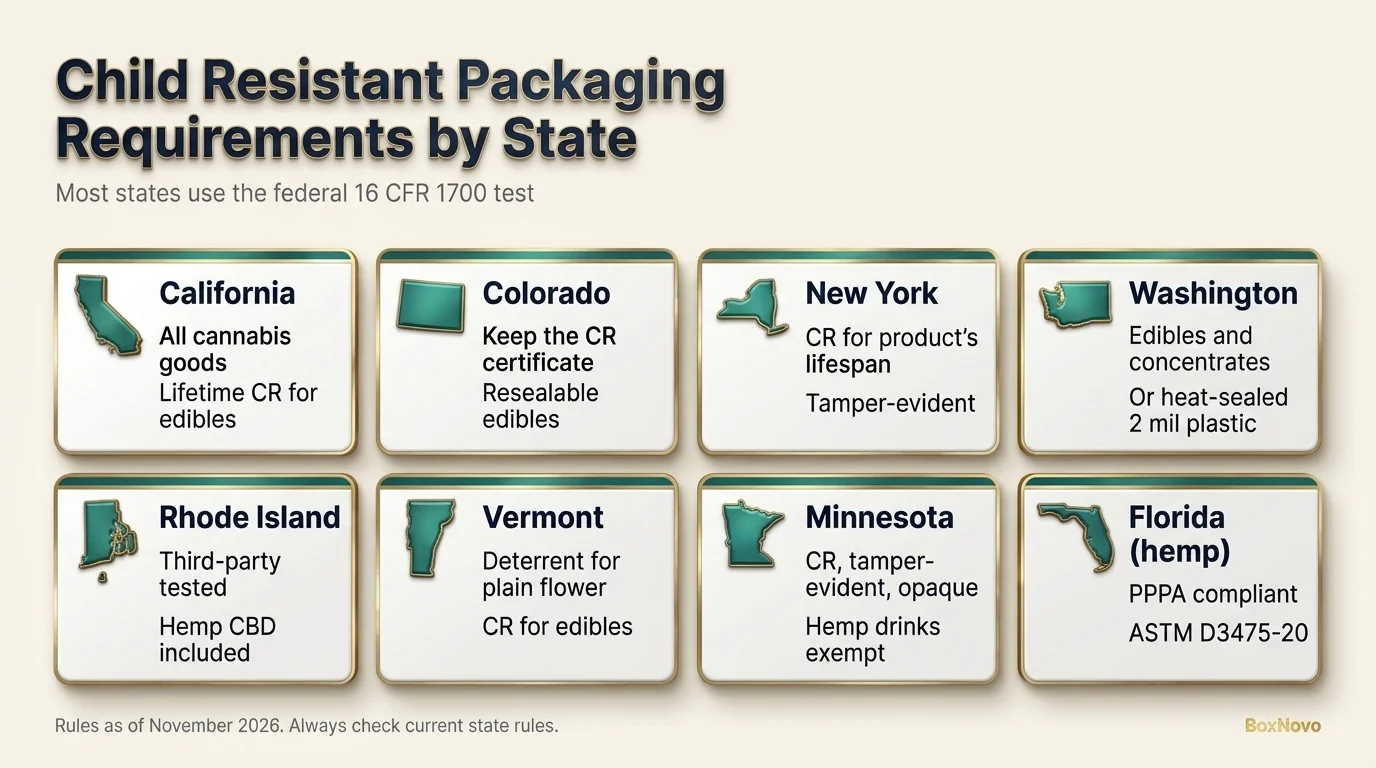
Child resistant packaging requirements are set state by state for cannabis, and increasingly for hemp. This table compares the rules in eight states:
| State | Rule | What It Requires |
|---|---|---|
| California | 4 CCR 17412 | All cannabis goods sold in CR packaging. It qualifies through PPPA certification under 16 CFR 1700.15(b)(1), a pry-off crown cap (single serving), or plastic at least 4 mils thick, heat-sealed with no easy-open tab, dimple, corner or flap (single-use or single serving). Edibles, oral concentrates and suppositories need lifetime CR. The licensee that packaged the goods is responsible. |
| Colorado | 1 CCR 212-3, Rule 3-1010 | Containers must meet 16 CFR 1700.15 and 1700.20. Licensees must keep a copy of the certificate for each child-resistant container. Multi-serving edibles must use a resealable CR container. |
| New York | 9 NYCRR Part 128 | Retail packaging must meet 16 CFR 1700.15 and 1700.20, stay CR for the product’s lifespan, be tamper-evident and be resealable for multiple servings. Licensees must keep records proving it. |
| Washington | WAC 314-55-105 | Concentrates and edibles need CR packaging consistent with 16 CFR Part 1700, or plastic at least 2 mil thick, heat-sealed with no easy-open tab, dimple, corner or flap. |
| Rhode Island | OCR packaging guidance | Packages must be “tested and certified” to 16 CFR 1700 by a qualified third-party testing firm. The licensee must make sure each package is certified, OCR can ask for proof at any time, and OCR will not certify packaging itself. Hemp CBD products must also be in CR packaging. |
| Vermont | Cannabis Control Board guidance | Child-deterrent packaging for plain flower and pre-rolls. Opaque, child-resistant packaging for edibles, concentrates and infused pre-rolls. |
| Minnesota | Minn. Stat. 342.62 | Cannabis, hemp edibles and hemp-derived products must be child-resistant, tamper-evident and opaque, either prepackaged or at the point of sale. Multi-serving edibles must be resealable. Hemp beverages are exempt from the CR rule. |
| Florida (hemp) | Fla. Stat. 581.217; Rule 5K-4.034 | Hemp extract containers must comply with the PPPA “without regard to provided exemptions.” The amended rule, in effect since March 12, 2025, requires CR packaging that complies with ASTM D3475-20. |
Regulators do not approve packaging for you. Rhode Island’s guide states that the regulator “will not certify, provide approval, or otherwise deem any packaging” child-resistant. Responsibility sits with the brand or licensee, and that is why the certificate matters.
Hemp CBD Products and the 2026 Federal Change
Hemp-derived CBD sits between federal and state law. Federal PPPA rules do not list CBD, so the CR requirement for most CBD products comes from states such as Florida, Rhode Island and Minnesota. The federal definition of hemp is also changing:
- The law: P.L. 119-37, enacted in November 2025, rewrote the hemp definition. Final hemp-derived cannabinoid products with more than 0.4 mg of total THC and similar cannabinoids per container are excluded from “hemp.” The container is the innermost package touching the product.
- The dates: the Congressional Research Service reports that P.L. 119-103 delayed most of the change to December 11, 2026. The exclusion for cannabinoids the plant cannot naturally produce still took effect on November 12, 2026.
- What it means for packaging: products that fall outside the new definition are no longer hemp. Brands are reformulating, resizing or leaving the market, so confirm what each SKU will legally contain before ordering a long print run of hemp product boxes.
CR Packaging Options by Product
The table below matches common cannabis and CBD products to CR formats that suit them. Whatever you pick, the specific design still needs a test report.
| Product | Common CR Formats | Single-Use or Reclosable? | Outer Packaging |
|---|---|---|---|
| Pre-rolls | Squeeze pop-top tube, press-and-slide tray box | Single-use allowed in many states; reclosable is easier for multi-packs | Pre-roll packaging styles |
| Flower | CR zipper mylar bag, push-and-turn jar | Single-use allowed in California with warning | Flower barrier pouches |
| Gummies and edibles | Reclosable CR zipper pouch, CR tin, CR tray box, blister | Reclosable for multiple servings | Printed gummy cartons and resealable edible pouches |
| Tinctures and oils | Push-and-turn dropper cap | Reclosable (orally consumed concentrate) | Carton around the CR bottle |
| Dab, wax and shatter | Push-and-turn glass jar, CR silicone or glass container | Single-use allowed in California with warning | Concentrate jar cartons |
| Vape cartridges | CR blister or clamshell, press-and-slide box | Single-use allowed in California with warning | Cartridge retail boxes |
| Topicals | CR jar or tube cap | Single-use allowed in California with warning | Printed carton or label |
Child Resistant Mylar Bags
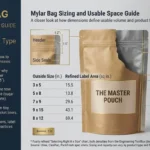
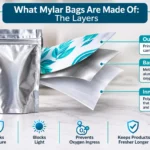
Child resistant mylar bags use a special zipper: the user pinches or presses a marked spot, or slides a lock, before the track separates. A child pulling at the top cannot open it. They fall under ASTM D3475 Type XI (reclosable flexible), so a tested design can work for multi-serving edibles. Ask your supplier three things before ordering:
- Which zipper was tested, and on what bag size and film.
- Whether the test covered reclosing, not just first opening.
- Whether the heat seal above the zipper is tamper-evident.
A heat-sealed pouch with no zipper can also count as single-use CR in some states if it meets the thickness rule: 4 mil in California, 2 mil for some Washington products. BoxNovo’s CR zipper pouch options are built around these closures.
Child Resistant Boxes
Child resistant boxes are usually press-and-slide tray boxes (ASTM D3475 Type X). The drawer locks inside the sleeve until the user presses two release points at the same time and slides the tray out. Adults find it intuitive, while young children rarely press both points together. These boxes suit pre-rolls, gummies, chocolates and cartridges. They also give a large printable surface for branding and the required warnings.
A standard folding carton with a tuck flap is not child-resistant, however rigid or premium it looks. When the carton is only secondary packaging, the CR feature has to be on the jar, bottle or pouch inside. Retail countertop display boxes are also secondary packaging, so the CR feature still has to be on each unit.
Certificates to Ask Your Supplier For
Several states require you to keep proof. Colorado requires a copy of the certificate for each child-resistant container. New York requires records for every retail package, and Rhode Island can ask for documentation at any time. Ask for:
- The full 16 CFR 1700.20 test report, not a one-page badge. It should name the lab, test dates, the child panel results (openings in the first 5 minutes and the full 10 minutes) and the senior adult use effectiveness.
- An exact package description matching what you are buying: size, material, closure part number, and the container and closure tested together. Adding a part after testing, such as an orifice reducer in a bottle, can void the result.
- The ASTM D3475 type the package falls under. Florida hemp products need ASTM D3475-20 compliance.
- Proof of reclosing for any multi-serving product: the adult test must show the package was opened and properly resecured.
- A statement linking your order to the tested design, so a change in film, board or closure supplier gets flagged before production.
The CPSC keeps a list of child-resistant package testing firms. Rhode Island’s guide points to that list but notes that neither the CPSC nor the state endorses those firms.
Designing CR Packaging That Sells
- Print the opening instructions. The adult panel reads only what is on the package, so clear words and an arrow (“press both sides, then slide”) help it pass and help customers.
- Avoid designs that appeal to children. Florida bans hemp products that are “attractive to children,” which includes human, cartoon or animal shapes, anything resembling an existing candy product, and products containing color additives. New York and other states restrict cartoons and bright, candy-like design.
- Check opacity rules. Rhode Island, Minnesota and Vermont require opaque packaging for some or all products, so a clear window can make a package non-compliant.
- Plan label space. State warnings, universal symbols, batch numbers and THC or CBD amounts need room. Use the label sizing tool to fit labels on jars and pouches.
- Add tamper evidence. New York requires tamper-evident packaging. Shrink bands, heat seals and void sticker seals and labels work with most formats.
If you also package tobacco, see cigarette pack counts explained for how pack formats differ.
Common Mistakes
- Calling a package “child-resistant” because it looks secure: without a 16 CFR 1700.20 test of that exact design, it is not.
- Using single-use CR for multi-serving edibles: most states require lifetime, reclosable CR.
- Relying on a checkout exit bag: California stopped accepting exit bags as the CR layer in 2020.
- Changing one part after testing: a new cap, liner, dropper or film can void the result.
- Leaving out the single-use warning: California requires “This package is not child-resistant after opening” on initial-CR packages.
- Accepting a one-page badge instead of the report: inspectors and buyers want the full test report.
- Bright, candy-like artwork: it can break “attractive to children” rules even when the closure passes.
- Ignoring the 2026 hemp change: CBD and hemp SKUs may need reformulating, which can change pack sizes.
Child-Resistant Packaging Checklist
- Your state’s current CR rule identified for each product type
- Single-use or lifetime (reclosable) CR decided per SKU
- CR layer decided: primary package, secondary package or exit package (where allowed)
- Format chosen: CR zipper bag, tray box, push-and-turn cap, pop-top, blister
- Full 16 CFR 1700.20 test report received for the exact design and size
- ASTM D3475 type confirmed (ASTM D3475-20 for Florida hemp)
- Opening instructions printed on the package
- Required warnings placed, including “not child-resistant after opening” where needed
- Artwork checked against “attractive to children” and opacity rules
- Tamper evidence added where required
- Copies of certificates filed for inspections
Frequently Asked Questions
What is child resistant packaging?
Child resistant packaging is packaging that children under 5 find significantly difficult to open in a reasonable time, while adults can still use it. To make the claim, it must pass the 16 CFR 1700.20 test.
What does 16 CFR 1700.20 require?
16 CFR 1700.20 tests a package with up to 200 children aged 42 to 51 months, given 5 minutes, then a demonstration, then 5 more minutes. It also tests 100 adults aged 50 to 70. At least 85% of children must fail to open it before the demonstration, 80% after, and at least 90% of adults must be able to use it.
Is CR packaging the same as child-proof packaging?
No. No package is child-proof. CR packaging is a tested standard that still allows up to 20% of children to open the package after a demonstration.
What are the child resistant packaging requirements for cannabis?
They are set by each state. Most states require packaging that meets 16 CFR 1700.15 and 1700.20, require reclosable CR for multi-serving edibles, and require licensees to keep certificates. Rules differ on exit packaging, opacity and which products are covered.
Does CBD need child-resistant packaging?
Federal PPPA rules do not list CBD, but several states require it for hemp products. Florida requires hemp extract containers to comply with the PPPA and ASTM D3475-20, and Rhode Island and Minnesota also require CR packaging for hemp products.
What is ASTM D3475?
ASTM D3475 is the Standard Classification of Child-Resistant Packages. It sorts CR packages into 13 types by how they open, such as Type I continuous thread closures, Type X box or tray packages and Type XI reclosable flexible packages. It is a classification, not a test.
What is the difference between single-use and reclosable CR packaging?
Single-use CR is child-resistant only until first opened, and California requires the warning “This package is not child-resistant after opening.” Reclosable CR stays child-resistant every time it is closed, which is needed for multi-serving edibles in most states.
Are child resistant mylar bags compliant?
They are when the exact bag and zipper design has passed the 16 CFR 1700.20 test. Ask for the test report for your bag size and film, and confirm the test covered reclosing.
Are child resistant boxes really child-resistant?
Press-and-slide tray boxes can be, if the design has passed the federal test; ASTM D3475 classes them as Type X box or tray packages. A standard tuck-end carton is not child-resistant.
Can an exit bag make a product compliant?
Only in some states and for some products. California ended exit packaging as the CR layer on January 1, 2020. Colorado still requires a CR exit package for flower in non-CR containers, and Rhode Island allows CR exit packages only for medical flower and concentrates.
Does 4 mil plastic count as child-resistant?
In California, plastic at least 4 mils thick, heat-sealed with no easy-open tab, dimple, corner or flap, counts for single-use or single-serving products. Washington allows 2 mil for some products. Other states require tested CR packaging.
Who certifies child-resistant packaging?
Independent testing labs run the 16 CFR 1700.20 test and issue reports. The CPSC lists testing firms but does not endorse them, and state regulators such as Rhode Island do not approve packaging. The brand or licensee is responsible.
How many children are tested for child-resistant packaging?
Children are tested in groups of 50, up to 200, all aged 42 to 51 months. A strong design can pass with the first 50 if no more than 3 open it in 5 minutes and no more than 5 in 10 minutes.
Does the box around a tincture bottle need to be child-resistant?
Usually not, if the bottle’s cap is already CR, because the box is secondary packaging. California classes tinctures as orally consumed concentrates that need lifetime, reclosable CR, which the cap provides.
Do vape cartridges need child-resistant packaging?
In most cannabis markets, yes. California allows single-use CR for vape cartridges, with the “not child-resistant after opening” warning. Liquid nicotine containers fall under the Child Nicotine Poisoning Prevention Act.
What documents should I keep for inspections?
Keep the full 16 CFR 1700.20 test report, a description that matches the exact package and closure, the ASTM D3475 type, and proof of reclosing for multi-serving products. Colorado and New York require licensees to keep these records.
Final Takeaway
Child resistant packaging is a tested claim, not a look. The federal 16 CFR 1700.20 test sets the bar, ASTM D3475 names the package types, and states decide which cannabis and CBD products need single-use or lifetime CR, and whether exit bags count. Choose the format for the product and the state, get the full test report for the exact design, and design the artwork so it informs adults without appealing to children.
Planning compliant packaging for a launch? Get an instant price estimate, then request a CR quote with your product, state and quantities so we can match the right closure and outer packaging.
Sources
- U.S. Consumer Product Safety Commission: Poison Prevention Packaging Act Business Guidance
- 16 CFR 1700.14: Substances Requiring Special Packaging
- 16 CFR 1700.15: Poison Prevention Packaging Standards
- 16 CFR 1700.20: Testing Procedure for Special Packaging
- CPSC: Special Packaging Index (ASTM D3475 types)
- ASTM D3475: Standard Classification of Child-Resistant Packages
- CPSC: Child Nicotine Poisoning Prevention Act
- Contemporary Pediatrics: Edible Cannabis Exposure in Young Children (Tweet et al., Pediatrics, 2023)
- Cal. Code Regs. tit. 4, § 17412: Child-Resistant Packaging Requirements
- California Department of Cannabis Control: Child-Resistant Packaging
- Law Offices of Omar Figueroa: Child-Resistant Packaging Required on All California Cannabis Products in 2020
- Colorado 1 CCR 212-3, Rule 3-1010: Packaging and Labeling
- New York Office of Cannabis Management: Part 128 Packaging and Labeling Guidance
- Washington WAC 314-55-105: Packaging and Labeling Requirements
- Rhode Island DBR Office of Cannabis Regulation: Packaging and Labeling Guide
- Rhode Island DBR Bulletin 2020-5: Packaging and Labeling FAQs
- Rhode Island DBR: CBD Licensing Information
- Vermont Cannabis Control Board: Child-Resistant vs Child-Deterrent Packaging
- Minnesota Statutes 342.62: Packaging
- Florida Statutes 581.217: State Hemp Program
- Florida Department of Agriculture and Consumer Services: Hemp Extract Child-Resistant Packaging Resources
- Florida Rule 5K-4.034: Hemp Extract for Human Consumption
- Congressional Research Service: Changes to the Statutory Definition of Hemp
- Congressional Research Service: Delay in Changes to Hemp Definition (October 2026)
- Berlin Packaging: Child-Resistant Packaging (testing cap and container together)