

Quick answer: A standard pack of cigarettes holds 20 cigarettes, and a carton of cigarettes holds 10 packs, or 200 cigarettes. In the US, federal law bans packs of fewer than 20, so 20 is both the minimum and the most common count. Some brands sell packs of 25.
Key facts at a glance
- 1 pack = 20 cigarettes (standard in the US, UK, EU and Australia)
- 1 carton = 10 packs = 200 cigarettes
- 1 sleeve = another name for a carton
- “King size” and “100s” describe cigarette length, not how many are in the pack
- Legal minimum: 20 per pack in the US, EU, UK and Canada; Australia allows only 20
Every legal and technical fact in this guide is checked against official regulations and research bodies, listed in the Sources section.
In this guide
- How many cigarettes are in a pack
- How many packs are in a carton
- What a carton of cigarettes is
- How many cigarettes in a pack by country
- Types of cigarette packs
- Cigarette pack dimensions
- Cigarette carton size and packaging
- Little cigars and roll-your-own
- How much a pack of cigarettes costs
- US rules for sellers
- What a pack-year means
- History of the cigarette pack
- Common myths and mistakes
- Packaging lessons for brands
- Frequently asked questions
- Sources
How Many Cigarettes Are in a Pack?
How many cigarettes are in a pack depends on where it is sold, but the answer for the US and most major markets is 20. If you are wondering how many cigarettes in a pack you will find at a US store, a gas station or a tobacco shop, expect 20 in almost every case.
In the United States, a pack can legally hold more than 20 but never fewer. Federal regulations state that no manufacturer, distributor or retailer may sell or distribute a cigarette package containing fewer than 20 cigarettes (21 CFR 1140.16). A small number of brands sell 25-count packs, but 20 is the norm.
So whether someone asks how many cigs in a pack, how many smokes in a pack or how many sticks in a pack, the standard answer is the same: 20.
| Pack Type | Cigarettes per Pack | Where You See It |
|---|---|---|
| Standard pack | 20 | US, UK, EU, Australia and most major markets |
| Larger pack | 25 | Some brands in the US and Canada |
| Small pack | 10 | Some markets in Asia and Africa; not allowed in the US, UK, EU, Canada or Australia |
Why Are There 20 Cigarettes in a Pack?
Twenty became the industry standard long before it was written into law. Regulators later kept it as a minimum because smaller, cheaper packs make cigarettes easier for young people to afford. In the US, the 1998 Master Settlement Agreement included a 20-cigarette minimum that expired at the end of 2001. The FDA restored it in its 2010 rule, which aimed to reduce easy access to tobacco by minors. The European Union, the United Kingdom and Canada also set 20 as the legal minimum, and the WHO Framework Convention on Tobacco Control encourages countries to stop the sale of cigarettes individually or in small packets that make them more affordable to minors.
Does “King Size” or “100s” Change the Count?
No. These names describe the length of each cigarette, not the number in the pack. A pack of king size cigarettes and a pack of 100s both hold 20 cigarettes in a standard US pack. The 100s pack is simply taller to fit longer cigarettes. “Slims” are narrower cigarettes, usually in a slimmer pack, but the count is still typically 20.
How Are 20 Cigarettes Arranged Inside a Pack?
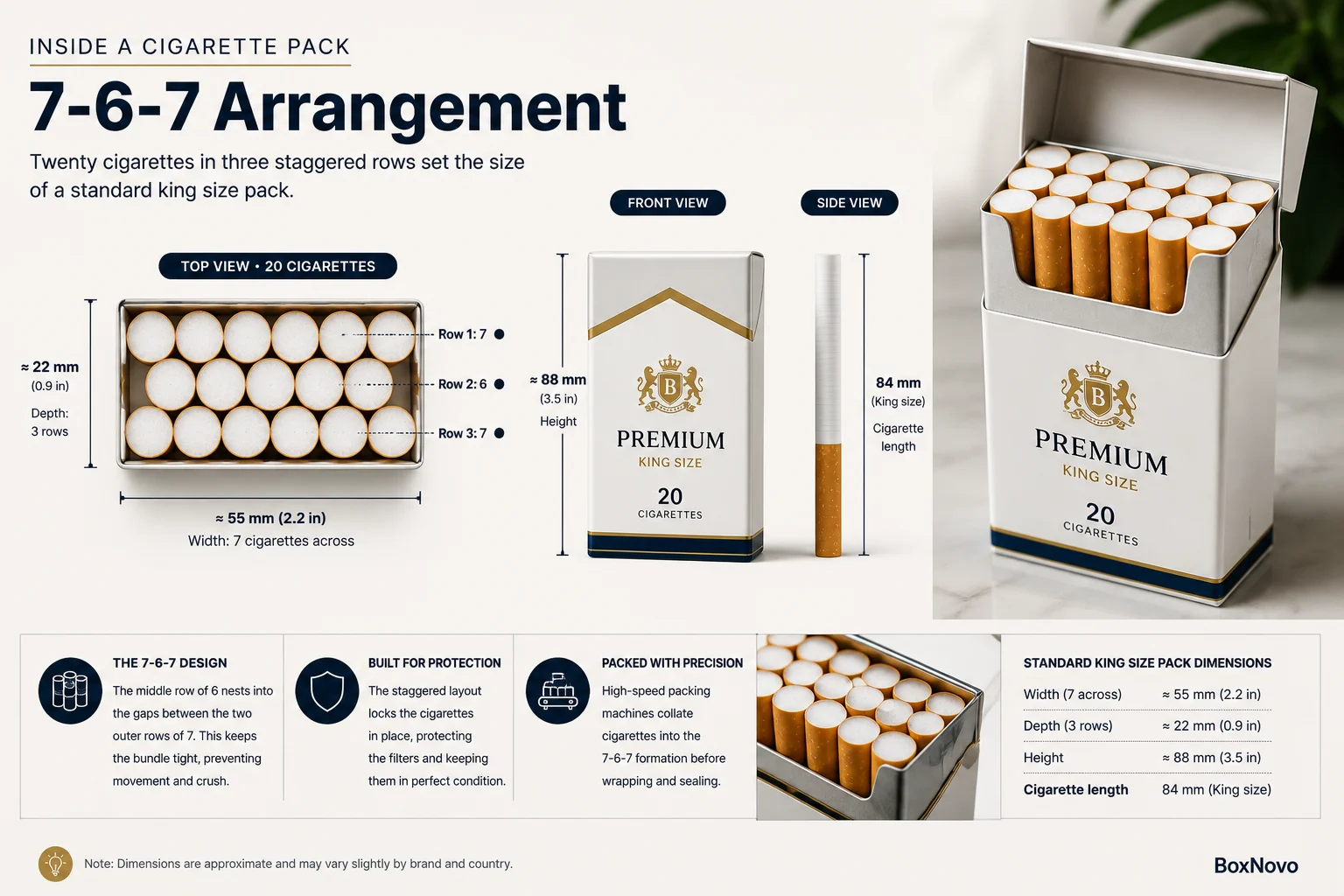
Most 20-cigarette packs hold the cigarettes in three staggered rows: 7, 6 and 7. The middle row of 6 nests into the gaps between the two outer rows of 7, which keeps the bundle tight so the cigarettes do not shift or crush. On the production line, packing machines group the cigarettes into this formation before wrapping them in a foil liner and closing the pack, a process known as collation. You can read more about how collation works in printing and on packaging lines.
How Many Packs of Cigarettes Are in a Carton?
How many packs of cigarettes are in a carton? A standard carton holds 10 packs. With 20 cigarettes in each pack, that makes 200 cigarettes per carton. This 10-pack carton is the standard in the US and in most markets that use 20-stick packs. Australia also standardized cartons at 10 packs from 1 July 2025.
| Unit | Packs | Cigarettes |
|---|---|---|
| 1 pack | 1 | 20 |
| Half a carton | 5 | 100 |
| 1 carton (sleeve) | 10 | 200 |
| 2 cartons | 20 | 400 |
| 5 cartons | 50 | 1,000 |
| 1 carton of 25-count packs (where sold) | 10 | 250 |
Quick formulas: cigarettes = packs × 20. Packs = cartons × 10. Cigarettes = cartons × 200. For 25-count packs, replace 20 with 25.
Example for retailers: a store that receives 30 cartons has 300 packs, or 6,000 cigarettes, to put on the shelf. Counting by carton and pack, never by cigarette, keeps ordering and stock checks simple.
What Is a Carton of Cigarettes?
A carton of cigarettes is a paperboard outer package that holds several packs, usually 10, sealed together for sale and distribution. Retailers stock cartons, and many shoppers buy a carton of cigarettes instead of single packs. In casual speech, people also call it a carton of cigs or a sleeve. All three terms mean the same 10-pack unit.
The carton is the middle layer of a three-level packaging system:
| Level | Unit | Typical Contents | Main Job |
|---|---|---|---|
| Primary | Pack | 20 cigarettes | Protects the cigarettes and carries required warnings |
| Secondary | Carton | 10 packs (200 cigarettes) | Groups packs for retail sale, storage and stocking |
| Tertiary | Shipping case | Many cartons; count varies by manufacturer | Protects cartons during shipping and warehousing |
Most consumer products use the same three layers, and these packaging levels explained show how they work together. The number of cartons in a wholesale shipping case is not standardized and depends on the manufacturer and distributor, so always check the case label or invoice rather than assuming a fixed number.

Pack, Packet, Carton or Sleeve? Common Terms
| Term | Meaning |
|---|---|
| Pack | The single box of cigarettes, usually 20. The common US word. |
| Packet | The same as a pack. More common in British, Irish and Australian English. |
| Carton / sleeve / carton of cigs | 10 packs sold as one unit, usually 200 cigarettes. |
| Case | A wholesale shipping box holding many cartons. |
| 20s / 25s | Shorthand for packs of 20 or 25 cigarettes. |
| King size / 100s / 120s | Cigarette length (about 84, 100 or 120 mm), not the count. |
| Box / hard pack | A rigid flip-top pack. |
| Loosies | Single cigarettes sold outside a pack, which US rules prohibit. |
How Many Cigarettes in a Pack by Country?
Most countries with pack-size laws require at least 20 cigarettes per pack, and Australia now allows exactly 20. The number of cigarettes in a cigarette pack is set by law in many countries, and rules change over time, which is why many older guides still list sizes that are no longer sold.
| Country or Region | Cigarettes per Pack | Key Rule |
|---|---|---|
| United States | 20 standard; some 25 | No packs under 20 (21 CFR 1140.16) |
| European Union | At least 20 | Packs must be cuboid and hold at least 20 (Directive 2014/40/EU, Article 14) |
| United Kingdom | At least 20 | Minimum of 20 with standardized plain packs; 10-packs were phased out by May 2017 |
| Canada | 20 or 25 are common | At least 20 per package (Tobacco and Vaping Products Act); plain slide-and-shell packs |
| Australia | 20 only | Since 1 July 2025, every pack holds 20 and every carton holds 10 packs (Australian Government) |
| Parts of Asia and Africa | 10 or 20 | Smaller 10-stick packs are still sold in some markets |
Note on Australia: many guides still say Australian packs hold 25, 26, 30 or more. That was true in the past, but Australia standardized pack sizes at 20 cigarettes from 1 July 2025.
Types of Cigarette Packs
The two main types of cigarette pack are the hard pack (flip-top box) and the soft pack. A pack of cigarettes can look very different from brand to brand and country to country, but most fall into the formats below.
| Pack Type | How It Works | Typical Count |
|---|---|---|
| Hard pack (flip-top box) | Rigid paperboard box with a hinged lid; can be closed again after opening. Philip Morris introduced the flip-top hard pack in 1955. | 20 |
| Soft pack | Thin paper wrap opened by tearing the top; cannot be resealed and crushes more easily | 20 |
| Slide-and-shell | An inner tray slides out of an outer shell; required for cigarettes in Canada under its plain packaging rules | 20 or 25 |
| 100s and longer packs | Taller hard or soft packs that fit longer cigarettes | 20 |
| Slim packs | Narrower packs for thinner cigarettes | Usually 20 |
What Is Inside a Hard Pack?
- Clear outer film with a tear strip, which seals the pack and keeps it fresh.
- Paperboard shell with the hinged lid and printed panels for branding and required warnings.
- Inner frame (collar): a stiff paperboard insert that holds the lid closed and keeps its shape.
- Foil or metallized paper liner wrapped around the 7-6-7 bundle to protect aroma and freshness.
The slide-and-shell format works much like slide-out sleeve packaging used for other retail products, and hard packs are made from folding paperboard packaging materials.
Cigarette Pack Dimensions
A standard king size cigarette pack of 20 measures about 88 × 55 × 22 mm, or 3.5 × 2.2 × 0.9 inches. The pack is sized tightly around its contents, so you can work out these dimensions from the cigarettes themselves:
- Width: 7 cigarettes side by side at about 7.9 mm each ≈ 55 mm.
- Depth: three staggered rows (7-6-7) ≈ 22 mm.
- Height: an 84 mm cigarette plus a few millimeters for the lid and board ≈ 87 to 88 mm.
| Pack | Approximate Size (mm) | Approximate Size (inches) |
|---|---|---|
| King size, 20 cigarettes | 88 × 55 × 22 | 3.5 × 2.2 × 0.9 |
| 100s, 20 cigarettes | About 104 × 55 × 22 | About 4.1 × 2.2 × 0.9 |
Exact sizes vary by brand, board thickness and country. Some countries, such as Canada, prescribe pack dimensions in their plain packaging rules.
Standard Cigarette Sizes
| Cigarette Type | Typical Length | Typical Diameter |
|---|---|---|
| Regular (non-filter) | About 70 mm | About 7.9 mm |
| King size | About 84 mm | About 7.9 mm |
| 100s | About 100 mm | About 7.9 mm (slim versions are narrower) |
| 120s | About 120 mm | Usually slim |
| Superslim | Often king size length | About 5.4 mm |
Standard king size cigarettes have a circumference of about 25 mm, and superslims about 17 mm, according to CORESTA, the tobacco science research body. Those circumferences work out to the diameters above.
Cigarette Carton Size and Packaging
A king size cigarette carton measures roughly 275 × 90 × 45 mm, or about 10.8 × 3.5 × 1.8 inches. It is a long, flat paperboard box that holds 10 packs lying in two layers of five. Its size follows the pack size, so a carton of 100s is longer in one direction than a carton of king size packs, and exact sizes vary by brand.
Cartons do three jobs:
- Retail sale: shoppers can buy 10 packs as one unit.
- Stock control: stores count and reorder by carton instead of by pack.
- Protection: cartons keep packs clean, square and undamaged in storage and transit.
When cartons are shipped in bulk, the outer case size drives freight cost, so distributors size cases carefully. This guide to measuring a shipping case explains length, width and height, and this DIM weight calculator shows how box size affects shipping charges.
Little Cigars, Cigarillos and Roll-Your-Own Tobacco
Pack-size rules do not always stop at cigarettes. Some countries apply similar minimums to other tobacco products:
- Canada: cigarettes, little cigars and blunt wraps must be sold in packages of at least 20 units.
- Australia: since 1 July 2025, little cigar packs hold 20 cigars and roll-your-own pouches hold 30 grams of tobacco.
- United States: the federal 20-unit minimum covers cigarette packages. Cigars, cigarillos and other products follow their own federal, state and local rules.
How Much Is a Pack of Cigarettes?
A common search, often typed as “how much packet of cigarettes,” can mean two things: how many cigarettes are in a pack (20) or how much a pack costs. Prices change often and vary widely by location, so this guide explains what sets the price instead of listing figures that quickly go out of date.
The price of a pack of cigarettes in the US is built from:
- Federal excise tax: $1.01 per pack of 20 ($50.33 per 1,000 cigarettes), a rate in place since April 2009.
- State excise tax: set by each state and the biggest reason prices differ so much from state to state.
- Local taxes: some cities and counties add their own tax.
- Manufacturer price and brand: premium brands cost more than discount brands.
- Retailer margin and sales tax.
| To Work Out | Formula |
|---|---|
| Price per cigarette | Pack price ÷ 20 |
| Approximate carton price | Pack price × 10 (some stores price cartons slightly lower) |
| Price per cigarette from a carton | Carton price ÷ 200 |
For current figures, check your state’s department of revenue, which publishes its cigarette tax rate.
US Rules Every Seller Should Know
- Minimum pack size: no packs of fewer than 20 cigarettes.
- No single cigarettes: retailers may not open a pack to sell individual cigarettes (“loosies”) or any number smaller than the minimum pack.
- Minimum age: the federal minimum age to buy tobacco products is 21.
- Health warnings: packs, cartons and advertising must carry required warning statements.
- Tax stamps: most states require a tax stamp on each pack to show state tax was paid.
Warnings, tax stamps and barcodes all compete for space on a small pack, so the artwork has to be planned around them, the same way you would when planning label content for any regulated product.
State and local laws can add further rules. This summary is general information, not legal advice, so sellers should confirm current requirements with federal, state and local authorities.
What Is a Pack-Year?
A pack-year is a measure doctors use to describe how much a person has smoked over time. It is built on the standard 20-cigarette pack: multiply the number of packs smoked per day by the number of years smoked. One pack a day for one year equals one pack-year, and so does two packs a day for six months (National Cancer Institute SEER).
| Smoking History | Calculation | Pack-Years |
|---|---|---|
| 1 pack (20 cigarettes) a day for 20 years | 1 × 20 | 20 |
| Half a pack (10 cigarettes) a day for 30 years | 0.5 × 30 | 15 |
| 2 packs (40 cigarettes) a day for 10 years | 2 × 10 | 20 |
Pack-years matter for health screening. The US Preventive Services Task Force recommends yearly lung cancer screening with low-dose CT for adults aged 50 to 80 with a history of at least 20 pack-years who currently smoke or quit within the past 15 years (AAFP summary of the USPSTF recommendation). Anyone who fits that description should ask a doctor about screening.
A Short History of the Cigarette Pack
| Milestone | What Changed |
|---|---|
| Early 20th century | Packs of 20 become a common retail size, and printed packs grow into a key branding tool. |
| 1955 | Philip Morris introduces the flip-top hard pack, which protects cigarettes from crushing and can be closed again. |
| 1966 | US packs begin carrying federally required health warnings. |
| 1998 | The US Master Settlement Agreement includes a 20-cigarette minimum pack size, which expires at the end of 2001. |
| 2010 | An FDA rule restores the 20-cigarette minimum pack size in the US. |
| 2012 | Australia becomes the first country to require plain packaging, followed later by others including the UK, France and Canada. |
| 2014 to 2017 | The EU sets a minimum of 20 cigarettes in cuboid packs, and the UK phases out packs of 10. |
| 2025 | Australia standardizes every cigarette pack at 20 and every carton at 10 packs. |
Common Myths and Mistakes
| Myth | Fact |
|---|---|
| “A pack of 100s has 100 cigarettes.” | 100s are 100 mm long cigarettes. The pack still holds 20. |
| “US law says packs must contain exactly 20.” | The law sets a minimum of 20. Larger packs, such as 25s, are allowed. |
| “Australian packs hold 25, 26 or 30.” | Not anymore. Since 1 July 2025, Australian packs hold 20 and cartons hold 10 packs. |
| “A carton and a case are the same.” | A carton holds 10 packs. A shipping case holds many cartons. |
| “A sleeve is half a carton.” | In the US, sleeve is slang for a full 10-pack carton. |
| “Packs of 10 are sold in the US.” | They are not allowed. The minimum is 20. |
What Brands Can Learn From the Cigarette Pack
The cigarette pack is one of the most refined small packages ever made. Whatever you sell, its design offers useful lessons:
- Size the box to the product: the pack is built around the exact 7-6-7 bundle, with no wasted space. The same approach applies when choosing custom box dimensions for any product.
- Make it easy to open and reclose: the flip-top lid and inner frame let users open the pack many times without damage.
- Protect freshness: the foil liner and sealed outer film keep contents in good condition.
- Plan the whole system: pack, carton and case are designed together, so each fits the next. The same thinking applies to packaging structure and branding for any product line.
- Design for the counter: packs are made to display well at the point of sale, much like countertop display packaging.
BoxNovo produces branded cigarette packaging with a hinged opening, along with pre-roll packaging options and custom cigar packaging. You can explore the full range of CBD and smoke-shop boxes. Tobacco packaging must follow the rules of every market where it is sold, including warning labels, pack sizes and, in some countries, plain packaging.
Quick Reference
| Question | Answer |
|---|---|
| How many cigarettes in a pack? | 20 (standard) |
| How many packs of cigarettes are in a carton? | 10 |
| How many cigarettes in a carton of cigarettes? | 200 |
| Smallest legal pack in the US | 20 cigarettes |
| Is a sleeve the same as a carton? | Yes, 10 packs |
| Do 100s have more cigarettes? | No, they are longer, not more |
Frequently Asked Questions
How many cigs in a pack?
A standard pack holds 20 cigs. In the US, 20 is also the legal minimum, and some brands sell packs of 25.
How many cigarettes are in a carton of cigs?
A carton of cigs holds 10 packs of 20, which is 200 cigarettes. With 25-count packs, a 10-pack carton holds 250.
How many packs are in a sleeve of cigarettes?
A sleeve is another name for a carton, so it holds 10 packs, or 200 cigarettes.
How many cigarettes are in half a carton?
Half a carton is 5 packs, or 100 cigarettes.
How many cigarettes are in a pack of Marlboro?
A standard pack of Marlboro cigarettes in the US holds 20, and a Marlboro carton holds 10 packs, or 200 cigarettes.
How many cigarettes are in a pack of Newports?
A standard pack of Newports holds 20 cigarettes, the same as other major US brands.
Can you buy a pack of 10 cigarettes in the US?
No. US regulations do not allow packs of fewer than 20 cigarettes.
Are 25-cigarette packs legal in the US?
Yes. The law sets a minimum, not a maximum, so packs of 25 are allowed and are sold by some brands.
How many cigarettes are in a pack of 100s?
20. “100s” refers to the 100 mm length of each cigarette, not the number in the pack.
Why can’t stores sell single cigarettes?
US rules stop retailers from opening a pack to sell individual cigarettes or any amount smaller than the 20-cigarette minimum pack.
How many cigarettes are in a pack in Australia?
20. Since 1 July 2025, Australian cigarette packs must contain 20 cigarettes and cartons must contain 10 packs.
How many cigarettes are in a pack in Canada?
At least 20. Packs of 20 and 25 are both common in Canada.
How many cigarettes are in a pack in the UK?
At least 20. Packs of 10 were phased out by May 2017.
How many cartons are in a case of cigarettes?
It varies by manufacturer and distributor. Check the case label or invoice for the exact count.
How many cigarettes are in a box?
A box usually means a hard pack, which holds 20 cigarettes. A box of 10 packs is a carton, which holds 200.
How many cigarettes are in a soft pack?
A standard soft pack holds 20 cigarettes, the same as a hard pack.
How many cigarettes are in a pack in Europe?
At least 20. EU law requires every pack to hold at least 20 cigarettes, and packs with more than 20 are sold in some countries.
What is a pack-year?
A pack-year equals smoking one 20-cigarette pack a day for one year. Doctors multiply packs per day by years smoked to measure smoking history.
Final Takeaway
A standard pack of cigarettes holds 20, a carton of cigarettes holds 10 packs, and that makes 200 cigarettes per carton. In the US, 20 is the legal minimum, larger 25-count packs are allowed, and terms like king size and 100s describe length, not count. Rules outside the US vary, and some, like Australia’s, have recently changed, so check local law for any market you sell in.
Smoking causes serious disease. If you or someone you know wants help quitting, call 1-800-QUIT-NOW in the US for free support.
If you are designing packaging for tobacco, CBD or related products, BoxNovo can help with structure, sizing and print. Get a packaging quote to start your project.
Sources
- US Code of Federal Regulations, 21 CFR 1140.16: minimum cigarette package size
- EU Tobacco Products Directive 2014/40/EU, Article 14
- Canada Tobacco and Vaping Products Act, section 10
- Australian Government Department of Health: tobacco reforms
- CORESTA: cigarette circumference by format
- US Patent 4,784,261: conventional 7-6-7 arrangement of 20 cigarettes
- US Treasury testimony to the Senate Finance Committee: federal cigarette excise tax
- National Cancer Institute SEER glossary: pack-year
- AAFP: USPSTF lung cancer screening recommendation