
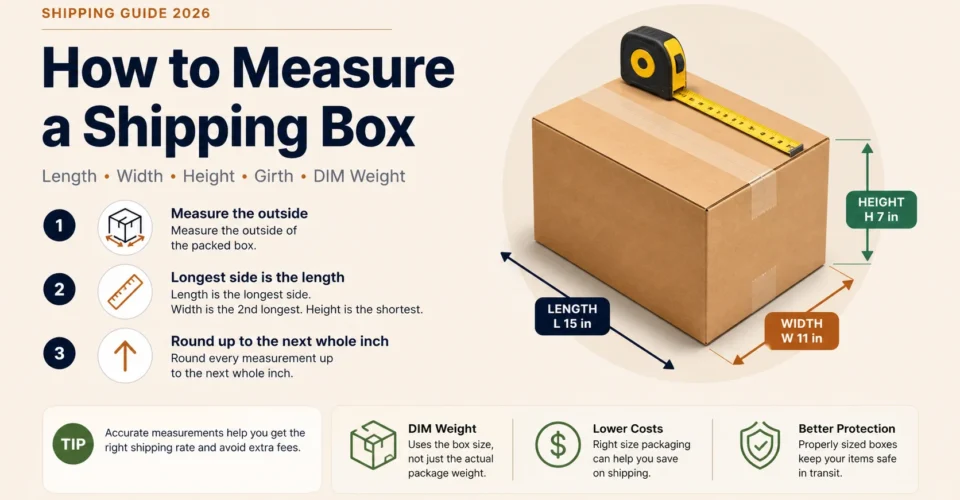
To measure a shipping box, measure the outside of the packed, sealed box with a tape measure. The length is the longest side, the width is the next longest side, and the height is the shortest side. Round each number up to the next whole inch and write it as length × width × height (L × W × H). UPS, FedEx and USPS use those three numbers to work out dimensional weight, girth and any oversize fees, so a quarter inch can change what you pay.
This guide shows how to measure a box for shipping step by step, how to calculate girth and length plus girth, how each carrier rounds and bills package size in 2026, and how to measure tubes, poly mailers and odd shapes. It ends with a calculator that does the math for you.
Key takeaways
- Measure the outside of the box after it is packed and taped, not the inside and not the product.
- Length is always the longest side. Width is the second longest. Height is the shortest.
- Round up every fraction to the next whole inch: 14.2 in counts as 15 in at UPS, FedEx and USPS.
- Girth is 2 × width + 2 × height. Length plus girth is L + 2W + 2H.
- Dimensional (DIM) weight is L × W × H ÷ 139 for UPS Daily Rates, FedEx and USPS (USPS only for boxes over 1,728 cubic inches). You pay for the higher of DIM weight and actual weight.
- Boxes longer than 22 in (USPS) or 48 in (UPS and FedEx) start to trigger extra fees.
In this guide
- How to Measure a Shipping Box in 5 Steps
- Length, Width and Height: Which Side Is Which?
- Inside vs Outside Dimensions: Measure the Outside for Shipping
- How to Calculate Girth and Length Plus Girth
- Dimensional Weight: How Carriers Bill Package Size
- Carrier Size Limits and Oversize Fees in 2026
- How to Measure Tubes, Poly Mailers and Irregular Packages
- Common Package Measuring Mistakes (and What They Cost)
- How to Reduce Dimensional Weight With the Right Box Size
- Common Shipping Box Sizes and Their DIM Weight
- What to Enter on the Label and in Shipping Software
- Frequently Asked Questions About Measuring a Shipping Box
- Measure Once, Ship Smarter
How to Measure a Shipping Box in 5 Steps
You need a tape measure or a rigid ruler, a flat surface and the box packed exactly as it will ship. Here is how to measure box dimensions for shipping:
- Pack and seal the box first. Add the product, the void fill and any inserts, then tape it shut. Contents can bulge the panels, and carriers measure the box you hand them, not the empty one.
- Measure the length. Find the longest side of the box and measure it from one outside edge to the other. Keep the tape straight and flat against the panel. If a panel bulges, measure across the widest point.
- Measure the width. Turn the box 90 degrees and measure the next longest side, edge to edge on the outside.
- Measure the height. Measure the remaining side, the shortest one, from the bottom of the box to the top of the closed flaps.
- Round up and write it down. Round each measurement up to the next whole inch, then write the size as L × W × H with the longest number first, for example 15 × 11 × 7 in. Weigh the box and round the weight up to the next whole pound.
That's the whole method for a standard box. The rest of this guide explains why each step matters, because most shipping surprises come from measuring the wrong side, the wrong surface or skipping the rounding.
Length, Width and Height: Which Side Is Which?
For shipping, the names follow size, not how the box sits on a table. UPS puts it simply: measure the longest side first, and that is the length. Then rotate the box and measure the next longest side for the width, and the last side is the height.
| Dimension | What it means for shipping | Example: a 15 × 11 × 7 in box |
|---|---|---|
| Length (L) | The longest side | 15 in |
| Width (W) | The second-longest side | 11 in |
| Height (H) | The shortest side | 7 in |
| Order on the label | Longest to shortest | 15 × 11 × 7 |
The order matters because two carrier rules are tied to specific sides. Length plus girth always starts from the longest side, and fees such as the USPS $4.50 charge for packages longer than 22 inches look at the longest side wherever it points.
Box makers use a different order. A regular slotted carton is usually ordered as length × width × depth, where the first two numbers describe the opening and the depth is the distance from opening to bottom. So a carton sold as 10 × 6 × 14 has a 10 × 6 in opening and is 14 in deep, but for a shipping label it becomes 14 × 10 × 6. If you're sizing a custom box for a product, use the manufacturing order. If you're filling in a shipping label, sort the numbers from longest to shortest.
Inside vs Outside Dimensions: Measure the Outside for Shipping
Carriers bill the space a package takes up on the truck, so they use the outside dimensions. The inside dimensions only tell you whether your product fits.
The difference comes from the thickness of the board. A cardboard box can't have the same inside and outside size, because its walls take up room, and the flaps double up at the top and bottom. A common rule of thumb for regular slotted corrugated boxes:
| Box wall | Add to inside length and width | Add to inside height |
|---|---|---|
| Single-wall corrugated (most mailing boxes) | About 1/4 in | About 1/2 in |
| Double-wall corrugated (heavy or fragile items) | About 1/2 in | About 1 in |
These are estimates, because flute size and box style change the numbers. A box listed as 12 × 12 × 12 inside can measure 12¼ × 12¼ × 12½ outside, which rounds up to 13 × 13 × 13 for shipping. That takes the box from 1,728 cubic inches to 2,197, and its DIM weight at UPS or FedEx from 13 lb to 16 lb.
If you buy boxes, ask the supplier whether the listed size is inside or outside. Stock boxes are usually listed by inside dimensions. The quickest way to be sure is to measure one packed box yourself. If you're choosing between corrugated board grades, remember that thicker double-wall board adds outside size as well as strength.
How to Calculate Girth and Length Plus Girth
Girth is the distance around the thickest part of the box, measured around the two sides that are not the length. Carriers use it with the length to set their size limits.
Girth = (2 × width) + (2 × height)
Length plus girth = length + (2 × width) + (2 × height)
Using the 15 × 11 × 7 in box:
- Girth = (2 × 11) + (2 × 7) = 22 + 14 = 36 in
- Length plus girth = 15 + 36 = 51 in
You can also measure girth directly. Wrap a soft tape measure once around the middle of the box, crossing the width and height sides but not the length, and read the number where the tape meets.
Watch out for one common mix-up. Some guides call L + 2W + 2H the "girth." It isn't. That figure is length plus girth, which is the number carriers compare with their limits. Girth on its own leaves the length out.
Dimensional Weight: How Carriers Bill Package Size
Dimensional weight, also called DIM weight or volumetric weight, is a weight carriers assign to a box based on its size. You pay for whichever is higher: the actual weight or the DIM weight. That's why a light but bulky box can cost the same as a heavy one.
DIM weight (lb) = length × width × height (in inches) ÷ DIM divisor
Billable weight = the higher of actual weight and DIM weight, rounded up to the next pound| Carrier and rate type | DIM divisor | When DIM weight applies | How dimensions are rounded |
|---|---|---|---|
| UPS Daily Rates | 139 | Every package | Up to the next whole inch |
| UPS Retail Rates (UPS Store and walk-in) | 166 | Every package | Up to the next whole inch |
| FedEx (standard list rates) | 139 | Every package | Up to the next whole inch |
| USPS Ground Advantage, Priority Mail, Priority Mail Express | 139 (was 166 before July 12, 2026) | Only boxes over 1 cubic foot (1,728 cu in) | Up to the next whole inch since July 12, 2026 |
| DHL Express (international, metric) | 5,000 | Every package | Formula uses cm and gives kg |
FedEx and UPS both started rounding every fraction of an inch up to the next whole inch on August 18, 2025. Before that, fractions under half an inch were often rounded down. USPS followed on July 12, 2026, when it also cut its divisor from 166 to 139, so a 12.2 in side is now billed as 13 in at all three carriers. USPS cubic pricing still uses its own quarter-inch rule.
A Worked Example: Why a Few Tenths of an Inch Matter
Say your packed box measures 14.2 × 10.4 × 6.1 in and weighs 4.3 lb.
- Round each side up: 15 × 11 × 7 in.
- Multiply: 15 × 11 × 7 = 1,155 cubic inches.
- Divide by 139: 1,155 ÷ 139 = 8.31, which rounds up to 9 lb.
- Compare with the actual weight: 4.3 lb rounds up to 5 lb. The higher number is 9 lb, so UPS (Daily Rates) and FedEx bill 9 lb.
- USPS: 1,155 cubic inches is under 1,728, so USPS uses the actual weight and bills 5 lb.
Now trim the box so it measures exactly 14 × 10 × 6 in. That's 840 cubic inches, a DIM weight of 6.04, rounded up to 7 lb. Shaving a fraction of an inch off each side saved 2 billable pounds on every UPS and FedEx shipment.
Check Your Own Box
Enter your three measurements in any order and the packed weight. The calculator sorts the sides, rounds them the way carriers do, and shows girth, length plus girth, DIM weight, billable weight and any size fee alerts for UPS, FedEx and USPS.
Shipping Box Measurement Calculator
Enter the three sides of your packed box in any order, plus its weight. You get the length, width and height to type on the label, girth, length plus girth, dimensional weight and billable weight for UPS, FedEx and USPS, plus any size fee warnings.
Estimate based on published 2026 carrier rules: dimensions rounded up to the next whole inch, divisor 139 for UPS Daily Rates, FedEx and USPS (USPS only for boxes over 1,728 cubic inches) and 166 for UPS Retail Rates. Inside-to-outside sizes use a common rule of thumb, not a carrier rule. Negotiated rates, fees and limits can differ, so confirm with your carrier.
Carrier Size Limits and Oversize Fees in 2026
Once you know your box's length and length plus girth, check them against each carrier's limits. These are the published thresholds for domestic US shipments in 2026.
| Rule | USPS | UPS | FedEx Ground |
|---|---|---|---|
| Maximum weight | 70 lb | 150 lb | 150 lb |
| Maximum length | No single-side limit; size is capped by length plus girth | 108 in | 108 in (FedEx Express allows 119 in) |
| Maximum length plus girth | 108 in for Priority Mail and Priority Mail Express; 130 in for Ground Advantage | 165 in | 165 in |
| First size fee | Longest side over 22 in: $4.50 | Additional handling: longest side over 48 in, second-longest side over 30 in, or length plus girth over 105 in | Same additional handling thresholds as UPS |
| Bigger size fee | Longest side over 30 in: $10 (Ground Advantage) or $21 (Priority Mail); over 2 cubic feet: $21 or $35 | Large package: longest side over 96 in, length plus girth over 130 in, or over 17,280 cu in | Oversize: longest side over 96 in or length plus girth over 130 in |
| Minimum billable weight with that fee | None | 40 lb for size-based additional handling; large packages usually 90 lb | 40 lb for additional handling; 90 lb for oversize |
A few details that catch shippers out:
- USPS length fees and volume fees stack. A Ground Advantage box longer than 30 in and larger than 2 cubic feet pays $10 + $21.
- USPS Ground Advantage boxes between 108 and 130 in of length plus girth are charged the oversized price. Anything over 130 in, or over 70 lb, can't be mailed, and USPS now charges a $200 fee if it finds one in the network.
- USPS DIM weight is capped. If a box's DIM weight is over 70 lb, USPS charges the 70 lb price.
- USPS charges $3 when dimensions are missing or wrong on a package that should have paid a size fee, after its scanners measure the box.
Fee amounts change every year or two, so treat the dollar figures as a guide and check the carrier's current price list before you set shipping rates. The size thresholds change far less often.
How to Measure Tubes, Poly Mailers and Irregular Packages
Irregular Shapes
UPS tells shippers to measure an irregular package as if it sat inside a rectangular box. Measure from the extreme points: the furthest point on the left to the furthest point on the right, front to back, and top to bottom. Handles, corners and anything sticking out count. Then use those three numbers like any other box.
Tubes and Cylinders
Measure a mailing tube's length end to end, including the end caps, and its diameter across the widest point.
- For UPS and FedEx, treat the tube as a box whose width and height both equal the diameter. A 38 in tube that is 4 in across is entered as 38 × 4 × 4 in.
- For USPS, girth on a cylinder is the circumference: diameter × 3.1416. USPS also charges a $4.50 nonstandard characteristics fee on tubes and rolls, or the length fee if that's higher. Square or triangular tubes avoid the rolling problem and are easier to measure.
Poly Mailers and Padded Envelopes
Pack the mailer first, then lay it flat. Measure the length and width of the filled mailer, then measure the thickness at its thickest point. Use those three numbers as L × W × H. At USPS, an envelope thicker than 3/4 in is a parcel, not a flat, so a stuffed mailer is priced as a package. Soft goods such as clothing often ship cheaper in branded poly mailers than in a box, because the package has almost no empty space to bill.
Several Boxes Shipped Together
Don't tape two boxes together to save a label. Carriers measure the combined shape, it often ends up longer than 22 in or 48 in, and the joint is a weak point. Ship them as separate packages or use one larger box.
Common Package Measuring Mistakes (and What They Cost)
| Mistake | What happens | Fix |
|---|---|---|
| Measuring the product or the inside of the box | The label shows a smaller size than the carrier's scanner finds, and you're billed an adjustment | Measure the outside of the packed box |
| Measuring before the box is packed | Contents bulge the panels, adding fractions that now round up | Measure after packing and taping |
| Skipping the rounding | Carriers round up anyway, so your quoted rate is too low | Round every side up to the next whole inch |
| Putting the height first | Length plus girth and length fees are calculated on the wrong side | Write the longest side first |
| Treating length plus girth as girth | You think a box is within the limit when it isn't, or the other way round | Girth = 2W + 2H; add the length separately |
| Mixing centimeters and inches | A 30 cm side typed as 30 in makes the DIM weight look huge | 1 in = 2.54 cm, so divide centimeters by 2.54 |
| Guessing from a box's printed size | The printed size is often the inside size | Measure one box yourself and save it in your shipping software |
Carrier dimensioners scan most packages automatically, and if their numbers are bigger than yours, the difference shows up as an adjustment on your invoice. Measuring the same way they do is the simplest way to avoid that.
How to Reduce Dimensional Weight With the Right Box Size
Once you can measure a package accurately, the biggest saving comes from shipping less air. A few practical ways:
- Right-size the box. Leave enough room for protection, not more. Our box sizing tool suggests a box size from your product size and the padding you need.
- Aim for whole-inch outside sizes. Because every fraction rounds up, a box that measures 11.9 in outside costs less to ship than one at 12.1 in.
- Pick the right box style. Printed mailer boxes are shallow and fit flat products well, while custom shipping cartons suit heavier and taller orders. Our kraft mailer guide explains when a mailer is the better choice.
- Use inserts instead of bigger boxes. Inserts and cardboard dividers hold products in place, so you need less void fill and a smaller box. Bottles are a classic case: boxes for bottles with fitted inserts stay compact, and our guide to shipping wine safely shows how.
- Don't downsize past what the box can carry. A smaller box made from lighter board can crush in transit. Check stacking strength before you switch to a thinner board.
- Compare the numbers before you order. Run a proposed size through the calculator above or our DIM weight checker, then estimate wasted material to see how much board and filler you'd save.
Common Shipping Box Sizes and Their DIM Weight
Here are typical outside sizes, worked out with the rules above. "USPS DIM" shows whether USPS applies dimensional weight at all.
| Box size (in) | Cubic inches | Length + girth | DIM weight at 139 | DIM weight at 166 | USPS DIM |
|---|---|---|---|---|---|
| 8 × 6 × 4 | 192 | 28 in | 2 lb | 2 lb | No |
| 6 × 6 × 6 | 216 | 30 in | 2 lb | 2 lb | No |
| 12 × 9 × 3 | 324 | 36 in | 3 lb | 2 lb | No |
| 10 × 8 × 6 | 480 | 38 in | 4 lb | 3 lb | No |
| 14 × 10 × 6 | 840 | 46 in | 7 lb | 6 lb | No |
| 12 × 12 × 8 | 1,152 | 52 in | 9 lb | 7 lb | No |
| 16 × 12 × 8 | 1,536 | 56 in | 12 lb | 10 lb | No |
| 12 × 12 × 12 | 1,728 | 60 in | 13 lb | 11 lb | No (exactly 1 cu ft) |
| 18 × 14 × 8 | 2,016 | 62 in | 15 lb | 13 lb | Yes |
| 20 × 20 × 12 | 4,800 | 84 in | 35 lb | 29 lb | Yes, plus the over-2-cubic-feet fee |
| 24 × 18 × 12 | 5,184 | 84 in | 38 lb | 32 lb | Yes, plus the length and volume fees |
| 18 × 18 × 18 | 5,832 | 90 in | 42 lb | 36 lb | Yes, plus the over-2-cubic-feet fee |
Notice the 12 × 12 × 12 box. At exactly 1,728 cubic inches it is not over 1 cubic foot, so USPS bills its actual weight. If its outside measures 12¼ in on each side, it rounds to 13 × 13 × 13 and USPS DIM weight applies.
What to Enter on the Label and in Shipping Software
- Type whole inches, longest side first, for example 15 × 11 × 7.
- Enter the packed weight rounded up to the next pound, or in pounds and ounces if your software asks for both.
- Save each box you use as a preset in your shipping software. Measure it once, packed, and you won't need to measure it again for every order.
- Re-measure when anything changes, such as a new insert, a thicker board or a different supplier, because the outside size can change even when the inside doesn't.
- For international shipments in centimeters, measure in centimeters and round up to the next whole centimeter, or convert: inches × 2.54 = centimeters. DHL Express divides cm × cm × cm by 5,000 to get volumetric weight in kilograms.
Frequently Asked Questions About Measuring a Shipping Box
How do you measure a box for shipping?
Pack and seal the box, then measure the outside. The longest side is the length, the next longest is the width, and the shortest is the height. Round each side up to the next whole inch and write it as L × W × H, longest first.
Is the length always the longest side of a package?
Yes. For shipping, UPS, FedEx and USPS all treat the longest side as the length, however the box sits. Width is the second-longest side and height is the shortest.
Do you measure the inside or outside of a box for shipping?
Measure the outside. Carriers bill the space the package takes up, so they use outside dimensions. Inside dimensions only matter for checking that your product fits.
What order do box dimensions go in?
On a shipping label, write length × width × height, from the longest side to the shortest. Box makers often use length × width × depth instead, where the first two numbers describe the opening, so re-sort those numbers before you buy a label.
How do you measure a package for USPS?
Measure the packed box the same way: length is the longest side, then width and height. Round each side up to the next whole inch. USPS uses length plus girth for its size limits (108 in for Priority Mail, 130 in for Ground Advantage) and charges extra when the longest side is over 22 in.
How do you calculate girth for shipping?
Girth = (2 × width) + (2 × height). For a 15 × 11 × 7 in box, girth is 22 + 14 = 36 in. You can also wrap a soft tape around the middle of the box, crossing the width and height but not the length.
What is length plus girth?
It's the length plus the girth: L + 2W + 2H. A 15 × 11 × 7 in box measures 15 + 36 = 51 in. UPS and FedEx accept up to 165 in, USPS Ground Advantage up to 130 in, and USPS Priority Mail up to 108 in.
Do you round up box measurements for shipping?
Yes. UPS and FedEx have rounded every fraction of an inch up to the next whole inch since August 18, 2025, and USPS has done the same since July 12, 2026. A 12.2 in side is billed as 13 in.
What is dimensional weight?
It's a weight based on the box's size: L × W × H in inches divided by a divisor, rounded up to the next pound. Carriers charge the higher of DIM weight and actual weight, so large, light boxes cost more than their weight suggests.
What DIM divisor do UPS, FedEx and USPS use in 2026?
UPS uses 139 for Daily Rates and 166 for Retail Rates. FedEx uses 139 for standard rates. USPS switched from 166 to 139 on July 12, 2026, and applies dimensional weight only to boxes over 1,728 cubic inches. Negotiated contracts can use different divisors.
How do you measure box size in centimeters?
Measure the outside of the packed box in centimeters, longest side first, and round up. To convert to inches for US carriers, divide by 2.54. For international express shipments, volumetric weight is usually cm × cm × cm ÷ 5,000, giving kilograms.
How do you measure a poly mailer for shipping?
Fill and seal the mailer, lay it flat, and measure its length, width and thickest point. Use those as L × W × H. At USPS, anything thicker than 3/4 in is priced as a package rather than a large envelope.
How do you measure a tube for shipping?
Measure the length end to end, including the caps, and the diameter. UPS and FedEx treat the tube as a box with width and height equal to the diameter. USPS uses the circumference as the girth and adds a nonstandard characteristics fee for tubes.
What happens if my package measurements are wrong?
Carriers scan packages with dimensioning machines. If their measurements are larger, they bill the difference as an adjustment, and USPS adds a $3 fee when wrong or missing dimensions would have triggered a size fee. Measuring the packed box's outside and rounding up avoids most adjustments.
What is the largest box I can ship with USPS?
A USPS Ground Advantage package can measure up to 130 in of length plus girth and weigh up to 70 lb. Priority Mail and Priority Mail Express allow up to 108 in. Larger or heavier packages need UPS, FedEx or freight.
Measure Once, Ship Smarter
Measuring a shipping box takes a minute: outside of the packed box, longest side first, every side rounded up, then girth and DIM weight. Getting it right means accurate shipping quotes, no carrier adjustments and a clear picture of which box sizes cost you money.
If your measurements show you're paying to ship empty space, a box built to your product's size usually fixes it. Get a price range for custom shipping boxes in seconds, or talk to our team about a size, board and insert that keep DIM weight down.