

Quick answer: Custom drone packaging boxes hold the folded drone, controller, batteries and propellers in separate fitted cavities, survive parcel shipping, follow lithium battery shipping rules and present the brand well. Most use a rigid or corrugated box with a die-cut foam or molded insert, plus a plain outer shipping carton for e-commerce orders.
Key facts at a glance
- Protection: fitted cavities for every part, a guard for the gimbal camera and no loose movement
- Fit: design around the folded drone and every accessory, then add the outer shipper
- Batteries: drone batteries ship as UN3481 (lithium ion in or with equipment); standard shipping limits are 100 Wh per battery and 20 Wh per cell
- Testing: ISTA 3A simulates parcel delivery for packages up to 150 lb (70 kg)
- Presentation: rigid or magnetic boxes for retail, corrugated mailers with inserts for direct-to-consumer shipping
- Insert card: in the US, recreational drones of 250 g (0.55 lb) or more must be registered with the FAA
Shipping and battery rules in this guide are checked against FAA, USPS and federal regulations, listed in the Sources section. This is general guidance, not legal advice; carriers can be stricter than the rules.
In this guide
- Why drone packaging is different
- Protection: inserts and testing
- Fit: sizing a drone box
- Shipping drones with lithium batteries
- Box styles for drones
- Branding and unboxing
- Lessons from other packaging categories
- Sustainable drone packaging
- Common mistakes
- Drone packaging checklist
- Frequently asked questions
- Sources
Why Custom Drone Packaging Boxes Are Different
A drone is not one product but a kit: the aircraft, a controller, one or more lithium batteries, spare propellers, a charger, cables and often a gimbal camera that is easy to damage. Custom drone packaging boxes have to hold all of it in place, protect the most fragile parts, meet battery shipping rules and still look good when the box is opened.
| Drone Component | Packaging Risk | What the Box Must Do |
|---|---|---|
| Gimbal and camera | Bending or knocking during drops | Hold the gimbal still with a guard or a dedicated cavity |
| Arms and frame | Cracks from pressure and impact | Cradle the folded body evenly on all sides |
| Propellers | Bent or chipped blades | Store separately in a pocket or bag |
| Lithium batteries | Short circuit, crushing, shipping restrictions | Separate compartment, terminals protected, rigid outer box |
| Controller | Broken control sticks and screen scratches | Fitted cavity with room for the sticks |
| Charger and cables | Loose parts rattling against the drone | Secure in a lidded compartment or under the main tray |
Protection: How to Keep a Drone Safe in Transit
Protection comes from the insert more than the box. A strong box with a loose drone inside still fails. The goal is simple: every part sits in its own cavity, nothing touches anything else, and nothing can move.

Insert Materials Compared
| Insert | Strengths | Trade-offs | Best For |
|---|---|---|---|
| Polyethylene (PE) foam, die-cut | Closed-cell, moisture-resistant, strong shock absorption, recyclable | Less premium feel than EVA | Most shipping and retail drone boxes |
| EVA foam | Dense, firm, clean cut edges, premium look | Heavier and more expensive | Premium and pro drone kits |
| Polyurethane (PU) foam | Soft and flexible | Open-cell, absorbs moisture, less shock absorption | Light accessories, lid padding |
| Molded pulp | Paper-based, recyclable, holds shape well | Less precise fit; tooling needed for large runs | Eco-focused consumer drones |
| Corrugated or paperboard insert | Low cost, recyclable, easy to print | Less cushioning on its own | Accessories, small drones, partitions |
PE foam is closed-cell and resists moisture, while PU foam is open-cell and absorbs it, which is why PE and EVA are the usual choices for electronics (CIP Packaging). Typical densities range from about 20 to 120 kg/m³ for PE foam and 33 to 280 kg/m³ for EVA, compared with 18 to 45 kg/m³ for PU (PakFactory). Anti-static versions of these foams are available for electronics.
Protection Checklist
- Gimbal: fit the manufacturer’s gimbal guard or design a cavity that stops the camera from moving.
- Arms: pack the drone folded, and cut the cavity to the folded shape so the arms cannot open.
- Propellers: remove them and store them in a separate pocket, sleeve or bag.
- Batteries: give each battery its own cavity, away from metal parts, with terminals covered.
- Controller: leave room for the sticks or remove them if the design allows.
- Loose electronics: ship spare boards or modules in metallized static-shielding bags, which protect against electrostatic discharge outside a controlled area (Eleshop).
- Outer carton: for parcel shipping, place the retail box inside a corrugated shipper with cushioning on all sides. A single-wall 32 ECT corrugated carton is a common starting point; it resists 32 lb of edge crush force per linear inch and is typically used for packages up to about 65 lb (Parcelpath). Use the box strength calculator to check the carton can take the load.
Multi-compartment layouts work like box partition inserts: each item has its own cell, so nothing knocks against anything else.
Transit Testing
Before you order thousands of boxes, test a few packed samples. ISTA 3A is the common test for packages shipped through parcel delivery networks. It covers packages up to 70 kg (150 lb) and includes a series of drops and random vibration, with optional low-pressure vibration to simulate high altitude (ISTA). If you sell on Amazon, the ISTA 6-Amazon.com test series checks packaging against Amazon’s requirements for “Ships in Own Container” (SIOC) and over-boxed products (Element).
Fit: How to Size Custom Drone Packaging Boxes
Good fit means the box is sized around the drone kit, not the other way round. Too much space lets parts move and raises shipping cost; too little crushes parts or makes the box hard to close.
What to Measure
| Item | Measure |
|---|---|
| Drone, folded | Length, width and height without propellers, at the widest points |
| Controller | Length, width and depth, including sticks or screen |
| Batteries | Each battery’s size, and how many come in the kit |
| Propellers and accessories | Spare props, charger, cables, filters, manuals |
| Weight | The full packed kit, for box strength and shipping cost |
Example: the DJI Mini 4 Pro measures 148 × 94 × 64 mm folded without propellers, weighs under 249 g and uses an 18.96 Wh battery (DJI specifications). A box for this drone starts from those folded dimensions, then adds the controller, spare batteries and foam walls around each cavity. Larger camera and enterprise drones need much bigger boxes, often with two layers of inserts.
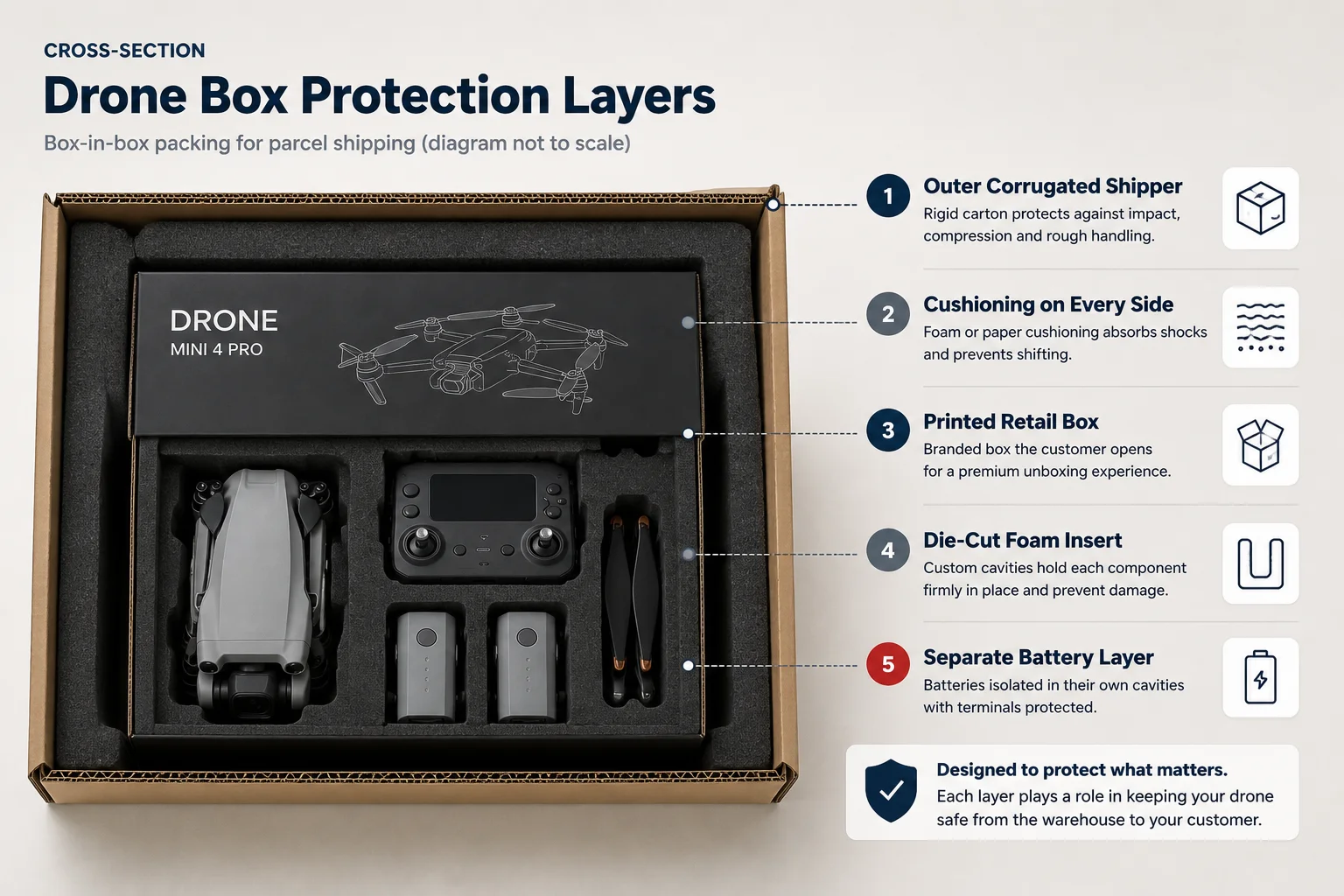
Sizing Steps
- Lay out the kit on a flat surface the way you want it to appear when the box opens.
- Measure each item at its widest point, then add a small, even clearance so parts slide in without forcing.
- Add foam or pulp walls between cavities and around the outside edge.
- Stack layers if needed: a top tray for the drone, a lower layer for batteries, charger and cables.
- Set the inside dimensions of the box from the insert size, then add board thickness for the outside dimensions.
- Size the shipper around the retail box with cushioning on every side.
- Prototype a sample, pack the real kit and drop-test it.
For more detail on measuring and box dimensions, see choosing custom box dimensions and this guide to measuring a shipping box. Oversized shippers raise costs, so check the outer carton with the DIM weight calculator.
Shipping Drones With Lithium Batteries
Drone batteries are lithium ion, so the box has to work with dangerous goods rules. Drone batteries shipped inside the drone or in the same box as it are classed as UN3481: lithium ion batteries contained in equipment, or packed with equipment.
| Rule | What It Means for the Box |
|---|---|
| Watt-hour limits | Standard shipping covers cells up to 20 Wh and batteries up to 100 Wh. Larger batteries face stricter, fully regulated shipping. |
| Strong rigid outer packaging | The outer box must be rigid and strong enough to prevent crushing and movement. |
| Short circuit and activation | Batteries and the drone must be packed so terminals cannot touch metal and the device cannot switch on. |
| Lithium battery mark | Needed on many shipments; leave a clear panel on the outer carton for it. Small shipments with no more than 4 cells or 2 batteries installed in the equipment are often exempt. |
| Drop test for packed-with batteries | For air, spare batteries packed with equipment under the smaller-battery rules need packaging that passes a 1.2 m drop test. |
These requirements come from the FAA’s lithium battery shipping guide and the federal hazardous materials rules (FAA).
Mailing Drones With USPS
- Domestic: lithium ion batteries installed in or packed with equipment can travel by ground or air, up to 100 Wh per battery and no more than 8 cells or 2 batteries per package. The mailpiece must be rigid, sealed and large enough for the lithium battery mark on the address side, unless only up to 4 cells or 2 batteries are installed in the equipment (USPS Packaging Instruction 9D).
- International: batteries must be installed in the drone; spare batteries packed separately are not allowed, and the limit is 4 cells or 2 batteries per package, with no lithium battery mark permitted (USPS Packaging Instruction 9E).
- Used or damaged drones: special restrictions apply, including surface-only transport for many domestic shipments.
UPS, FedEx and DHL have their own battery programs and can be stricter than these rules. Confirm battery rules with your carrier before you finalize the box design.
Box Styles for Custom Drone Packaging Boxes
| Box Style | Best For | Why |
|---|---|---|
| Rigid box with foam insert | Retail and premium drones | Strong walls, premium feel and a fitted insert |
| Magnetic closure rigid box | Gift sets and flagship kits | Book-style opening that reveals the drone |
| Two-piece rigid box (lid and base) | Retail shelves and gift packs | Classic lift-off reveal with deep inserts |
| Corrugated mailer box with insert | Direct-to-consumer and e-commerce | Ships without an extra carton, prints well inside and out |
| Folding carton with sleeve | Small and toy drones | Lower cost with good shelf graphics |
| Corrugated outer shipper | Any retail box sent by parcel | Protects the printed box and keeps the contents discreet |
BoxNovo produces rigid boxes with inserts, magnetic closure rigid boxes, two-piece rigid boxes, corrugated mailer boxes and custom corrugated shippers for drone kits. To compare board grades and rigid materials, see this guide to packaging material types.
Branding and Unboxing
Drones are often a gift or a big purchase, so the unboxing matters. Plan the opening sequence the same way you plan the protection:
- Outer shipper: plain or lightly branded, so high-value contents are not advertised in transit.
- Printed box: product image, model name and key specs on the outside; a printed message or pattern inside the lid.
- First layer: the drone on show in its cavity, with the controller beside it.
- Second layer: batteries, charger, cables and spare props, each in a labeled spot.
- Paper inserts: a quick-start card, safety notes and a QR code to the full manual or app.
- Finishes: matte or soft-touch lamination, spot UV, foil and embossing give a premium feel on rigid boxes.
- Labeled cavities: printing “Batteries,” “Propellers” or icons on the insert speeds up setup and repacking.
- Registration reminder: in the US, recreational drones of 250 g (0.55 lb) or more must be registered with the FAA, so many brands add a reminder card for heavier models (Gigafact, citing the FAA).
- Tamper evidence: branded seal stickers show the box has not been opened; see these tamper seal stickers ideas.
- Manuals: a small booklet must fit its slot; this guide to instruction booklet sizes helps you match the booklet to the box.
For the full process from structure to print, see these steps for packaging design planning.
Lessons From Other Packaging Categories
Drone packaging borrows proven ideas from other product categories. Each one solves a problem drone brands also face:
| Category | What It Does Well | Lesson for Drone Boxes |
|---|---|---|
| Luxury watch packaging boxes | Rigid boxes, fitted cushions and an outer sleeve or shipper | Present a high-value product like a premium object, and protect the presentation box with an outer carton. See rigid presentation boxes. |
| Pharmaceutical packaging boxes | Clear identification, lot codes and tamper evidence; FDA requires tamper-evident packaging for many over-the-counter drugs | Add batch or serial labels and a tamper-evident seal so buyers know the drone is new and untouched. |
| CBD packaging boxes | Packaging planned around rules that vary by market | Plan for battery rules and carrier marks early, before the artwork is final. Compare the CBD box range. |
| Cake packaging boxes | Fragile products kept level, with bases that stop sliding | Use a fitted base so the drone cannot slide, and mark “This side up” on the shipper. See custom cake boxes. |
| Apparel packaging boxes | Lightweight mailers with strong branded unboxing | A printed mailer with an insert can replace a separate retail box and shipper for direct-to-consumer drones. See custom apparel boxes. |
| Hair packaging boxes | Windows and inserts that hold soft products neatly on display | Display-style boxes with a window suit small toy drones on retail shelves. See hair extension boxes. |
The tamper-evident rule for over-the-counter drugs is set out in 21 CFR 211.132. Drone packaging does not have to meet it, but the same idea builds trust in an expensive product.
Sustainable Drone Packaging
- Right-size the box: less empty space means less material and lower shipping cost.
- Paper-based inserts: molded pulp and corrugated inserts are curbside recyclable in many areas, unlike most foams.
- Mono-material where possible: an all-paper box and insert is easier for customers to recycle than mixed materials.
- Recyclable foam: if foam is needed, PE foam can be recycled where facilities exist.
- Reusable packaging: a strong box with a fitted insert doubles as storage, so customers keep it instead of throwing it away.
Common Drone Packaging Mistakes
| Mistake | Fix |
|---|---|
| Designing the box before the insert | Lay out the kit, design the insert, then size the box around it |
| Gimbal free to move | Use a gimbal guard or a cavity that locks the camera in place |
| Batteries loose or touching metal parts | Give each battery its own cavity with terminals protected |
| No space for the lithium battery mark | Leave a clear panel on the outer carton for the mark |
| Shipping the printed retail box with no shipper | Add a corrugated outer carton or use a strong printed mailer |
| Oversized shipping carton | Right-size the shipper and check dimensional weight |
| No transit test | Drop-test packed samples, ideally to ISTA 3A |
| Accessories rattling in a loose tray | Add lidded compartments or a second insert layer |
Drone Packaging Checklist
- Every kit item measured, including the folded drone without propellers.
- Insert material chosen: PE, EVA, molded pulp or corrugated.
- Separate cavities for drone, controller, batteries and propellers.
- Gimbal secured and arms held folded.
- Battery terminals protected and the drone unable to switch on.
- Box style chosen for retail, gift or direct-to-consumer.
- Outer shipper sized with cushioning and space for battery marks.
- Battery rules confirmed with your carrier for domestic and international shipping.
- Quick-start card, booklet and any registration reminder included.
- Packed samples drop-tested before full production.
Frequently Asked Questions
What are custom drone packaging boxes?
Boxes made to fit a specific drone kit, with fitted inserts for the drone, controller, batteries and accessories, printed with the brand’s design.
What is the best insert for drone packaging?
Die-cut PE or EVA foam for most drones, because both are closed-cell and absorb shock well. Molded pulp is the main paper-based option.
Can I ship a drone with the battery inside?
Usually yes, as UN3481 lithium ion batteries contained in equipment, within watt-hour limits and with a strong rigid outer box. Check your carrier’s rules first.
Do I need a lithium battery label on a drone box?
Often. Many shipments need the lithium battery mark, but shipments with no more than 4 cells or 2 batteries installed in the equipment are often exempt. USPS international mail does not permit the mark for installed batteries.
Can I mail spare drone batteries internationally with USPS?
No. USPS international mail only accepts lithium batteries installed in the equipment they power.
What watt-hour limit applies to drone batteries?
Standard shipping covers batteries up to 100 Wh and cells up to 20 Wh. Larger batteries are fully regulated dangerous goods.
Should drones ship in a rigid box or a mailer?
Rigid boxes suit retail and premium kits but need an outer shipper for parcel delivery. Corrugated mailers with inserts suit direct-to-consumer orders.
How do I protect a drone gimbal in packaging?
Fit the gimbal guard and cut a cavity that holds the camera still, so it cannot move during drops.
How do I size a drone box?
Measure the folded drone, controller, batteries and accessories, design the insert around them, then set the box dimensions from the insert.
What test should drone packaging pass?
ISTA 3A is the common parcel delivery test, with drops and vibration for packages up to 150 lb. Amazon sellers may also need ISTA 6 testing.
Do drones need to be registered?
In the US, recreational drones of 250 g (0.55 lb) or more must be registered with the FAA. Many brands include a reminder card in the box.
Is foam packaging recyclable?
PE foam can be recycled where facilities accept it, but it is rarely curbside recyclable. Molded pulp and corrugated inserts are easier to recycle.
Should drone packaging be double-boxed?
Printed retail boxes should ship inside a corrugated outer carton with cushioning. A strong printed mailer with an insert can ship on its own.
How can drone packaging be reused?
A strong box with a fitted insert makes good storage between flights, so many customers keep it.
What box strength do drone shipping cartons need?
A single-wall 32 ECT corrugated carton suits most single drone kits. Heavier or larger professional kits may need double-wall board.
Can custom drone packaging boxes be printed inside and out?
Yes. Rigid boxes and corrugated mailers can be printed on the outside and inside the lid, and inserts can carry labels or icons for each cavity.
Final Takeaway
The best custom drone packaging boxes start with the insert: every part in its own cavity, the gimbal locked, batteries separated and nothing free to move. Size the box around that insert, choose a rigid box or mailer to suit how you sell, follow lithium battery shipping rules, and test packed samples before full production. Branding then turns a safe box into an unboxing customers remember.
Planning packaging for a drone or electronics kit? BoxNovo can design the box, insert and shipper together. Request a packaging quote to get started.
Sources
- FAA: interactive guide to shipping lithium batteries
- USPS Publication 52, Packaging Instruction 9D: lithium batteries, domestic
- USPS Publication 52, Packaging Instruction 9E: lithium batteries, international
- ISTA: Procedure 3A overview
- Element: ISTA 6 Amazon packaging requirements
- CIP Packaging: PE foam vs PU foam
- Parcelpath: 32 ECT box strength
- PakFactory: polyethylene foam and foam comparison
- Eleshop: ESD bag types
- DJI Mini 4 Pro specifications
- Gigafact: FAA drone registration threshold
- 21 CFR 211.132: tamper-evident packaging for OTC drugs