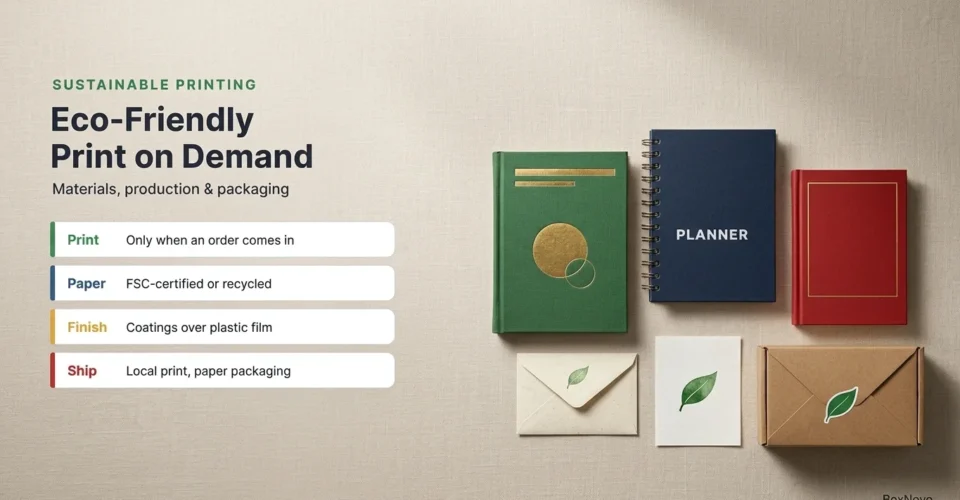
Quick answer: Eco friendly print on demand means printing books, journals, cards, magazines and planners only when they are ordered, on responsibly sourced paper, with recyclable finishes, close to the customer and in right-sized, paper-based packaging. Printing to order avoids unsold stock, but the materials, finishes and shipping you choose decide how green each copy really is.
Key facts at a glance
- How POD works: books are printed “in ultra-short runs or only when an order has been received” (IngramSpark)
- Biggest benefit: no overstock to warehouse, return or pulp
- Paper: FSC 100%, FSC Mix or FSC Recycled labels show responsible sourcing
- Finishes: heavy plastic lamination and glitter make paper harder to recycle
- Local printing: Gelato says 87% of its 2022 orders were produced in the customer’s own country
- Children’s books: ordinary paper books are exempt from US third-party lead testing but must still meet lead limits and carry tracking labels
- Packaging: right-sized paper mailers or book boxes keep the shipment recyclable
In this guide
- What eco-friendly print on demand means
- Is print on demand really greener?
- Materials: paper, inks, finishes and binding
- Production: presses, energy and location
- Product guides: books, journals, cards, magazines, planners
- Packaging considerations
- Making honest green claims
- Eco print on demand checklist
- Frequently asked questions
- Sources
What Is Eco-Friendly Print on Demand?
Print on demand (POD) is digital printing in very short runs, often one copy at a time, triggered by a real order. IngramSpark describes it as books printed “in ultra-short runs or only when an order has been received” (IngramSpark).
Eco friendly print on demand goes one step further: it combines that print-to-order model with lower-impact choices at every stage, from paper and inks to binding, production location and shipping packaging. This guide covers printed products: books, journals, greeting cards, magazines and planners. Apparel print on demand has its own issues (fabric, dyes, garment waste) that are outside this guide.
| Stage | Eco-Friendly Choice |
|---|---|
| Quantity | Print to order or in short runs; no large speculative print runs |
| Paper | FSC-certified or recycled paper, at the lightest weight that works |
| Inks and finishes | Recyclable finishes; avoid glitter, heavy plastic lamination and mixed materials |
| Binding | Paper-friendly bindings; metal wire instead of plastic coils |
| Production | Printers near the customer, with an environmental management system |
| Packaging | Right-sized, paper-based, recyclable shipping packaging |
| Claims | Specific, provable claims instead of vague “eco” language |
Is Print on Demand Really More Sustainable?
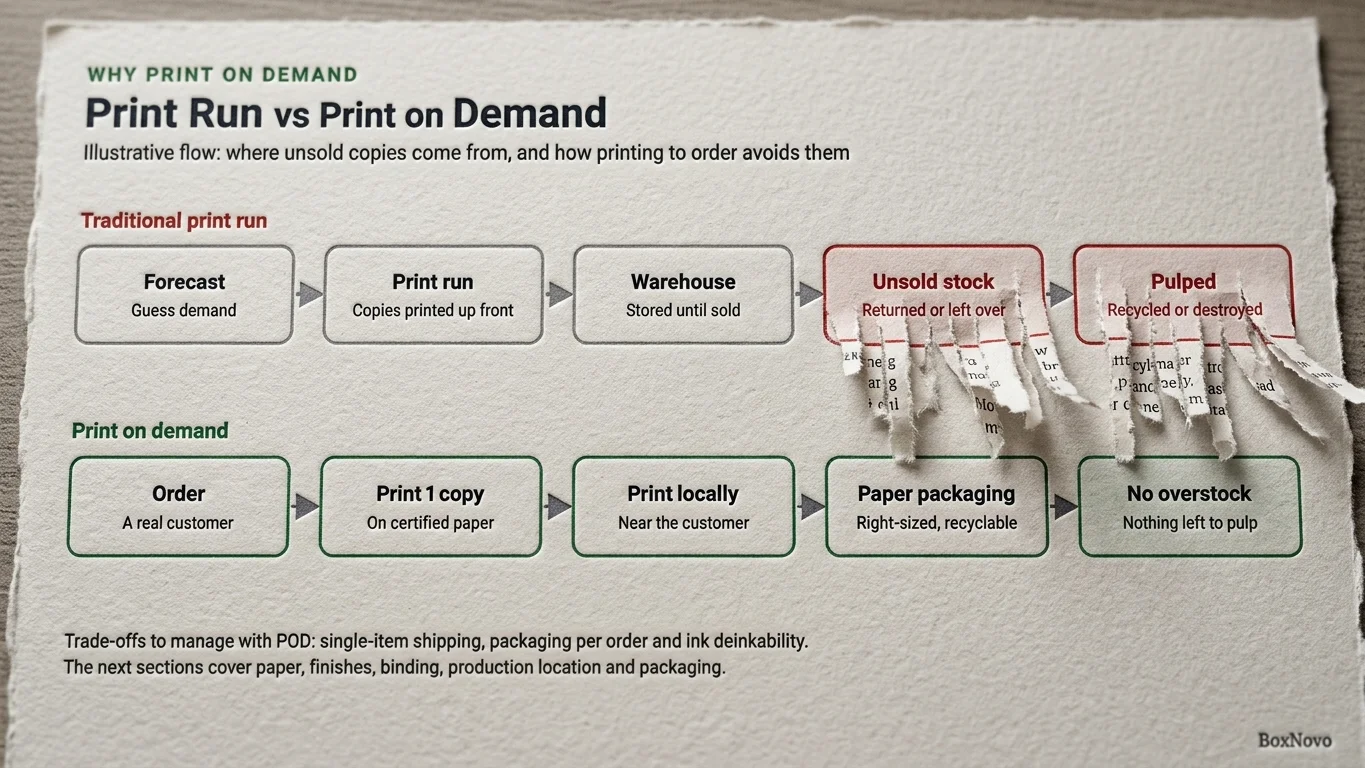
Often yes, but not automatically. The main environmental win is avoiding waste: a traditional print run is a forecast, and copies that do not sell are stored, returned and often pulped. With print on demand, every copy printed already has a buyer.
| Where POD Helps | Where POD Can Cost More |
|---|---|
| No overstock, returns or pulping of unsold copies | Each copy may ship on its own, with its own packaging |
| No warehouse space for slow-selling titles | For very long runs, offset printing can be more efficient per copy |
| Content can be updated before the next copy, so outdated editions are not thrown away | Some digital inks and toners have been harder to remove in paper recycling |
| Printing near the customer shortens shipping distances | Express shipping of single items adds transport emissions |
For a title that sells steadily in large numbers, an offset run on certified paper can be efficient. For niche books, personalized journals, short-run magazines and seasonal planners, print on demand usually wastes far less. The rest of this guide shows how to close the gaps in the right-hand column.
Eco-Friendly Materials: Paper, Inks, Finishes and Binding
Paper
Paper is the biggest material choice in any printed product. The Forest Stewardship Council uses three on-product labels (FSC US):
| FSC Label | What It Means |
|---|---|
| FSC 100% | Made entirely of virgin material from FSC-certified forests |
| FSC Mix | A combination of FSC virgin fiber, recycled material and/or controlled wood |
| FSC Recycled | Made with 100% recycled fiber |
- Recycled content: recycled or FSC Recycled stock uses recovered fiber instead of new pulp.
- Uncoated paper: suits journals, planners and text-heavy books, and takes pen and pencil well.
- Coated paper: gives sharper color for photo books and children’s picture books; choose it where color quality matters.
- Lighter weight: a slightly lighter text paper reduces material use and shipping weight across every copy.
Inks and Toners
Print on demand uses digital presses: dry toner, liquid toner or inkjet. Recycling mills remove ink from recovered paper in a process called deinking, and some digital inks have historically been harder to remove than conventional offset inks (Pulp & Paper International). Press and ink makers now test for this: the European Recovered Paper Council’s deinkability scorecard, based on INGEDE Method 11, grades printed products as good, fair, poor or unsuitable for deinking (Recycling Today). Ask your printer whether its presses and inks have a deinkability rating.
Covers and Finishes
- Lamination: a plastic film on the cover adds durability but mixes plastic with paper. The UK On-Pack Recycling Label scheme treats paper laminated on one side as recyclable but says double-sided laminations “cannot be reprocessed” (OPRL).
- Coatings instead of film: aqueous coatings or varnish protect covers without a separate plastic layer.
- Skip glitter and plastic embellishments: they add materials a paper mill has to remove.
- Use foil sparingly: keep metallic effects to small accents.
Binding
| Binding | Common For | Eco Note |
|---|---|---|
| Saddle stitch (staples) | Magazines, booklets, zines | Simple, paper-based; few materials |
| Perfect binding (glued spine) | Paperback books, journals | Paper plus adhesive; no plastic parts |
| Case binding (hardcover) | Children’s books, premium editions | Uses board for a long-lasting book that gets reread and passed on |
| Wire-O or spiral | Planners, notebooks, cookbooks | Choose metal wire over plastic coil; it lays flat and is easier to separate |
For a full comparison of packaging boards and substrates, see BoxNovo’s separate packaging material types guide; this article focuses on the printed product itself.
Production: Presses, Energy and Location
- Environmental management: look for printers with a certified environmental management system. IngramSpark, for example, lists ISO 14001:2015 for Lightning Source and says it expects paper suppliers not to use paper sourced from endangered old-growth forests.
- Print near the customer: distributed print networks route orders to a printer close to the buyer. Gelato reports that 87% of its 2022 orders were produced locally, in the same country as the end consumer (Gelato).
- Chain of custody: a printer with FSC chain-of-custody certification can print FSC paper with a valid on-product claim.
- Ask for evidence: renewable energy, waste recycling and carbon claims are easy to make; ask for certificates, reports or audit results.
Questions to Ask a Print on Demand Partner
- Which paper stocks are FSC-certified or recycled, and do you hold FSC chain-of-custody certification?
- Do you have an environmental management system such as ISO 14001?
- Which presses and inks do you use, and do they have drinkability test results?
- Which cover finishes avoid plastic film?
- Where will my orders be printed, and can they be printed close to my customers?
- What packaging do you ship in, and can I supply branded, recyclable packaging?
Eco-Friendly Print on Demand by Product
Print on Demand Children’s Books
Print on demand children’s books need bright color, durable pages and safety compliance.
- Safety: in the US, ordinary children’s books “printed on paper or board using process inks” and bound by conventional methods are exempt from the CPSIA third-party lead testing requirement, but must still meet lead limits and carry tracking labels; novelty books and book-plus-toy products still need testing (Publishers Weekly).
- Paper: coated FSC paper for picture books; uncoated for chapter books.
- Durability: a hardcover lasts through many readings and can be passed on.
- Avoid: glitter, plastic windows and attached toys, which complicate recycling and safety.
Print on Demand Journals
Print on demand journals are ideal for personalized, lined, dotted or guided journals sold in small numbers.
- Paper: uncoated FSC or recycled paper that takes ink without bleeding through.
- Binding: perfect binding for a clean spine, or metal Wire-O so the journal lays flat.
- Cover: a coated or uncoated card cover instead of a plastic-laminated one where possible.
- Page count: design to the number of pages people actually use, to avoid blank waste.
Print on Demand Cards
Print on demand cards cover greeting cards, invitations, postcards and thank-you cards.
- Stock: recycled or FSC card stock; uncoated stocks give a natural feel and are easy to write on.
- Envelopes: paper envelopes without plastic windows.
- Embellishments: skip glitter; use small foil or embossing accents if needed.
- Sleeves: paper bands or envelopes instead of plastic cello sleeves.
Check common formats in this postcard size guide and these tips on where to print invitations.
Print on Demand Magazines
Print on demand magazines let independent publishers, schools and brands print issues to order instead of guessing a print run.
- Binding: saddle stitch, with page counts in multiples of 4.
- Paper: lighter coated or uncoated text stock to reduce mailing weight.
- Delivery: skip plastic poly-bagging where a paper wrap or envelope works.
- Digital first: offer a digital edition and print only for readers who want paper.
Learn more about formats in this booklet size guide and the catalog printing guide.
Print on Demand Planners
Print on demand planners suit niche, personalized and small-business planners.
- Undated layouts: undated pages stay usable whenever someone starts, so unsold dated stock is not wasted.
- Binding: metal Wire-O lays flat and separates from paper more easily than plastic coil.
- Refills: offer refill inserts that reuse the cover.
- Covers: heavy board or card with a coating instead of plastic covers.
Product Summary
| Product | Greener Choices |
|---|---|
| Children’s books | FSC coated paper, hardcover for long life, no glitter or plastic add-ons, CPSIA tracking labels |
| Journals | Uncoated FSC or recycled paper, perfect or metal Wire-O binding, coated card cover |
| Cards | Recycled card stock, paper envelopes, no glitter or plastic sleeves |
| Magazines | Saddle stitch, lighter paper, paper mailing wraps, print to order |
| Planners | Undated layouts, metal Wire-O, refill inserts, coated board covers |
For setting up print files, see these steps for print-ready Canva files and the bleed and safe zone guide. For longer projects, read the book printing guide or compare custom booklet printing.
Packaging Considerations for Print on Demand
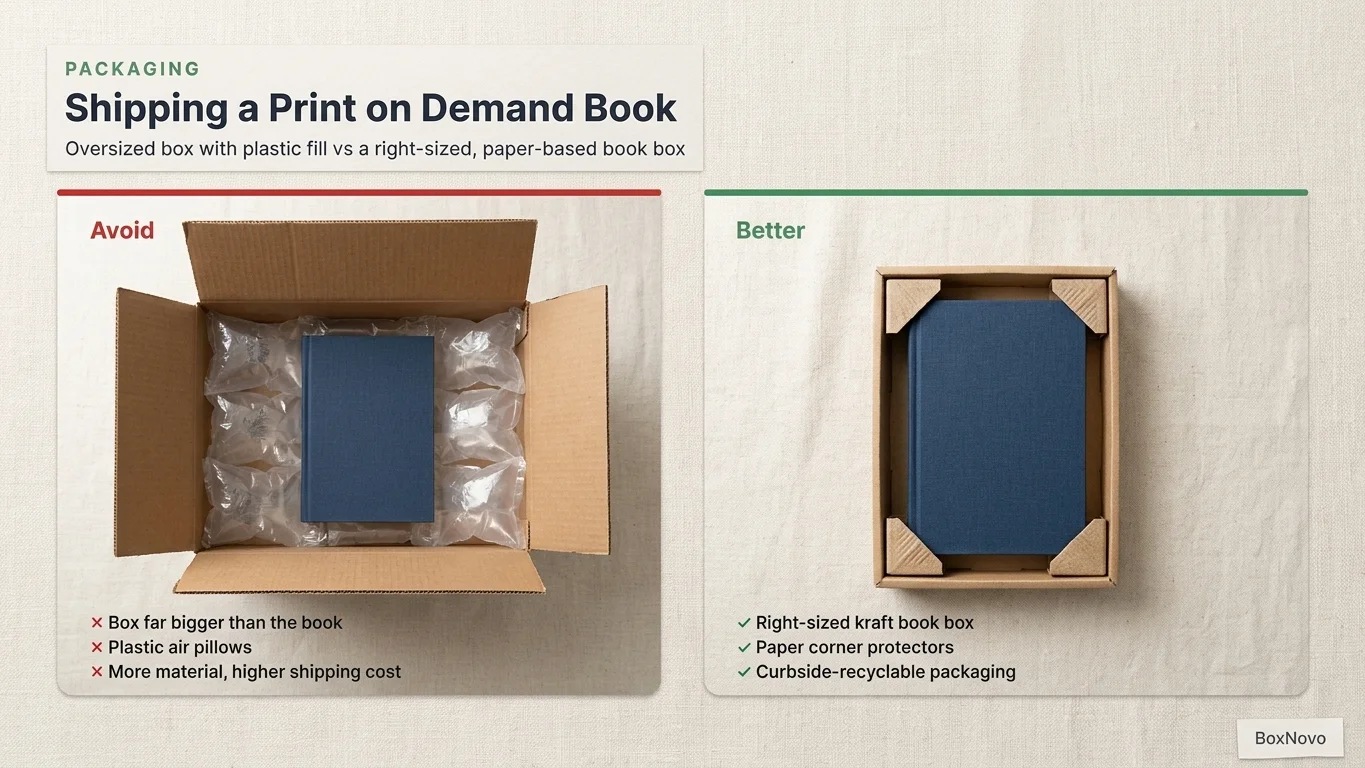
Shipping packaging is where many POD products lose their eco advantage: single books sent in oversized boxes with plastic air pillows, or cards in plastic sleeves inside plastic mailers.
| Product | Eco-Friendly Packaging |
|---|---|
| Single books and journals | Paper book mailer or a right-sized corrugated book box with corner protection |
| Multiple books or gift sets | Printed mailer box with a paperboard insert instead of plastic fill |
| Cards and postcards | Rigid paper mailer or board-backed envelope |
| Magazines | Paper envelope or paper wrap instead of poly bags |
| Planners | Kraft mailer box or paper sleeve plus mailer |
- Right-size: a box that fits the book uses less board, needs less void fill and keeps dimensional weight down. Check sizes with the dimensional weight calculator.
- Paper over plastic: paper and corrugated packaging are widely recycled at the curb, while plastic film usually needs store drop-off.
- Protect corners: book corners are the first thing to dent; a fitted box or paper corner protectors prevent damaged returns.
- Print instructions: tell customers how to recycle each part of the packaging.
BoxNovo makes custom book boxes, branded mailer boxes and eco-friendly packaging options for publishers and POD brands. Compare formats in this guide to kraft mailer boxes, or see kraft packaging materials.
Making Honest Green Claims
- Be specific: “printed on FSC Mix paper” or “100% recycled paper” is stronger and safer than “eco-friendly”.
- Recyclable claims: under the FTC Green Guides, an unqualified “recyclable” claim needs recycling facilities available to at least 60% of consumers or communities; otherwise, qualify it (Kelley Drye summary of the Green Guides).
- Degradable claims: the Green Guides define “degradable” as breaking down within a reasonably short time, no more than a year, for items not usually sent to landfills, incinerators or recycling.
- FSC labels: use the FSC label and claim only when your printer’s chain-of-custody certification covers your product.
- California: SB 343 restricts recycling symbols and claims; its October 4, 2026 compliance date was paused by a federal court injunction on July 14, 2026 (Davis Wright Tremaine). Check the current status before printing recycling symbols.
Eco-Friendly Print on Demand Checklist
- Print to order or in short runs that match real demand.
- Choose FSC-certified or recycled paper at the lightest weight that works.
- Use coatings instead of plastic film where possible; avoid glitter and plastic add-ons.
- Pick paper-friendly bindings; metal Wire-O over plastic coil.
- Ask about deinkability, ISO 14001 and FSC chain of custody.
- Print close to your customers.
- Ship in right-sized, paper-based packaging with recycling instructions.
- Make specific, provable claims.
- For children’s books, keep CPSIA tracking labels and lead-limit compliance in place.
Common Mistakes
| Mistake | Better Choice |
|---|---|
| Calling every POD product “eco-friendly” | State exactly what is greener: paper, finish, location or packaging |
| Plastic-laminated covers on every product | Aqueous coating or varnish where durability allows |
| Plastic coil binding on planners | Metal Wire-O |
| Dated planners printed in bulk | Undated layouts or print-to-order dated editions |
| One book in an oversized box with plastic air pillows | Right-sized book box or paper mailer |
| Using the FSC logo without certification | Use FSC claims only through a certified printer |
Frequently Asked Questions
What is eco friendly print on demand?
Printing products only when they are ordered, using responsibly sourced paper, recyclable finishes, local production and paper-based packaging.
Is print on demand better for the environment?
Usually, because it avoids overstock, returns and pulped copies. The paper, finishes, shipping and packaging decide how green each copy is.
What paper is best for eco-friendly printing?
FSC-certified or recycled paper. FSC Recycled means 100% recycled fiber; FSC Mix combines certified, recycled and controlled fiber.
Are digital printing inks recyclable?
Printed paper is recycled by removing ink. Some digital inks have been harder to remove, so ask your printer for deinkability test results.
Is book lamination recyclable?
One-sided lamination on paper is generally accepted for recycling in schemes such as the UK OPRL, but double-sided lamination is not. Coatings avoid the plastic layer.
What is the most eco-friendly binding?
Saddle stitch and perfect binding use only paper, staples or glue. For planners and notebooks, choose metal Wire-O over plastic coil.
Do print on demand children’s books need lead testing?
Ordinary paper children’s books are exempt from US third-party lead testing, but must still meet lead limits and have tracking labels. Novelty books with toys still need testing.
What is the best paper for print on demand journals?
Uncoated FSC or recycled paper that takes pen without bleeding, with perfect or metal Wire-O binding.
How can print on demand cards be more sustainable?
Use recycled card stock and paper envelopes, and skip glitter and plastic sleeves.
Are print on demand magazines eco-friendly?
They avoid unsold copies. Saddle-stitch binding, lighter paper and paper wrapping instead of poly bags make them greener.
How do I make print on demand planners more sustainable?
Use undated layouts, metal Wire-O binding, refill inserts and durable covers without plastic.
What packaging should I use for print on demand books?
Right-sized paper mailers or corrugated book boxes with paper inserts, with recycling instructions printed on them.
Can I say my products are recyclable?
Only if recycling is available to at least 60% of consumers or communities; otherwise qualify the claim, according to the FTC Green Guides.
Does printing locally reduce emissions?
It shortens shipping distances. Distributed networks such as Gelato produce most orders in the customer’s own country.
Final Takeaway
Eco friendly print on demand starts with printing only what is ordered, then makes every remaining choice count: certified or recycled paper, coatings instead of plastic film, paper-friendly bindings, printing close to the customer and right-sized, recyclable packaging. Whether you sell children’s books, journals, cards, magazines or planners, specific and provable choices make both the product and your green claims stronger.
Explore BoxNovo’s custom printing products, or request a packaging quote for book boxes and mailers that match your printed products.
Sources
- IngramSpark: environmental responsibility
- FSC US: what the FSC labels mean
- Pulp & Paper International: digital printing and paper recycling
- Recycling Today: ERPC deinkability scorecard
- OPRL: laminated paper recyclability
- Gelato: local production network
- Publishers Weekly: CPSIA exemption for children’s books
- Kelley Drye: FTC Green Guides summary
- Davis Wright Tremaine: SB 343 injunction