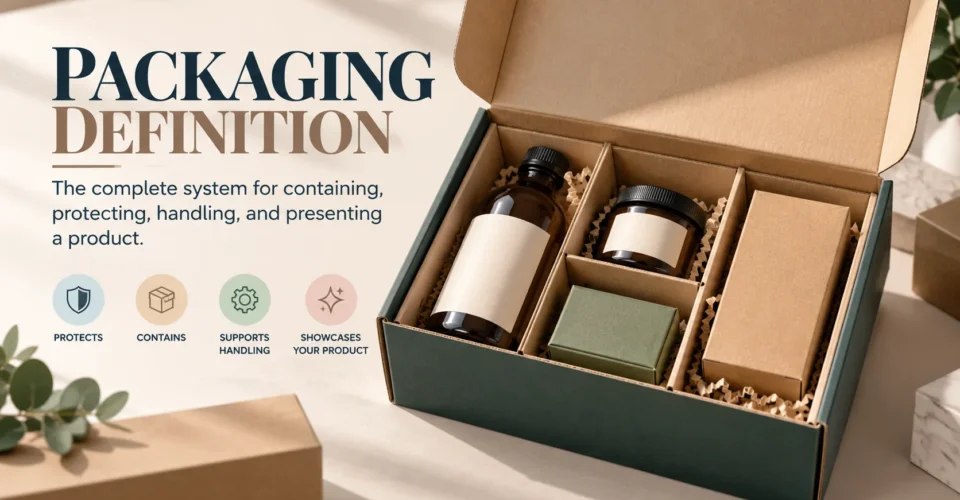
Quick definition: Packaging is the material, structure, and presentation used to contain, protect, handle, store, transport, sell, or present a product.
It can be a bottle, pouch, carton, bag, tray, custom box, shipping case, or a combination of components. The right packaging depends on the product and the job the package needs to perform.
Packaging Definition: What Is Packaging?
Packaging is the material, structure, and presentation used to contain, protect, handle, store, transport, sell, or present a product. It can refer to the physical package itself and, depending on context, the process of putting products into containers or preparing them for sale or shipment.
In simple terms, packaging is what helps a product move through its journey from production and storage to distribution, sale, delivery, and use. It may be a bottle, jar, pouch, carton, bag, tray, custom box, shipping case, or a combination of several components.
That definition matters because packaging is not simply a box or wrapper. The package has a job to perform. Its material, dimensions, structure, closure, internal components, printed information, and presentation all need to fit the product and the way the product will be handled.
For readers moving from the definition to the practical side of packaging, BoxNovo’s product packaging resources provide a useful next step for understanding how packaging choices connect with real products and applications.
What Does Packaging Include?
A complete packaging system can include the product’s primary container, an outer package, protective components, inserts or partitions, closures, labels, printed information, and transport packaging. Not every product needs every component.
| Packaging element | Main role | Example |
|---|---|---|
| Primary package | Contains the product and may directly contact it. | Bottle, jar, pouch, tube, can |
| Secondary package | Groups or protects one or more primary packages and can provide presentation. | Retail carton or branded box |
| Internal packaging component | Positions, separates, cushions, or presents products inside another package. | Insert, tray, partition, pad |
| Transport package | Supports handling, storage, and distribution of packaged products. | Corrugated shipping case |
| Label / printed information | Communicates product, identification, handling, use, storage, or other required information. | Product label or printed carton |
Packaging vs. Package vs. Packing vs. Labeling
These terms are closely related, but they describe different things. Packaging is the broader system or process; a package is the physical container or grouped unit; packing commonly describes the act of placing goods into containers or protective material; and labeling refers to the information applied to or associated with the package.
| Term | What it means | Simple example |
|---|---|---|
| Packaging | The broader package system, materials, structure, presentation, and process of preparing products for sale or shipment. | Developing a printed box and insert around a cosmetic product. |
| Package | The physical container or grouped unit that holds or surrounds the product. | The finished carton containing the product. |
| Packing | The act of putting items into containers or protective material; it can also refer to protective material placed around an item. | A fulfillment worker packs an order into a mailer. |
| Labeling | Written, graphic, or electronic information applied to or associated with the package. | A label showing product name, quantity, instructions, or other required information. |
When packaging information and graphics are part of the project, the package and its label should be considered together. BoxNovo’s product label design guidance explains why usable surface area, information hierarchy, material, and real-world handling all matter.
What Are the Main Functions of Packaging?
Packaging normally performs several functions at once. The priorities change with the product, market, and distribution environment.
- Containment: Keeps the product or its components together as a manageable unit.
- Physical protection: Helps protect contents from relevant stresses such as impact, vibration, abrasion, or compression.
- Barrier protection: When the application requires it, a package can limit exposure to factors such as moisture, oxygen, light, or contaminants.
- Information: Communicates product, identification, handling, use, storage, disposal, or other required information.
- Convenience: Can make carrying, opening, dispensing, stacking, storage, or other handling easier.
- Transport and logistics: Helps products move through warehousing, distribution, and delivery in a practical format.
- Presentation and branding: Uses structure, graphics, color, print, and finish to present the product and communicate brand identity.
- Security: Some packages can incorporate tamper-evident or other security features when the application requires them.
Primary, Secondary, and Tertiary Packaging
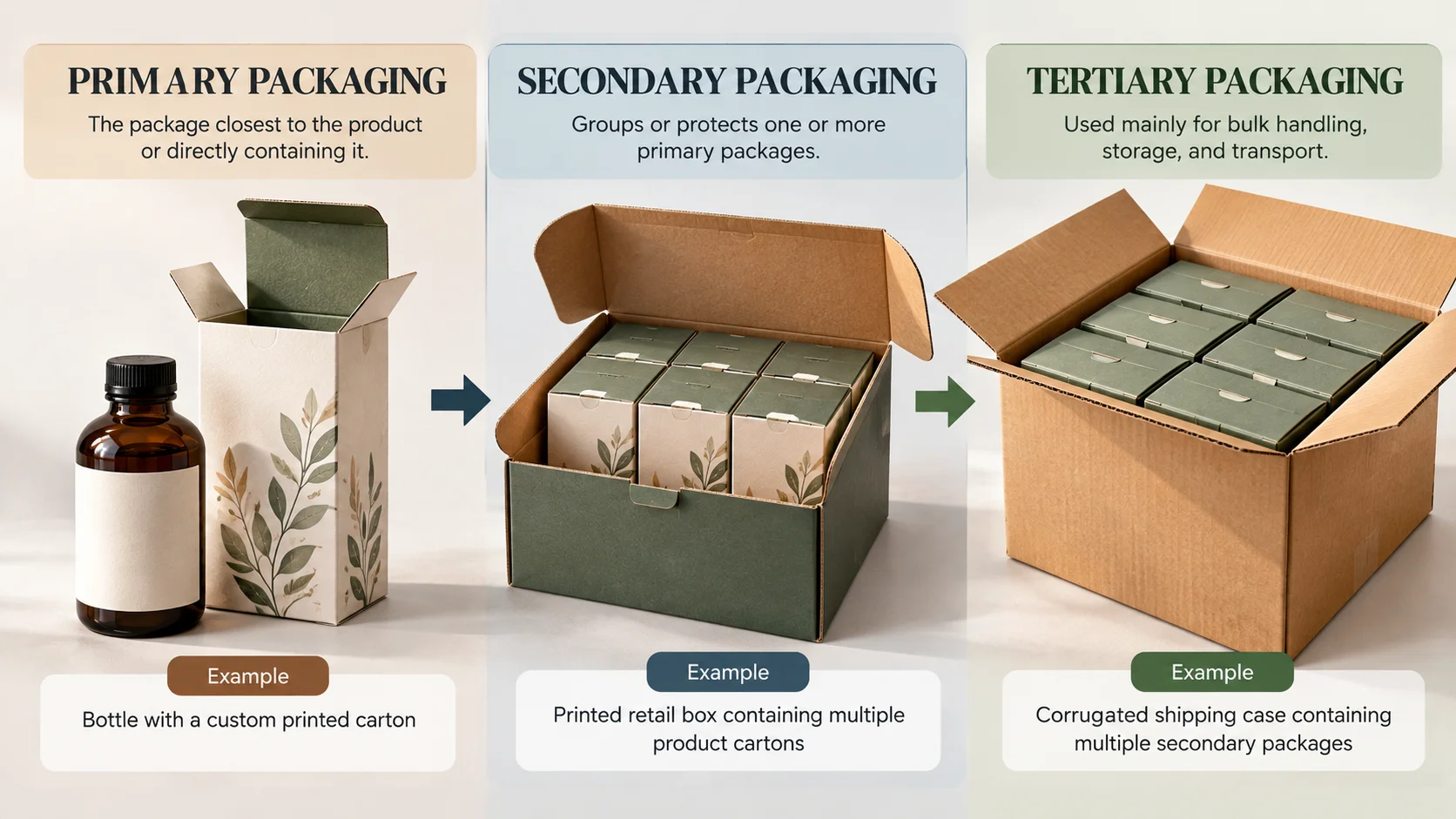
Packaging is often classified by its level in the distribution system. These are functional categories, not fixed material categories: the same material can serve different levels depending on how it is used.
| Level | Definition | Examples |
|---|---|---|
| Primary packaging | The package closest to the product or directly containing it. | Bottle, jar, pouch, tube, can, inner carton |
| Secondary packaging | Packaging outside the primary unit that groups or protects one or more primary packages. | Retail box, multipack carton, branded outer box |
| Tertiary packaging | Packaging used mainly to support bulk handling, storage, and transport. | Shipping case, palletized load, transport unit |
For example, a skincare product could have a bottle as primary packaging, a printed carton as secondary packaging, and a corrugated shipping case as tertiary packaging. The classification depends on how each component functions in the distribution system.
Common Types of Packaging
Packaging can also be classified by physical format or application. There is no single universal list because packaging serves many industries and distribution systems.
| Packaging format | Typical role | Examples / applications |
|---|---|---|
| Paperboard / folding carton | Printed product presentation for many retail applications. | Cosmetics, food, personal care, consumer goods |
| Corrugated box | Shipping and protective packaging with a fluted structure. | E-commerce orders, fulfillment, transport |
| Rigid box | Substantial structure and premium presentation. | Luxury goods, gifts, jewelry, specialty products |
| Mailer box | Direct-to-consumer packaging designed around opening and shipping needs. | Subscriptions, e-commerce orders, promotional kits |
| Sleeve | Adds presentation or branding around another package or product. | Soap, gifts, retail cartons |
| Bag or pouch | Flexible containment and lightweight presentation. | Food, apparel, personal care, specialty goods |
| Tray / insert / partition | Positions, separates, or presents products inside another package. | Gift sets, fragile products, multi-product kits |
| Shipping case | Transport-oriented outer protection. | Distribution and warehouse shipments |
What Are Packaging Materials Made From?
Common packaging material families include paperboard, corrugated fiberboard, rigid board, kraft-based paper or board, plastic, glass, metal, wood, molded fiber, and combinations of these materials.
In packaging discussions, “cardboard” is often used as a consumer-facing term for paper-based box materials. For technical specifications, use the actual substrate and construction supplied for the package rather than relying on a broad material label.
The correct material is not determined by appearance alone. Product requirements, structure, protection, printing, handling, distribution, and presentation all matter. For a broader comparison of the main paper-based packaging choices, see BoxNovo’s packaging material comparison guide.
| Material family | Common strengths | Key considerations |
|---|---|---|
| Paperboard / cardboard | Versatile, printable, and suitable for many retail structures. | Board specification, folding structure, product weight, printing, and presentation. |
| Corrugated fiberboard | Fluted construction adds structure and is commonly used for shipping. | Flute, wall construction, dimensions, handling, and distribution conditions. |
| Rigid board | Substantial structure and premium presentation. | Construction, weight, interior configuration, and presentation goals. |
| Kraft paper / board | Distinctive natural paper appearance and useful paper-based construction. | Surface appearance, structure, print, coatings, and intended use. |
| Plastic | Wide range of flexible and rigid formats and functional properties. | Product compatibility, barrier needs, structure, applicable requirements, and end-of-life considerations. |
| Glass / metal | Rigid containment with useful properties for many applications. | Weight, breakage or forming, closure, transport protection, and application-specific requirements. |
How Packaging Works as a System
A strong packaging decision starts with the product rather than with a box name. Product size, shape, weight, fragility, surface sensitivity, accessories, and intended use all affect the package. The sales channel and distribution path add further requirements.
- Product: What is being packaged, and what makes it vulnerable?
- Fit: What usable internal space is needed for the actual packed configuration?
- Structure: What box, carton, pouch, tray, closure, or combination fits the job?
- Material: What substrate and construction provide the needed balance of protection and presentation?
- Information: What product, identification, handling, use, storage, or regulatory information must appear?
- Channel: Will the package stay in retail, ship directly to customers, move through a warehouse, or serve several channels?
- Experience: How should the package open, present the product, and support the brand?
- Validation: Does the finished package need a proof or physical sample before larger production?
Because fit is one of the easiest places to make an avoidable packaging mistake, use BoxNovo’s product-measurement and box sizing guide when you need to translate product dimensions into usable package dimensions.
Packaging Design: More Than Artwork
Packaging design combines structure, material, graphics, and the way the finished package is used. A visually strong package can still create problems if the product does not fit, the closure does not work, the package is inefficient to pack, or the structure does not suit distribution.
For a custom package, start with actual product dimensions and the packed configuration. Determine the usable internal dimensions, select the structure, choose the material, and then prepare artwork around the approved dieline and supplier specifications.
Printing and finishing form the presentation layer. Depending on the package, options may include full-color printing, coatings, foil effects, embossing, debossing, or other treatments. The right finish depends on the material, artwork, intended appearance, production method, and budget.
For a deeper look at how structure, size, materials, printing, finishing, and presentation fit together, see BoxNovo’s custom packaging design guidance. You can also explore custom box styles and structural formats when comparing packaging constructions.
Retail vs. E-Commerce vs. Shipping Packaging
| Priority | Retail | E-commerce | Shipping / distribution |
|---|---|---|---|
| Primary job | Communicate and present the product. | Protect, pack efficiently, and create an appropriate opening experience. | Protect and handle products through distribution. |
| Design focus | Shelf/display visibility and information hierarchy. | Fit, closure, packing efficiency, protection, and presentation. | Structure, protection, handling, and logistics. |
| Common formats | Folding cartons, display boxes, sleeves, rigid boxes. | Mailer boxes, corrugated boxes, inserts. | Corrugated cases and transport packaging. |
| Common risk | Choosing appearance before solving structure. | Oversizing or under-protecting the package. | Mismatch between package design and actual handling conditions. |
For direct-to-customer orders where the outer package needs to combine shipping practicality with branded presentation, BoxNovo offers mailer-style packaging for e-commerce orders.
How to Choose the Right Packaging for a Product
- Define the product and the exact configuration that will be packaged.
- Measure relevant maximum dimensions and note weight, fragile areas, closures, and accessories.
- Decide whether the package contains one product, multiple products, or a complete kit.
- Identify the distribution environment: retail, e-commerce, parcel shipping, warehouse, or a combination.
- Choose a structure that fits the job before finalizing graphics.
- Select the material and construction according to the product and handling requirements.
- Account for inserts, partitions, sleeves, windows, closures, and other components that consume internal space.
- Prepare artwork from the approved dieline and supplier specifications.
- Review a proof or physical sample when fit, structure, print, opening, or presentation needs verification.
- Compare supplier quotations using equivalent dimensions, materials, construction, printing, finishing, quantity, and shipping assumptions.
For the broader planning process, BoxNovo’s complete custom packaging planning guide brings these decisions together from structure and materials through sizing, printing, and finishing.

Common Packaging Mistakes
- Using a generic box because the listed dimensions look close.
- Measuring only the bare product and forgetting caps, closures, accessories, or inserts.
- Confusing internal dimensions with external dimensions.
- Choosing a material by appearance alone.
- Finalizing artwork before the structural dieline is approved.
- Ignoring the package’s actual handling and distribution environment.
- Adding protective components without accounting for the internal space they consume.
- Comparing supplier quotes built from different specifications.
- Skipping a sample when fit, structure, or presentation is critical.
- Treating packaging only as a marketing surface instead of a physical system.
Packaging and Sustainability
Sustainability in packaging is not determined by a material name alone. A practical evaluation considers the package’s purpose, material use, product protection, transport, reuse or recovery options, and the waste-management system available in the intended market.
A smaller package is not automatically better if it fails to protect the product and causes avoidable damage or waste. At the same time, unnecessary material, layers, or empty space can add volume and resource use. The useful question is whether the complete package performs its job with an appropriate amount of material and complexity.
For custom packaging, ask whether the dimensions can be optimized, whether components can be simplified, whether materials can be separated for recovery, and whether the package can be reused or recovered in the intended market. Specific environmental claims should be tied to the actual material, construction, market, and applicable evidence.
What Is Custom Packaging?
Custom packaging is packaging manufactured or converted to specified requirements for a product or brand. Those requirements can include dimensions, structure, material, printing, finish, closure, insert, partition, window, and other packaging components.
Custom packaging is therefore more than putting a logo on a stock box. A package can be developed around the product’s dimensions, intended use, distribution environment, presentation, and customer experience.
For a product-focused example, explore made-to-fit product box solutions. For a paper-based box application, see branded cardboard box options. For premium presentation where the interior is part of the experience, rigid presentation boxes with fitted interiors are another relevant format.
Packaging by Industry and Product
Packaging requirements change with the product. A bottle, candle, cosmetic, food item, electronics product, gift set, and apparel item can all require different structures, materials, internal protection, and presentation.
The most useful industry-level question is not “Which box is best?” but “What does this product need its package to do?” That keeps the decision tied to containment, protection, handling, presentation, and the distribution channel.
To compare packaging approaches by product category and market, explore BoxNovo’s packaging solutions across different industries.
Frequently Asked Questions About Packaging Definition
What is the definition of packaging?
Packaging is the material, structure, and presentation used to contain, protect, handle, store, transport, sell, or present a product. The term can also refer to the process of preparing products in containers for sale or shipment.
What is packaging in simple words?
Packaging is what contains or surrounds a product so it can be protected, handled, stored, transported, sold, and used.
What is the difference between packaging and a package?
Packaging is the broader system or process; a package is the physical container or grouped unit.
What is the difference between packaging and packing?
Packing commonly refers to putting goods into containers or protective material, while packaging is the broader package system, including structure, material, presentation, and related development.
What are the main functions of packaging?
The main functions can include containment, physical protection, barrier protection where required, information, convenience, transport and logistics, presentation, branding, and security where needed.
What are the three levels of packaging?
Primary packaging is closest to or directly contains the product; secondary packaging groups or protects primary units; tertiary packaging mainly supports bulk handling, storage, and transport.
What are the main types of packaging?
Common formats include paperboard cartons, corrugated boxes, rigid boxes, mailers, sleeves, bags, pouches, trays, inserts, partitions, and shipping cases.
What are common packaging materials?
Common material families include paperboard, corrugated fiberboard, rigid board, kraft-based paper or board, plastic, glass, metal, wood, and molded fiber.
How do I choose the right packaging?
Start with the product’s dimensions, weight, fragility, packed configuration, and distribution environment. Then select the structure, material, internal components, printing, and finishing that fit the job.
Does packaging always mean a box?
No. Packaging can be a bottle, jar, pouch, bag, carton, tray, sleeve, rigid box, corrugated case, or combination of components.
Why is packaging important?
Packaging helps products move through storage, handling, distribution, sale, and use while providing containment, protection, information, convenience, and presentation.
What is product packaging?
Product packaging is the package system associated with a specific product, including its container or box and relevant protective, informational, or presentation components.
What is custom packaging?
Custom packaging is packaging developed to specified product or brand requirements such as dimensions, structure, material, printing, finish, closure, and inserts.
Should custom packaging be sampled?
For complex, high-value, or tightly fitted packaging, a proof or physical sample can help verify fit, structure, artwork, opening, insert positioning, and presentation before larger production.
Final Takeaway
The simplest packaging definition is useful, but it is only the starting point. Packaging is a system that combines containment, protection, handling, information, presentation, and—when relevant—branding and security.
The right package depends on the product, the distribution environment, and the job the package needs to perform. Start with the actual product and packed dimensions, choose the structure and material around those requirements, prepare artwork from the approved dieline, and validate the finished package when fit or presentation matters.
If you are moving from understanding packaging to planning a real custom package, BoxNovo can help you evaluate dimensions, structures, materials, printing, finishing, and internal packaging components for the application. Discuss your packaging requirements with BoxNovo when you are ready to define a specific project.