What Is Product Packaging?
Product packaging is the physical system that holds, protects, presents and communicates your product before, during and after the sale. The right package is not simply the box that looks best. It has to fit the product, survive the way it will be handled, communicate the information buyers need, suit the sales channel, and make sense for your production and shipping requirements.
For most brands, the best packaging decision starts with the product rather than the box style. Measure the item, understand its fragility and weight, identify how it will be sold and shipped, then choose the structure, material, insert and artwork around those requirements. That sequence reduces expensive redesigns and helps prevent the common mistake of choosing a package for appearance before confirming that it works physically.
This guide explains product packaging from that decision point through sizing, materials, design, printing, inserts, testing, production and cost. It is designed to help both first-time packaging buyers and teams preparing a custom package for a production run.
Product Packaging Definition
Product packaging is the container, enclosure or packaging system that directly holds or presents a product. Depending on the product, it can be a folding carton, custom product box, rigid box, pouch, bag, sleeve, tray or another purpose-built structure.
A useful definition is: product packaging combines physical protection, product presentation and information delivery in a form that works for the way the product is sold and handled. The packaging may also work with secondary or tertiary packaging, such as an outer shipping carton or palletized case.
What Product Packaging Needs to Do
- Protect the product from expected handling, compression, vibration, abrasion and other relevant distribution risks.
- Fit the product securely without creating unnecessary empty space or making insertion and removal difficult.
- Present the brand, product name, instructions, required information and other content clearly.
- Support the sales channel: shelf presentation, direct-to-consumer delivery, wholesale distribution or a combination.
- Make packing, storage, shipping and opening practical for the people who handle it.
- Meet the material, labeling and regulatory requirements that apply to the product and destination market.
Product Packaging vs. Shipping Packaging
Product packaging and shipping packaging are not always the same thing. A folding carton can provide retail presentation but may need an outer corrugated shipper for parcel delivery. A rigid presentation box can create a premium unboxing experience while still requiring a protective outer carton. An ecommerce mailer can sometimes serve as both the customer-facing package and the shipping container.
The important question is not “Which box is best?” but “Which packaging layers does this product need?” A simple product may need one package. A fragile, premium or multi-component product may need a primary package, an insert and an outer shipping layer. For outer protection, corrugated outer shipping protection can be evaluated separately from the customer-facing package.
How to Choose the Right Product Packaging
Choose packaging in this order: product requirements → sales channel → protection level → dimensions → structure → material → insert → artwork → testing. Starting with artwork or a favorite box style can create problems later because the structure may not suit the product.
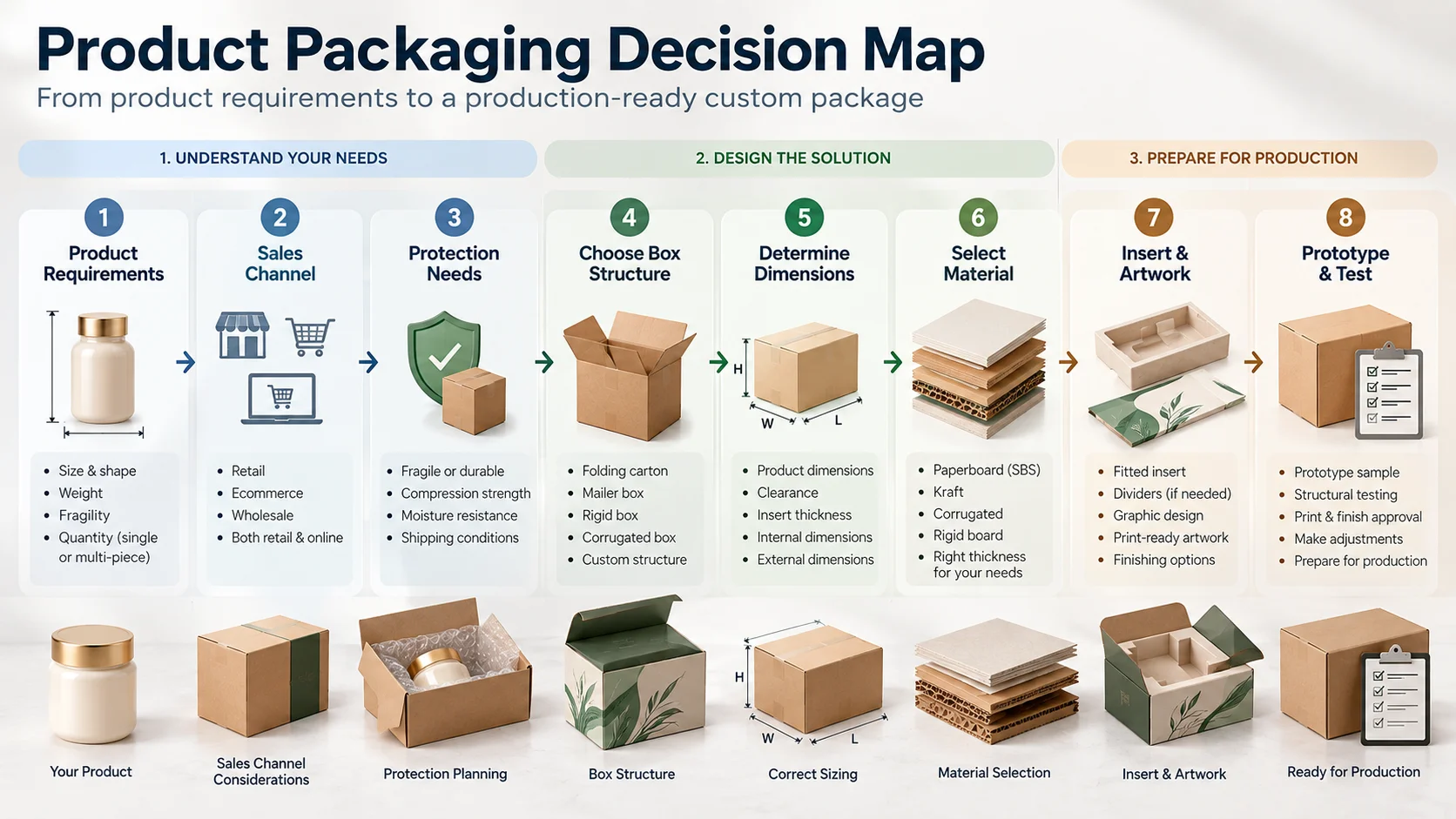
Start With the Product
Record the product’s length, width and height in a consistent orientation. Also record packed weight, fragile components, protruding parts, liquid content where relevant, surface sensitivity and any components that must remain separated.
Consider Weight and Fragility
Lightweight products can often use compact paperboard structures. Fragile products may need a more controlled fit and a dedicated insert. Heavy products place greater demands on the package structure and the outer shipping layer. The right material and structure depend on the actual product and distribution conditions rather than a generic label such as “premium” or “strong.”
Consider Where the Product Is Sold
Retail packaging needs to communicate quickly on a shelf and remain readable from a practical viewing distance. Ecommerce packaging has a different priority: it must survive parcel handling and arrive looking intentional. Wholesale packaging may need stronger outer cases and consistent labeling because products move through additional handling points.
Packaging Decision Matrix
| Situation | Packaging direction to evaluate | Primary reason |
|---|---|---|
| Shelf-ready retail product | Folding carton or printed product box | Clear product presentation, efficient display and required information. |
| Direct-to-consumer product | Mailer, product box, or product box inside an outer shipper | Balance protection, shipping practicality and unboxing. |
| Premium gift or luxury item | Rigid presentation box or premium product box | Structure, presentation and perceived value. |
| Fragile multi-part product | Custom box with fitted insert | Control movement and separate components. |
| Heavy product | Stronger product structure plus appropriate outer shipper | Manage load, handling and compression risks. |
| Small lightweight item | Compact folding carton, sleeve or small box | Right-size the package and reduce unnecessary material. |
| Wholesale product | Retail package plus protective master case when needed | Protect multiple units through distribution and handling. |
| Food or regulated product | Product-specific food-safe or regulated packaging format | Material and labeling requirements must match the product and market. |
Product Packaging Types Compared
Packaging format should follow the product and sales channel. The same brand may use several formats across its product line rather than forcing every SKU into one structure.
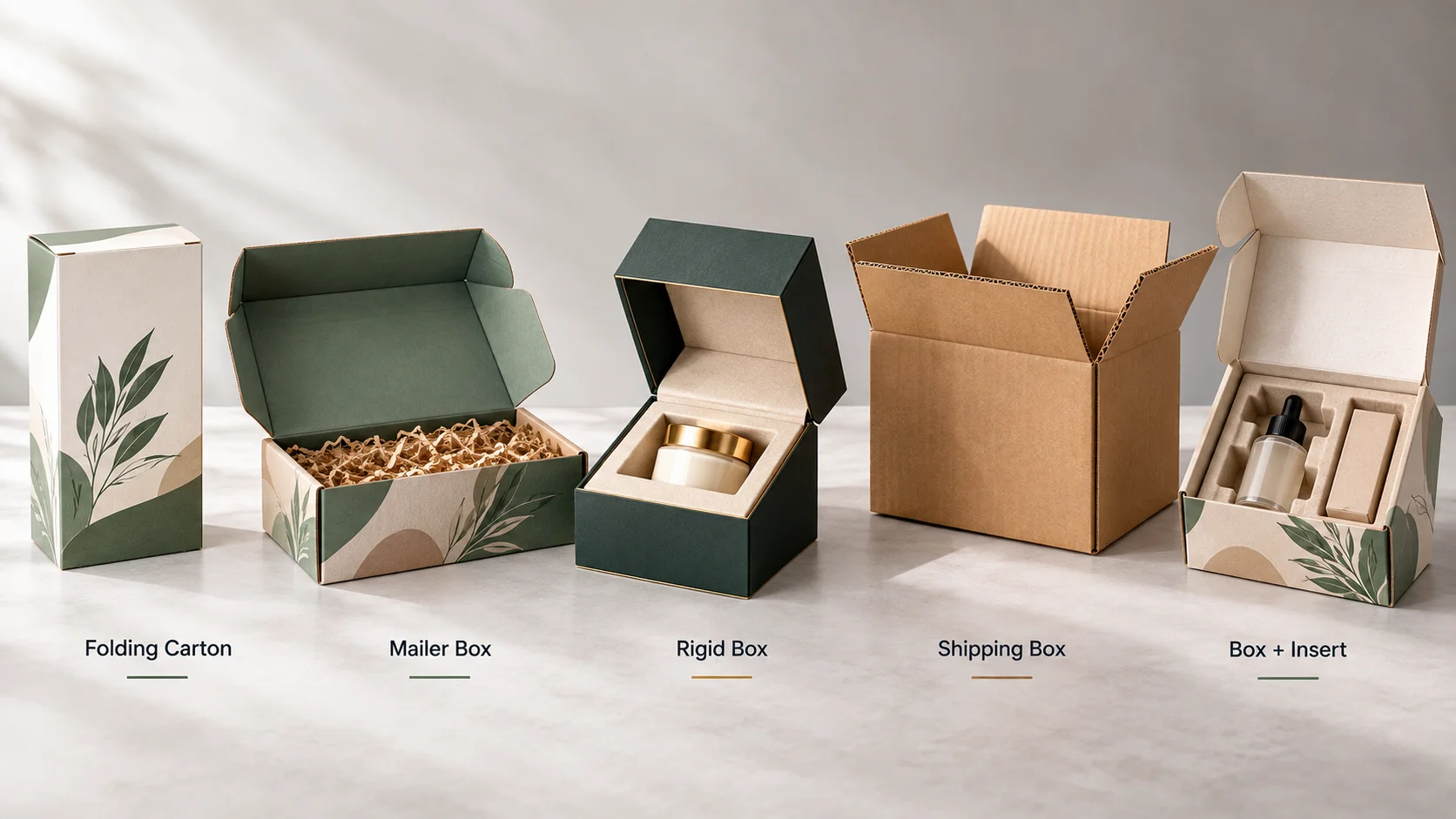
| Packaging type | Best suited to | Key strengths | Watch-outs |
|---|---|---|---|
| Folding carton | Retail products, cosmetics, food, lightweight goods | Efficient flat storage, strong printable surface, many structural options | Not automatically suitable for heavy or highly fragile products. |
| Custom product box | Branded products needing a dedicated fit | Flexible dimensions, branding and presentation | Structure must be matched to product weight and handling. |
| Mailer box | Ecommerce and subscription products | Combines shipping function with branded presentation | May need additional internal protection for fragile items. |
| Rigid box | Luxury, gifts, premium sets, presentation-led products | Strong feel and premium presentation | Usually uses more material and storage space; construction can be more involved. |
| Sleeve or slipcase | Product presentation, trays, books and gift formats | Adds branding without replacing an inner structure | Fit must be controlled so the sleeve is neither too loose nor too tight. |
| Corrugated shipping box | Outer shipping and distribution | Good structural protection and stacking capability | Usually less focused on premium product presentation. |
| Bag or flexible pouch | Soft goods and selected food/consumer products | Lightweight and material-efficient for suitable products | Limited crush protection compared with a rigid structure. |
Product Packaging by Product Type
Beauty and Personal Care
Beauty and personal care packaging often needs a compact fit, strong shelf presentation and enough printable area for product information. Bottles, jars, pumps and tubes can also create specific clearance or movement issues. A carton may hold the primary container while an insert or fitted structure keeps it positioned during handling.
Cosmetics and Makeup
Cosmetics packaging has a high visual component, but appearance should not override fit. Small jars, palettes, compacts and sets can benefit from structures that prevent shifting while leaving enough room for readable branding and required information.
Luxury Products and Gifts
Premium packaging usually puts more weight on the opening experience and physical feel. Rigid boxes, fitted inserts, specialty finishes and layered presentation can be appropriate when the packaging itself is part of the perceived product experience. For gift-led products, gift-focused presentation packaging can be one format to evaluate alongside other presentation structures.
Medical and Regulated Products
Regulated products require additional care with labeling, product information and applicable market requirements. Packaging design should reserve enough space for required copy and should be reviewed against the requirements that apply to the specific product and market before production.
Pet Care Products
Pet-care packaging varies widely by product weight, shape and material requirements. Small accessories may fit folding cartons or compact boxes, while heavier products can require stronger structures and an outer shipping layer.
Food and Beverage
Food packaging needs materials and components appropriate for the intended contact and distribution conditions. The exact requirements vary by product and market, so material suitability and labeling should be confirmed before production.
Electronics and Consumer Products
Electronics and delicate consumer products often benefit from inserts, compartments or cushioning that control movement. The packaging should be evaluated for drop, vibration and compression risks relevant to its actual distribution route.
Retail vs. Ecommerce Product Packaging
Retail Packaging
Retail packaging has to work before the sale. Product identification, brand hierarchy, required information and visual differentiation need to remain clear when the package is displayed beside competing products. Stackability, shelf orientation and efficient case packing can also matter. For many lightweight retail products, folding box structures for retail presentation can be evaluated when the structure and product requirements support that format.
Ecommerce Packaging
Ecommerce packaging has to work during and after shipping. The package may face sorting, drops, vibration, compression and repeated handling before the customer opens it. The package should therefore balance protective structure, dimensional efficiency and the customer’s unboxing experience. For direct shipping, ecommerce-ready mailer packaging is a relevant format to evaluate.
Wholesale Packaging
Wholesale distribution introduces additional handling and often changes how many units travel together. A retail-ready unit may need a separate master case or other protective layer. Consistent unit dimensions can also simplify storage, picking and case packing.
When to Use a Product Box With an Outer Shipping Box
Use two packaging layers when the customer-facing package is not designed to absorb the full risks of parcel or freight distribution. The inner package can focus on presentation and product fit while the outer shipper handles the harsher transportation environment. In that setup, corrugated outer shipping protection can be considered for the protective outer layer.
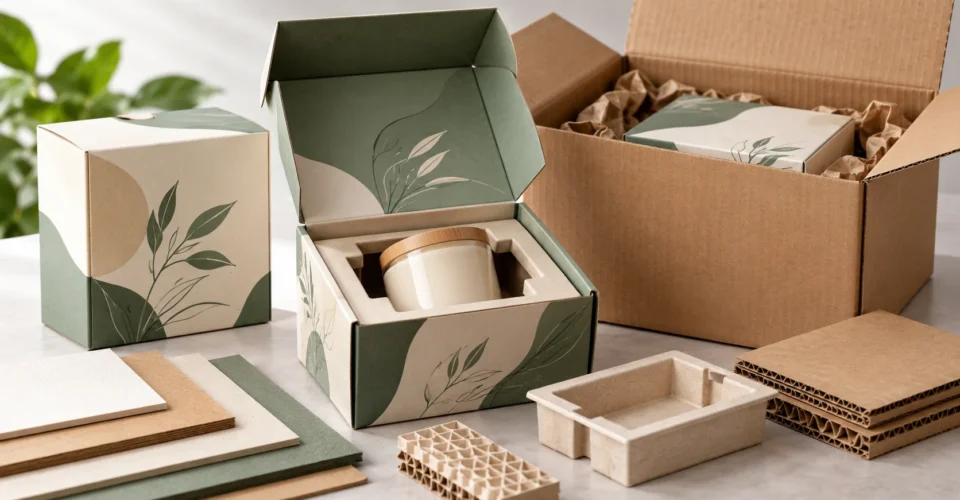
Product Packaging Materials
Material choice affects print quality, stiffness, weight, protection, finish options, recyclability considerations and cost. No single material is best for every product.
| Material | Typical role | Strengths | Considerations |
|---|---|---|---|
| Paperboard | Folding cartons and printed product boxes | Clean printing, folding and broad design flexibility | Less suited to heavy loads unless the structure is engineered appropriately. |
| Kraft paperboard | Natural-look cartons, bags and selected packaging | Paper-based appearance and broad branding options | Print appearance and surface characteristics depend on grade and process. |
| Corrugated board | Shipping boxes and protective outer structures | Fluted construction provides structural strength and cushioning | More focused on protection than fine retail print appearance. |
| Rigid board | Rigid presentation boxes | Substantial feel and premium presentation | More storage volume and typically more complex construction. |
| Flexible film | Pouches and bags where appropriate | Lightweight and useful for selected barrier needs | Does not provide the crush protection of a rigid box. |
| Paper-based cushioning / inserts | Internal protection and separation | Can control movement without relying on loose filler | Insert design must be included in the dimensional plan. |
Choosing Material Thickness
Material thickness should be considered together with the product’s weight, structure, folding or forming requirements, insert design and distribution conditions. A thicker substrate is not automatically the right choice if it creates unnecessary bulk or changes the fit.
How Material Choice Affects the Package
Think about material as part of the complete package rather than a finish selected after the box is designed. A change in board thickness can affect the internal fit, crease behavior, folding, storage and finished dimensions. If you are comparing substrates before requesting production, BoxNovo’s packaging material selection guide is a useful supporting reference.
How to Calculate the Right Product Packaging Size
The starting point is the product’s actual dimensions, not the outside dimensions of a package you happen to like. A practical sizing sequence is: measure the product → define required clearance → account for insert thickness → establish usable internal dimensions → select the structure and material → verify the resulting external dimensions. A practical box-dimension planning can help organize this planning before the structure is finalized.
Measure the Product Correctly
Record length, width and height consistently. Measure the largest relevant points, including caps, handles, protrusions or other features that affect fit. If the product changes shape under pressure or includes flexible components, define the packed condition that the package must accommodate.
Internal vs. External Dimensions
Internal dimensions describe the usable space available to the product. External dimensions describe the finished footprint of the package. They are not interchangeable. Board thickness, folds, construction and closure geometry occupy physical space, so a package specified only from its outside size can produce a poor product fit.
Clearance and Insert Thickness
A product that is exactly the same size as the inside of a rigid package may be difficult to insert or remove and may be exposed to pressure. On the other hand, excessive clearance can allow movement. When an insert is used, its thickness and geometry become part of the available internal space.
Why Oversized Packaging Can Increase Costs
A larger package can use more material, occupy more warehouse space and increase shipping dimensions. For parcel shipments, dimensional-weight rules may also make outer dimensions financially important. The carrier’s current rules should be checked for the specific shipment rather than assuming a single universal threshold.
Packaging Inserts: When Does Your Product Need One?
An insert is useful when the package needs to hold a product in a specific position, separate multiple components, improve presentation or provide printed information. Inserts can be structural or informational.
| Insert type | Useful for | Main planning issue |
|---|---|---|
| Paperboard insert | Small products, compartments, printed messaging | Must fit the box and fold/lock reliably. |
| Corrugated insert | Fragile or heavier products needing separation | Adds thickness and affects internal dimensions. |
| Molded-fiber or formed insert | Products needing shaped support | Requires product-specific tooling or forming considerations. |
| Foam or soft cushioning | Selected fragile products | Material compatibility, appearance and end-of-life considerations. |
| Divider/compartment system | Sets and multi-piece products | Compartment dimensions must match every component. |
| Printed card/instruction insert | Education, care, QR or promotional messaging | Must not interfere with product fit or opening sequence. |
For a premium or ecommerce package, the insert should be planned at the same time as the box rather than added after the box dimensions are finalized. If the insert is informational, a compact printed format such as trifold brochures used as packaging inserts can be evaluated when the available internal space and opening sequence support it.
Product Packaging Design
Good packaging design is where structure, graphics and materials meet. The design should make the product easy to identify, easy to understand and appropriate for the brand without compromising the physical package.
Structure Before Artwork
For a custom box, the structural dieline should be established before final artwork. The dieline identifies cuts, folds, flaps, glue areas and other structural features. Designing artwork on a generic rectangle and trying to force it onto the final structure later can move important content into folds or cut areas.
Brand Identity
Use consistent brand colors, typography, logo treatment and visual hierarchy. The front or primary presentation panel usually needs the clearest product identification, while side and back panels can carry supporting information.
Front, Side and Back Panel Planning
- Primary panel: brand, product name and the most important visual or benefit.
- Secondary panels: supporting claims, features, usage or product information.
- Information panel: ingredients, instructions, warnings, barcode or other required content where applicable.
- Interior surfaces: unboxing messages, care instructions, QR codes or other content when structurally appropriate.
Typography and Readability
Small text should be checked at final physical size. Keep important information away from folds, cuts and areas that may be obscured by closures or inserts.
Barcode and QR Code Placement
Barcodes and QR codes should be tested in the actual production context when they are important to scanning. The final placement should preserve adequate clear space and keep the code away from structural features that could interfere with scanning.
Product Packaging Printing and Finishing
Printing and finishing should be selected with the material, quantity, artwork and desired appearance in mind. The supplier’s actual production process determines which options are available and how files should be prepared.
| Process/finish | What it can contribute | Key consideration |
|---|---|---|
| Digital printing | Flexible for changing artwork and shorter production runs | Confirm substrate compatibility and color expectations. |
| Offset printing | High-quality printed cartons and longer runs | Setup and production economics depend on quantity and process. |
| Flexographic printing | Common for certain corrugated and flexible applications | Best suited to substrates and runs compatible with the process. |
| Matte coating/finish | Lower-glare, understated appearance | Can change how colors and scuff resistance appear. |
| Gloss finish | Higher visual shine | Surface appearance should be evaluated with the design and lighting. |
| Foil | Metallic or specialty visual accent | Requires compatible production setup and artwork preparation. |
| Emboss/deboss | Raised or recessed tactile detail | Adds tooling/production complexity and should be evaluated for scale and material. |
Print-Ready Artwork Checklist
- Use the final supplier-approved dimensions and dieline.
- Keep structural cut and fold information on the correct production layers.
- Confirm bleed, safe area and file format with the packaging supplier.
- Confirm color expectations and whether the supplier requires a specific color workflow.
- Check placed images at their final physical size.
- Proof small text, fine lines, barcodes and QR codes.
- Review all product, legal, ingredient, warning and contact information.
- Request a digital or physical proof when the project requires precise color, alignment or structural confidence.
Sustainable Product Packaging
Sustainable packaging is not one material choice. It is a system-level decision involving material selection, package size, product protection, manufacturing, shipping and end-of-life.
Right-Size the Package
Avoid creating a large empty cavity around a small product simply to make the package look substantial. Right-sizing can reduce material use and shipping volume while also improving product stability.
Paper-Based Packaging
Paperboard and corrugated structures can be useful where their physical properties match the application. Recyclability depends on the actual material, coatings, components and local collection systems, so avoid treating a material label as a universal end-of-life guarantee. Where the application supports it, paper-based lower-impact packaging options is one BoxNovo option to review alongside the product and distribution requirements.
Reduce Unnecessary Components
Every extra insert, coating, mixed-material component or decorative layer should have a purpose. If an element does not protect the product, communicate useful information or materially improve the customer experience, question whether it needs to be there.
Make Sustainability Claims Specific
Avoid vague environmental language. If a package has a specific material composition, recycled-content claim, certification or disposal instruction, the claim should be accurate and supportable for the exact package being produced.
How Custom Product Packaging Is Made
- Packaging brief: define product dimensions, weight, quantity, sales channel, protection requirements, artwork needs and target experience.
- Structural planning: select a suitable format and establish internal dimensions, closures, inserts and other physical features.
- Dieline development: create or approve the flat structural template used for artwork and production.
- Artwork and prepress: place graphics, copy, colors and required information into the approved structure.
- Prototype or proof: inspect physical fit, appearance and opening behavior before committing to the main run.
- Printing: produce the approved artwork on the selected substrate using the appropriate process.
- Conversion: die-cut, crease, fold, glue and otherwise build the package according to the structure.
- Insert and assembly: add internal components where required and verify that the packed product fits as intended.
- Quality control: inspect dimensions, print, closures, seams, inserts, barcode/QR readability and overall appearance.
- Packing and distribution: pack finished units in an appropriate master case or shipping configuration and verify the distribution plan.
Prototype and Test Before the Full Run
A prototype answers questions that a screen mockup cannot: Does the product fit? Does the closure work? Can the customer remove the product? Does the insert stay in position? Does the box look correct when assembled? Is there enough clearance? Does the package survive representative handling?
Testing should reflect the actual distribution risk. Depending on the application, that can include drop, vibration, compression, climate or pilot-shipment evaluation. The specific protocol should be selected for the product, package and distribution route rather than using one universal test for every product.
How Much Does Product Packaging Cost?
There is no reliable universal per-box price for custom product packaging because the final cost depends on the package itself. The major variables are structure, dimensions, material, printing, finishing, inserts, quantity, tooling and assembly.
| Cost factor | Why it changes the quote |
|---|---|
| Dimensions | Larger blanks generally consume more material and may change shipping/storage requirements. |
| Material | Board grade, thickness, substrate and construction affect material cost and production behavior. |
| Structure | Complex folds, closures, windows, compartments or unusual shapes can increase tooling and conversion work. |
| Printing | Coverage, number of colors/process and run size affect production economics. |
| Finishing | Foil, embossing, specialty coatings and other finishing steps add production operations. |
| Inserts | Separate components add material, tooling and assembly considerations. |
| Quantity | Setup costs are spread differently across short and long production runs. |
| Assembly | Hand assembly, magnets, multi-component structures and other labor-intensive steps can materially affect unit economics. |
| Shipping | Outer dimensions and packed weight can influence freight and parcel costs. |
For a useful quote, provide the supplier with the product dimensions, desired internal fit, box style if known, material preference, print requirements, finish, quantity, destination and whether inserts or assembly are required. A vague request for “a custom box” produces much less useful pricing information.
Product Packaging Mistakes to Avoid
- Choosing a box style before measuring the product.
- Using external dimensions as if they were internal usable dimensions.
- Adding an insert after the box dimensions have already been finalized.
- Leaving so much empty space that the product can move during shipping.
- Choosing a material solely because it looks premium without checking its structural suitability.
- Putting important artwork, barcode data or required copy over folds or cut lines.
- Assuming a standard bleed or color setting applies to every packaging supplier.
- Skipping a physical sample when fit, color or opening behavior matters.
- Designing a beautiful customer-facing package without considering the outer shipping environment.
- Treating sustainability as a marketing phrase instead of checking the actual material and package system.
Product Packaging Checklist Before Production
Use this checklist before approving a production run:
- Product dimensions and packed weight are confirmed.
- Internal package dimensions are confirmed.
- Required clearance is understood.
- Insert thickness and placement are included.
- Material and board specification are confirmed.
- Box structure and closure are approved.
- Artwork uses the correct supplier-approved dieline.
- Bleed, safe areas and structural layers are correct.
- Product information and required labeling have been reviewed.
- Barcodes and QR codes have been checked.
- Color and finishing expectations are approved.
- A prototype or proof has been reviewed where appropriate.
- Product fit and opening experience have been tested.
- Shipping/handling requirements have been considered.
- Quantity and reorder requirements are documented.
- Final production approval is recorded.
Optional downloadable resource placement: insert the approved PDF/button here after uploading boxnovo-product-packaging-pre-production-checklist.pdf. Do not invent a media URL.
How to Choose Custom Packaging for Your Product
If you know the product but not the final box structure, start with the requirements rather than trying to choose from dozens of box styles. Define the product dimensions, weight, fragility, quantity, sales channel, presentation goals and shipping conditions first. When you are ready to move from requirements into a specific box format, made-to-fit product packaging is the most direct product-level path.
For ecommerce orders, ecommerce-ready mailer packaging can address the different requirements of direct shipping. For presentation-led products, rigid presentation boxes with built-in inserts are another format to evaluate. If you need a broader commercial starting point, custom packaging and box solutions gives readers a wider view of custom packaging and box solutions.
For dimension planning, use the sizing sequence above before finalizing the structure. The goal is to choose a package that works physically, visually and operationally—not simply the one with the most decorative features.
Frequently Asked Questions About Product Packaging
What is product packaging?
Product packaging is the container or packaging system that holds, protects and presents a product. It may be a folding carton, custom box, rigid box, mailer, pouch, sleeve, bag or another format selected for the product and sales channel.
What are the main types of product packaging?
Common formats include folding cartons, custom product boxes, mailer boxes, rigid boxes, sleeves, corrugated shipping boxes, bags and flexible pouches. The appropriate format depends on product size, weight, fragility, sales channel and distribution.
How do I choose the right packaging for my product?
Start with product dimensions, weight and fragility. Then consider the sales channel, shipping conditions, required protection, brand presentation, material, insert needs and budget. Choose the structure only after those requirements are clear.
How should I measure a product for custom packaging?
Measure length, width and height at the largest relevant points and record the orientation consistently. Then define the required clearance and account for any insert or cushioning thickness before setting the internal box dimensions.
Should product packaging and shipping packaging be separate?
Sometimes. A retail or premium product box may not be designed to absorb the full risks of parcel shipping, so an outer shipper can protect it. Ecommerce mailers can sometimes perform both roles when the product and distribution conditions allow.
Do I need an insert inside my product box?
Not always. Inserts are useful when the product needs controlled positioning, component separation, protection, or printed information. They should be designed at the same time as the box because they affect available internal space.
What material is best for product packaging?
There is no universal best material. Paperboard works well for many printed cartons, corrugated board is commonly used for shipping protection, and rigid board suits presentation-focused formats. The correct choice depends on the product and distribution requirements.
What should be on product packaging?
Depending on the product and market, packaging may need the brand, product name, features, instructions, ingredients, warnings, barcode, origin information, contact details or other required information. The exact requirements vary by product and destination.
How much does custom product packaging cost?
Cost depends on dimensions, material, structure, printing, finishing, inserts, quantity, tooling, assembly and shipping. A supplier can provide a useful quote when those specifications are defined.
Why is a prototype important?
A prototype lets you confirm product fit, clearance, closure, insert placement, appearance and opening behavior before committing to a full production run.
What is a packaging dieline?
A dieline is the flat structural template used to show cuts, folds, flaps, glue areas and other package features. Artwork is placed onto the approved dieline so the printed design aligns with the finished structure.
How can I make product packaging more sustainable?
Start by right-sizing the package, avoiding unnecessary material and choosing a suitable paper-based or other lower-impact material where the application allows it. Also consider inserts, coatings, mixed materials, shipping volume and accurate end-of-life instructions.
Conclusion: Build the Package Around the Product
Strong product packaging starts with a physical requirement, not a graphic treatment. Once you know what the product needs to survive, how it will be sold, how it will be shipped and what the customer needs to understand, the packaging format becomes much easier to choose.
From there, size the package around the product, account for inserts, select a suitable material, build artwork on the approved dieline, review the print and finishing requirements, test the physical package and only then approve the production run. That process gives the package a better chance of working as a product container, brand touchpoint and operational tool at the same time.
When you are ready to turn those requirements into a custom package, explore BoxNovo’s broader custom-packaging system guide for the broader decision process.