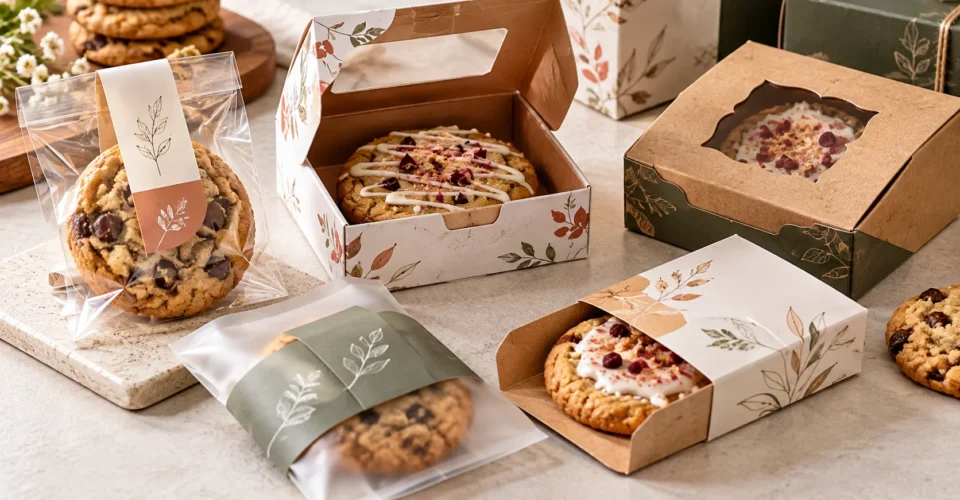
Cookie packaging works best when it is chosen around the finished cookie, not around a generic box style. The right format depends on the cookie’s dimensions, decoration, fragility, sales channel, handling route, branding needs, and whether the package also has to survive parcel shipping.
For one cookie, that may mean a food-contact bag, sleeve, backer-card system, folding carton, window carton, gift box, or a custom package with an insert. For ecommerce, the presentation package may also need a separate outer shipper.
If you are planning the full package system, BoxNovo’s broader custom-packaging planning guide can help connect structure, materials, printing, and the customer experience.
Why Single-Cookie Packaging Needs a Different Approach
A single cookie leaves very little room for packaging errors. A package that is slightly too large can let the cookie slide or rotate. One that is too tight can rub icing, damage fragile edges, or make packing inconsistent. A package that looks perfect at a bakery counter can also be unsuitable for parcel delivery.
Before choosing a format, consider five variables:
- Finished dimensions: measure the cookie after baking, cooling, decorating, and any final toppings.
- Protection: determine whether you need an inner wrap, liner, cup, pad, tray, cavity, divider, or other separation.
- Product behavior: consider brittleness, crumbs, surface grease, stickiness, softness, and raised decoration.
- Route: counter sale, event favor, retail shelf, gift, local delivery, and ecommerce create different handling conditions.
- Presentation: decide how much visibility, print area, opening experience, and brand storytelling the package should provide.
This is why a generic “standard cookie box size” is a weak starting point. The same cookie diameter can require a different package when its thickness, decoration, protective components, or delivery route changes.
15 Cookie Packaging Ideas for Single Cookies, Gifts, and Sales
1. Clear Bags or Pouches with a Branded Label
A clear bag or pouch is useful when product visibility and packing speed matter more than crush protection. A label, seal, or small printed element can provide the brand touchpoint.
Best for: Bakery counters, favors, samples, simple gifting, and products that do not need significant structural support.
Watch for: The bag itself does not solve crushing or movement during shipping. The complete food-contact system should match the intended application.
2. Paper Sleeves
A paper sleeve can make an individually packaged cookie feel more finished without surrounding it with a full box. It can work especially well for events, bakery presentation, and simple branded favors.
Best for: Fast presentation, event cookies, and brands that want a larger print surface without a complex structure.
Watch for: A sleeve is primarily a presentation component and may need an inner wrap or separate protective package.
3. Backer Card Plus Clear Outer Packag
ing
A printed card behind or beneath the cookie creates more branding area while keeping the product visible. It can carry a logo, flavor name, message, QR code, or useful product information.
Best for: Decorated cookies, event favors, promotional samples, and individually presented products.
Watch for: The card and outer wrap should be planned as one complete package system.
4. Small Folding Cartons
A small folding carton gives a single cookie more structure and printable area than a simple bag or sleeve. A window can be added when product visibility is important.
Best for: Retail, bakery sales, branded gifting, and products that need a more finished carton presentation.
Watch for: The carton still needs to be sized around the actual cookie and every inner component.
5. Custom Printed Single-Cookie Boxes
A purpose-built cookie box can be developed around the finished product instead of forcing the cookie into an available stock size. This becomes especially useful when the cookie has unusual dimensions, raised decoration, a special closure, a window, or a repeatable branded presentation.
Best for: Repeat production, strong branding, unusual cookie dimensions, special closures, inserts, windows, or controlled presentation.
For a direct look at a purpose-built option, see BoxNovo’s custom cookie box solutions.
Watch for: Custom packaging is most valuable when it solves a real fit, protection, branding, or repeatability problem.
6. Kraft Presentation Packaging
Kraft paperboard can create a natural or handmade visual direction. That appearance should not automatically be treated as proof of recyclability, compostability, or food-contact suitability.
Best for: Bakery brands, rustic or natural visual identities, favors, and gift presentation.
When comparing substrates and structures, BoxNovo’s packaging material selection guide provides a useful starting point.
Watch for: The exact board, coatings, inks, adhesives, liner, window, and final assembled system matter.
7. Minimal White Printed Cartons
White paperboard can provide a clean base for logos, illustrations, photography, flavor information, or brand colors.
Best for: Modern bakery brands, retail presentation, premium minimalism, and designs where print clarity matters.
Watch for: Final color and surface appearance depend on the actual substrate and printing process. Review an appropriate proof when color accuracy matters.
8. Cookie Sleeves with Branded Seals
A sleeve combined with a sticker or seal can create a simple opening experience without requiring a complicated box. A branded sticker can also make an otherwise simple package feel more intentional.
Best for: Small bakeries, events, seasonal collections, and businesses that want an easy-to-apply branding element.
For packaging-focused sticker ideas, BoxNovo’s custom sticker options for packaging can be considered alongside the sleeve or bag.
Watch for: The sleeve and seal should not interfere with the cookie, closure, or required information.
9. Individual Gift Boxes
A small gift box can make the package part of the gift instead of merely a protective container.
Best for: Thank-you gifts, wedding favors, corporate gifting, premium cookies, and special occasions.
For a broader gift-oriented direction, BoxNovo offers custom gift packaging for branded presentation.
Watch for: Gift presentation can increase package size and material use, so keep the structure proportional to the product.
10. Seasonal Cookie Packaging
A repeatable base structure can support seasonal artwork, labels, sleeves, or stickers for holidays and events.
Best for: Brands that run multiple campaigns throughout the year and want visual variation without redesigning every structural component.
Watch for: Confirm that seasonal labels or sleeves do not create a fit, closure, or information problem.
11. Packaging with a Message Insert
A small thank-you card, product story, serving note, or QR-driven insert can turn packaging into a useful communication point.
Best for: Ecommerce orders, gifting, subscription programs, customer appreciation, and branded cookie campaigns.
Watch for: Inserts should be sized so they do not crowd the cookie or interfere with closure and handling.
12. Windowed Presentation Boxes for Decorated Cookies
Decorated cookies are visual products, so a window can show the design without opening the package. The package should still control movement and keep the cookie from contacting the window during normal handling.
Best for: Decorated sugar cookies, seasonal designs, custom favors, and retail presentation.
For a broader windowed structure, BoxNovo’s windowed presentation box options can be evaluated against the cookie’s dimensions and decoration height.
Watch for: Measure the tallest decoration, not just the flat cookie body.
13. Compartment Packaging for Small Assortments
When a single-cookie sale becomes a sampler or mixed assortment, dividers or cavities can separate varieties and create a more organized presentation.
Best for: Mixed cookie sets, gift assortments, tasting collections, and products with different shapes or finishes.
Watch for: Each cavity should be developed around the actual product variation rather than assuming every cookie is identical.
14. Premium Rigid Packaging
Rigid construction can make sense when the cookie is part of a high-value gift or broader branded experience.
Best for: Corporate gifts, luxury gifting, premium seasonal collections, and packages where presentation is a major part of the product.
When controlled placement or premium presentation is important, BoxNovo’s rigid packaging with integrated insert support can be evaluated as part of the complete structure.
Watch for: Rigid construction can add material, storage, and shipping footprint, so the added value should justify the extra packaging.
15. A Custom Package Built Around the Cookie
The most product-specific approach treats the package as a complete system: cookie dimensions, protective components, structure, branding, inserts, closure, and delivery route are considered together.
Best for: Unusual cookies, premium programs, repeat ecommerce shipping, multiple sizes, controlled packing processes, or brands that need a distinctive unboxing experience.
BoxNovo’s made-to-fit product packaging options are relevant when the package needs to be developed around the finished product instead of adapted from a generic stock size.
Watch for: Test the complete packed system before committing to a production run.
How to Choose the Right Packaging for One Cookie
Start with the product, then work outward. Do not choose a package simply because the cookie fits inside it.
Step 1: Measure the Finished Cookie
Record the maximum length or diameter, maximum width if the shape is not round, greatest thickness, highest decoration or topper, and realistic production variation.
Measure finished production pieces, not an idealized dough-cutter size. If decorated cookies vary from piece to piece, the package needs to accommodate that real variation.
Step 2: Decide What Touches the Cookie
Determine whether the cookie will sit directly in the package or be separated by an inner wrap, liner, cup, pad, tray, or insert. Those components consume usable space and must be included in the package plan.
For food-contact applications, do not rely on a generic material name such as “paper,” “plastic,” or “kraft” as proof of suitability. The U.S. Food and Drug Administration explains that food-contact substances and uses are evaluated according to intended use and conditions of use.
FDA guidance on food-contact conditions of use
Step 3: Identify the Selling Route
- Bakery or counter sale: prioritize speed, visibility, and easy packing.
- Event or favor: prioritize presentation, simple handling, and branding.
- Retail: consider shelf visibility, stacking, labeling, and consistent fit.
- Gift: give more weight to presentation, opening experience, and message elements.
- Local delivery: account for movement and handling between bakery and customer.
- Ecommerce: treat the presentation package and outer shipping system as related but separate design decisions when necessary.
Step 4: Choose the Simplest Format That Meets the Requirements
A simple package is not automatically a cheap or low-quality package. If a bag or sleeve protects the cookie and meets the presentation needs, a more complex box may add little value. If movement, decoration damage, branding, or shipping is a recurring problem, a carton, insert, or custom structure may solve it more effectively.
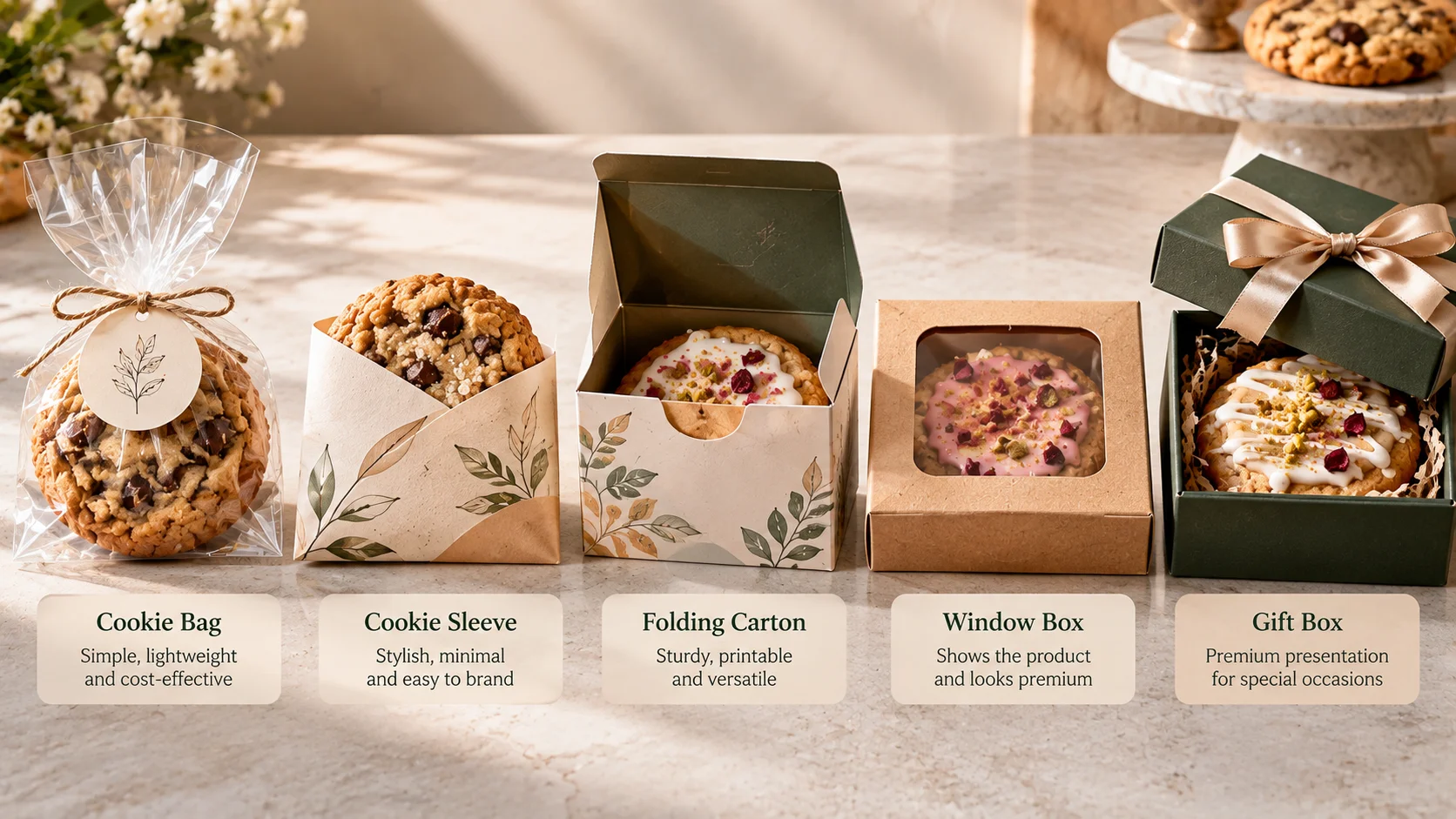
Single-Cookie Packaging Comparison
| Format | Visibility | Structural protection | Branding space | Typical fit | Shipping role |
|---|---|---|---|---|---|
| Clear bag or pouch | High | Low | Low to moderate | Simple sales, favors, samples | Usually needs outer protection |
| Paper sleeve | High | Low to moderate | Moderate | Events, bakery presentation | Usually presentation only |
| Backer card + wrap | High | Moderate | High | Branded individual cookies | May need outer shipper |
| Folding carton | Medium to high | Moderate | High | Retail, bakery, gifting | Route-dependent |
| Window carton | High | Moderate | High | Decorated cookies, retail | Route-dependent |
| Rigid gift box | Optional | High | High | Premium gifting | May need outer shipper |
| Custom mailer/presentation system | Medium to high | Designed for application | High | Ecommerce and branded delivery | Can combine or separate functions |
This comparison is a planning guide, not a performance guarantee. Actual protection depends on structure, materials, dimensions, closure, inserts, packing method, and delivery route.
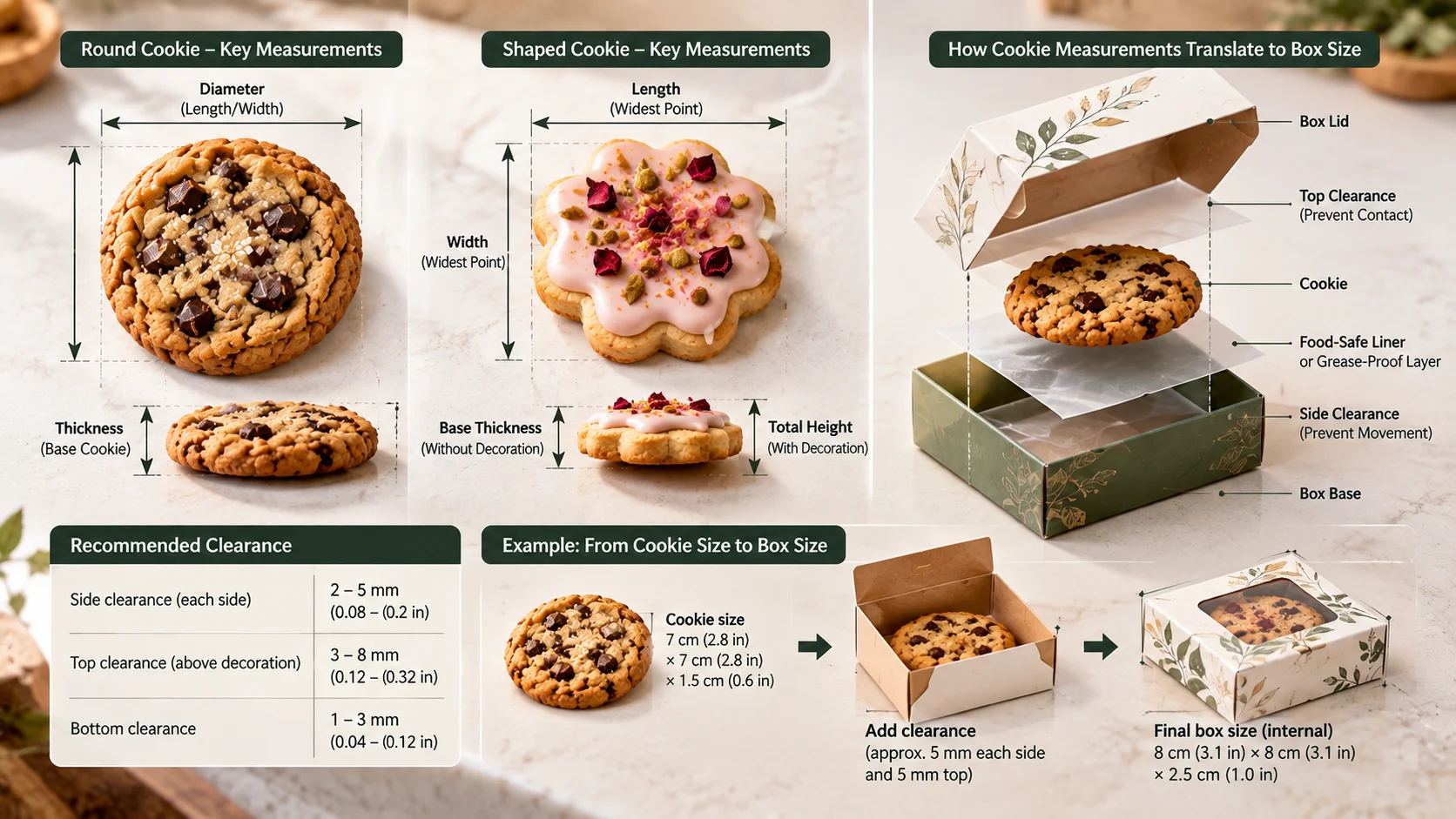
How to Size Cookie Packaging Without Guessing
There is no universal single-cookie box size. A 3-inch round cookie can require different internal dimensions depending on its thickness, decoration, inner wrap, cup, insert, and shipping requirements.
Start with the finished packed product:
- Internal length = product length + required side clearance + component allowance
- Internal width = product width + required side clearance + component allowance
- Internal height = product thickness + decoration height + top/bottom component allowance
The required clearance should not be treated as a universal fixed number. It depends on the cookie, structure, protective system, production variation, and handling route. Establish final dimensions through prototypes and testing.
Also distinguish three measurements:
- Product dimensions: the cookie itself.
- Internal dimensions: usable space available to the packed product.
- External dimensions: overall outside size of the finished package.
For fit planning, internal dimensions matter first. For storage, shipping, palletization, and postage, external dimensions also matter. BoxNovo’s custom box sizing reference can help keep the discussion focused on the finished package rather than only the flat artwork or outside measurement.
Decorated Cookie Packaging: Protect the Design, Not Just the Cookie
Raised Icing and Toppers
Measure the highest point of the finished decoration. A flat footprint is not enough when fondant, royal icing, chocolate, sprinkles, plaques, or toppers add height.
The package should prevent ordinary movement from rubbing the decoration against a lid, window, insert, or neighboring cookie.
Fragile Edges
Cutout shapes, thin points, embossed details, and brittle edges can need more controlled support than a simple round cookie. Consider a tray, cavity, divider, or other structure when the product and route justify it.
Crumbs and Movement
A larger cavity is not automatically safer. Too much room allows the cookie to slide, rotate, or collide with the package. Too little room can cause pressure or rubbing. The goal is controlled movement established through testing.
Grease and Surface Contact
Butter-rich or oily cookies can interact with paper and coatings. If the cookie will contact packaging directly, review the complete food-contact system for the actual application rather than relying on the generic material category.
Cookie Packaging Materials: What Each Option Is Good At
| Material / format | Often useful when | Main question |
|---|---|---|
| Paperboard carton | Printing, retail presentation, and structure matter | Is the selected board/coating/system appropriate for the intended use? |
| Kraft paperboard | A natural visual direction is desired | Does the actual construction support the required performance and claims? |
| Corrugated board | Outer shipping and compression protection matter | Is it the product package, outer shipper, or both? |
| Flexible bag / pouch | Visibility and low package volume matter | What barrier, seal, and food-contact requirements apply? |
| Rigid board | Premium presentation and structure matter | Does the added material, storage, and freight footprint make sense? |
Do not treat “kraft,” “paperboard,” or “plastic” as complete specifications. Substrate, coating, adhesive, ink, liner, window, closure, and the final assembled system can all affect performance and suitability.
Printing and Artwork: Make the Package Work Before It Looks Finished
Good cookie packaging design has two jobs: identify the product and work on the physical package.
Build the Artwork Around the Actual Structure
Develop printed artwork against the correct dieline or production template. Important text and logos should stay inside the printer’s safe area, while bleed should extend where the production specification requires it.
Do not design only from a flat screenshot of a box. A fold can change the visual position of a logo, a window can remove print area, and a closure panel can hide important information.
Artwork Resolution and Pixels
For raster artwork, 300 PPI at final output size is a common print-production target, but it is not a universal printer requirement. Follow the printer’s supplied specifications. Logos, line art, and other scalable elements are generally better supplied as vector artwork when available.
If a printer asks for a specific pixel dimension, calculate it from the final physical size and required PPI rather than choosing an arbitrary large image. For example, a 4-inch-wide raster element at 300 PPI would be 1,200 pixels wide.
For practical production artwork, BoxNovo’s Canva-to-print preparation guide can also help when Canva is part of your design workflow.
Color and Proofing
Screen color is not a substitute for a production proof. Substrate, ink system, coating, and printing process can change the final appearance. If brand color is important, approve a suitable proof before a large production run.
Useful Package Information
- Brand name and product identity.
- Ingredients and allergen information where required.
- Business/contact information where appropriate.
- Storage or handling information when relevant.
- Lot/date coding where required.
- QR code or website when it adds genuine customer value.
When a cookie package needs a dedicated food-labeling component, BoxNovo also offers custom food labeling options that can be planned alongside the package artwork.
Labeling requirements vary by product and jurisdiction, so use the requirements applicable to the market where the cookie is sold.
Branding Single-Cookie Packaging Without Overdesigning It
A single cookie does not need a large printed area to feel branded. Consistency is often more important than complexity.
- A recognizable color system.
- A consistent logo treatment.
- A short brand message.
- A flavor or product name.
- A branded sticker or seal.
- A printed sleeve or backer card.
- A small thank-you message.
- A QR code when it has a clear customer purpose.
Think about the opening sequence as well. A package can communicate quality through structure, print placement, opening behavior, and the condition of the cookie when it reaches the customer—not just through decoration.
When Custom Cookie Packaging Makes Sense
Custom packaging becomes more useful when stock packaging repeatedly forces compromises.
- The cookie does not fit consistently in available stock sizes.
- Decoration is being damaged by movement or contact.
- You need a window, insert, divider, special closure, or custom print layout.
- The package needs stronger branding.
- Multiple cookie sizes need a consistent packaging system.
- Staff need a repeatable packing process.
- Ecommerce orders need a defined relationship between presentation packaging and the outer shipper.
- Breakage, shifting, or inconsistent presentation is costing time or product.
When stock packaging creates fit or repeatability problems, a product-specific package can remove compromises around dimensions, branding, and repeatable packing.
Custom Cookie Box Structures to Consider
Folding Cartons
Useful when flat storage, print coverage, efficient packing, and a relatively lightweight structure are priorities.
Mailer-Style Packaging
Useful when ecommerce handling is central. A mailer can sometimes combine presentation and shipping functions, while other products are better served by a presentation box inside a separate shipper.
Rigid Boxes
Useful when premium presentation and structure are part of the product experience. If the package uses an insert or cavity, develop the interior as part of the complete structure rather than treating the insert as an afterthought.
Gift-Oriented Packaging
Useful when the recipient experience is central. Finishes, inserts, and closures should support the intended experience rather than simply adding decoration.
Ecommerce Cookie Packaging: Separate Presentation from Shipping When Needed
The package that looks good on a bakery counter is not automatically the package that can protect a cookie through parcel delivery.
For ecommerce, think in two layers:
- Presentation package: the part the customer sees when the order is opened.
- Shipping system: the outer box, cushioning, fit, and closure that handle transport.
They can be combined, but they do not have to be. For a purpose-built direct-to-customer format, BoxNovo’s custom mailer packaging for direct-to-customer orders can be evaluated as part of the complete shipping system.
A Useful Test Sequence
- Pack a representative production cookie.
- Use the actual liner, wrap, cup, insert, and closure.
- Pack it using the real production process.
- Carry, stack, handle, and store the packed package.
- For ecommerce, test the complete shipping configuration.
- Inspect for breakage, decoration transfer, crumbs, grease marks, shifting, crushed corners, or closure problems.
- Revise the structure or packing method before committing to a large production quantity.
Shipping dimensions can also affect postage. USPS publishes service-specific parcel size, weight, and fee standards, so verify the current rules for the carrier and service actually used rather than assuming a package will be priced only by scale weight.
USPS parcel size and weight standards
DIY vs. Stock vs. Custom Cookie Packaging
| Factor | DIY | Stock packaging | Custom packaging |
|---|---|---|---|
| Upfront simplicity | High | High | Moderate |
| Branding flexibility | Low to moderate | Moderate | High |
| Size flexibility | Low | Limited to available sizes | High |
| Repeatability | Moderate | High | High once finalized |
| Unique cookie fit | Limited | Sometimes | High |
| Windows / inserts | Limited | Depends on format | High flexibility |
| Ecommerce protection | Format-dependent | Format-dependent | Can be developed around the route |
| Best use | Small runs, events, early testing | Straightforward repeat sizes | Distinctive, repeatable, or complex programs |
DIY cookie packaging ideas can be completely appropriate for a small event, test launch, or low-volume favor. The point of custom packaging is not that stock packaging is always wrong. It is that a custom system can remove compromises when fit, branding, protection, or repeatability becomes important.
Cost and Quantity: What Actually Drives Packaging Price
Cookie packaging cost is affected by more than box size:
- Package structure and material.
- Dimensions and material yield.
- Printing coverage and number of print sides.
- Windows, inserts, dividers, closures, and special components.
- Finishes and special effects.
- Tooling or structural development where applicable.
- Order quantity and production efficiency.
- Packaging assembly requirements.
- Storage and shipping footprint.
- Prototype or sampling requirements.
A smaller package is not automatically cheaper if it requires a complex structure, special insert, difficult assembly, or inefficient production. Likewise, a larger package can increase material and freight requirements. Compare the cost of the complete packaging system, not only the unit price of the empty box.
Postage and Dimensional Efficiency
For direct-to-customer orders, packaging dimensions deserve attention before the design is finalized. A package that is much larger than the cookie may increase void space, require more protective material, and potentially increase shipping cost depending on the carrier and service.
USPS uses service-specific rules for package size, weight, and applicable fees. Those rules can change, so use the current carrier documentation for the actual shipping program.
Sustainability Without Vague Claims
More sustainable cookie packaging is not defined by one material or one color.
- Right-size the package around the finished product.
- Avoid unnecessary layers and components where they do not add value.
- Choose materials based on actual performance and end-of-life options.
- Evaluate the complete assembled package, not only the main board or film.
- Use specific, supportable environmental claims.
The FTC advises businesses to substantiate environmental claims and avoid broad, unqualified claims that can imply wider environmental benefits than the evidence supports.
FTC guidance on environmental marketing claims
Common Cookie Packaging Mistakes to Avoid
- Choosing a package from cookie count alone: Two six-cookie packages can require different dimensions depending on diameter, thickness, stacking, shape, decoration, and protective components.
- Using outside dimensions to judge product fit: The usable interior controls the cookie fit. Walls, folds, windows, inserts, and closures can consume space.
- Designing around a perfect sample: Production variation matters. Test representative pieces and the largest realistic product when fit is critical.
- Protecting the cookie body but ignoring the decoration: A cookie can arrive unbroken while its icing or topper is damaged.
- Treating a presentation package as a shipping package: A beautiful carton may need an outer shipper or additional protection for parcel delivery.
- Assuming a material name proves food-contact suitability: “Paper,” “kraft,” “plastic,” or “corrugated” is not a complete food-contact specification.
- Assuming more clearance is always safer: Too much empty space can increase movement and impact. The goal is controlled movement established through testing.
- Making unsupported sustainability claims: Do not label the complete package “eco-friendly,” “recyclable,” or “compostable” without evidence appropriate to the actual claim and market.
- Forgetting the packing process: A package that works in a prototype may become inefficient when a team packs hundreds of units.
A Practical Cookie Packaging Checklist
- Finished cookie length or diameter.
- Finished cookie width.
- Finished cookie thickness.
- Highest decoration or topper.
- Realistic production variation.
- Inner wrap, liner, cup, pad, tray, or insert.
- Number of cookies per package.
- Desired visibility.
- Required branding and information.
- Window, divider, insert, or closure requirements.
- Sales route: bakery, retail, event, gift, local delivery, or ecommerce.
- Outer shipping configuration, if applicable.
- Storage and stacking requirements.
- Artwork and dieline requirements.
- Prototype plan.
- Quantity and reorder expectations.
- Target packing speed and labor considerations.
A simple rule: if you cannot describe the finished cookie, the package components, and the delivery route, you probably do not have enough information to finalize the package dimensions.
Frequently Asked Questions About Cookie Packaging
What is the best packaging for a single cookie?
There is no universal best format. A bag or sleeve may be appropriate for a simple counter sale, while a carton, gift box, or custom system may make more sense for branded gifting, retail, or ecommerce. Choose based on the cookie, protection requirements, route, and presentation goal.
What is the simplest way to package one cookie?
A suitable food-contact packaging system such as a bag or sleeve with a secure closure can be simple when crush protection is not the main challenge. Fragile or decorated cookies may need more structure.
What size box do I need for one cookie?
Start with the finished cookie’s maximum length or diameter, width, thickness, and decoration height. Add the space required for liners, wraps, cups, inserts, and controlled clearance. Do not treat a generic single-cookie box size as a production standard.
How do you package decorated cookies without damaging them?
Measure the highest decoration, provide controlled clearance, prevent the cookie from shifting, and test the complete packed package. A window can improve visibility, but it should not allow ordinary movement to damage the decoration.
What are some cute cookie packaging ideas?
Cute cookie packaging can come from simple visual choices such as a branded sleeve, seasonal sticker, backer card, small window carton, custom message, or coordinated gift box. The strongest choice is one that matches the cookie and occasion without making the package harder to pack or ship.
What are creative cookie packaging options for events?
Consider sleeves, clear bags with branded seals, backer cards, small cartons, seasonal labels, or individual gift-style boxes. For larger event runs, prioritize fast and repeatable packing as well as appearance.
Can I customize packaging for individual cookies?
Yes. A custom package can be developed around the cookie’s dimensions, branding, material, structure, window, insert, closure, and selling route. Customization is most useful when it solves a specific fit, protection, branding, or repeatability need.
What packaging is best for cookies sold at events?
Simple sleeves, bags, backer-card systems, or small cartons can work well when fast packing and attractive presentation matter. The right format depends on whether the cookie is a favor, sample, retail item, or gift.
How should I package a single cookie for shipping?
Separate the presentation decision from the shipping decision when necessary. The cookie should be secured against movement, the presentation package should be protected from crushing, and the complete shipping configuration should be tested through the intended handling route.
What resolution should cookie packaging artwork be?
For raster artwork, 300 PPI at final output size is a common print-production target, but the printer’s specifications should control. Vector artwork is preferable for logos and line art when available. Pixel dimensions should be calculated from final physical size and required PPI.
How much does custom cookie packaging cost?
There is no single useful price without the package structure, dimensions, materials, printing, quantity, inserts or windows, finishes, assembly, and shipping requirements. Compare complete packaging systems rather than only the empty-box unit price.
Does packaging size affect postage?
It can. Carrier pricing can consider weight, dimensions, dimensional weight, service, and other factors. For U.S. shipments, verify the current rules for the actual service before finalizing a large package design.
Is kraft packaging suitable for cookies?
Kraft can be a useful visual and structural direction, but the exact board, coating, liner, adhesive, ink, and food-contact system must match the intended application. Kraft appearance alone does not establish food-contact suitability or an environmental claim.
When should I switch from stock to custom cookie packaging?
Consider custom packaging when stock sizes cause fit problems, decoration damage, inconsistent packing, weak branding, missing inserts or windows, shipping issues, or excessive package waste. Custom also becomes useful when the package is an important part of the product experience.
Final Takeaway
Good cookie packaging starts with the finished cookie, not the box.
Measure the real product. Account for decoration and protective components. Choose the simplest format that meets the sales and delivery requirements. Build artwork around the actual structure. Test the complete packed system before committing to production. For ecommerce, treat presentation and shipping as related decisions rather than assuming one package has to do everything.
For a simple single-cookie sale, a bag, sleeve, or small carton may be enough. For retail, gifting, premium presentation, or ecommerce, a purpose-built box, insert, or shipping system can solve problems that stock packaging cannot.
When you are ready to plan the complete package rather than only the container, BoxNovo’s custom packaging and box solutions provide a natural next step for developing dimensions, structure, print, inserts, and the overall customer experience.