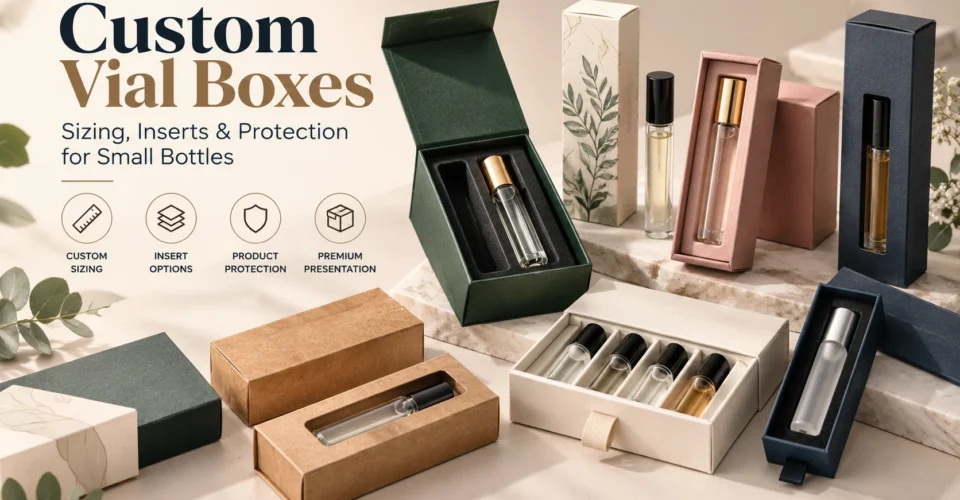
Custom vial boxes are purpose-built packages designed around the dimensions, shape, quantity, protection needs, and presentation of small bottles or vials. The best design starts with the product—not a generic box size—and works outward through the insert, internal fit, box structure, material, printing, and shipping or retail requirements.
For small glass or rigid containers, fit matters because a box that is too loose can allow unwanted movement, while a box that is too tight can make packing and removal difficult. The practical goal is controlled positioning: the product should sit securely, the package should close properly, and the overall structure should support the way the item will be stored, displayed, handled, and shipped.
If you are comparing packaging options, think of the box and insert as one system. The outer box supplies the structure and branding surface; the insert organizes the product inside it. That relationship is especially important when one package holds several vials, different bottle shapes, or a small product set.
What Are Custom Vial Boxes?
Custom vial boxes are boxes manufactured or converted to specified dimensions and structural requirements for vials or other small containers. Instead of selecting a stock carton and accepting excess empty space, the package can be planned around the product’s actual footprint, height, closure, quantity, and intended use.
A vial package may be a simple folding carton for one small container, a multi-unit carton with dividers, a presentation box with a fitted insert, or a protective outer package used for shipping. The right format depends on the product and the job the package needs to perform.
The term “vial” can cover different product forms, so the packaging specification should be based on the actual container rather than the name alone. A narrow glass vial with a stopper, a dropper bottle, a roller bottle, and a small cosmetic container can require very different internal geometry.
Why Vial Packaging Needs More Than a Small Box
Small products can create surprisingly demanding packaging decisions. Their compact size leaves less room for mistakes in fit, while closures, caps, droppers, shoulders, labels, and fragile materials can change the usable dimensions.
A good vial package should consider five connected jobs:
1. Containment — keep the product and any included components together.
2. Positioning — control movement with the right internal structure.
3. Protection — reduce the chance of damage caused by ordinary handling and transport conditions.
4. Presentation — give the product a clean, intentional retail or unboxing appearance.
5. Information — provide appropriate space for branding and applicable product information.
Protection should never be described as an absolute guarantee. Real performance depends on the product, materials, structure, packing method, and distribution conditions, so testing the finished package is important when damage risk is meaningful.
How to Measure a Vial Before Ordering Custom Boxes
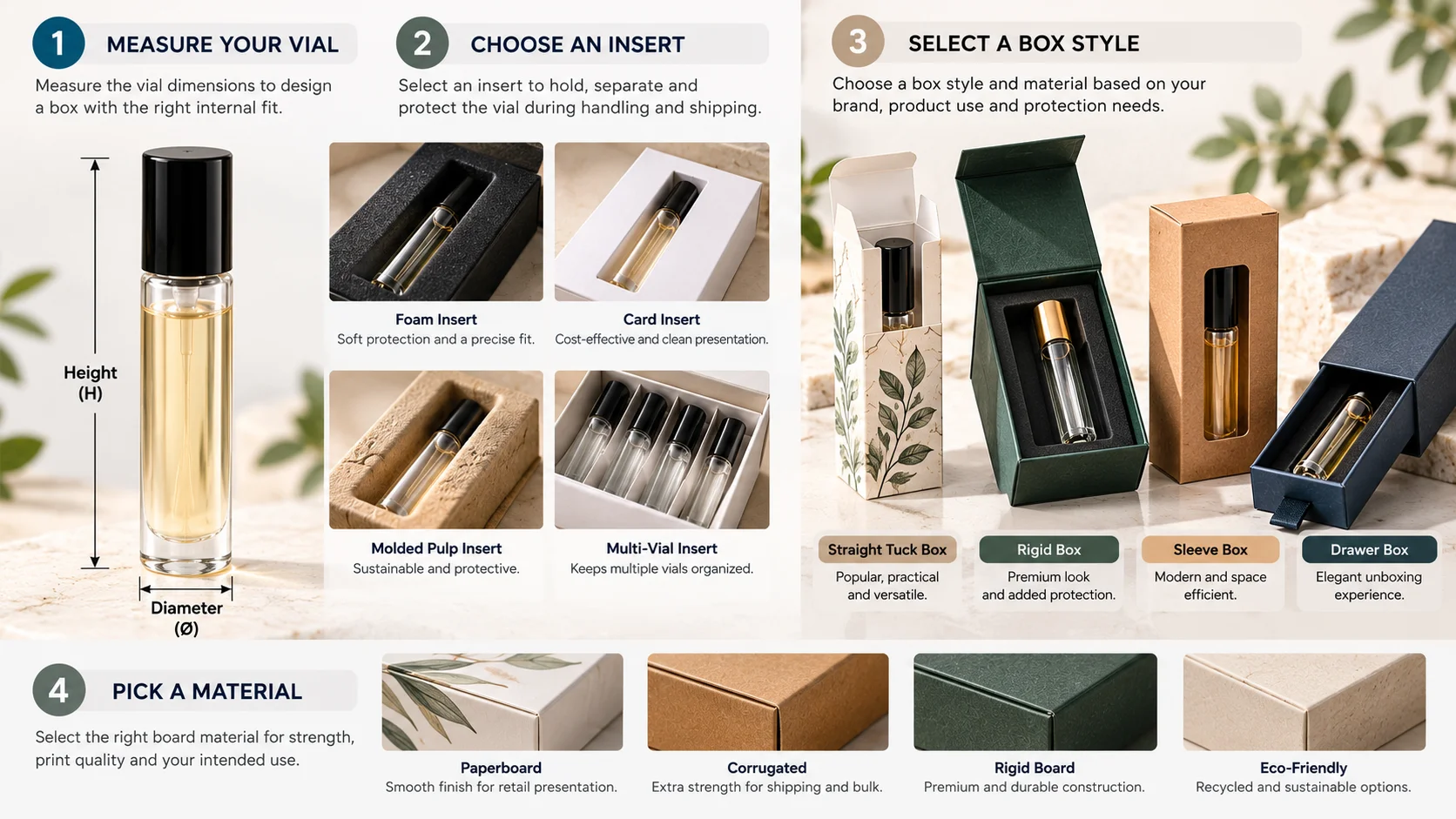
Accurate measurement is the foundation of a good custom box. Measure the finished container in the condition in which it will actually be packed.
Start with the maximum relevant dimensions: overall height, maximum width, and maximum depth or diameter. Include the cap, closure, pump, dropper, or other component if it remains attached during packing. If the product has an unusual shoulder, protruding closure, or irregular shape, record those features rather than reducing the product to a simple rectangle.
Then document how the vial will sit inside the package. Upright, horizontal, individually separated, and grouped arrangements can all lead to different internal dimensions. If several vials share one box, measure the complete packing arrangement—including dividers or trays—rather than simply multiplying one vial’s dimensions by the quantity.
BoxNovo’s product-measurement and box sizing guide is useful for working through internal versus external dimensions, product arrangement, and sampling considerations.
A Practical Vial Measurement Checklist
Before requesting a quote or dieline, record:
• Product height with the final closure attached
• Maximum product width or diameter
• Any irregular shape, shoulder, collar, or protrusion
• Quantity per box
• Orientation of each vial
• Divider or insert arrangement
• Any label or sleeve that changes the finished dimensions
• Whether the package is for retail presentation, e-commerce, storage, or another use
• Whether the product needs an individual cavity or can share a compartment
• Whether the box will be placed inside a larger shipping package
These details give a packaging supplier a much better basis for designing the internal and external structure.
How to Choose the Right Insert for Vials
The insert is often the most important part of a multi-vial package because it controls how the containers are positioned. The best insert is not automatically the thickest or most expensive option; it is the one whose material, geometry, and retention approach match the product and handling conditions.
Common insert approaches include die-cut paperboard or cardboard structures, foam-based cavities, molded pulp, and custom dividers. Availability and suitability depend on the box construction, product shape, production method, and desired presentation.
For one vial, an insert may be a simple collar or fitted cavity. For several vials, the design may use a grid, divider system, or individual cavities. If the package contains different small bottles, the insert can be zoned so each item has its own position instead of forcing every cavity to use the same shape.
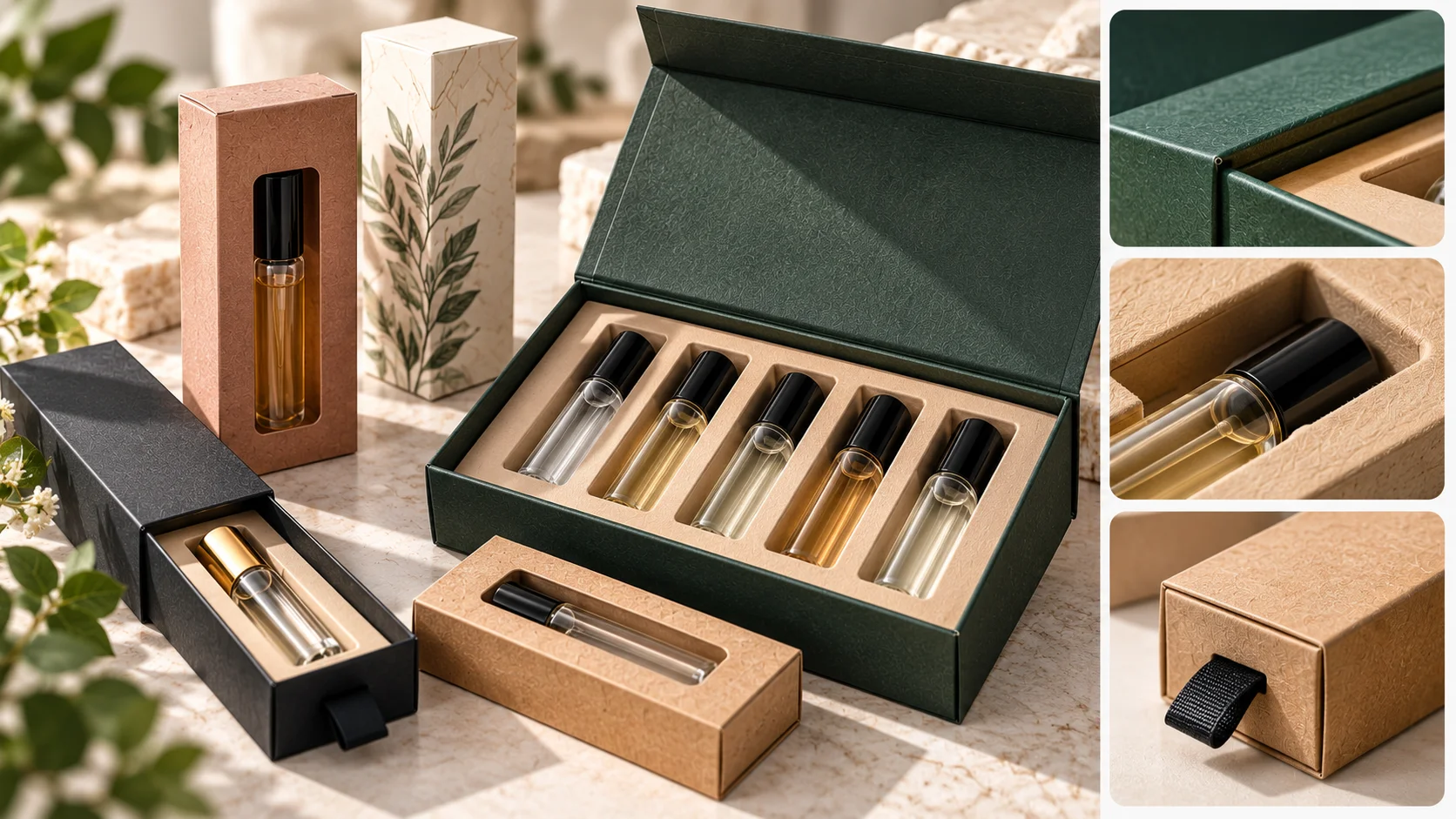
The insert should be designed together with the box. Changing the insert can change the required internal dimensions, which can change the outer dimensions and even the most suitable box style.
| Insert approach | Best suited to | Key consideration |
|---|---|---|
| Paperboard / cardboard insert | Printed retail packaging, organized multi-unit packs | Can be designed as part of the carton structure and branding experience. |
| Foam insert | Products needing individually shaped cavities or presentation-focused retention | Cavity geometry and material selection should be matched to the actual product. |
| Molded-pulp insert | Brands prioritizing a fiber-based molded structure | Form, fit, appearance, and production method need to be evaluated for the product. |
| Divider / grid system | Multiple similar vials in one package | Useful for separating units and keeping a repeatable arrangement. |
| Custom mixed insert | Kits containing different small containers or accessories | Requires the entire product set to be measured and laid out before finalizing the box. |
How Much Clearance Should a Vial Box Have?
There is no single clearance number that works for every vial package. Required space depends on the container shape, insert design, board or cushioning material, closure, packing process, and how the finished package will be handled.
The goal is not to make the cavity mathematically identical to the product. The goal is controlled fit. A product should be supported without being difficult to insert or remove, while the completed package should close without crushing the contents or forcing the structure out of shape.
For fragile or high-value products, do not approve the design from a drawing alone. A physical sample or realistic prototype can reveal issues that dimensions cannot: excessive movement, difficult insertion, lid interference, label rubbing, weak dividers, or an uncomfortable opening sequence.
Which Box Styles Work for Small Vials?
There is no single best box style for every vial application. The structure should follow the product, quantity, opening experience, production requirements, and distribution channel.
A folding carton can work well when the package needs a lightweight retail format and a strong printed surface. A tuck-style structure may suit simple access. A sleeve-and-tray or rigid presentation structure can make sense when the unboxing experience is a major part of the product presentation. A corrugated outer package becomes more relevant when shipping protection is the dominant requirement.
BoxNovo’s custom box styles and structural formats provide a useful starting point when comparing structures before the final dimensions and insert are approved.
Choosing the Material for Custom Vial Boxes
Material selection should follow the product and distribution requirements rather than a generic claim that one material is always better.
Paperboard or cardboard is often useful for printed retail cartons because it combines a printable surface with flexible converting options. Corrugated packaging becomes more relevant when the package needs additional structural support for shipping, storage, or handling. Rigid board is commonly selected when a substantial premium presentation is part of the brief.
BoxNovo’s packaging material comparison guide explains the main material categories and the trade-offs between structure, protection, printing, presentation, and intended use.
Cardboard, Corrugated, or Rigid: Which Is Right?
The choice is best made by asking what the package needs to do:
| Material direction | Consider it when | Watch for |
|---|---|---|
| Paperboard / cardboard | Retail presentation, printed cartons, compact product packaging | Final performance depends on board specification, structure, dimensions, and application. |
| Corrugated | Shipping, fulfillment, outer protection, or higher handling demands | Select the structure and flute configuration according to the actual shipping requirements. |
| Rigid board | Premium presentation, gifting, luxury retail, or a substantial unboxing experience | Higher structure and presentation may not be necessary for a simple high-volume carton. |
How to Package Multiple Vials in One Box
Multi-vial packaging needs a repeatable layout. Decide the number of units per package, then choose an arrangement that uses the available space efficiently while keeping the products separated and easy to count.
For identical vials, a consistent grid can simplify packing and presentation. For mixed sizes, individual cavities or zones may be more appropriate. The insert should prevent the units from freely contacting one another while leaving enough room for the box to close correctly.
If the package is going into e-commerce shipping, remember that the retail box and the shipping package have different jobs. A presentation carton may need an outer protective layer rather than being expected to absorb every distribution load by itself.
Custom Vial Boxes for Retail vs. E-Commerce
Retail and e-commerce packaging often share the same product-fit requirements but prioritize different outcomes.
| Requirement | Retail-focused vial packaging | E-commerce-focused vial packaging |
|---|---|---|
| Primary goal | Product presentation, information, shelf consistency | Transit protection, efficient packing, reliable closure |
| Structure | Folding carton, presentation box, sleeve-and-tray, or rigid format depending on product | Product box plus suitable outer shipping protection when needed |
| Insert | Supports display, organization, and product fit | Controls movement and helps keep the package organized |
| Artwork | Brand identity and product information are highly visible | Branding still matters, but outer shipping requirements may change the package system |
| Testing | Check fit, opening, display and print quality | Check fit plus packing method and realistic shipping/handling conditions |
What About Perfume, Eyeliner, Pen, Wax, Incense, and Eye-Shadow Packaging?
Vial packaging overlaps with other small-product packaging categories, but the package should still be designed around the actual item rather than copying a box style from another product.
For example, perfume boxes may need to accommodate a bottle and cap while emphasizing presentation. Custom eyeliner boxes typically deal with long, narrow cosmetic products. Pen boxes can require narrow channels or individual positions. Wax boxes and incense boxes may have different dimensions and protection requirements. Custom eye shadow boxes may need cavities for pans, palettes, or applicators. Airtight packaging is a separate functional question: a printed box should not be described as airtight unless the complete package is actually engineered and tested for that purpose.
These examples are useful because they show why “small product packaging” is not one universal category. Shape, closure, fragility, orientation, quantity, and handling conditions all influence the structure.
Printing and Branding for Small Vial Boxes
Once the structure is working, the exterior can be designed around the brand. Small packages have limited surface area, so information hierarchy matters. A strong design should make the brand and product identity easy to recognize without forcing every panel to carry the same amount of information.
Printing and finishing can be selected according to the box material and desired presentation. Depending on the structure, options can include full-color artwork, matte or gloss treatments, foil effects, embossing, debossing, spot UV, and other finishes. Final production options depend on the selected material and construction.
If the vial itself has a label, coordinate the label and box rather than designing them as unrelated pieces. BoxNovo’s product label design guidance explains why label dimensions, usable surface, information hierarchy, and packaging should be considered together.
How to Design Custom Vial Boxes Step by Step
A practical workflow is:
1. Define the product — identify the exact vial, closure, quantity, and intended use.
2. Measure the finished product — capture maximum dimensions and irregular features.
3. Decide the packing arrangement — determine orientation, count, and cavity layout.
4. Choose the insert approach — select the structure that controls the product position.
5. Choose the box style — match the opening, presentation, packing process, and distribution channel.
6. Select the material — balance structure, print, presentation, and protection.
7. Confirm internal and external dimensions — make sure the dimensions are discussed using the supplier’s convention.
8. Develop the dieline — build artwork only after the structural template is approved.
9. Sample the package — test the real vial in the real insert and box.
10. Approve production — confirm quantity, artwork, material, finish, packaging configuration, and delivery requirements.
Common Mistakes When Ordering Vial Boxes
The most expensive mistakes often happen before production starts.
• Ordering from the vial name rather than the actual measurements.
• Measuring the bottle but forgetting the cap, dropper, pump, or other attached component.
• Choosing the outer box before deciding how the product will be held inside.
• Treating an insert as decoration instead of part of the structural system.
• Assuming one clearance value works for every product or material.
• Designing artwork before receiving the final dieline.
• Ignoring how the box will be packed and opened in real use.
• Using a retail carton as the only shipping protection when the distribution conditions require a separate outer package.
• Approving production without testing the actual product in the final packaging arrangement.
How to Reduce Packaging Waste Without Sacrificing Fit
Efficient sizing can reduce unnecessary empty space, but “smallest possible box” is not automatically the best answer. The package still needs room for the insert, product insertion and removal, closures, and the level of protection appropriate to its use.
A better objective is an efficient package system: enough structure to perform its job, no unnecessary voids, and a material choice appropriate to the product and distribution channel. If sustainability is a priority, evaluate the complete package—including coatings, adhesives, inserts, and local end-of-life conditions—rather than judging the box material alone.
How to Choose a Custom Vial Box Supplier
Before approving a supplier, ask for enough information to evaluate the complete package, not just the printed exterior.
A useful supplier checklist includes:
• Can the box be made to the product’s actual dimensions?
• Can the insert be designed around the vial or bottle?
• Will you receive a dieline or structural proof before artwork is finalized?
• Can a physical sample be reviewed when fit or protection is important?
• Which materials and finishes are available for the selected structure?
• How will internal and external dimensions be specified?
• What quantity and production assumptions are included in the quote?
• How will the package be packed for shipment to you?
BoxNovo’s complete custom packaging planning guide is a useful resource for bringing dimensions, structure, materials, printing, finishing, sampling, quantity, and delivery into one project plan.
When Should You Consider Rigid Vial Packaging?
Rigid packaging makes the most sense when the presentation itself is an important part of the product experience. It can provide a substantial structure and support fitted interior configurations for premium products, gift sets, and presentation-focused applications.
For a straightforward high-volume vial carton, rigid construction may add complexity that is not necessary. The decision should be based on the product’s positioning, presentation goals, insert requirements, handling conditions, and budget.
For premium applications, BoxNovo’s rigid presentation boxes with fitted interiors show how a structured outer box and custom insert can be developed as one package.
Custom Vial Boxes: Final Buying Checklist
Before placing an order, confirm these points:
☐ Product dimensions measured with all components that remain attached during packing
☐ Quantity per box confirmed
☐ Product orientation confirmed
☐ Insert layout selected
☐ Internal dimensions and external dimensions clearly defined
☐ Box structure selected for the intended use
☐ Material selected according to protection, printing, and presentation needs
☐ Dieline or structural proof approved before final artwork
☐ Artwork and required product information proofread
☐ Physical sample tested when fit or protection is important
☐ Production quantity and delivery requirements confirmed
Final Takeaway
The strongest custom vial boxes are not simply small boxes with attractive printing. They are packaging systems designed around the actual product: the vial dimensions, closure, quantity, insert, box structure, material, presentation, and distribution conditions all work together.
Start with the finished product and packing arrangement. Measure carefully, choose the insert and structure together, confirm the material and dimensions, develop artwork from the approved dieline, and test the finished package before a full production run when fit or protection matters.
If you already know your vial dimensions and approximate quantity, you can explore made-to-fit product box solutions or Discuss your packaging requirements with BoxNovo to determine the most suitable custom packaging direction.
Frequently Asked Questions About Custom Vial Boxes
What are custom vial boxes?
Custom vial boxes are packaging boxes made to specified dimensions and structural requirements for vials or other small containers. They can be designed around the product, quantity, insert, material, printing, and intended use.
How do I measure a vial for a custom box?
Measure the finished vial in its actual packing condition, including the cap, closure, dropper, pump, or other attached components. Record the maximum height, width or diameter, depth, and any irregular features.
Do custom vial boxes need inserts?
Not always. A simple single-vial package may work without a separate insert, while multiple or fragile products may benefit from cavities, dividers, collars, or other internal structures that control positioning.
What insert is best for small bottles?
There is no universal best insert. Paperboard, foam, molded-pulp, dividers, and mixed structures can all be appropriate depending on the product shape, protection requirements, presentation, production method, and quantity.
How much clearance should a vial have inside the box?
Clearance should be determined from the product, insert, material, closure, packing method, and handling requirements. Avoid treating a single clearance number as a universal rule; test the finished package when fit is critical.
Can I put multiple vials in one box?
Yes. Multiple vials can be arranged in grids, divider systems, individual cavities, or other custom layouts. The arrangement should be designed from the complete product set rather than simply multiplying one vial’s dimensions.
Are vial boxes suitable for e-commerce?
They can be, but the retail or presentation box and the shipping package may have different jobs. For e-commerce, evaluate the complete packing system and test it under realistic handling conditions.
Can custom vial boxes be printed with branding?
Yes. Custom packaging can include printed artwork, colors, product information, and brand elements. Finishing options depend on the selected material and structure.
Can vial packaging be made from cardboard or corrugated material?
Yes. Paperboard/cardboard can be suitable for compact printed cartons, while corrugated construction is more relevant when shipping and handling protection are important. The appropriate specification depends on the application.
Are rigid boxes a good choice for vial packaging?
Rigid boxes can be a strong option when premium presentation and a substantial structure are important. They are not automatically the best choice for every vial application; simpler folding cartons may be more appropriate for other projects.
What is the difference between vial boxes and perfume boxes?
Both can be designed around small bottles, but their structures should follow the actual product. Perfume packaging often places greater emphasis on bottle presentation, while vial packaging may prioritize compact organization, individual cavities, or multi-unit arrangements.
Can a printed box make a package airtight?
A printed box should not be described as airtight simply because it closes. Airtight performance depends on the complete packaging system, including the actual container, closure, seals, and testing requirements.
Should I get a sample before ordering custom vial boxes?
A physical sample is worth considering when product fit, insert geometry, closure, protection, or presentation is important. Testing the real vial in the intended packaging can reveal problems that a digital design may not show.
How do I get started with custom vial packaging?
Prepare the product dimensions, quantity, orientation, insert requirements, preferred material or presentation, artwork needs, and intended use. A packaging supplier can then evaluate the appropriate structure and develop the project around those requirements.