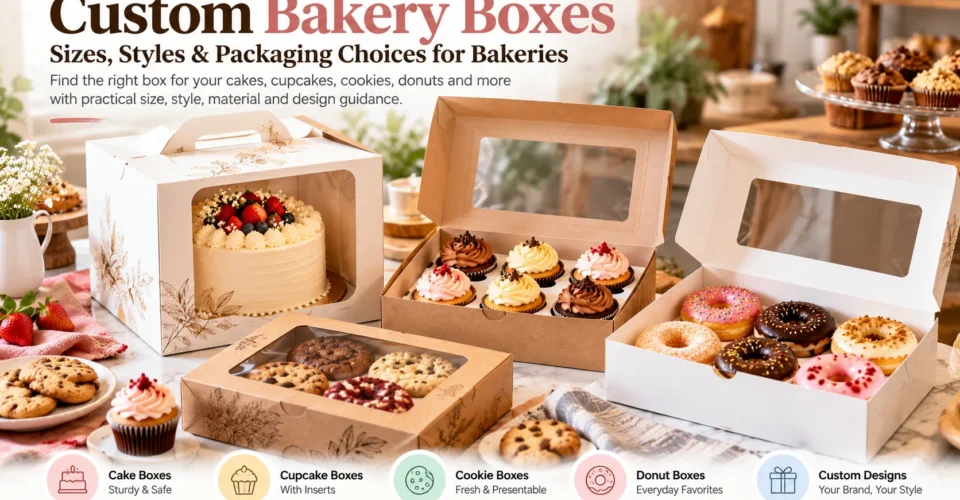
Custom bakery boxes are not just printed cartons. The right package has to fit the finished product, protect decorations, work with inserts or trays, close reliably, suit the bakery’s material and branding goals, and survive the way the product is actually handled.
The most reliable way to choose bakery packaging is to work from the product outward: measure the finished item, determine the usable space you need, choose a structure and material, then decide on closures, inserts, windows, printing, and delivery requirements. That approach is more useful than treating any published box dimension as a universal standard.
Quick answer: To choose custom bakery boxes, start with the finished product, not the box name. Measure its footprint and height, account for boards, trays, decorations and inserts, then select the box structure, material, closure and presentation features that match how the product will be packed, carried and delivered. For broader custom packaging options, start with the packaging requirements rather than the printed artwork.
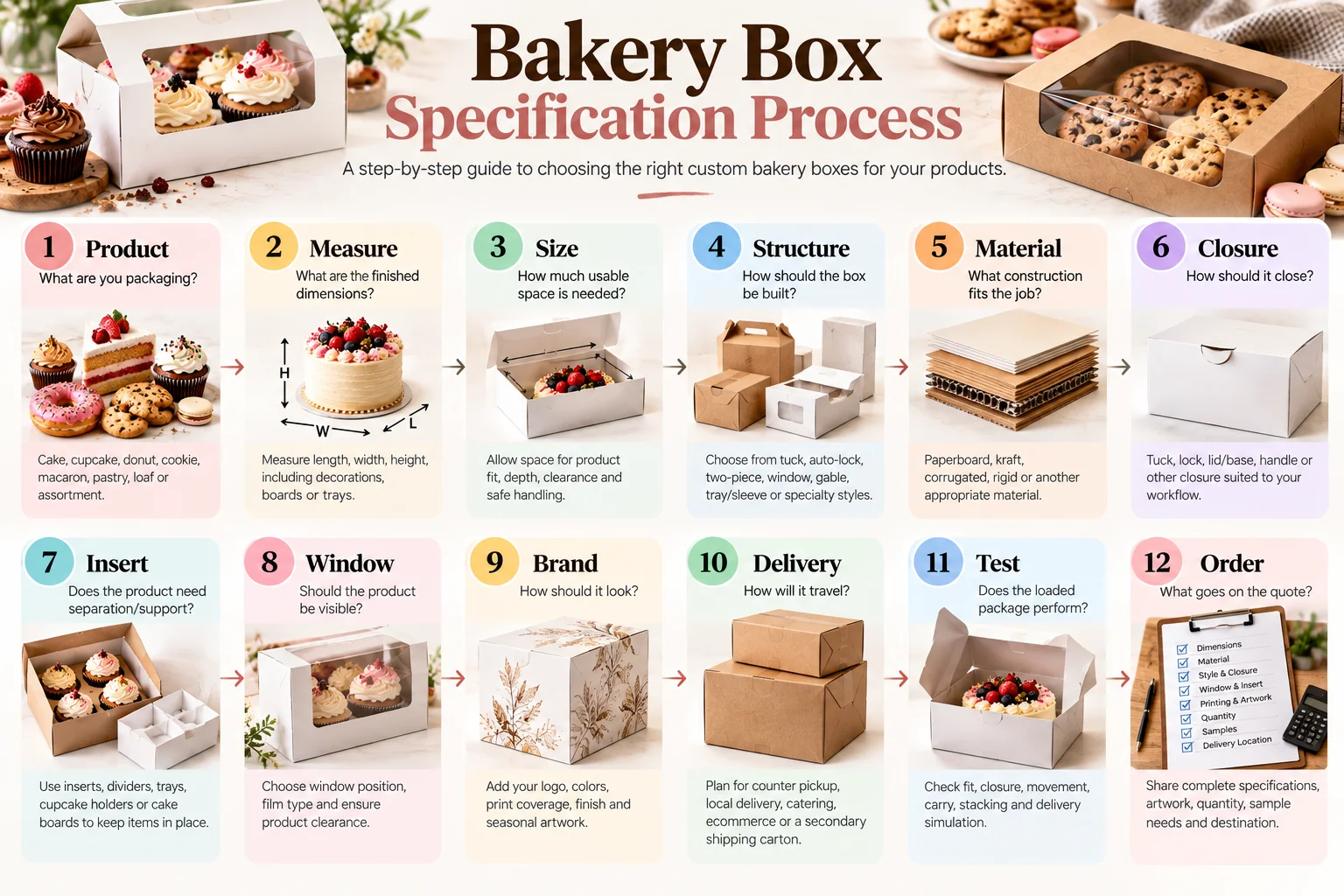
The Bakery Box Specification Method
| Step | Decision | What to determine |
|---|---|---|
| 1 | Product | Cake, cupcake, donut, cookie, macaron, pastry, loaf, assortment, etc. |
| 2 | Measure | Length, width/diameter, height, decoration height, board/tray size. |
| 3 | Size | Footprint, depth, loading/removal clearance and movement control. |
| 4 | Structure | Tuck, auto-lock, two-piece, window, gable, tray/sleeve or specialty format. |
| 5 | Material | Paperboard, kraft, corrugated, rigid or another appropriate system. |
| 6 | Closure | Tuck, lock, lid/base, handle or another closure suited to the workflow. |
| 7 | Insert | Cupcake cavities, dividers, trays, cake boards or other supports. |
| 8 | Window | Window position, film, rigidity, print area and product clearance. |
| 9 | Brand | Logo, colors, print coverage, finish, seasonal artwork and operational copy. |
| 10 | Delivery | Counter pickup, local delivery, catering, ecommerce or secondary shipping carton. |
| 11 | Test | Fit, closure, movement, carry, stacking and delivery simulation. |
| 12 | Order | Complete dimensions, components, materials, artwork, quantity, sample and destination. |
What Are Custom Bakery Boxes?
Custom bakery boxes are packaging made around a bakery’s product, brand and operating requirements rather than a generic off-the-shelf format. Customization can involve the box dimensions, structure, material, printing, window, insert, divider, finish and other components.
The important distinction is that customization is not simply adding a logo. A genuinely useful custom package solves a fit, protection, handling, presentation or branding requirement, or several at once.
How Custom Boxes Differ From Stock Bakery Boxes
| Factor | Stock box | Custom box |
|---|---|---|
| Dimensions | Limited to supplier’s available sizes | Can be developed around the finished product and components |
| Structure | Usually predetermined | Can be selected or developed for the intended use |
| Branding | None or limited stock artwork | Custom print and artwork |
| Window | Fixed options | Window size and placement can be specified |
| Insert | Available only in certain formats | Can be coordinated with the outer carton |
| SKU strategy | Catalog-driven | Can be planned around a bakery’s product range |
| Testing | Usually buyer-managed | Samples can be specified before production |
When Custom Dimensions Make Sense
Custom dimensions become especially useful when the product falls between common stock sizes, has unusual decoration height, uses a board or tray, needs an insert, must fit a particular delivery bag or outer carton, or needs a tighter balance between protection and material use. A practical place to review custom box sizing guidance is when you are turning finished-product measurements into a packaging specification.
Start With the Product, Not the Box
Two products with the same name can require different boxes. A plain 8-inch cake and a heavily decorated 8-inch cake may have the same footprint but very different height and clearance requirements. Six cupcakes in one bakery’s wrappers may also require a different insert layout from six cupcakes in another bakery’s wrappers.
| Product | Primary sizing variable | Packaging details to check |
|---|---|---|
| Round cake | Board/diameter + finished height | Frosting, toppers, supports, board thickness and removal clearance |
| Sheet cake | Length × width + height | Board size, corners, decoration and carrying method |
| Tiered cake | Footprint + total height | Supports, center of gravity, base strength and lid clearance |
| Cupcakes | Count + cavity arrangement | Wrapper diameter, insert, frosting height and finger access |
| Donuts | Count + grid arrangement | Actual diameter, glaze, spacing, tray and orientation |
| Cookies | Product footprint + quantity | Decoration, dividers, stacking and movement |
| Macarons | Count + tray layout | Fragility, shallow depth, wells and separation |
| Croissants/pastries | Length/width + quantity | Shape, grease, moisture and loading orientation |
| Loaves | Length × width × height | Weight, support, condensation and closure |
| Mixed assortment | Combined loaded layout | Dividers, separation, movement and presentation |
How to Measure a Bakery Product for Its Box
Measure the product in the condition in which it will actually be packed. For decorated products, that means measuring after decoration, not only the baking pan or base recipe.
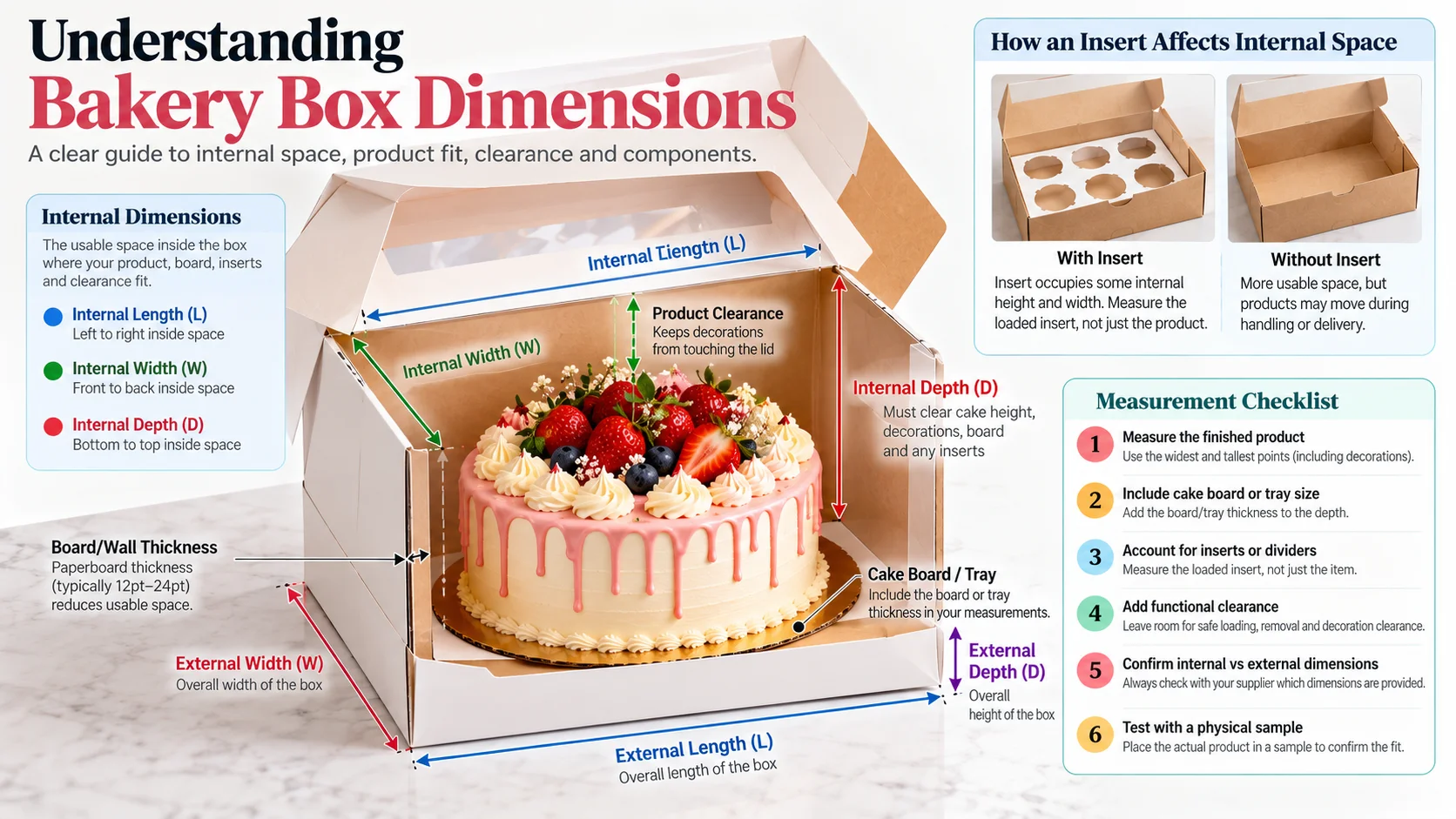
- Measure the widest finished point. For round products, record the finished diameter; for rectangular products, record both footprint dimensions.
- Measure the finished height, including frosting, glaze, toppers, wrappers or other parts that will remain with the product.
- Measure the cake board, tray, liner or other component that will occupy interior space.
- Record the number of items per box and the intended orientation.
- If an insert or divider will be used, treat the loaded insert as part of the packaging specification.
- Allow practical clearance for loading, removal and product protection without creating unnecessary empty space.
- Measure several representative products when handmade variation is significant. Use the largest expected configuration or create a separate package size when one box cannot safely cover the range.
- Confirm the final fit with a physical sample before committing to a production run.
Internal vs. External Box Dimensions
Always confirm whether a supplier is quoting internal or external dimensions. The distinction matters because board thickness, folds, double walls, inserts and structural features can reduce usable interior space. Do not assume that a catalog number describes the exact cavity available to your product.
How Much Clearance Should a Bakery Box Have?
There is no single clearance number that works for every bakery product. Clearance has to account for the product’s shape, decoration, board or tray, insert, loading method and transport conditions. A package that is too tight can scrape frosting or make loading difficult; a package that is unnecessarily large can allow movement and reduce presentation quality.
Practical rule: Use published dimensions as starting points, not final manufacturing specifications. The loaded product and a physical sample should determine whether the proposed dimensions actually work.
Bakery Box Sizes: A Practical Reference
The following are reference configurations commonly encountered in bakery packaging discussions. They are not universal industry standards. Suppliers can use different size conventions, structures and internal dimensions, so the finished product and packaging components should determine the final specification.
| Product | Reference configuration | What must be verified |
|---|---|---|
| 6-inch round cake | Often around 8 × 8 × 4 in | Cake board, decoration height and actual internal dimensions |
| 8-inch round cake | Often around 10 × 10 × 5 in | Decorations, board, clearance and structure |
| 10-inch round cake | Often around 12 × 12 × 6 in | Height, board, support and carry method |
| 6 cupcakes | Often around 10 × 7 × 4 in | Insert cavity layout and frosting clearance |
| 12 cupcakes | Often around 14 × 10 × 4 in | Insert dimensions, wrapper size and decoration height |
| 12 donuts | Sold in several footprint configurations | Actual donut diameter, grid, glaze and tray/insert |
| 6–24 macarons | Usually shallow formats with product-specific trays | Well dimensions, shell size and movement control |
Why “Standard Bakery Box Sizes” Can Be Misleading
A bakery box size is not meaningful by itself. Different suppliers can list different dimensions for the same product count because the products can be arranged differently, because the structure differs, or because one listing describes a tray while another describes a complete box. That is why a product-first specification is safer than choosing a size solely from a search result.
How Bakery Box Sizing Changes by Product
Cake Box Sizing
For cakes, start with the cake board or base footprint rather than the cake diameter alone. Then account for the widest decoration and total decorated height. Tall or heavily decorated cakes may require a deeper structure, stronger base, additional support or a different closure. When you are ready to compare a direct bakery packaging format, cake packaging formats can help translate the use case into a box structure.
Cupcake Box Sizing
Cupcake packaging is often determined by the insert. The insert controls cavity diameter, spacing and orientation, while the outer carton must provide enough clearance above the tallest frosting or topper. Test each meaningful cupcake size instead of assuming that one insert works for every SKU. For a product-specific reference, see cupcake box formats.
Donut Box Sizing
Donut boxes are often laid out as a grid. Count alone is not enough: donut diameter, glaze, toppings, tray geometry and desired orientation affect the footprint. A 12-count configuration can therefore have different dimensions depending on whether the donuts are arranged in a wider or longer grid. When the product has a consistent donut assortment, donut packaging formats can be evaluated around the actual grid and loaded footprint.
Cookie Box Sizing
Cookie packaging depends on the cookie’s diameter or footprint, thickness, quantity and decoration. Decorated cookies may need dividers or a tray to prevent decorated faces from touching one another or the lid. A dedicated cookie packaging format is worth considering when the product range has consistent cookie dimensions or presentation requirements.
Macaron Box Sizing
Macarons benefit from controlled movement. A shallow box with a properly fitted tray or wells can protect the shells and improve presentation. The outer box should be sized around the loaded tray, not simply the number of macarons.
Pastry, Croissant and Loaf Packaging
Pastries vary more than a simple size chart suggests. Shape, flakiness, grease, moisture and stacking tolerance can all affect the package. For loaves and heavier products, consider base strength and how the package will be carried. Warm products may also need a defined cooling or ventilation approach to limit condensation. For a directly relevant product example, pastry packaging formats can be evaluated against the product’s actual dimensions and handling needs.
How to Choose Bakery Box Materials
Material selection should follow the product and operating conditions. No single substrate is the best choice for every bakery application. For a broader comparison before choosing a substrate, review the packaging material guide.
| Material family | Often considered for | Key decision factors |
|---|---|---|
| Paperboard / folding carton | Counter-service bakery packaging and printed cartons | Product weight, dimensions, print requirements and handling |
| Kraft | Natural or artisan-oriented presentation | Print appearance, strength, product contact and desired look |
| Corrugated | Heavier products, stacking or additional transport protection | Flute/board construction, load, dimensions and delivery conditions |
| Rigid / setup box | Premium gifting and presentation | Cost, storage, presentation, weight and intended reuse |
Paperboard and Cardboard Considerations
For printed cartons and many counter-service applications, a paperboard or cardboard construction may be considered based on product weight, dimensions, print requirements and handling. Review cardboard packaging options when comparing that construction with other material families.
Kraft Packaging Considerations
Kraft can support a natural visual direction, but appearance should not be the only selection criterion. Print behavior, strength, intended food-contact conditions and the complete package construction still matter. See kraft packaging options for the material context.
Corrugated and Rigid Packaging Considerations
Corrugated construction can be considered when the product, dimensions, stacking or delivery conditions require more structural protection than a lighter carton can provide. Premium gifting may call for a different structural approach, including rigid construction. Compare corrugated packaging options and rigid packaging options only after defining the product and handling requirements.
Grease, Moisture and Condensation
Butter, oil, syrup, frosting and moisture can change how a package performs. Depending on the product, the packaging system may use an appropriate board treatment, liner, tray, parchment or another barrier. The correct solution should be evaluated against the actual product and intended conditions rather than assumed from a generic “grease-resistant” label.
Warm baked goods also deserve attention. Closing a warm product can create condensation, which may soften packaging or change the texture of the food. The right cooling time, ventilation or barrier approach depends on the recipe, packing temperature, holding period and delivery environment.
Food-Contact Considerations for Bakery Packaging
For U.S. bakery packaging, do not treat “FDA-safe” as a blanket description for an entire finished box. FDA explains that the regulatory status of a food-contact material depends on the individual substances that make up the article and their intended use. Applicable pathways can include regulations in Title 21 of the Code of Federal Regulations, GRAS status, prior sanctions, Threshold of Regulation exemptions or effective Food Contact Substance Notifications.
For paper and paperboard packaging, FDA identifies 21 CFR Part 176 among the relevant categories for paper and paperboard components, while other packaging components can fall under other regulatory sections. The appropriate status depends on the actual construction and intended conditions of use.
- Which surfaces are intended to contact food directly?
- What paperboard, coating, ink, adhesive, window film, insert or liner is being used?
- What are the intended food, temperature, fat/oil and moisture conditions?
- Can the supplier provide relevant compliance documentation for the proposed construction?
- If a coating or liner is used, does it change the package’s recycling or disposal guidance?
For U.S. requirements, consult the applicable FDA food-contact guidance for the specific package construction rather than relying on a blanket certification statement.
Do You Need a Bakery Box Window?
A window can be useful when product visibility is part of the selling experience, but it is a design trade-off rather than an automatic upgrade.
| Choose a window when… | Consider a closed format when… |
|---|---|
| Decorated products benefit from visual inspection | Protection or full-surface print is the priority |
| Counter presentation matters | The product does not gain much from visibility |
| The window can be positioned around the loaded product | The window would interfere with decoration or presentation |
| The proposed film and construction suit the application | The window adds unnecessary complexity or material |
Always evaluate the assembled box, not just the flat dieline. Check window position, glare, fogging, film tension, attachment, print area and whether tall decorations can touch the window.
When Should You Use Inserts or Dividers?
| Application | Potential component | Purpose |
|---|---|---|
| Cupcakes | Cavity insert | Keeps each cupcake upright and separated |
| Macarons | Tray with individual wells | Controls movement and protects delicate shells |
| Decorated cookies | Divider or tray | Separates decorated surfaces |
| Cake | Cake board/support | Provides a stable handling base |
| Donuts/pastries | Tray or fitted layout | Improves loading and movement control |
| Mixed assortment | Partitions/dividers | Separates products with different shapes or toppings |
The insert and outer carton should be treated as one system. An insert that bows, hides branding, blocks finger access or leaves excessive empty space can create problems even when the outer box dimensions look correct.
How to Choose the Right Closure
Closure choice should reflect the product, staff workflow and customer experience. A bakery that assembles hundreds of boxes during a morning rush may value a different closure from a premium gift line assembled one box at a time.
- Tuck closures can be straightforward for everyday cartons.
- Auto-lock constructions can reduce manual bottom-forming steps and can support certain heavier applications.
- Two-piece bases and lids can work well for cakes and presentation-focused packaging.
- Handle or gable structures can combine carrying and packaging functions where the load and product permit.
- Specialty closures should be tested for secure engagement, easy assembly and clean opening.
For structure comparisons, the BoxNovo custom box styles resource can help you evaluate format choices before finalizing a construction.
Custom Printing and Branding
Personalized bakery boxes can carry more than a logo. Useful printed information can include brand colors, product or flavor identification, reorder information, website details, care instructions, seasonal artwork and other operational copy appropriate to the bakery.
- Start with the logo and primary brand identity.
- Reserve readable areas for labels, dates, flavors, barcodes or customer/order information when needed.
- Confirm panel orientation on the approved dieline before final artwork.
- Account for bleed, safe zones, folds, glue areas and window cuts.
- Choose finishes that suit the bakery’s price point and handling environment.
- For kraft or other substrates that change the appearance of printed colors, review a material-specific proof or sample when color accuracy matters.
Packaging for Pickup, Delivery and Shipping
| Channel | Primary packaging priorities |
|---|---|
| Counter pickup | Presentation, quick assembly, closure and easy customer opening |
| Local delivery | Movement control, secure closure, carry strength and decoration protection |
| Catering/events | Count accuracy, stacking, carrying and efficient loading |
| Ecommerce | Primary package fit plus secondary shipping protection and handling |
| Premium gifting | Presentation, opening experience, finish and structural protection |
A printed bakery box is not automatically a shipping system. If the product is entering parcel delivery, the packaging design may need an outer shipping carton, protective components or other transport controls appropriate to the product and route.
How to Test a Bakery Box Before Production
A physical sample is one of the most valuable checkpoints in custom packaging. The objective is not only to see whether the product fits; it is to confirm that the entire packaging workflow works.
- Form the box and check that corners, folds and closures assemble cleanly.
- Load a production-representative product using the actual board, tray, insert or liner.
- Check the lid and all decorated areas for contact or crushing.
- Carry the loaded package the way staff and customers will actually carry it.
- Perform a gentle movement test to identify unwanted product shifting.
- Check the bottom and closure after loading.
- Test planned stacking if boxes will be stacked.
- Simulate the relevant pickup or delivery route, including turns, braking and normal handling.
- Inspect the product and package at the intended handoff time.
- Record any change needed before approving production.
What Determines Custom Bakery Box Cost?
Custom box pricing depends on the complete specification rather than the word “custom” alone.
| Cost factor | Why it matters |
|---|---|
| Finished dimensions | Affects material yield, flat size and shipping volume |
| Material and thickness | Changes strength, appearance and material cost |
| Structure | Different constructions require different converting processes |
| Quantity | Production economics usually change with volume |
| Print coverage | More complex artwork can affect production |
| Window | Adds film and converting requirements |
| Insert/divider | Adds components, material and assembly considerations |
| Coating/finish | Specialty finishes add production steps |
| Samples/proofs | Development and approval requirements vary |
| Assembly/packing | Additional labor or packaging operations can affect the quote |
| Freight/destination | Box volume can materially affect delivered cost |
When comparing quotes, compare the same specification. One supplier’s price may include an insert, window, sample or delivery while another quote covers only the printed outer box.
Stock vs. Custom Bakery Boxes
| Situation | Stock may be practical | Custom may be practical |
|---|---|---|
| New product test | You need packaging quickly and can work around available sizes | You already know the required dimensions |
| Small or changing SKU range | A few standard formats cover most products | Products consistently fall between stock sizes |
| Branding | Plain or label-based presentation is acceptable | Printed packaging is part of the brand experience |
| Protection | Existing stock structure performs adequately | Product needs a specific insert, closure or strength profile |
| Growth | Short-term solution is the priority | You want a repeatable packaging system across SKUs |
The decision should be based on fit, workflow, volume, branding and total delivered cost, not simply on whether the word “custom” appears in the quote.
Bakery Box Size & Style Planner
Use the planner below as a specification aid. It produces a packaging-planning profile rather than a manufacturing-ready dieline. Final dimensions should be confirmed from the real product and physical sample.
Bakery Box Ordering Checklist
Before requesting a quote or approving a production sample, have these details ready:
- Product type and product photos where useful
- Quantity per box and expected SKU range
- Finished length, width/diameter and height
- Decoration or topper height
- Cake-board, tray, liner or insert dimensions
- Product weight where structural load matters
- Window, insert, divider or ventilation requirements
- Preferred structure or request for structure recommendations
- Material or appearance preference
- Pickup, delivery, catering or ecommerce use
- Assembly, storage and stacking requirements
- Artwork, logo and brand-color information
- Quantity tiers and reorder pattern
- Target date and delivery destination
- Required sample/proof type
For a broader packaging planning reference before requesting a quote, the custom packaging guidance resource can help connect product requirements with the wider packaging specification.
Common Bakery Packaging Mistakes
- Choosing a box by product name instead of finished measurements.
- Assuming a catalog dimension is automatically the usable internal space.
- Ignoring the cake board, tray, liner or insert.
- Forgetting frosting, toppers or other decoration height.
- Making the box so large that the product moves during handling.
- Assuming one cupcake insert works for every wrapper and frosting configuration.
- Selecting a window before checking where the product actually sits after loading.
- Choosing material by appearance alone instead of considering load, moisture, grease and handling.
- Comparing supplier quotes that contain different components.
- Skipping a physical sample before a large production order.
- Treating a printed bakery box as a complete ecommerce shipping system.
- Using broad food-contact or sustainability claims without checking the complete package construction and applicable requirements.
Frequently Asked Questions About Custom Bakery Boxes
What are custom bakery boxes?
Custom bakery boxes are packaging designed around a bakery’s product, dimensions, structure, material, branding and handling requirements. Customization can include size, construction, printing, windows, inserts, dividers and finishes.
Are bakery box sizes standardized?
No single universal sizing system should be assumed. Different suppliers and structures can use different dimensions for the same product count. Treat published sizes as reference points and confirm the final fit using the actual product and a physical sample.
How do I choose the right bakery box size?
Measure the finished product, including decorations, then account for the cake board, tray, insert or liner. Confirm internal versus external dimensions and allow practical clearance for loading, removal and movement control.
How do I measure a cake for a box?
Measure the finished cake board or base footprint, the widest decorated point and the total height from the bottom of the board to the tallest stable decoration. Use those measurements to specify the interior space and then confirm the fit with a sample.
What size box do I need for 12 cupcakes?
A 14 × 10 × 4-inch configuration is a commonly cited reference for a dozen cupcakes, but it is not universal. The insert cavity size, wrapper dimensions and frosting height can change the required box dimensions.
What size box do I need for a dozen donuts?
There is no single universal dozen-donut dimension. Donut diameter, grid arrangement, glaze, tray design and structure can produce different footprints. Measure the actual donuts and select the layout before finalizing the box.
Do cupcakes need inserts?
Cupcakes often benefit from fitted inserts because the cavities control movement and separate frosting. The insert should be tested with the actual wrappers, cupcake dimensions and decoration height.
When should I use dividers for bakery boxes?
Use dividers when products can touch, shift, damage decorated surfaces or need separation by flavor or type. The divider should be designed with the outer carton so it does not block loading, removal or presentation.
Should I choose a window bakery box?
Choose a window when product visibility adds value and the window can be positioned around the loaded product. Also consider printable area, rigidity, film, fogging, decoration clearance and the complete package’s disposal considerations.
Which material is best for custom bakery boxes?
It depends on the product and use case. Paperboard suits many printed counter-service cartons, kraft can support a natural visual direction, corrugated can be useful when additional structural protection is needed, and rigid formats can suit premium presentation.
Are kraft bakery boxes suitable for food packaging?
Kraft can be used in bakery packaging, but suitability depends on the complete construction and intended food-contact conditions. Confirm the relevant board, coatings, inks, adhesives, liners and other components with the packaging supplier.
When should I use corrugated bakery boxes?
Consider corrugated construction when the product, dimensions, stacking or delivery conditions require more structural protection than a lighter carton can provide. The appropriate construction depends on the actual load and handling environment.
Are custom bakery boxes food-safe?
Food-contact suitability depends on the specific materials and intended conditions of use. In the United States, FDA explains that the regulatory status of a food-contact article depends on the individual substances that comprise it and their applicable authorization or exemption. Ask for documentation appropriate to the proposed construction.
What affects custom bakery box pricing?
Dimensions, material, structure, quantity, printing, windows, inserts, dividers, coatings, specialty finishes, samples, assembly, packing and freight can all affect the delivered price.
Should I order a sample before production?
Yes. A physical sample lets you check real product fit, decoration clearance, closure, movement, carrying, stacking and the overall workflow before committing to production.
Can custom bakery boxes be used for delivery?
They can be part of a delivery system, but the package should be tested for movement, closure, carrying, stacking and decoration protection. Ecommerce or parcel delivery may require secondary shipping protection.
What information should I give a bakery box manufacturer?
Provide the product type, quantity, finished dimensions, decoration height, board or tray dimensions, weight where relevant, insert/window needs, material preference, artwork, delivery channel, quantity tiers, destination and sample requirements.
What is the difference between personalized and custom bakery boxes?
The terms overlap, but personalized usually emphasizes branding or artwork, while custom can refer to the broader packaging specification, including dimensions, structure, materials, components and printing.
How many bakery box sizes should a bakery carry?
There is no universal number. Build a packaging SKU matrix around the products you sell most often, then decide whether related products can share a footprint or require dedicated sizes. Avoid forcing very different products into one oversized box just to reduce the number of SKUs.
Final Takeaway
The right custom bakery box is not simply the box with the right name or the most attractive print. It is the package that fits the finished product, controls movement, protects the presentation, works for the bakery’s staff, matches the required material and food-contact conditions, and performs through the intended pickup or delivery journey.
Start with the product. Measure what customers will actually receive. Build the specification around the loaded product and every component that occupies space. Then choose the structure, material, closure, insert, window and branding. Finally, test the package with a real product before approving production.
If your bakery product does not fit a stock format, or you need a coordinated combination of dimensions, structure, inserts, printing and presentation, BoxNovo can help you turn the product requirements into a custom packaging specification. Explore bakery packaging solutions when you are ready to review the relevant commercial category.